FIR Quashing in Calcutta High Court under Section 528 BNSS
FIR quashing in Calcutta High Court is the fastest lawful exit from a criminal case that should never have been filed. This guide explains when quashing in High Court is possible under Section 528 of the Bharatiya Nagarik Suraksha Sanhita, 2023 (formerly Section 482 CrPC), the seven Bhajan Lal grounds, when a settlement is enough, and exactly how a CRR petition moves through the Appellate Side.
What quashing in High Court actually means
Quashing is an order of the High Court that ends a criminal proceeding — an FIR, a complaint case, a chargesheet or a summoning order — before trial, because allowing it to continue would be an abuse of the process of court or would defeat the ends of justice. It is not an acquittal on evidence; it is a finding that the prosecution should never have been set in motion, or should not be carried further.
The power is extraordinary and is used sparingly. The Court does not hold a mini-trial or weigh the credibility of witnesses. It reads the FIR or complaint, the chargesheet if one has been filed, and any unimpeachable documents, and asks a narrow question: taking the allegations at face value, is a criminal case made out at all — and if it is, is there a compelling reason why the process should still stop?
In the Calcutta High Court, a quashing petition is filed as a Criminal Revisional Application (CRR) on the Appellate Side and is heard by a Single Bench holding the relevant determination. Our Calcutta High Court consultation desk can review your FIR and tell you which route fits before anything is filed.

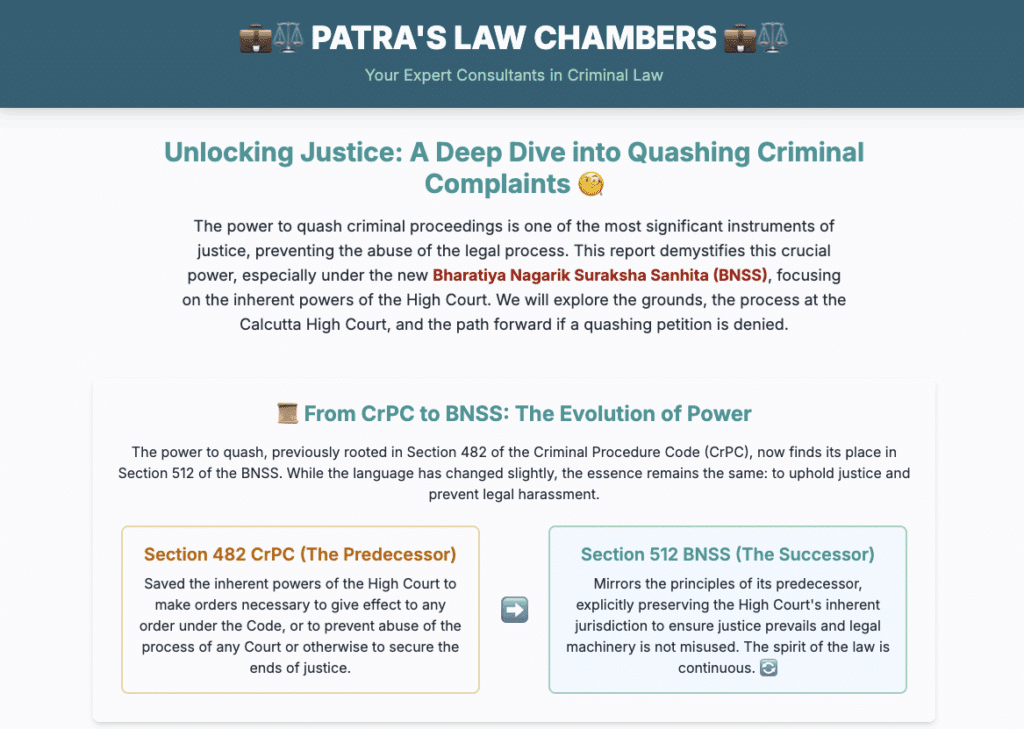
From Section 482 CrPC to Section 528 BNSS
From 1 July 2024 the Bharatiya Nagarik Suraksha Sanhita, 2023 replaced the Code of Criminal Procedure, 1973. The High Court’s inherent power was carried over word for word into Section 528. Tap between the two versions below — only one word changes.
“Nothing in this Sanhita shall be deemed to limit or affect the inherent powers of the High Court to make such orders as may be necessary to give effect to any order under this Sanhita, or to prevent abuse of the process of any Court or otherwise to secure the ends of justice.”
Because the text is identical, every precedent decided under Section 482 CrPC — Bhajan Lal, Gian Singh, Parbatbhai Aahir, Neeharika — applies with full force under Section 528 BNSS. The official text of the Sanhita is available on India Code.
The applicable law turns on the date the petition is filed, not the date of the FIR. The Sikkim High Court in Deepam Pradhan v. Krishna Kumari Bhandari (2025) held that an application instituted after 1 July 2024 is governed by the BNSS even if the FIR was registered in 2022. Petitions citing only Section 482 CrPC for post-July 2024 filings risk being returned by the registry.
Section 512 BNSS deals with defects in attachment proceedings and has nothing to do with quashing. Equally, Section 482 of the BNSS is the new anticipatory bail provision (old Section 438 CrPC). The quashing power sits only in Section 528 BNSS, and it is preserved, not conferred — it exists because the High Court is a superior court of record.
The seven Bhajan Lal grounds for quashing an FIR
In State of Haryana v. Bhajan Lal the Supreme Court set out seven illustrative categories in which the High Court may quash. They remain the first filter every Bench applies. Tap a card to reveal the rule and an illustrative authority. The full judgment is freely available on Indian Kanoon.
Other grounds the Calcutta High Court regularly applies
Failure to pay under a contract is not cheating unless dishonest intention existed at the very inception of the transaction. Courts repeatedly hold that the police cannot act as a recovery agent. Property, inheritance and society-management disputes dressed up as offences under Sections 316 or 318 BNS (old 406/420 IPC) are frequently quashed.
Where a complaint under Sections 85/86 BNS (old 498A IPC) names the husband’s entire family with general, undated allegations and attributes no specific act to relatives living elsewhere, the Calcutta High Court has cautioned courts to be extremely careful and has quashed proceedings against such relatives.
If the allegations do not disclose the intent the offence requires — for example, no proximate act of instigation in an abetment-of-suicide case under Section 108 BNS (old 306 IPC) — the prosecution cannot be sustained and may be quashed.
Inordinate, unexplained delay in investigation or trial that is not attributable to the accused violates the right to a speedy trial. Delay in lodging the FIR, however, is ordinarily a matter for trial and is rarely a stand-alone ground for quashing.
Section 173(3) BNSS lets police conduct a 14-day preliminary inquiry before registering an FIR for offences punishable with three to seven years. In Imran Pratapgadhi v. State of Gujarat (2025) the Supreme Court stressed this filter for speech-based offences and quashed the FIR. Failure to use it is an emerging argument in matrimonial and commercial matters.
A second FIR or complaint on the same allegations, with no new cause of action — particularly after acquittal or closure in the first case — is a clear abuse of process and has been quashed by the Calcutta High Court.
Can the case be quashed on compromise?
After Gian Singh the High Court may quash even non-compoundable offences on settlement, but only where the wrong is essentially private. Compounding under Section 359 BNSS (old 320 CrPC) is a separate, narrower statutory route. Pick an offence to see how the Court is likely to view a compromise.
Cruelty complaints under Sections 85/86 BNS are treated as private disputes. Where the couple has settled or obtained a mutual-consent divorce, continuing the prosecution serves no purpose. Both parties are usually asked to appear to confirm the settlement is voluntary.
Gian Singh (2012) · Narinder Singh (2014)Is your case a quashing case?
Answer two or three questions for a first read on the right route. This is general information, not legal advice — the facts of every FIR matter.
Quashing, discharge, writ or bail — which route fits?
A quashing petition is not always the best first move. The remedies overlap, and choosing the wrong one wastes months.
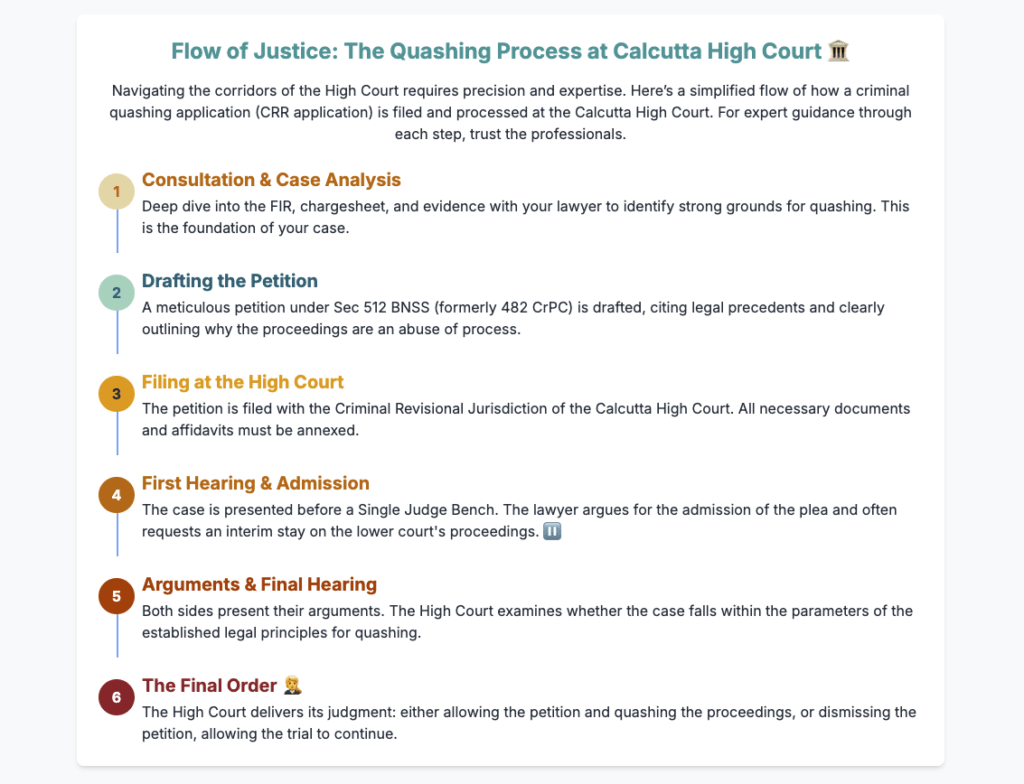
How a CRR quashing petition moves in the Calcutta High Court
Tap each step for what happens and what you need. The spine fills as you move through the process.
Obtain clear copies of the FIR, the written complaint, the chargesheet and cognisance order if any, any settlement deed, and documents that show the dispute is civil or the allegations are false. Legibility matters — illegible annexures are a common defect.
The cause title reads “In the High Court at Calcutta, Criminal Revisional Jurisdiction, Appellate Side”. Parties: the petitioner-accused against the State of West Bengal and the de facto complainant. Grounds should lead with the Bhajan Lal category, then the facts. Supported by an affidavit and a vakalatnama.
File physically at the Appellate Side registry or through e-filing. The registry scrutinises the petition and issues a defect sheet; once defects are cured the matter is given a CRR number.
Copies go to the office of the Public Prosecutor, High Court, representing the State, and to the de facto complainant as opposite party. An affidavit of service with postal tracking proof is filed.
The matter is mentioned before the Bench holding the determination. At admission the petitioner may pray for a stay of proceedings. After Neeharika, stays are granted only with brief reasons where a strong prima facie case exists.
The State may produce the case diary; the complainant may file an affidavit-in-opposition and the petitioner a reply. In settlement matters the parties are usually asked to appear to confirm the compromise.
A Special Leave Petition under Article 136 lies within 90 days, filed through an Advocate-on-Record. It must show a grave error of law or miscarriage of justice, not a re-argument of facts.
Key judgments on quashing of criminal proceedings
The origin of the doctrine: quashing lies where there is a legal bar, where the allegations disclose no offence, or where there is no legal evidence to support the charge.
Laid down the seven illustrative categories for quashing, framed against a politically motivated corruption complaint. Still the first test in every quashing petition.
Distinguished compounding from quashing; the inherent power can end non-compoundable proceedings on settlement where the dispute is predominantly private.
Guidelines on settlement-based quashing, weighing the nature and gravity of the offence and the stage at which the compromise is reached.
Consolidated the settlement principles: heinous offences and economic offences affecting the financial well-being of the State are not to be quashed on private compromise.
Attempt-to-murder cases can be quashed on settlement only after examining the nature of injuries, the weapon used and whether the dispute was genuinely private.
High Courts should not stifle legitimate investigation or pass blanket “no coercive steps” orders; any interim stay needs brief reasons.
A quashing petition does not become infructuous because the police file a chargesheet while it is pending; the High Court may examine the chargesheet too.
Set aside a Calcutta High Court order and quashed an FIR that gave a civil property dispute a criminal colour with vague allegations.
No absolute bar on quashing at the nascent stage of investigation; where no offence is disclosed on the face of the FIR, the High Court should intervene. Emphasised the Section 173(3) BNSS preliminary inquiry for speech-related offences.
Petitions filed on or after 1 July 2024 are governed by the BNSS, even where the FIR was registered under the CrPC regime.
What has changed since this guide was first published
High Court registries increasingly return fresh petitions that cite only Section 482 CrPC. Invoke Section 528 BNSS in the cause title and the prayer, while continuing to rely on the full body of CrPC-era precedent.
Benches now ask whether a preliminary inquiry should have preceded the FIR for offences punishable with three to seven years. Where the police skipped it in an essentially private dispute, that is worth pleading.
The inherent power cannot be used to recall or review the High Court’s own final order on merits. Get the petition right the first time — a second bite is rarely available.
Courts increasingly ask why a petitioner waited years after the FIR, and are reluctant to interfere once charges are framed and the trial is under way. Move early.
Common mistakes that sink quashing petitions
The Court is not deciding guilt at this stage. Lead with the Bhajan Lal category the case falls into, then show the facts that place it there.
A settlement petition that does not address the gravity test in Parbatbhai Aahir is incomplete and is likely to be dismissed.
After Neeharika, interim stays are the exception. Pursue anticipatory bail in parallel where arrest is a real risk.
Courts have deprecated citations that turn out not to exist. Every authority must be checked against a reliable reporter before filing.
The longer a case runs, the more the Court prefers to let the trial decide. File as soon as the grounds are clear.
Speak to an FIR quashing lawyer at the Calcutta High Court
Our chamber, a short walk from the Calcutta High Court, drafts and argues CRR quashing petitions, anticipatory bail applications and Supreme Court SLPs. Send us the FIR and we will tell you plainly whether quashing is the right route.
Patra’s Law Chambers was established in 2020 by Advocate Sudip Patra, Advocate, Supreme Court of India and Calcutta High Court, an alumnus of the Rajiv Gandhi School of Intellectual Property Law, IIT Kharagpur, with a Post Graduate Diploma in Business Law from IIM Calcutta. The firm handles criminal, writ, civil, service, banking, tax and Supreme Court matters.
Established by a distinguished alumnus of IIT Kharagpur, Patra’s Law Chambers stands as a beacon of legal expertise in Kolkata & Delhi. Know more →
Email: [email protected]
Frequently asked questions on FIR quashing
It is an order under Section 528 BNSS (formerly Section 482 CrPC) that ends a criminal proceeding — an FIR, complaint or chargesheet — because continuing it would abuse the process of court or defeat the ends of justice. It is decided on the record, without a trial.
For any petition filed on or after 1 July 2024, cite Section 528 BNSS — even if the FIR was registered earlier. All earlier Section 482 precedents still apply because the text is identical.
No. Section 512 BNSS concerns defects in attachment proceedings. The quashing power is in Section 528 BNSS. Note also that Section 482 BNSS now deals with anticipatory bail.
Yes. Under Abhishek v. State of M.P. a pending petition survives the filing of a chargesheet, and a fresh petition can challenge the chargesheet and the cognisance order together.
Generally yes. Matrimonial disputes are treated as private, so a genuine settlement or mutual-consent divorce is a recognised basis for quashing. The Court usually wants both parties to confirm the settlement in person or by video conference.
Only in exceptional cases. After Neeharika Infrastructure, a stay or “no coercive steps” order needs brief reasons and a strong prima facie case. Anticipatory bail is often pursued alongside.
There is no fixed timeline. It depends on registry scrutiny, listing before the determination Bench, service on the State and complainant, and whether affidavits are exchanged. Settlement-based matters typically move faster than contested ones.
Court fees on a CRR are modest; the main cost is professional fees, which depend on the complexity of the FIR, the volume of documents and whether the matter is contested. Call us for a clear estimate after we review the papers.
You may file a Special Leave Petition before the Supreme Court under Article 136 within 90 days, through an Advocate-on-Record, showing a grave error of law or miscarriage of justice. Alternatively, you contest the case at trial and seek discharge or acquittal.