How to Quash an NI Act or PSS Act Case in Calcutta High Court:
A Complete Defense Guide
Creditor and contributor of this article:
Patra’s Law Chambers:
About Us:
Patra’s Law Chambers is a law firm with offices in Kolkata & Delhi, offering comprehensive legal services across various domains. Established in 2020 by Advocate Sudip Patra (Advocate, Supreme Court of India & Calcutta High Court) an alumnus of the Prestigious Rajiv Gandhi School of Intellectual Property Law, IIT Kharagpur ,with Post Graduate diploma in Business Law from IIM Calcutta, the firm specializes in Civil, Criminal, Writs, High Court Matters, Trademark, Copyright, Company, Tax, IT, GST & Customs, Banking & DRT, Property disputes, Service law & CAT & High Court related service matters, Military Law, Family law, and Supreme Court matters. You can know more about us in here
Kolkata Office:
NICCO HOUSE, 6th Floor, 2, Hare Street, Kolkata-700001 (Near Calcutta High Court)
Delhi Office:
House no: 4455/5, First Floor, Ward No. XV, Gali Shahid
Bhagat Singh, Main Bazar Road, Paharganj, New Delhi-110055
Website: www.patraslawchambers.com
Email: [email protected]
Phone: +91 890 222 4444/ +91 7003 715 325
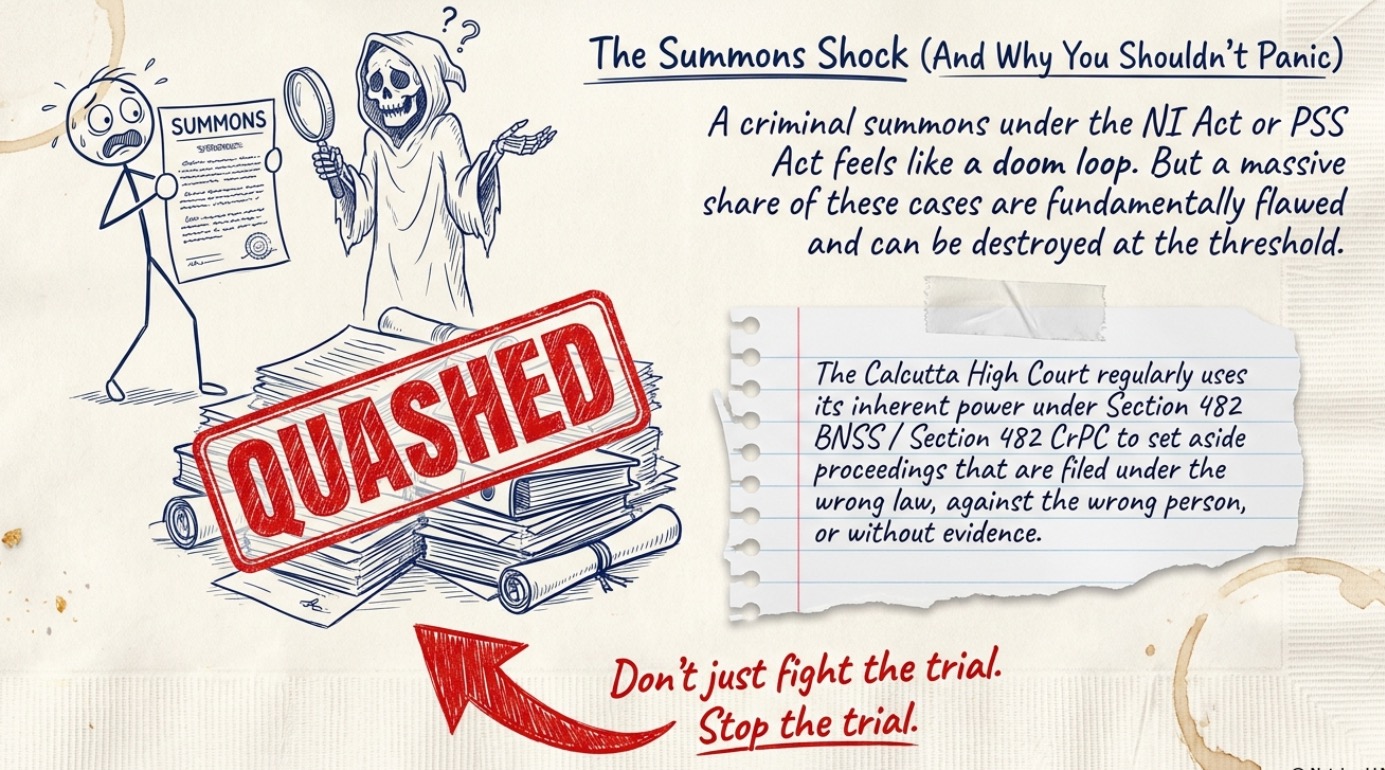
A cheque bounce notice or a criminal summons under the Negotiable Instruments Act, 1881 can feel like the end of the road — but a large share of these prosecutions are quashable at the threshold, before trial even begins. The Calcutta High Court, exercising its inherent power under Section 482 of the Bharatiya Nagarik Suraksha Sanhita, 2023 (BNSS) / Section 482 of the Code of Criminal Procedure, 1973 (CrPC), regularly sets aside NI Act and Payment and Settlement Systems (PSS) Act proceedings that were filed under the wrong provision, filed against the wrong person, or filed without the mandatory evidentiary foundation. This guide walks through the five situations where a quashing petition is most likely to succeed — wrong-statute prosecutions for NACH/ECS bounces, NBFC loan-recovery cheques, blank security cheques, non-signatory or legal-heir prosecutions, and director liability under Section 141 — and how each is argued before the High Court.
1. Quashing NACH/ECS Bounce Cases Wrongly Filed Under Section 138 NI Act
The digitisation of financial transactions across commercial lending and retail credit has driven a major shift from paper negotiable instruments to automated electronic fund clearing. Paper cheque dishonours remain governed by Section 138 of the NI Act, while electronic debit failures — including National Automated Clearing House (NACH) mandates and Electronic Clearing Service (ECS) instructions — are governed by Section 25 of the Payment and Settlement Systems Act, 2007 (PSS Act). Getting this distinction wrong is one of the most common — and most quashable — errors complainants make.
Statutory Framework and Procedural Divergence
Section 25(1) of the PSS Act creates a legal fiction: where an electronic fund transfer cannot be executed due to insufficiency of funds or because it exceeds the arranged amount, the account holder is deemed to have committed an offence, and the provisions of the NI Act apply mutatis mutandis. But this deeming fiction does not erase the technical, jurisdictional, and procedural boundaries that separate paper cheques from electronic debit instructions.
| Statutory Dimension | Section 138, NI Act 1881 | Section 25, PSS Act 2007 |
| Primary subject matter | Physical, signed negotiable instruments (paper cheques, bills of exchange) | Electronic fund transfers (EFT), NACH auto-debit, ECS mandates |
| Initiation mechanism | Physical delivery of instrument by drawer to payee | Pre-authorised electronic instruction executed through a clearing house |
| Jurisdictional rule | Section 142(2) NI Act — place where payee maintains account | General criminal procedure rules and clearing-house transaction nodes |
| Technical prerequisite | Original paper cheque return memo from paying bank | Certified electronic audit trail, bank debit memo, system log certificate |
| Compounding provision | Section 147, NI Act | Section 31, PSS Act |
The Leading Precedent: Ram Sawrup Industries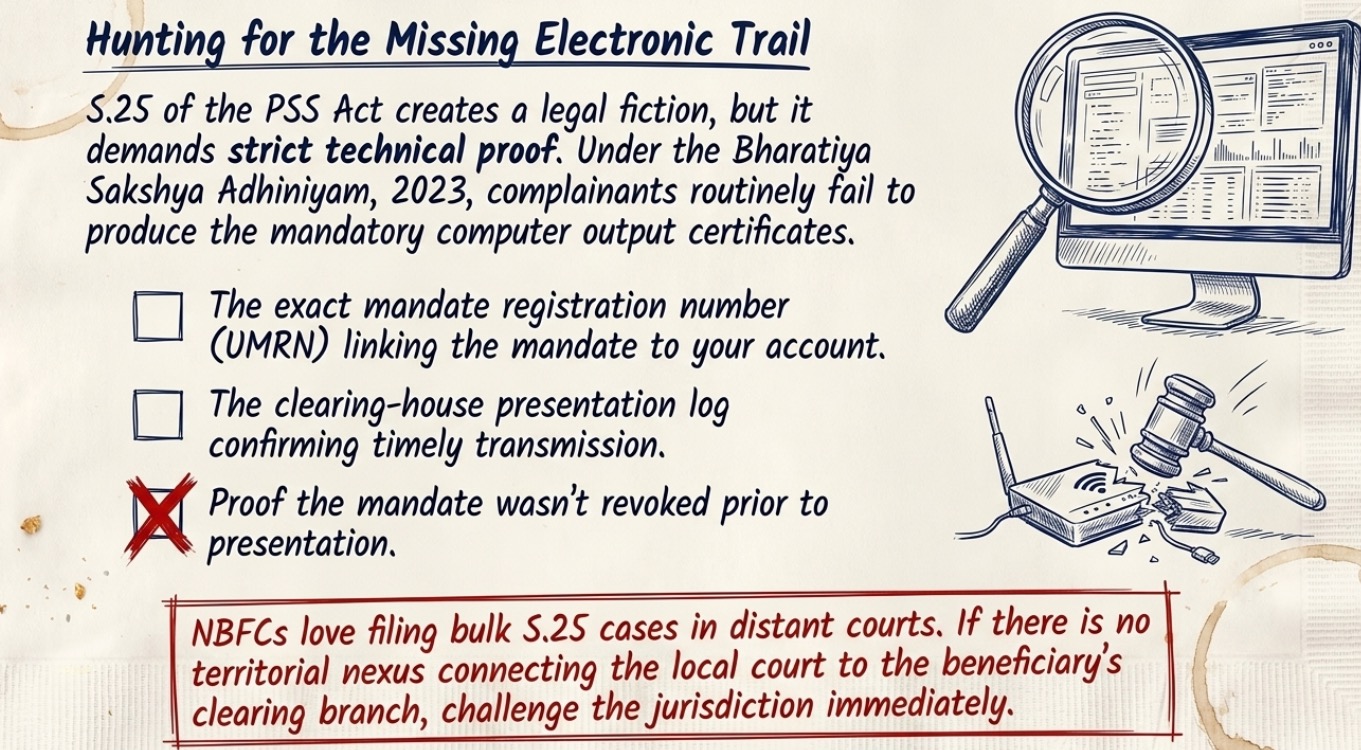
In Ram Sawrup Industries Ltd. v. State of West Bengal, the Calcutta High Court held that where a complaint rests exclusively on failure to honour an electronic fund transfer from a company account, taking cognizance under Section 138 NI Act is illegal and unsupportable in law. In the absence of an allegation that a physical cheque was drawn and presented, Section 138 cannot be invoked. Orders taking mechanical cognizance under the NI Act for what was, in truth, an electronic default are liable to be set aside, sending the matter back for de novo consideration at the pre-cognizance stage under Section 25 of the PSS Act.
Before filing or opposing a Section 25 PSS Act complaint, scrutinise the electronic transaction trail. Under the Bharatiya Sakshya Adhiniyam, 2023 (and the corresponding Indian Evidence Act provisions it replaces), electronic debit memos and system logs must carry mandatory statutory certificates validating computer output. Complainants routinely fail to produce:
- The exact electronic mandate registration reference number (UMRN) linking the mandate to the debtor’s account
- The clearing-house presentation log confirming timely instruction transmission
- Evidence that the mandate was not revoked prior to presentation
Territorial jurisdiction under Section 25 PSS Act also does not automatically inherit the extended venue rules of Section 142(2) NI Act unless the complaint explicitly pleads the exact nexus connecting the local court to the beneficiary’s clearing branch. Where NBFCs file bulk Section 25 prosecutions in distant forums with no territorial nexus to the transaction, that alone is a ground to challenge jurisdiction.
Grounds for a Section 482 Quashing Petition in NACH/ECS Cases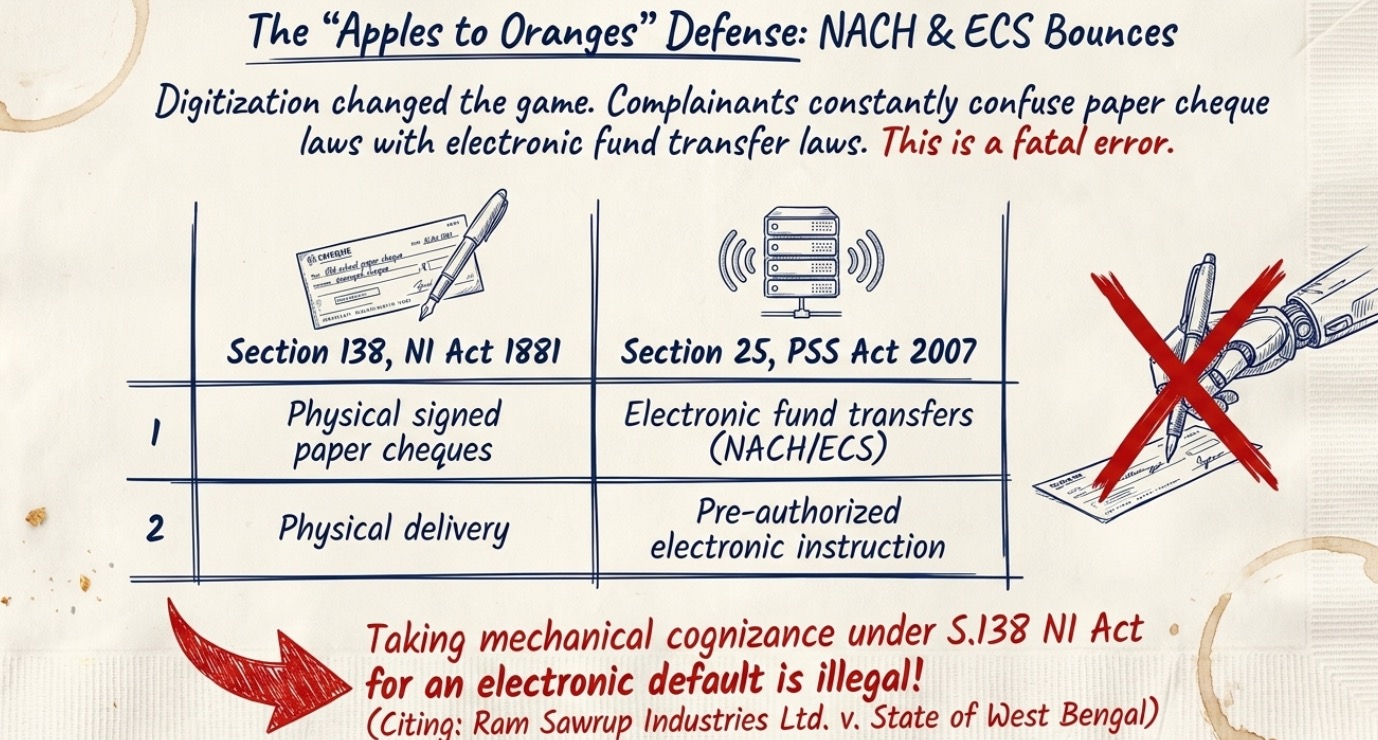
- Improper statutory labelling — cognizance taken under Section 138 NI Act for what is, in fact, an electronic mandate dishonour
- Defective demand notice — no valid notice issued within thirty days of learning of the dishonour
- Premature prosecution — complaint filed before the fifteen-day payment window (from notice receipt) had expired
- Absent transaction logs — no certified banking memo documenting the exact return code generated by the clearing host
Where identical transaction defaults spawn parallel prosecutions under both Section 138 NI Act and Section 25 PSS Act across different jurisdictions, the High Court may grant interim relief against coercive steps and entertain a unified quashing petition to prevent abuse of process.
2. Quashing NBFC and Fintech Cheque-Bounce Cases — Rebutting the Section 139 Presumption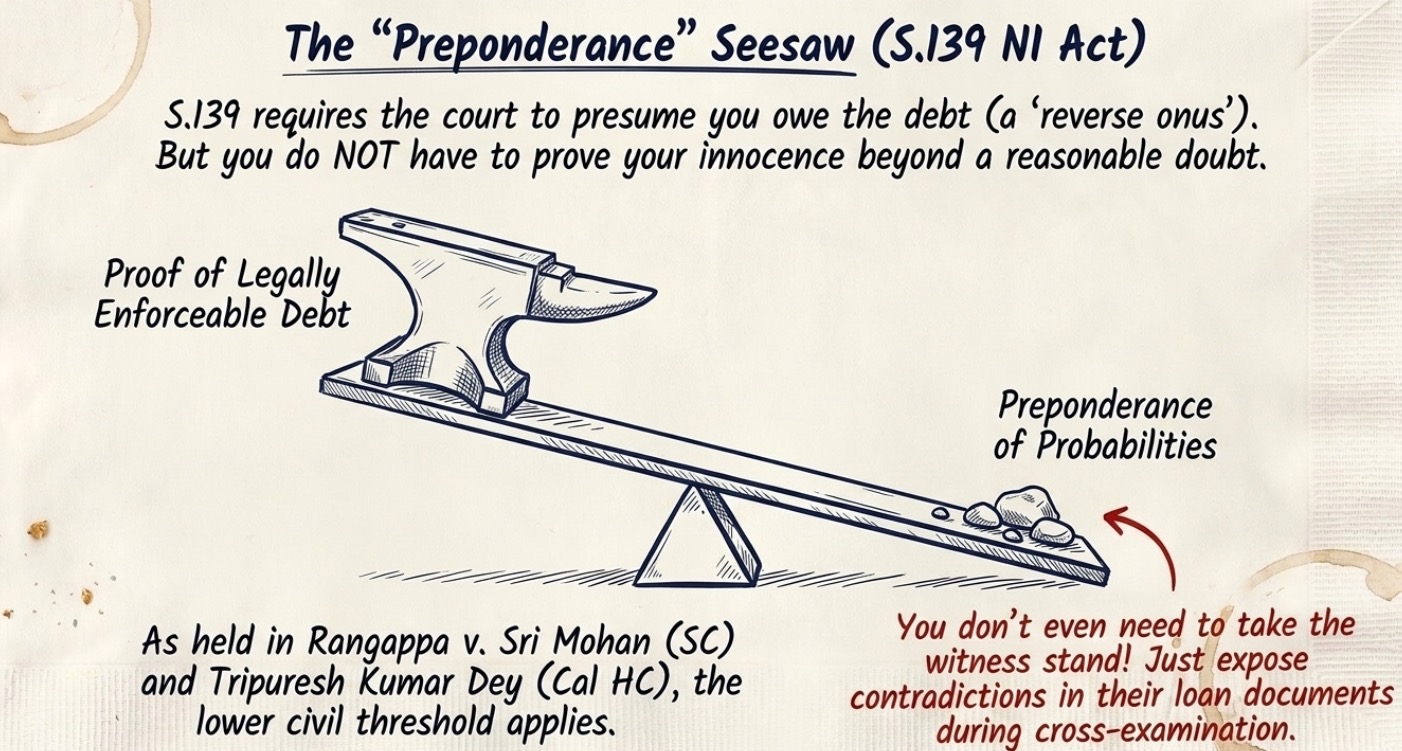
Non-Banking Financial Companies (NBFCs) and fintech lenders frequently use Section 138 NI Act as a debt-recovery shortcut, procuring blank, signed security cheques at the time of loan disbursement. Where the amount later filled in does not match the actual enforceable debt, the prosecution is vulnerable — but the defence has to actively rebut a statutory presumption to get there.
The “Preponderance of Probabilities” Standard
Section 139 NI Act requires the court to presume, unless the contrary is proved, that the holder of a cheque received it for the discharge of a debt or liability — a statutory reverse-onus clause. But as the Supreme Court held in Rangappa v. Sri Mohan, and as the Calcutta High Court reiterated in Tripuresh Kumar Dey v. Tushar Kanti Jana, the accused does not have to disprove liability beyond reasonable doubt. The lower civil threshold of “preponderance of probabilities” applies.
Practically, this means the accused is not obliged to enter the witness box or lead independent evidence at all. It is enough to expose contradictions in the complainant’s own loan documentation during cross-examination, or to show that no legally enforceable debt existed on the date marked on the instrument.
Exposing Pre-Filled and Blank Security Cheques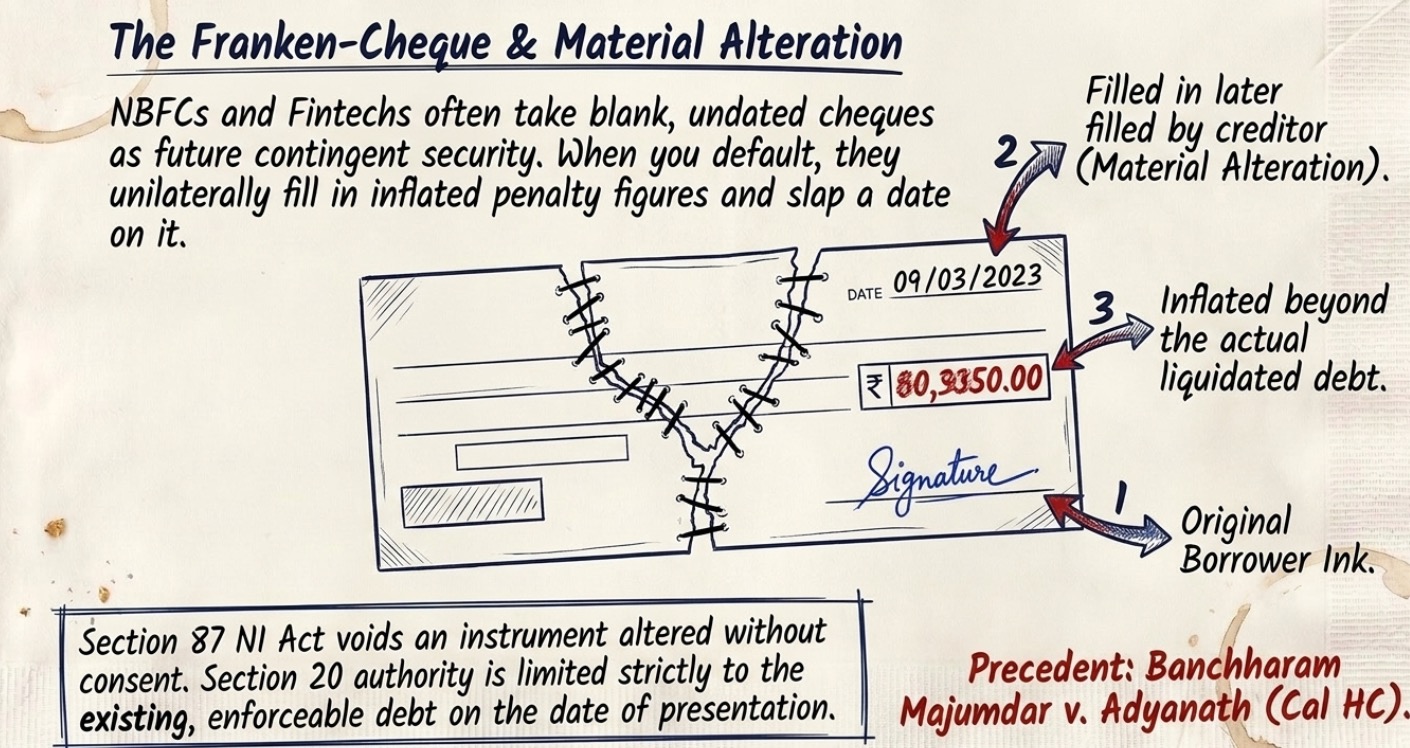
Fintech lenders and NBFCs often collect blank, undated cheques as collateral at loan origination. On default, they fill in inflated figures — penalty interest, bounce charges, unverified foreclosure fees — before presenting the cheque. Section 20 NI Act gives a holder conditional authority to complete an inchoate instrument, but that authority is not absolute: it is strictly limited to the actual, existing legally enforceable debt on the date of presentation. An NBFC that fills in a sum exceeding the real liquidated balance strips the instrument of Section 138 protection. Demand a complete statement of account under Section 91 CrPC / Section 94 BNSS, and cross-check the default notice against it.
The Calcutta High Court has consistently held that Section 139 cannot be used as a license to convict without underlying loan documentation on record. Where an NBFC cannot produce the sanction letter, hypothecation agreement, or certified bank statement establishing the precise balance owed, the foundational element of a “legally enforceable liability” collapses — and once the accused shows a probable defence on this basis, the onus shifts back to the NBFC to prove the exact debt, failing which an acquittal must follow.
3. Quashing Cases Built on Misused Undated Security Cheques
A recurring commercial dispute is whether a cheque was issued toward an existing, enforceable debt, or handed over as future security for an executory contract. Lenders often try to collapse this distinction to convert a civil default into a criminal prosecution.
- Existing liquidated debt — the debt is fully determined, due, and legally enforceable at the exact time the instrument is dated and presented. Section 138 applies.
- Future contingent security — the instrument was handed over as advance collateral for a contract whose obligations were still unfulfilled at the time of deposit. Section 138 does not apply.
Where an undated security cheque is deposited despite the underlying contractual contingency never having occurred, no offence under Section 138 is committed — the liability on the date of presentation remains contingent, not a “legally enforceable debt.”
Material Alteration Under Section 87 NI Act
Section 87 NI Act voids an instrument as against any party who did not consent to a material alteration. Filling in details by mutual agreement is protected under Section 20; unilateral insertion of a date, amount, or payee name by the creditor is not — it is a material alteration under Section 87. If the drawer’s cover letter or contract marked the cheque “Security Only,” and the lender later inserted a date and inflated amount without written consent, Section 87 can invalidate the instrument outright.
Cross-Examination Roadmap Under Section 145 NI Act
- Origination context — confirm the cheque was handed over at the time the credit agreement was executed, and that the date field was blank on receipt
- Consideration and existing debt — probe whether a formal demand notice specifying the exact liquidated amount preceded the dating of the instrument
- Material alterations — highlight ink, pen, or handwriting differences between the signature and the date/amount fields
- Accounting discrepancies — confront the witness with interim NEFT/RTGS payments not reflected in the amount written on the cheque
4. Quashing Prosecutions Against Non-Signatories and Legal Heirs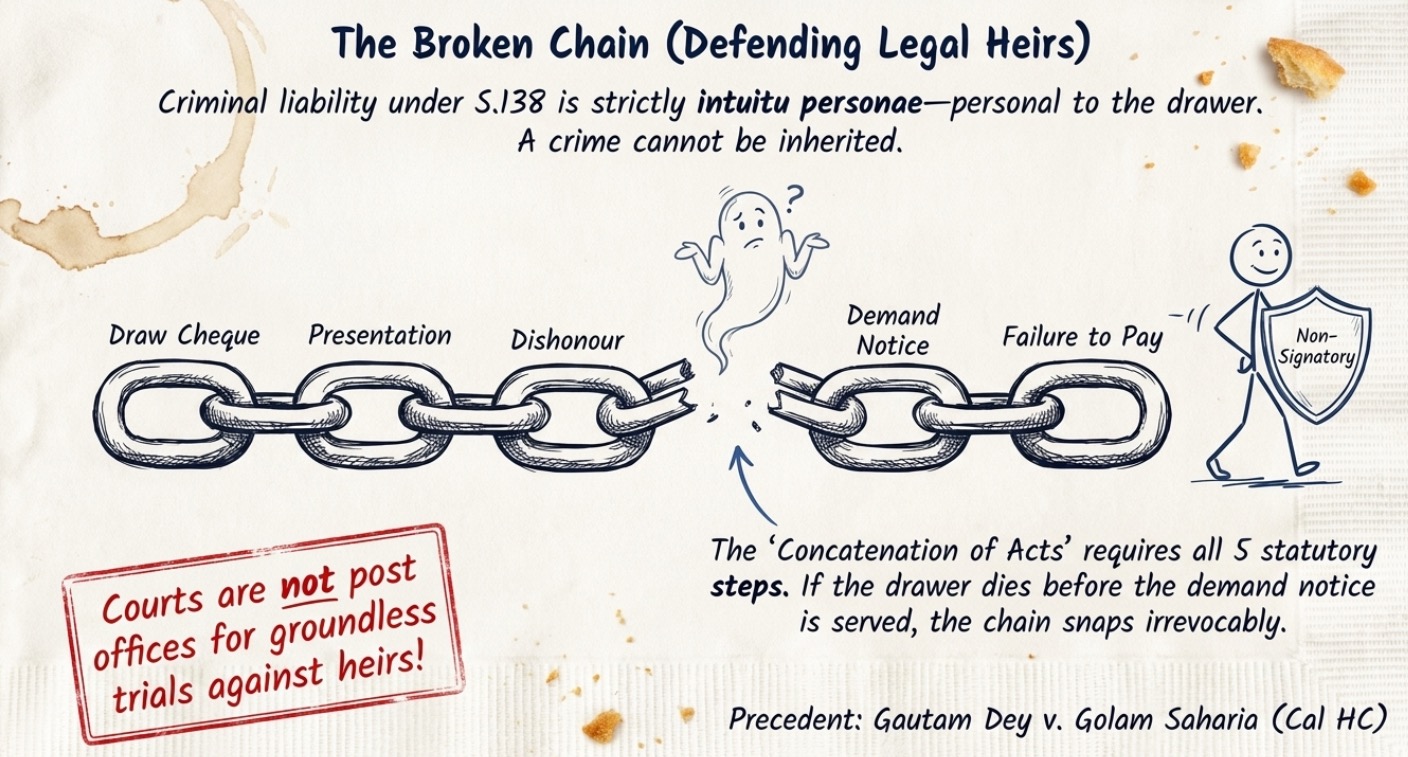
A recurring abuse of NI Act litigation is arraying non-signatories, surviving family members, and legal heirs as co-accused after the drawer’s default or death.
The Intuitu Personae Doctrine
In Gautam Dey v. Golam Saharia and related revisional decisions, the Calcutta High Court held that criminal liability under Section 138 is strictly intuitu personae — personal to the drawer of the instrument. Section 138 targets exclusively the person who draws a cheque, under their own signature, on an account they maintain. The Court affirmed that:
- Criminal liability is not a heritable estate that passes to surviving family members or legal heirs
- A crime cannot be inherited, regardless of whether the heir inherits civil assets or continues the business
- Courts are not “post offices” bound to continue groundless trials against non-signatory representatives
The Statutory “Concatenation of Acts”
An offence under Section 138 is not committed on mere bank return — it requires a complete statutory chain: drawing of the cheque by the drawer, presentation within its validity period, dishonour for insufficient funds, service of a demand notice within thirty days, and the drawer’s failure to pay within fifteen days of notice. If the drawer dies before presentation or notice, this chain breaks irrevocably. A legal heir served with a notice has no statutory obligation to pay, since they were never the drawer — so their non-payment cannot itself constitute an offence. Prosecuting a non-signatory co-borrower or legal heir under Section 138 is unsustainable and quashable under Section 482 BNSS/CrPC.
Sample Reply to a Notice Served on a Non-Signatory or Legal Heir
Where a demand notice is wrongly served on a non-signatory or a legal heir, an immediate formal reply builds the evidentiary record for a later quashing petition. The core points such a reply should make are set out below — treat this as a starting structure to be adapted to the facts, not as a ready-to-send document.
- Absolute lack of privity and non-signatory status — the recipient neither drew the cheque nor maintains the account it was drawn on
- Criminal liability is strictly intuitu personae — citing Gautam Dey v. Golam Saharia — and is not a heritable estate
- Breakdown of the statutory concatenation of acts — the drawer’s death (with date) revoked the bank mandate by operation of law before the statutory chain could complete
- Demand to withdraw the notice, with notice that any complaint filed will invite quashing proceedings under Section 482 BNSS/CrPC and a claim for costs for malicious prosecution
5. Quashing Section 141 Vicarious Liability Cases Against Directors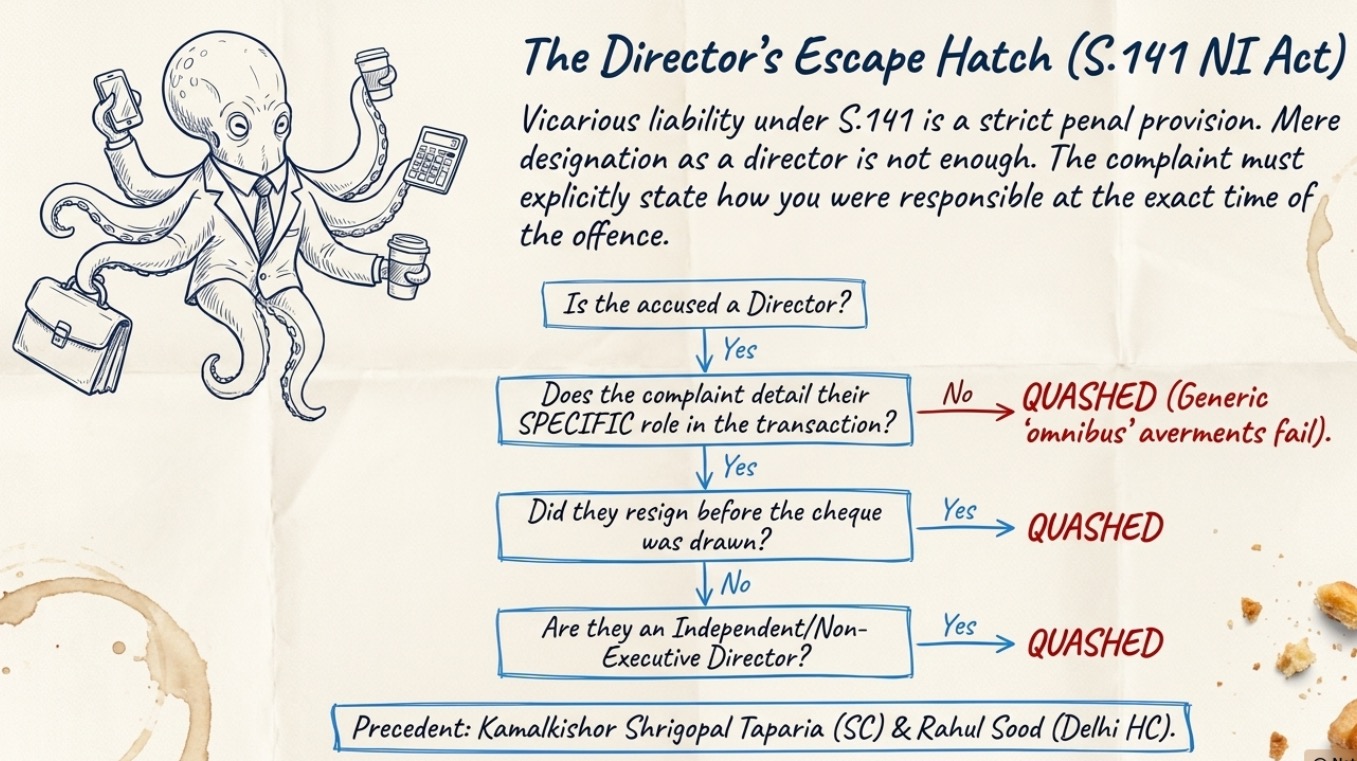
When a company commits an offence under Section 138, Section 141 NI Act extends vicarious liability to corporate officers — but as a strict penal provision, it demands exact pleading standards.
What the Complaint Must Actually Say
To fasten liability under Section 141(1), the complaint must contain specific, unambiguous averments showing how the named director was in charge of and responsible for the company’s business at the exact time the offence was committed. The Supreme Court, in Kamalkishor Shrigopal Taparia v. India Ener-Gen Private Limited and Rahul Sood v. State of NCT of Delhi, held that:
- Mere designation as a director does not automatically generate liability
- Generic, “bald and omnibus” averments that all directors were “in-charge of daily affairs” are legally insufficient
- The complaint must spell out the specific role the individual director played in the transaction
Resigned Directors: Form DIR-11 and DIR-12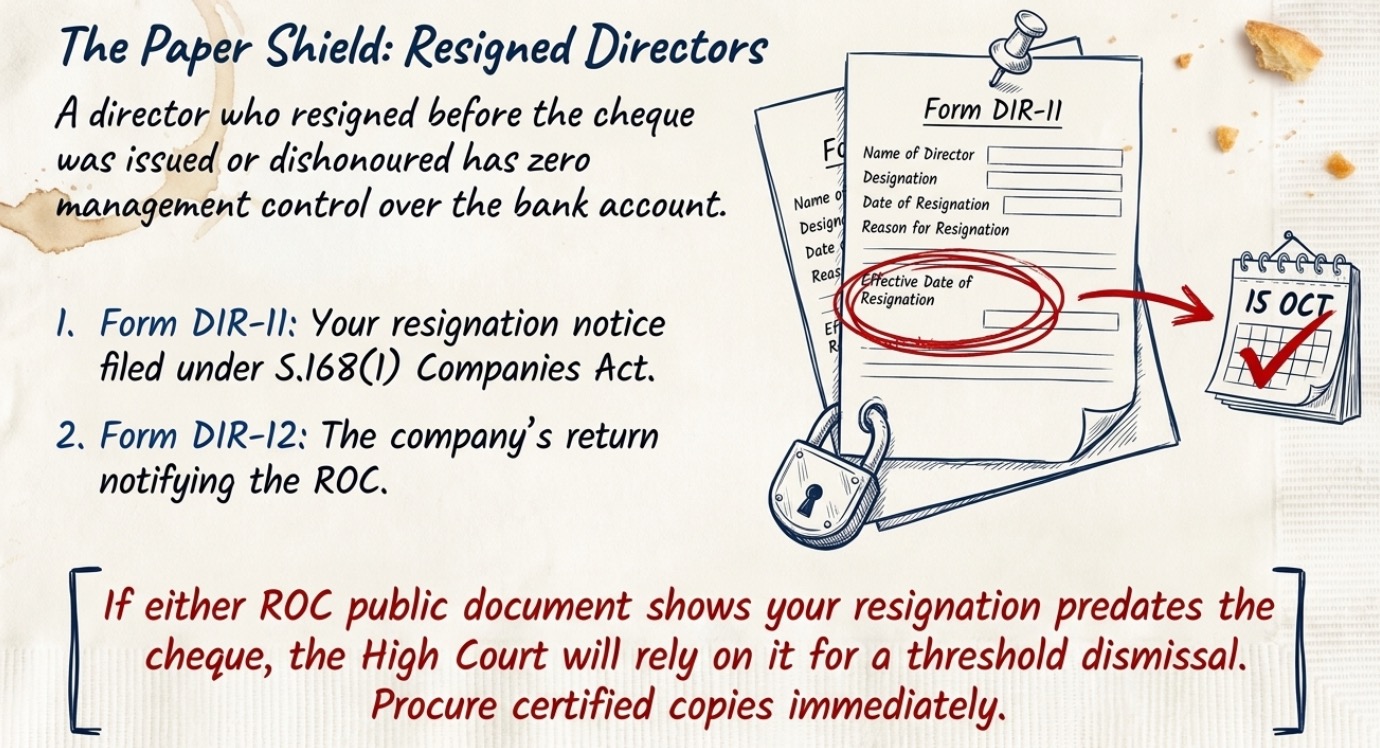
A director who resigned before the cheque was issued or dishonoured cannot be held vicariously liable. Two ROC-maintained public documents are decisive for a threshold Section 482 dismissal:
- Form DIR-11 — the resignation notice filed by the director under Section 168(1), Companies Act 2013
- Form DIR-12 — the company’s return notifying the ROC of the change in directorship and its effective date
Where either form shows the resignation became effective before the cheque was drawn or presented, the High Court will rely on these official filings to quash the complaint against the former director — a former director has no management control over the bank account or financial operations.
Independent and Non-Executive Directors
Section 149(12), Companies Act 2013 protects Independent and Non-Executive Directors who are not key managerial personnel — they can be held liable only for acts done with their knowledge, consent, or connivance, or for a failure to act diligently. In Kamalkishor Shrigopal Taparia, the Supreme Court quashed proceedings against an independent non-executive director because the complaint failed to attribute any specific financial role to him. Establishing that the director had no signatory powers and no involvement in daily financial operations is usually enough to secure quashing.
Quick-Reference Defense Matrix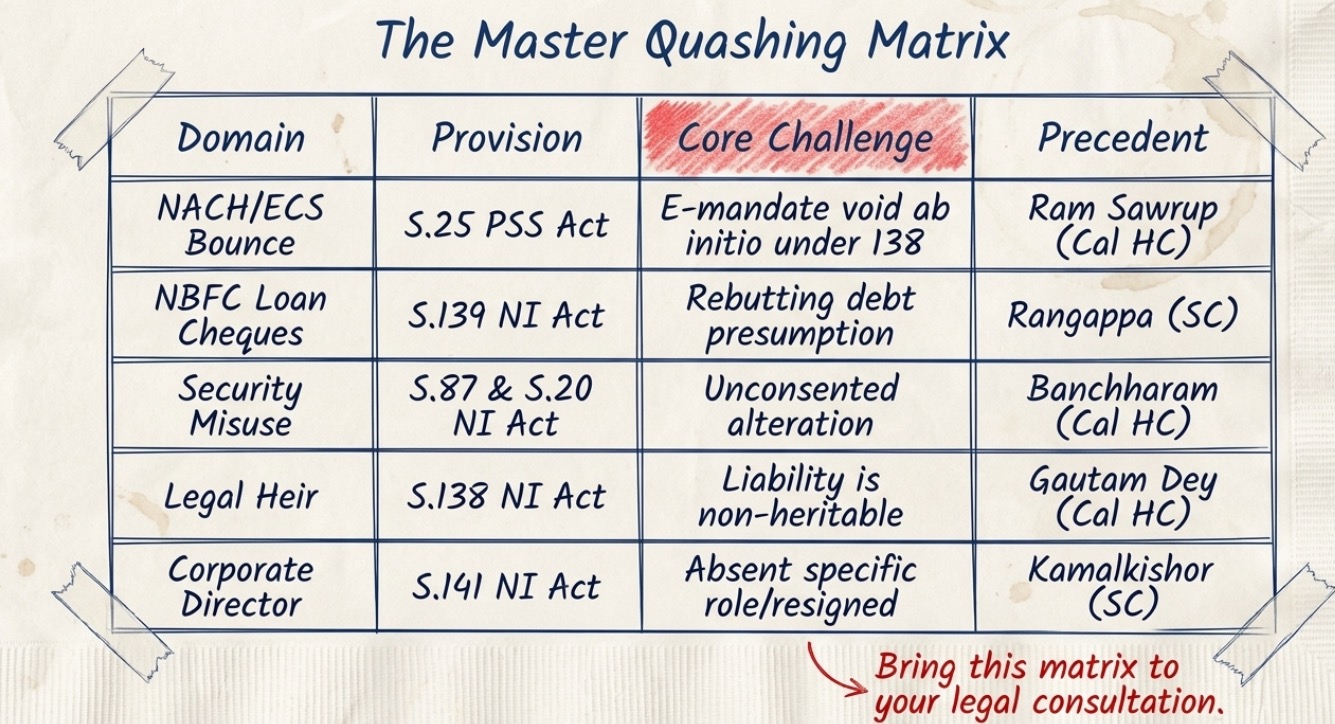
| Defense Domain | Primary Provision | Core Challenge | Key Precedents |
| NACH/ECS bounce | S.25 PSS Act vs S.138 NI Act | Cognizance under S.138 for an electronic mandate dishonour is void ab initio | Ram Sawrup Industries v. State of WB (Cal HC) |
| NBFC/fintech loan cheques | S.139 NI Act (reverse onus) | Rebutting debt presumption on preponderance of probabilities; inflated pre-filled amounts | Rangappa v. Sri Mohan (SC); Tripuresh Kumar Dey v. Tushar Kanti Jana (Cal HC) |
| Security cheque misuse | S.87 & S.20 NI Act | Instrument altered without consent; cheque was for future contingent security, not existing debt | Banchharam Majumdar v. Adyanath (Cal HC) |
| Non-signatory / legal heir | S.138 NI Act — intuitu personae | Liability is personal and non-heritable; concatenation of acts breaks on drawer’s death | Gautam Dey v. Golam Saharia (Cal HC) |
| Corporate director liability | S.141 NI Act & S.168 Companies Act | Absent specific role averments; resignation predates the offence; independent-director immunity | Kamalkishor Shrigopal Taparia v. India Ener-Gen (SC); Rahul Sood v. State (Delhi HC) |
Step-by-Step: Filing a Section 482 Quashing Petition Before the Calcutta High Court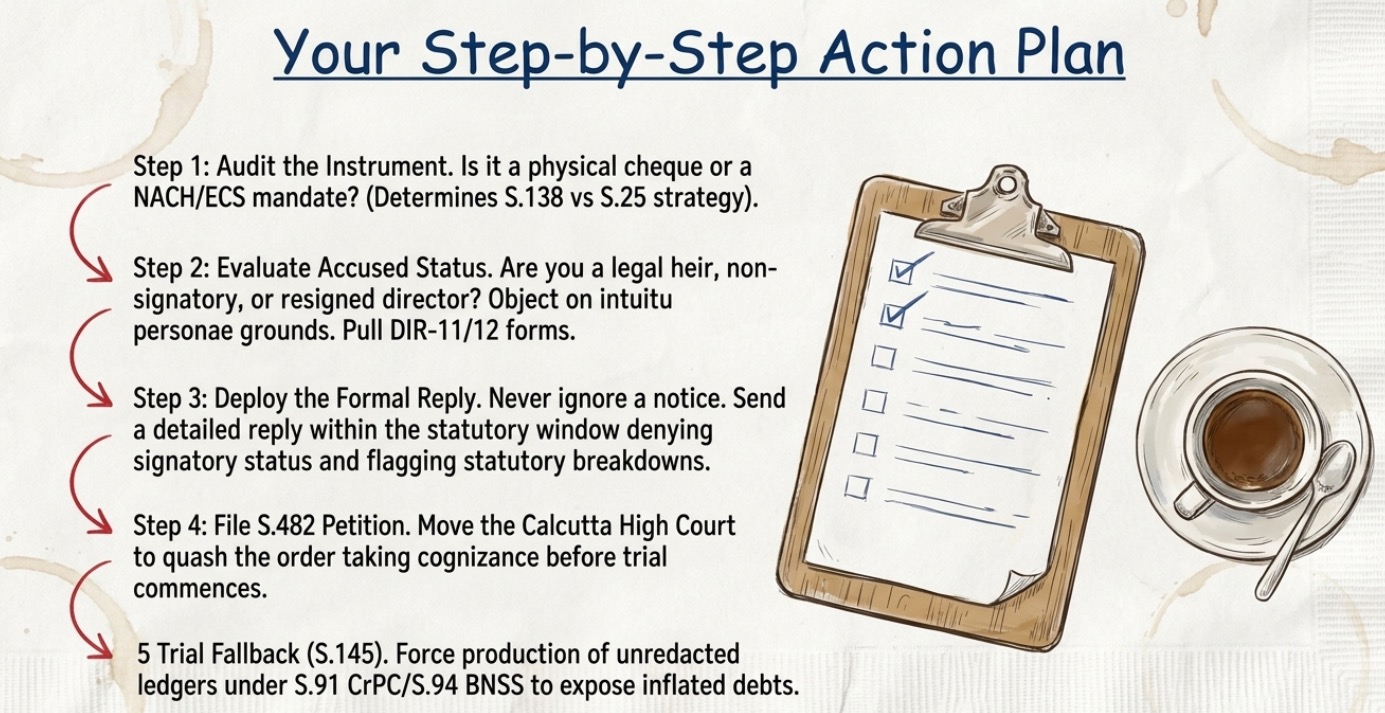
- Audit the instrument and mandate type — confirm whether the failure is a physical cheque or an electronic NACH/ECS mandate. Mismatched cognizance under Section 138 for a purely electronic default is grounds for an immediate quashing petition citing Ram Sawrup Industries.
- Evaluate accused status — if the client is a legal heir, relative, or non-signatory business associate, object to the issuance of process on intuitu personae grounds, relying on Gautam Dey v. Golam Saharia.
- Pull ROC records for directors — procure certified Form DIR-11 and DIR-12; if resignation predates the cheque, or the client is a non-executive independent director, cite Kamalkishor Shrigopal Taparia.
- Send a formal reply to every notice — any statutory notice received by a non-signatory, legal heir, or resigned director should get a detailed reply within the statutory window, denying signatory status and flagging the breakdown of statutory conditions.
- Prepare the trial-stage fallback — even where a case survives to trial, focus cross-examination under Section 145 NI Act on displacing the Section 139 presumption, forcing production of unredacted ledgers under Section 91 CrPC / Section 94 BNSS, and establishing material alteration under Section 87 where relevant.
How Patra’s Law Chambers Can Help
Patra’s Law Chambers handles NI Act, PSS Act, and Section 482 BNSS/CrPC quashing matters before the Calcutta High Court and the Supreme Court of India, including wrong-statute NACH/ECS prosecutions, NBFC and fintech cheque-bounce defence, security-cheque disputes, and vicarious-liability matters for directors and legal heirs. Each matter is assessed on its own facts, documents, and forum before a strategy is proposed.
Frequently Asked Questions
Can a NACH or ECS bounce be prosecuted under Section 138 NI Act?
No. Electronic fund transfer failures, including NACH and ECS bounces, are governed by Section 25 of the PSS Act, 2007, not Section 138 NI Act. Cognizance taken under Section 138 for a purely electronic default is liable to be quashed.
Can a legal heir be prosecuted for a cheque bounce after the drawer’s death?
No. The Calcutta High Court has held that Section 138 liability is intuitu personae — personal to the drawer — and does not pass to legal heirs. The statutory chain of acts required for the offence breaks on the drawer’s death.
Can a resigned director be held liable for a cheque issued after resignation?
No. Once Form DIR-11 and DIR-12 confirm the resignation took effect before the cheque was drawn or dishonoured, the director no longer had control over the company’s bank account and cannot be held vicariously liable under Section 141.
What is the standard of proof to rebut the Section 139 presumption?
The accused only needs to meet the civil standard of “preponderance of probabilities,” not proof beyond reasonable doubt, and can do this through cross-examination of the complainant’s own witnesses without leading independent defence evidence.
Is a blank security cheque enough to sustain a Section 138 conviction?
Only if the amount filled in matches the actual, existing enforceable debt on the date of presentation. If the amount was inflated or the cheque was security for a contingency that never occurred, the prosecution is vulnerable to quashing.
Where is a Section 482 quashing petition filed for a Calcutta cheque bounce case?
Before the Calcutta High Court, invoking its inherent powers under Section 482 of the Bharatiya Nagarik Suraksha Sanhita, 2023 (or Section 482 CrPC for matters still governed by the old code), against the order taking cognizance or the complaint itself.
Creditor and contributor: Patra’s Law Chambers
⚖️ Patra’s Law Chambers (Est. 2020)
Founded by Advocate Sudip Patra (Supreme Court & Calcutta High Court)
9›+ Years of Professional Legal Experience
🎓 Alumnus: IIT Kharagpur | IIM Calcutta
📍 Kolkata: NICCO HOUSE, Hare Street | 📍 Delhi: Paharganj
🌐 www.patraslawchambers.com | 📞 +91 890 222 4444