Documents Required for SIR in West Bengal: A Plain Guide
The Special Intensive Revision (SIR) of the electoral roll asks every West Bengal elector to submit an Enumeration Form, and some to attend an ERO hearing. This guide explains the forms, the 2002 roll match, the documents that matter at the hearing, and what to do if a name is left out. Verify current dates on the official CEO West Bengal portal.
What the SIR means for a West Bengal voter
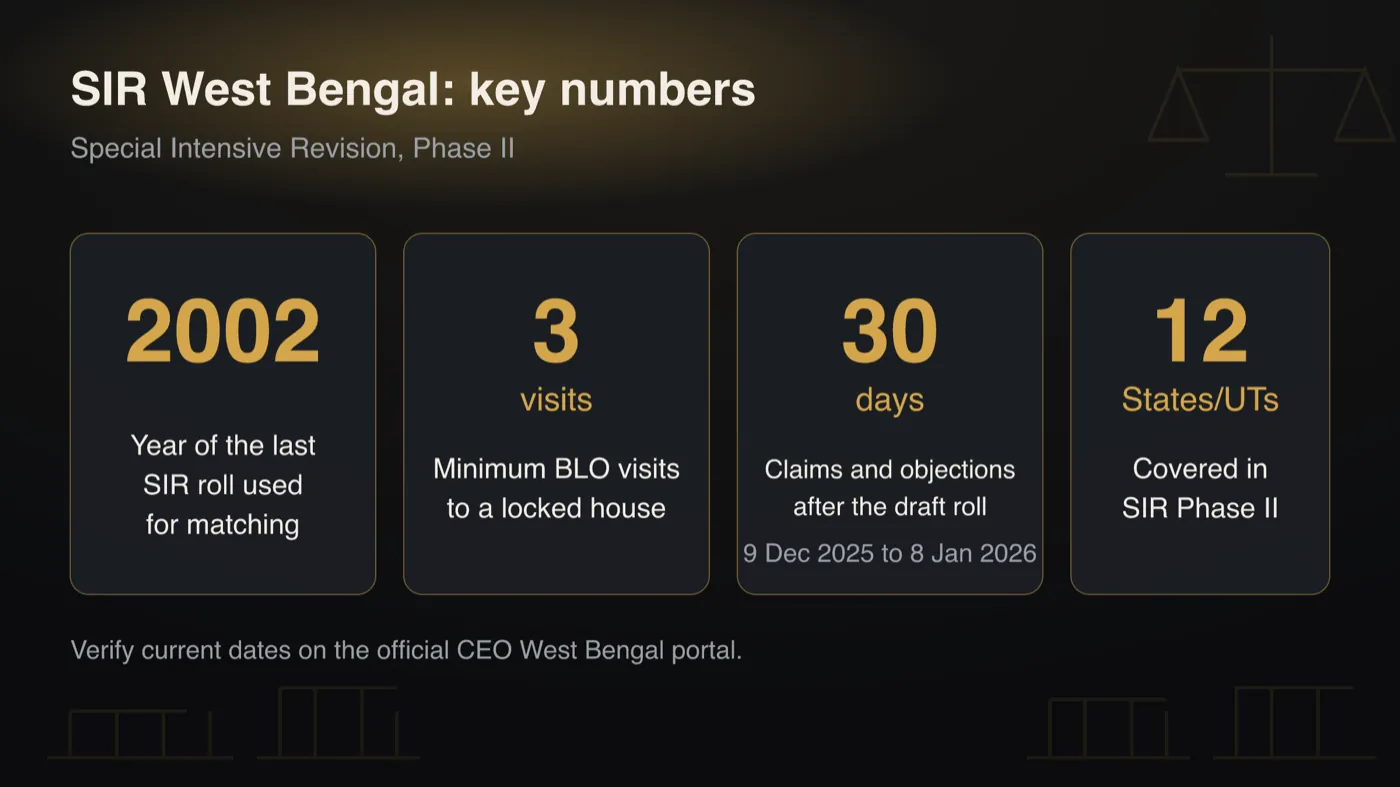
The Special Intensive Revision (SIR) is a door-to-door verification of the whole electoral roll, ordered by the Election Commission of India under Article 324 of the Constitution, Section 21 of the Representation of the People Act, 1950 and the Registration of Electors Rules, 1960. It is different from the yearly Special Summary Revision. Phase II, started by the ECI order dated 27.10.2025, covers West Bengal and 11 other States and Union Territories, with 1 January 2026 as the qualifying date for new voters. The official orders and notices are on the Election Commission of India website.
In West Bengal, the current roll is compared with the roll of the last SIR, held in 2002. A voter who is linked to that roll, directly or through a parent or grandparent, has a simpler path. A voter who is not linked may be called by the Electoral Registration Officer (ERO) for a hearing and asked to show documents. If a name is excluded or an ERO decision goes against you, the remedies are claims, appeals and, in the end, a Calcutta High Court proceeding. The firm’s page on the SIR Tribunal appeal explains the appeal stage.
Matched voter or unmatched voter: what changes?
On the ECI’s early-November 2025 data, about 32% of West Bengal electors were matched to the 2002 roll and about 68% were not.
Short explainers from Adv. Sudip Patra
More short explainers on our YouTube channel: Patra’s Law Chambers on YouTube ↗
Which stage of the SIR are you at right now?
Pick the line that matches your situation. This is general information on how the Special Intensive Revision (SIR) usually runs in West Bengal, not advice on your own case.
Choose one of the options above.
How the SIR moves in West Bengal, from form to final roll
The dates below are the official schedule given on this page. Check the Election Commission or CEO West Bengal portal for any change.
BLOs distribute and collect the Modified Enumeration Form (Annexure III). The ECI order of 27.10.2025 says no documents are to be collected at this stage. Sign both copies and take the stamped receipt.
The draft roll carries the names of those whose forms were submitted. Check your name and your family’s names the same day, on the portal or at the BLO’s office.
If you are left out, a claim for inclusion goes in on Form 6. Objections to an entry go in on Form 7 and corrections on Form 8. Keep a dated acknowledgement for each.
The ERO decides claims and objections and calls unmatched voters to a hearing. Bring your receipt and documents. If an order goes against you, speak to an advocate. Our SIR tribunal appeal advocate page explains the appeal stage.
The final roll is published and forms the basis of the 2026 Assembly election. A wrongful rejection can still be challenged. Writ jurisdiction is explained on our Calcutta High Court advocate page.
Three SIR doubts, answered. Tap a card
Not during enumeration. The ECI order of 27.10.2025 says no document is to be collected at that stage. Documents come into play only if the ERO calls you to a hearing.
No. Unmatched means your entry could not be linked to the 2002 roll, and you may be called to a hearing to show eligibility. It is a flag for verification, not a deletion.
Yes. It is your proof that you submitted the form. If your name is missing from the draft roll, the receipt is your first piece of evidence for a claim.
Forms, documents and hearings in the SIR
Filling Annexure III correctly
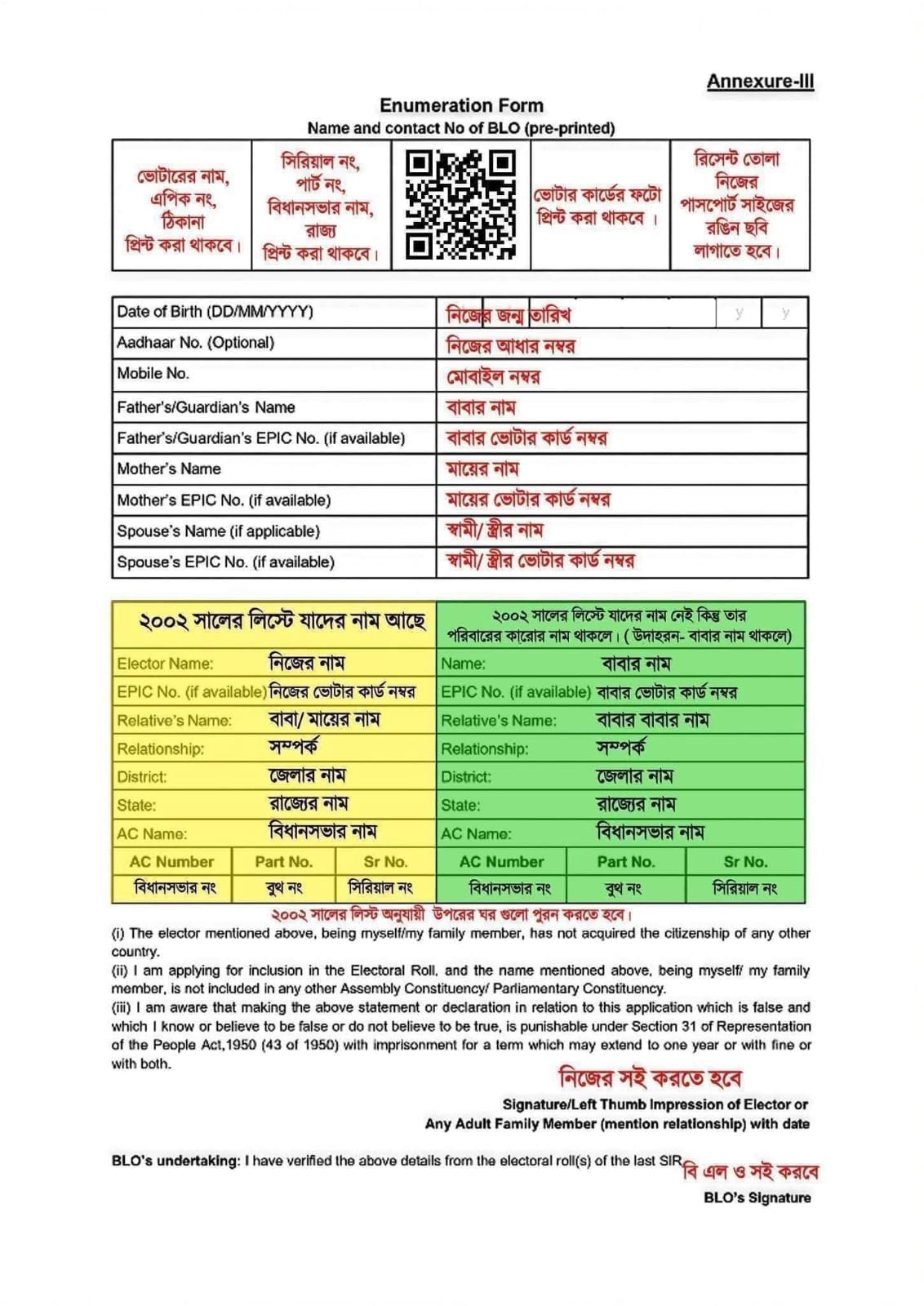
The BLO gives two copies of the pre-filled form. Check your name, EPIC number and address, add date of birth, parents’ details and mobile number, sign both copies, and keep the stamped acknowledgement. Aadhaar is optional. Do not enter false 2002 details.
Matched and unmatched voters
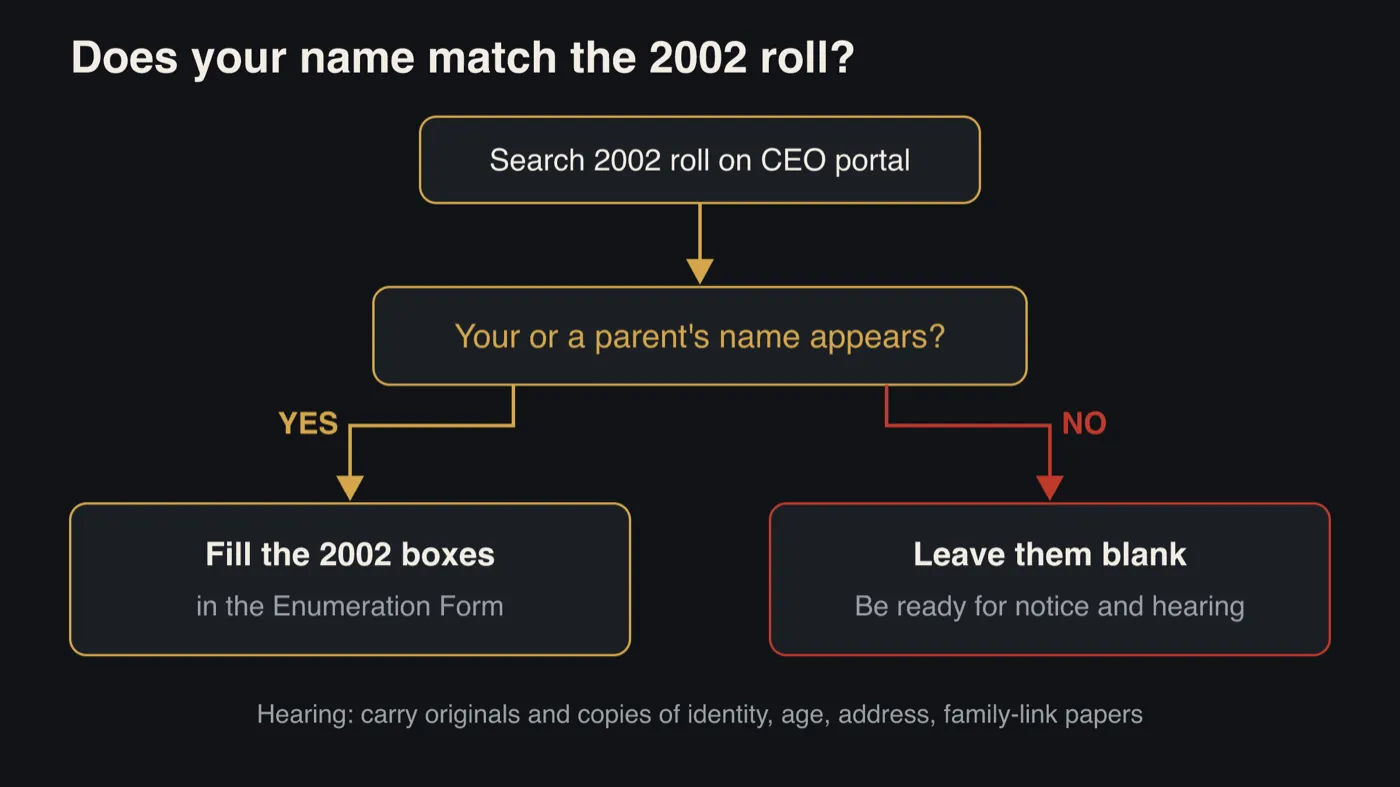
Search the 2002 roll on the CEO West Bengal portal by district, constituency and polling station. If your name or a parent’s name appears, fill the 2002 boxes. If not, leave them blank and be ready for a notice and hearing.
Claims and objections
After the draft roll is published, check your name. A person left out may file a claim in Form 6. An objection to an ineligible entry is made in Form 7. Keep the acknowledgement receipt, as it is your main proof of having submitted the form.
Documents for the hearing
The ERO notice calls the elector to prove eligibility. Carry originals and copies of the identity, age, address and family-link papers listed in the ECI order, and any 2002 roll extract. Check the current list of accepted documents on official sources before the hearing.
What to do after an adverse ERO decision
- Keep the Enumeration Form acknowledgement and any hearing notice.
- Check the draft and final roll on the CEO West Bengal portal.
- File Form 6 within the claims period if your name is missing.
- Appeal against an ERO order within the time allowed; verify the forum and period in the order.
- Seek early listing through the SIR Tribunal route where an appeal is pending.
- Approach the Calcutta High Court only on legal grounds such as denial of a fair hearing.
What the courts have said about SIR, deletion and the voter's right to be heard
These decisions set the limits on the Special Intensive Revision. Your name cannot simply disappear from the roll, and the Election Commission’s power under Article 324 has to be used fairly and within the law.
1995
No deletion without notice and hearing
The Supreme Court held that a voter already on the roll cannot be removed on mere suspicion. Apart from the case of a dead voter, the Electoral Registration Officer must give notice and a fair hearing. The fact that the person was on the earlier roll must be given proper weight before notice is issued and during the inquiry. This is the starting point for every SIR hearing.
1977
Article 324 power is bound by natural justice
A Constitution Bench held that the Election Commission’s power under Article 324 of the Constitution is wide, but it is not unlimited. Where an order of the Commission has civil consequences for a person, the rule of fair hearing (audi alteram partem) applies. Losing your vote is a civil consequence, so SIR decisions must follow fair procedure.
2025
Aadhaar accepted as the 12th document
In the Bihar SIR challenge, the Supreme Court directed the Election Commission to accept Aadhaar as a twelfth document, in addition to the eleven listed documents, as proof of identity. The Court made it clear that Aadhaar is not proof of citizenship, and that officers may check whether the Aadhaar card is genuine. The Commission issued instructions the next day.
2026
SIR is valid under Article 324
The Supreme Court upheld the Election Commission’s power to carry out the SIR under Article 324 and Section 21(3) of the Representation of the People Act, 1950. It held that the exercise serves free and fair elections. Deletion from the roll is a decision about electoral eligibility, not a final finding on citizenship. If the competent authority later holds that a deleted person is a citizen, the name must be restored.
2026
Appellate tribunals for West Bengal exclusions
For West Bengal, the Supreme Court directed that independent appellate tribunals, headed by former judges of the Calcutta High Court, be set up to hear appeals against exclusion from the roll. Nineteen tribunals were notified, and reasons for each inclusion or exclusion were to be made available. By the later order, a tribunal may accept fresh documents, but only after checking that they are genuine.
How an elector moves through SIR in West Bengal, from the enumeration form to appeal
Fill the Enumeration Form and keep the receipt
Check the pre-filled details on the Enumeration Form (Annexure III), fill in what is missing, and sign both copies. Fill in the 2002 roll link only if your own name, or a parent’s or grandparent’s name, is actually on that roll. Keep the copy the BLO countersigns and stamps. It is your proof that you took part.
Check the draft roll and the list of names left out
When the draft roll comes out, look for your name, and also check the list of electors not included, which gives a reason such as Absent, Shifted, Deceased or Duplicate. If your name is missing, file a claim in Form 6. Any person may object to a wrong entry in Form 7.
Answer the ERO's notice and attend the hearing
If you could not be linked to the 2002 roll, the Electoral Registration Officer will send you a notice for a hearing. Bring the listed documents and Aadhaar as proof of identity, along with your stamped receipt. Under Lal Babu Hussein, your earlier inclusion on the roll must be given proper weight. Ask for the reasons for the decision in writing.
Appeal against an exclusion order
Section 24 of the Representation of the People Act, 1950 provides an appeal against the ERO’s order. For West Bengal SIR exclusions, the Supreme Court has set up appellate tribunals of former High Court judges. File the appeal with the order, the reasons and your documents. Fresh documents are accepted only after they are checked for genuineness. See our SIR Tribunal appeal advocate page.
Approach the Calcutta High Court only in limited cases
The Calcutta High Court has generally sent deletion disputes back to the SIR Appellate Tribunal. It has, however, asked tribunals to decide urgent appeals quickly, for example where a passport or a job depended on the voter entry. A writ petition under Article 226 is worth considering for delay or a clear breach of procedure. See our Calcutta High Court advocate consultation page.
From enumeration form to final roll
Each stage leads to the next, and an adverse order has a remedy in appeal.
BLO visit and form
Sign two copies and take the stamped receipt.
Draft roll on 9 Dec 2025
Check that your name is on it.
Claim or objection
Use Form 6, 7 or 8 within the claims period.
ERO hearing and order
The ERO decides after hearing you.
Appeal if rejected
Appeal as the order directs, then writ if needed.
Final roll on 7 Feb 2026
The roll for the 2026 election is published.
Mistakes that cost electors their place on the roll
Writing a false 2002 link to avoid a hearing If you are unmatched, leave the 2002 boxes blank. A wrong entry can be checked against the 2002 roll and will damage your credibility at the hearing and in any appeal.
Losing the stamped acknowledgment The countersigned copy of the Enumeration Form is often your only proof that you took part. Keep the original safe and keep a photo of it on your phone.
Treating Aadhaar as proof of citizenship The Supreme Court has said Aadhaar is proof of identity only. Bring other listed documents too, such as a birth certificate, a school certificate, or your parents’ entries on old rolls, to show you are eligible.
Waiting for the court instead of filing the appeal The Supreme Court refused to let excluded persons vote while their appeals were still pending, and both the Supreme Court and the High Court have sent such cases to the appellate tribunals. File the tribunal appeal promptly and ask for an early hearing if the matter is urgent.
Legal help with SIR hearings and appeals
If you received an ERO notice, were excluded from the roll, or had a claim rejected, an advocate can review your papers, explain the time limits and prepare your reply or appeal. Each matter depends on its own facts and the orders of the authority, and no result can be promised. Bring the notice, the acknowledgement receipt and your identity and family documents to the consultation.
Book a ConsultationEstablished by a distinguished alumnus of IIT Kharagpur, Patra’s Law Chambers stands as a beacon of legal expertise in Kolkata & Delhi. Know more →
Kolkata Office
NICCO House, 6th Floor, 2 Hare Street
Kolkata-700001 (Near Calcutta High Court)
Delhi Office
4455/5, First Floor, Gali Shahid Bhagat Singh
Main Bazar Road, Paharganj, New Delhi-110055
Contact
[email protected]
+91 890 222 4444 / +91 7003 715 325
How long each SIR window runs
Calculated from the dates in the official schedule given on this page.
Frequently asked questions on SIR in West Bengal
SIR stands for Special Intensive Revision. It is a full, door-to-door re-verification of the electoral roll by the Election Commission of India, different from the yearly Special Summary Revision. It rests on Article 324 of the Constitution and Section 21 of the Representation of the People Act, 1950.
The last intensive revision in West Bengal was in 2002, and the 2002 roll is the reference point for the current exercise. Voters are asked to link their entry to their own name or a parent’s or grandparent’s name on that roll.
During enumeration, no document is collected, as per the ECI order dated 27.10.2025. You only fill and sign the Enumeration Form. If you are called for an ERO hearing, you may need to prove eligibility with documents from the list in the order. Verify that list on the official portal.
Open the CEO West Bengal portal (ceowestbengal.wb.gov.in), choose “Elector Roll SIR 2002”, then your district, assembly constituency and polling station as they stood in 2002. Open the Final Roll PDF and search for your name or your parents’ names.
The BLO should make at least three visits to a locked or closed house. An adult family member can sign the form for you, and you can also submit it online on the official portals. Always keep a copy or a screenshot of what you submit.
File a claim for inclusion on Form 6 within the claims period, attaching your stamped acknowledgement. The period given in the schedule is 9 December 2025 to 8 January 2026. Check the portal for the current dates before you rely on them.
Fill the Enumeration Form as usual and leave the 2002 section blank if you cannot trace a link. Watch for an ERO notice after the draft roll, then attend the hearing with your receipt and the documents asked for.
Yes. The Representation of the People Act, 1950 and the Registration of Electors Rules, 1960 provide appeals, and a special SIR tribunal arrangement has been announced by the Supreme Court. Appeal time limits are short, so check the order and speak to an advocate soon.