GSTAT Appeal: How to File a GST Second Appeal under Section 112
The GST Appellate Tribunal (GSTAT) hears second appeals against orders passed in first appeal or revision. This guide covers limitation, the pre-deposit, Form GST APL-05, fees, the Kolkata Bench and what follows a GSTAT order, as the position stood on 25 October 2026.
What GSTAT is and which orders you can appeal
The GST Appellate Tribunal is the second appeal forum under the CGST Act, 2017 and the West Bengal GST Act, 2017. It hears appeals against orders of the Appellate Authority under Section 107 and of the Revisional Authority under Section 108. Original adjudication orders, advance rulings and summons do not come to GSTAT. The Tribunal was launched with its e-filing portal on 24 September 2025, and the official portal is gstat.gov.in. A second appeal is filed online in Form GST APL-05 under Rule 110 of the CGST Rules, 2017.
Where the dispute is about place of supply, only the Principal Bench in New Delhi can hear it (Section 109). Every other appeal goes to the State Bench. For West Bengal, Sikkim and the Andaman and Nicobar Islands, that is the Kolkata State Bench at 2/5 Judges Court Road, Alipore, which began functioning under Public Notice No. 01/2026 dated 23 March 2026. Filing is on the portal, not on paper at Alipore. If you are still at the notice stage, read our guide on a GST demand notice, or see the firm’s GST lawyer page.
The figures that matter
Which GST order do you have in your hand?
Pick the latest order you received to see the forum that usually hears it and the usual next step. This is general information, not advice, and your own papers and dates should be checked before you act.
Choose one of the options above.
How a GSTAT second appeal moves from order to decision
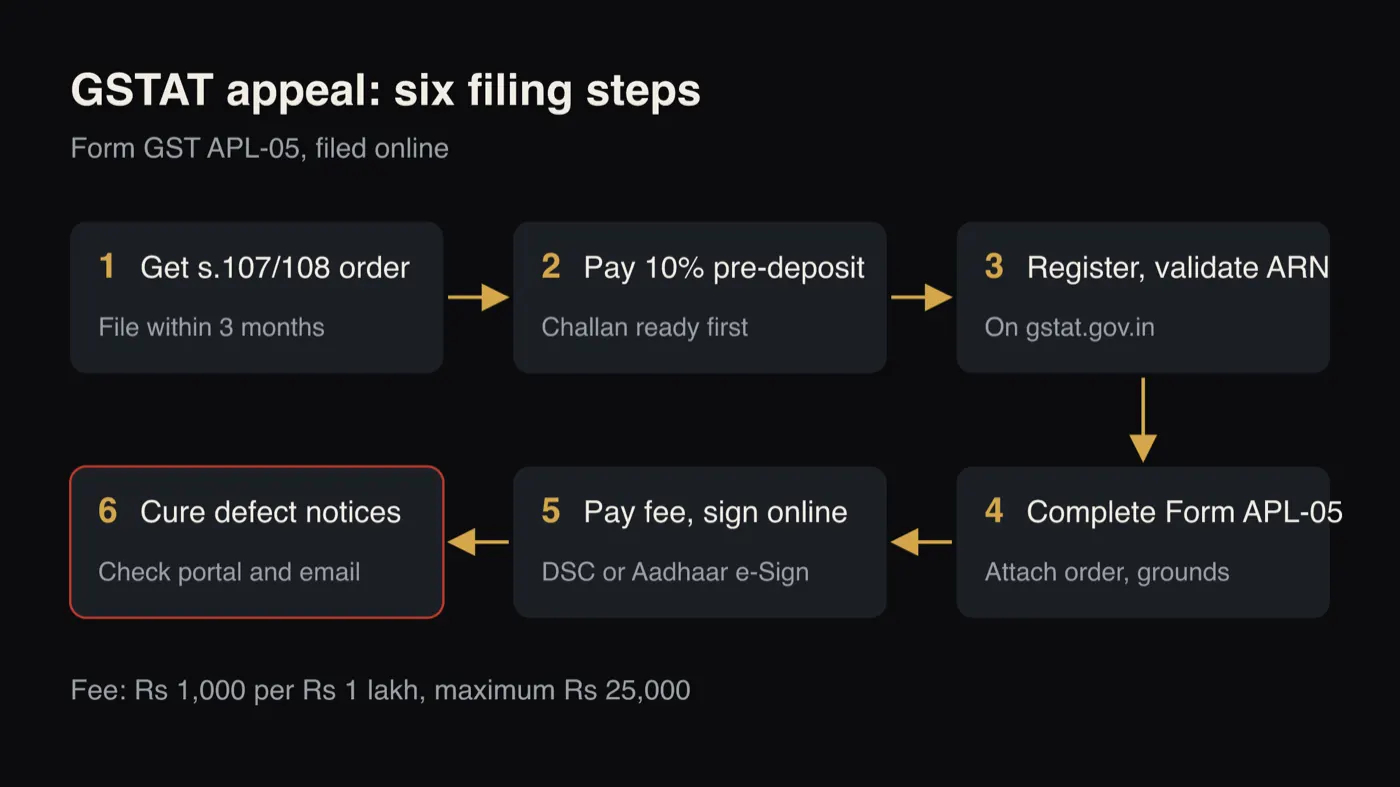
This is the usual route for an order of the Appellate Authority or Revisional Authority. Dates and fees are changing quickly, so verify them on the GSTAT portal before you file.
Time runs from the date the order is communicated, not from the date you read it. Check that the order is a first appeal or revision order, because adjudication orders and similar papers do not go to GSTAT. For the earlier stages see our GST lawyer page and the guide on a GST demand notice.
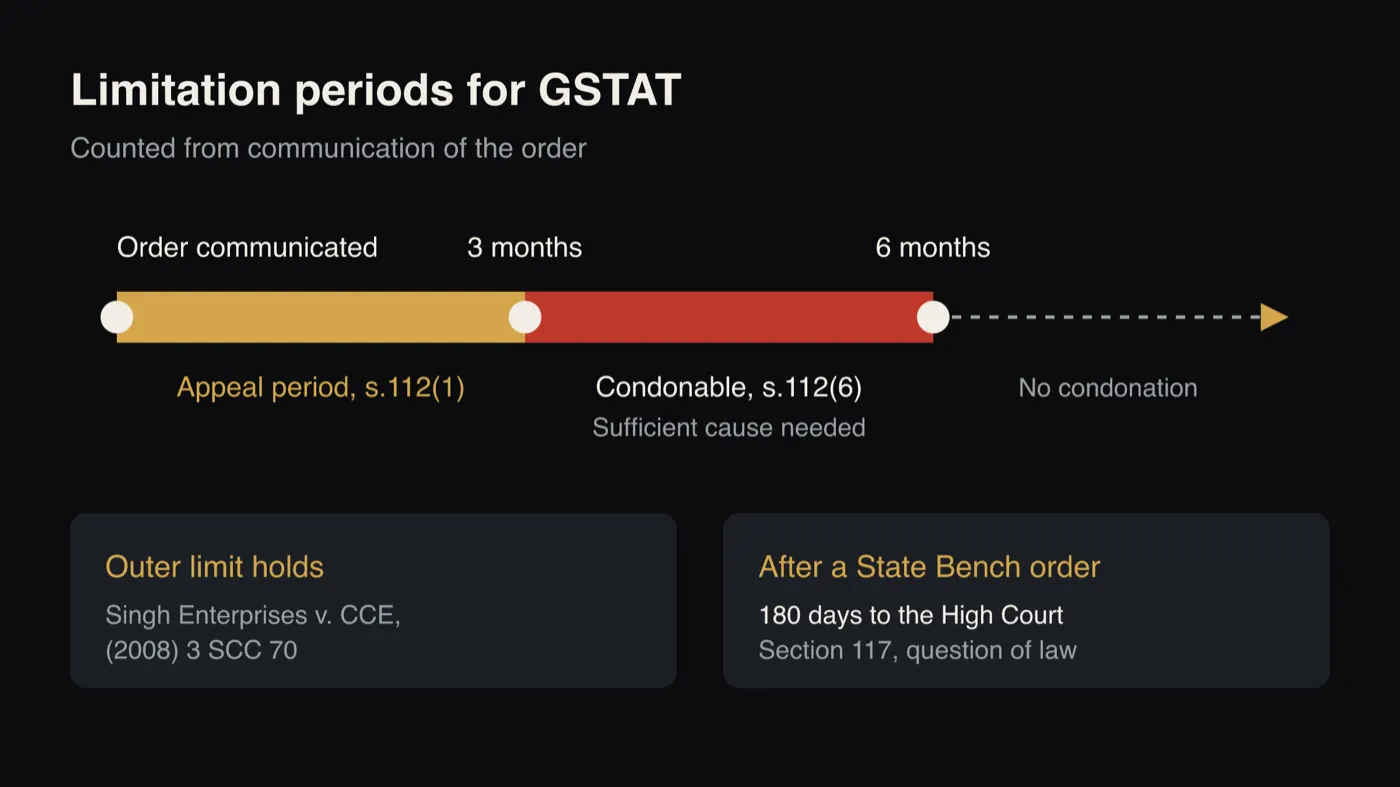
The normal period is 3 months under Section 112(1), with up to 3 more months condonable for sufficient cause under Section 112(6). Place of supply cases go to the Principal Bench in New Delhi, and West Bengal cases to the Kolkata State Bench.
Pay the admitted amount in full and 10% of the remaining disputed tax, in addition to what was paid at the first appeal. The cap is Rs 20 crore for CGST and Rs 20 crore for SGST. Keep the challan or payment proof ready before you open Form GST APL-05.
Register on the GSTAT portal, validate the first appeal case, complete APL-05, pay the fee and sign with DSC or Aadhaar e-Sign. The fee is Rs 1,000 per Rs 1 lakh of tax or penalty involved, up to Rs 25,000. Download the provisional acknowledgement.
The Registry checks the appeal and lists defects, which must be cured in the time allowed. Short pre-deposit and missing authorisation are frequent problems. Check the portal dashboard and your registered email regularly.
Each party gets a maximum of 3 adjournments under Section 113(2), and new evidence is allowed only on the grounds in Rule 112. A State Bench order can go to the High Court, and a Principal Bench order to the Supreme Court. A writ in the Calcutta High Court is limited to exceptional cases.
Three things people miss before a GSTAT appeal, tap a card
Section 112(8) asks for 10% of the remaining disputed tax in addition to the amount paid under Section 107(6). The cap is Rs 20 crore each for CGST and SGST.
The special date for older orders ended on 31.07.2026, and token holders had 60 days after that. Late appeals now depend on condonation, so an un-appealed older order needs immediate checking.
The Calcutta High Court now usually sends parties to GSTAT where a statutory appeal exists. A writ survives mainly for lack of jurisdiction, breach of natural justice or a challenge to a law.
Where a GST dispute goes after the first appeal
Limitation and condonation
The appeal must be filed within 3 months of communication of the order, counted from communication and not from the date of upload. The Tribunal may condone a further 3 months for sufficient cause. In Singh Enterprises v. CCE, (2008) 3 SCC 70, the Supreme Court held that delay cannot be condoned beyond a statutory outer limit, which Revenue relies on here.
Pre-deposit and stay
Pay the admitted amount in full plus 10% of the remaining disputed tax, in addition to the 10% paid at the first appeal. The cap is Rs 20 crore each for CGST and SGST. Once paid, recovery of the balance is stayed under Section 112(9). A short or wrongly computed deposit is a common defect, so have the challan ready before opening APL-05.
Form GST APL-05 and filing
File online: register, validate the first-appeal ARN or order number, complete APL-05, pay the fee of Rs 1,000 per Rs 1 lakh of tax or penalty involved (maximum Rs 25,000) and sign with DSC or Aadhaar e-Sign. Attach the certified order, grounds, pre-deposit proof and authorisation. Cross-objections are filed in Form APL-06.
After GSTAT, and writs
A State Bench order goes to the High Court on a substantial question of law within 180 days (Section 117). A Principal Bench order goes to the Supreme Court (Section 118). The Calcutta High Court now usually sends parties to GSTAT, and entertains a writ petition only in exceptional cases such as want of jurisdiction.
Documents and points to settle before filing APL-05
- Certified copy of the Section 107 or 108 order and the order-in-original, each as a PDF
- Pre-deposit proof from the GST portal (DRC-03 or linked payment), computed on the demand after the first appeal
- Statement of facts and numbered grounds of appeal, with English translations of any Bengali documents
- Vakalatnama or authorisation letter, with a board resolution for a company
- Separate appeal for each order; joint appeals by several persons are not allowed
- Check the portal dashboard and registered email for defect notices, as defects must be cured within the time allowed
Court rulings that shape a GSTAT appeal
These Supreme Court and High Court rulings decide when you must go to the GST Appellate Tribunal, how strictly time limits are applied, and how the pre-deposit can be paid. Each citation below was checked against a published report; read the full judgment before relying on it for your own facts.
2021
Use the statutory appeal before any writ
The Supreme Court set aside a Telangana High Court order that had entertained a writ against a GST demand when the appeal under Section 107 of the CGST Act was available. A writ is the exception. It lies only for breach of a fundamental right, violation of natural justice, an order without jurisdiction, or a challenge to the validity of a statute.
2026
Calcutta High Court sends taxpayers to GSTAT
The petitioner said the adjudication went beyond the show cause notice. The Calcutta High Court still declined to examine the challenge to the first appellate order and left every issue open for the GST Appellate Tribunal. Recovery was not to be made during the appeal period if the appeal was filed in time, subject to Section 78. See our writ petition guide.
2008
No condonation beyond the statutory outer limit
When a statute gives a fixed appeal period and a limited extra period for sufficient cause, the appellate body cannot condone delay beyond that extra period, and Section 5 of the Limitation Act does not help. Revenue relies on this ruling against GSTAT appeals filed after the further three months allowed by Section 112(6) of the CGST Act.
2023
Section 5 relief view stayed by Supreme Court
The Division Bench held that Section 5 of the Limitation Act applies to GST appeals under Section 107. The Supreme Court issued notice and stayed that judgment on 30.08.2024, and the Allahabad and Delhi High Courts have taken the opposite view. Until the Supreme Court decides, treat the time in Section 112(6) as the outer limit for a GSTAT appeal.
2025
First-appeal pre-deposit may come from credit ledger
The Supreme Court dismissed the department’s petition and left in place the Gujarat High Court’s ruling, which followed the Bombay High Court in Oasis Realty, that the 10% pre-deposit under Section 107(6) may be paid from the electronic credit ledger. Whether the same applies to the Section 112(8) deposit at GSTAT is not settled. Verify current GSTAT portal practice before paying.
How to file a GSTAT appeal in Form GST APL-05
Confirm the order can go to GSTAT
A GSTAT appeal lies only against an order of the Appellate Authority under Section 107 or the Revisional Authority under Section 108 of the CGST Act. An original adjudication order (DRC-07) goes first to the Appellate Authority in APL-01. Advance rulings and summons do not go to GSTAT. Find your GST service page here.
Choose the correct bench
If any issue concerns place of supply, the appeal goes only to the Principal Bench in New Delhi (Section 109). All other appeals from West Bengal, Sikkim and the Andaman and Nicobar Islands go to the Kolkata State Bench at Alipore. Filing is online on the GSTAT portal. If you filed at the wrong bench, use the portal’s transfer application.
Count the time limit from communication
File within 3 months of the date the order was communicated to you (Section 112(1)), not the date it was uploaded. The Tribunal may allow up to 3 more months if you file an application showing sufficient cause (Section 112(6)). The special window for older orders closed on 31.07.2026, so get older orders checked at once.
Pay the pre-deposit and keep the challan
Pay the admitted amount in full, plus 10% of the tax still disputed after the first appeal, on top of the 10% already paid under Section 107(6). The cap is Rs 20 crore CGST and Rs 20 crore SGST (Section 112(8)). Keep the DRC-03 challan or debit entry ready before you open the APL-05 form.
Prepare the paper book
Prepare a certified copy of the appellate order, the order-in-original, a statement of facts, numbered grounds of appeal, pre-deposit proof, a vakalatnama or authorisation (with a board resolution for a company), the verification, and English translations of any Bengali documents. Index and paginate everything as PDFs within the portal size limit.
File online, pay the fee and track defects
Register on the GSTAT e-filing portal and validate the case with the ARN of the first appeal. Then complete APL-05, pay the fee (Rs 1,000 per Rs 1 lakh of tax or penalty, maximum Rs 25,000), sign with DSC or Aadhaar e-Sign, and download the acknowledgement. Check the dashboard and your email for defect memos and cure them within the time the Registry allows.
GSTAT pre-deposit and fee under Section 112(8) of the CGST Act (enter the tax still disputed after the first appeal)
Mistakes that cost taxpayers their GST second appeal
Calculating the 10% on the wrong figure. Section 112(8) requires 10% of the tax that remains disputed after the first appeal, in addition to the Section 107(6) deposit. Do not include interest or penalty in that disputed tax. A short deposit is among the most common defects, and recovery of the balance is stayed only once the full pre-deposit is paid (Section 112(9)).
Assuming late filing can always be condoned. The Tribunal can condone only 3 further months under Section 112(6). After the Singh Enterprises ruling, and with the Supreme Court’s stay of S.K. Chakraborty, a delay beyond that is generally treated as fatal.
Filing a writ instead of the appeal. Now that GSTAT is working, the Calcutta High Court usually sends petitioners to the Tribunal (RSH Amit Realty, 2026). A writ is entertained only for lack of jurisdiction, breach of natural justice or a challenge to the validity of a statute.
Pursuing an appeal after taking the Section 128A waiver. If you used the Section 128A waiver of interest and penalty for a Section 73 demand, the pending appeal for that demand must be withdrawn. You cannot have both the waiver and a GSTAT appeal on the same demand.
Discuss your GSTAT appeal before the limitation period runs
Limitation, the pre-deposit and the choice of bench each depend on the dates and figures in your own order. If you have received an adverse first appeal or revision order, we can read the order, work out the dates and the pre-deposit with you, and explain the options, including recovery or bank account attachment concerns. Every matter is assessed on its own facts, and no outcome can be promised. Please bring the order, the first appeal papers and proof of payments made so far.
Book a ConsultationEstablished by a distinguished alumnus of IIT Kharagpur, Patra’s Law Chambers stands as a beacon of legal expertise in Kolkata & Delhi. Know more →

Kolkata Office
NICCO House, 6th Floor, 2 Hare Street
Kolkata-700001 (Near Calcutta High Court)
Delhi Office
4455/5, First Floor, Gali Shahid Bhagat Singh
Main Bazar Road, Paharganj, New Delhi-110055
Contact
[email protected]
+91 890 222 4444 / +91 7003 715 325
Frequently asked questions about a GSTAT appeal under Section 112
The usual period is 3 months from the date the first appeal or revision order is communicated, under Section 112(1) of the CGST Act. GSTAT may condone a further 3 months for sufficient cause under Section 112(6). Count from communication, and verify the exact date.
The special window for older orders closed on 31.07.2026, and token holders had 60 days after that. A late appeal now depends on condonation. As of 25.10.2026 no further extension was found, so get the order and its dates checked immediately.
Pay the admitted amount in full, plus 10% of the remaining disputed tax, on top of the amount paid at the first appeal. The cap is Rs 20 crore for CGST and Rs 20 crore for SGST. Penalty-only orders have a separate rule, so verify.
The Kolkata State Bench at Alipore hears appeals from West Bengal, Sikkim and the Andaman and Nicobar Islands. Cases where any issue relates to place of supply go only to the Principal Bench in New Delhi, under Section 109.
The fee is Rs 1,000 for every Rs 1 lakh of tax or penalty involved, with a maximum of Rs 25,000. Appeals with no tax or penalty and interlocutory applications carry a lower fee. Check the corrected fee schedule on gstat.gov.in before paying.
No. The appeal is filed online on the GSTAT portal in Form GST APL-05, signed with DSC or Aadhaar e-Sign. You do not file on paper at Alipore. Hearings are listed before the bench, either physically or virtually with approval.
Recovery of the balance demand is deemed stayed under Section 112(9) once the full pre-deposit is paid. The stay is not automatic before that. Give the jurisdictional officer a copy of the APL-05 acknowledgement, and verify the position in your case.
An order of a State Bench can be appealed to the High Court under Section 117 within 180 days, but only on a substantial question of law. An order of the Principal Bench goes directly to the Supreme Court under Section 118.