- The right to anticipatory bail stems from Article 21 and protects against pre-arrest deprivation of liberty under BNSS Section 482.
- Applicant must show a tangible reason to believe imminent arrest for a non-bailable offence, not mere floating apprehension.
- Supreme Court "Trinity" (Sibbia, Mhetre, Sushila Aggarwal) established broad, discretionary and often open-ended anticipatory bail.
- Statutory bars exist: SC/ST Act, NDPS, UAPA, and PMLA impose special or twin-condition hurdles.
- Courts deny bail for genuine custodial interrogation needs, abscondence, or successive applications without substantial change.
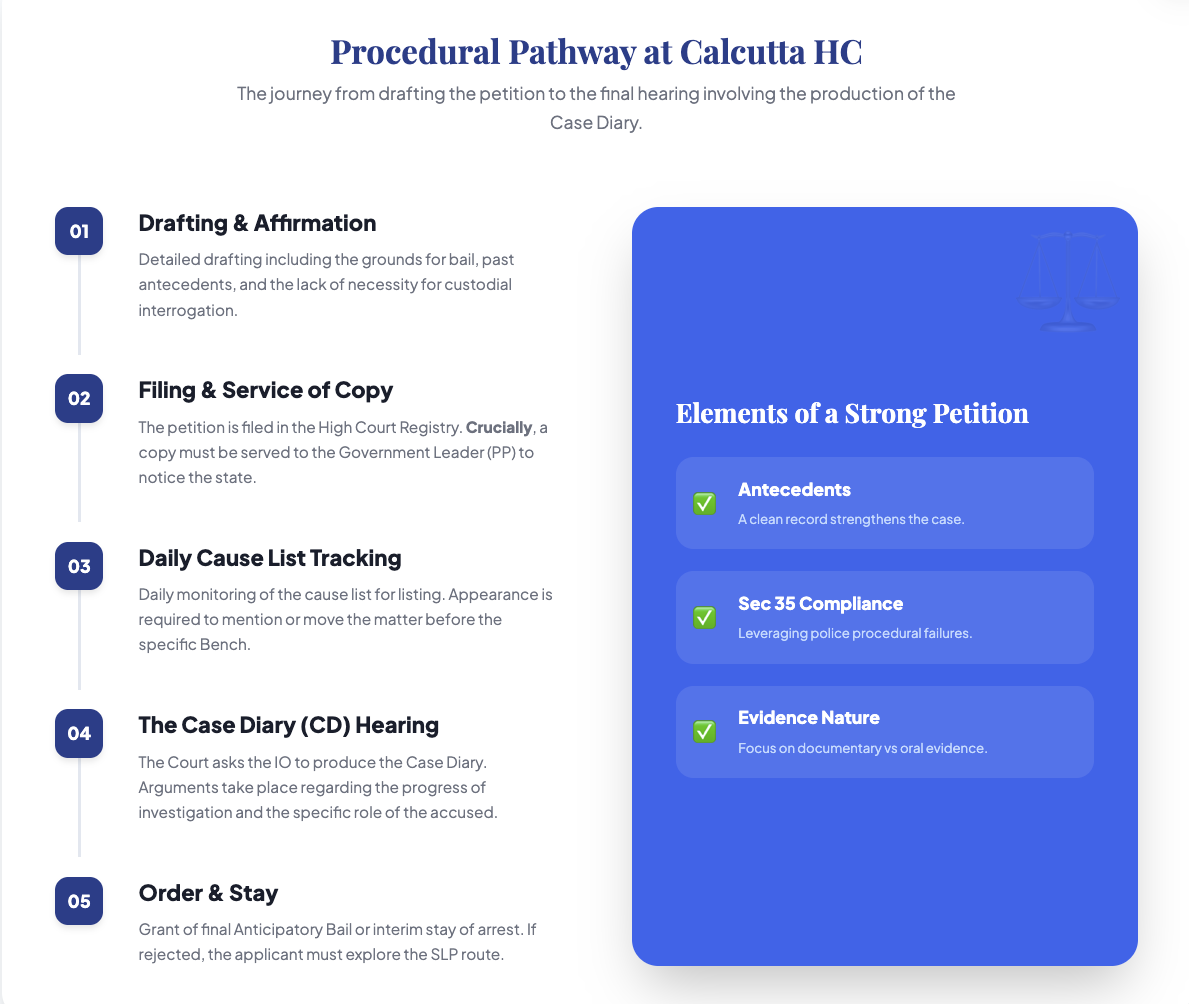
- Calcutta HC procedure: prefer Sessions Court first; file via SARTHAC with CRM(M)/CRM(R) classification and serve the Public Prosecutor.
- Section 35 BNSS notice regime limits arrests for <7-year offences; compliance strengthens anticipatory bail prospects.
Filling Anticipatory Bail the Calcutta High Court

-
-
Creditor and contributor of this article:
Patra’s Law Chambers:
About Us:
Patra’s Law Chambers is a law firm with offices in Kolkata & Delhi, offering comprehensive legal services across various domains. Established in 2020 by Advocate Sudip Patra (Advocate, Supreme Court of India & Calcutta High Court) an alumnus of the Prestigious Rajiv Gandhi School of Intellectual Property Law, IIT Kharagpur ,with Post Graduate diploma in Business Law from IIM Calcutta, the firm specializes in Civil, Criminal, Writs,High Court Matters, Trademark, Copyright, Company, Tax, Banking, Property disputes, Service law, Family law, and Supreme Court matters.You can know more about us in here
Kolkata Office:
NICCO HOUSE, 6th Floor, 2, Hare Street, Kolkata-700001 (Near Calcutta High Court)
Delhi Office:
House no: 4455/5, First Floor, Ward No. XV, Gali Shahid
Bhagat Singh, Main Bazar Road, Paharganj, New Delhi-110055
Website: www.patraslawchambers.com
Email: [email protected]
Phone: +91 890 222 4444/ +91 7003 715 325
Resources:Anticipatory bail infographic.pdf
-
I. Introduction: The Constitutional Sentinel of Liberty
The concept of “Bail” is not merely a procedural mechanism within the criminal justice system; it is the operationalization of the fundamental right to life and personal liberty enshrined in Article 21 of the Constitution of India. Within this broad spectrum of liberty, Anticipatory Bail stands as a unique, pre-emptive legal shield. It is a remedy designed not for those already in the clutches of the state, but for those who live under the shadow of imminent arrest—often stemming from accusations that may be frivolous, politically motivated, or borne out of personal vendetta.1
While the term “Anticipatory Bail” is a misnomer—the order does not grant bail in anticipation, but rather directs release in the event of arrest—its significance in the Indian legal framework cannot be overstated. Unlike regular bail, which is a post-trauma remedy sought from behind bars, anticipatory bail is a pre-trauma vaccination against the ignominy of incarceration. It acknowledges that the power of arrest is a potent tool that, if unchecked, can destroy reputations and livelihoods before a trial even commences.
This treatise serves as an exhaustive guide for litigants, legal practitioners, and scholars operating within the jurisdiction of the Calcutta High Court. It navigates the transition from the Code of Criminal Procedure (CrPC), 1973, to the Bharatiya Nagarik Suraksha Sanhita (BNSS), 2023, dissecting the substantive laws, procedural nuances, and the practical realities of filing, listing, and arguing these matters in one of India’s oldest High Courts. Furthermore, it outlines the critical role of legal aid and the appellate pathways to the Supreme Court of India, provided by Patra’s Law Chambers.
1.1 The Legislative Genesis and the “Reason to Believe”
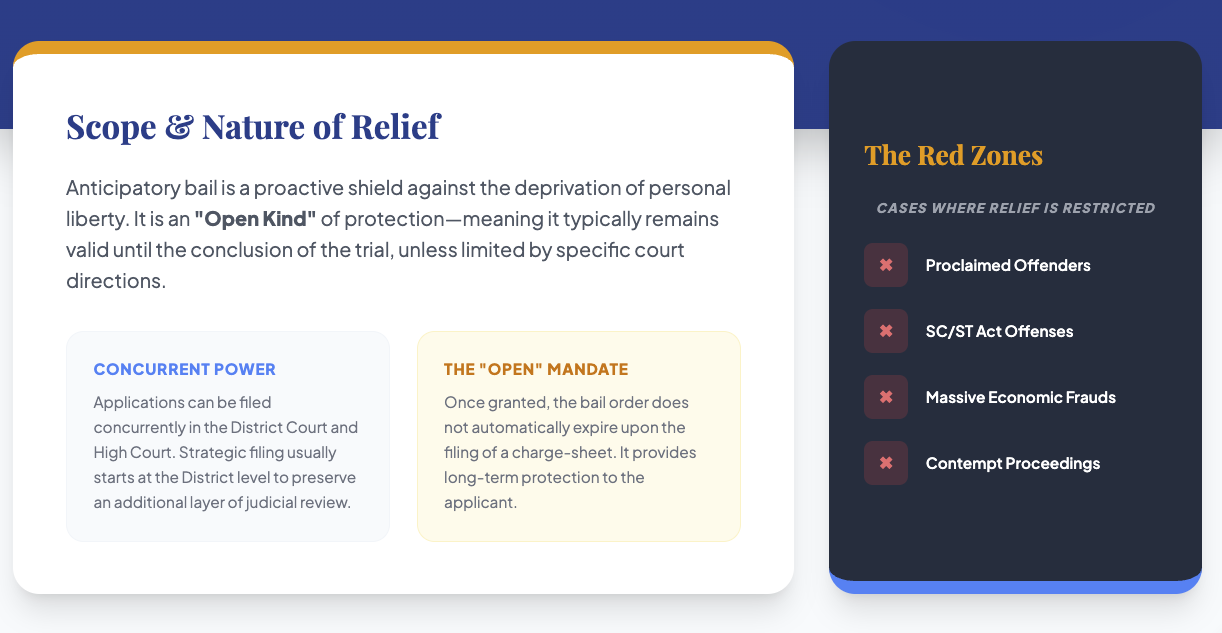
The provision for anticipatory bail was conspicuously absent in the Code of Criminal Procedure, 1898. It was the 41st Report of the Law Commission of India (1969) that identified a pressing need for such a provision. The Commission observed that with the rise of political rivalry and complex social interactions, the police machinery was increasingly being weaponized to harass opponents through arbitrary arrests. Consequently, Section 438 was introduced in the CrPC, 1973.
Under the new dispensation of the BNSS, 2023, this power is retained under Section 482, which is in pari materia (on equal footing) with the old Section 438. The core ingredient remains the “Reason to Believe”.
The applicant must demonstrate that they have a “reason to believe” that they may be arrested on an accusation of having committed a non-bailable offence.
- Tangible Apprehension: This belief cannot be founded on vague fears or a “floating apprehension.” It must be rooted in tangible facts—such as the filing of a First Information Report (FIR), police raids at one’s residence, specific threats of implication by a complainant, or the issuance of a Section 35 (BNSS) notice.1
- The “Non-Bailable” Threshold: The remedy is exclusively available for non-bailable offences. For bailable offences, bail is a matter of right and can be granted by the police officer immediately upon arrest; hence, the extraordinary remedy of anticipatory bail is redundant.
II. The Jurisprudential Trinity: Scope and the “Open” Bail
The scope of anticipatory bail has been shaped not by the rigid letter of the law, but by the interpretive wisdom of the Supreme Court of India. Three landmark Constitution Bench judgments form the “Trinity” of bail jurisprudence: Gurbaksh Singh Sibbia, Siddharam Satlingappa Mhetre, and Sushila Aggarwal. Understanding these is crucial for drafting any petition, as they define what is now known as the “Open kind of Anticipatory Bail.”
2.1 Gurbaksh Singh Sibbia v. State of Punjab (1980)
For decades, conflicting High Court judgments created confusion. Some courts held that anticipatory bail should be granted only in “exceptional” cases. The Constitution Bench in Sibbia authoritatively rejected this restrictive view.1
- Rejection of Straitjacket Formulas: The Court held that the legislature conferred wide discretionary power on the High Court and Sessions Court. To lay down rigid rules or a “straitjacket formula” would fetter this discretion and defeat the legislative intent.
- Article 21 Nexus: The Court explicitly linked Section 438 (now Section 482 BNSS) to Article 21. Since the denial of bail deprives a person of their liberty, the procedure for such deprivation must be “fair, just, and reasonable.” Therefore, courts must lean in favor of liberty unless there are compelling reasons to the contrary.
- Not Just for “Rare” Cases: The judgment clarified that anticipatory bail is not an extraordinary remedy reserved for rare cases but a statutory right available to any person who apprehends false implication.
2.2 The “Open” Bail: Sushila Aggarwal v. State (NCT of Delhi) (2020)
A significant controversy arose regarding the duration of anticipatory bail. Should it be time-bound (e.g., valid for 30 days) to force the accused to surrender and seek regular bail, or should it continue until the trial ends?
The Supreme Court in Sushila Aggarwal settled this debate, establishing the principle of “Open” Anticipatory Bail.1
The Core Holdings of Sushila Aggarwal:
| Aspect | Ruling | Implication for Petitioners |
| Duration | Not automatically time-bound. It should ordinarily continue till the conclusion of the trial. | You do not need to surrender and apply for regular bail after the charge sheet is filed. |
| Limitability | The Court can limit the duration if specific facts warrant it (e.g., fear of tampering). | If the order is silent on duration, it is deemed to be “open-ended.” |
| Conditions | Courts can impose conditions (passport surrender, IO reporting). | Violation of conditions is the only ground for cancellation. |
| Summons | The order does not end when the court takes cognizance or issues summons. | The protection survives the filing of the charge sheet (challan). |
Why “Open” Bail Matters:
In practice at the Calcutta High Court, this means that when Patra’s Law Chambers secures an anticipatory bail order for a client, that protection typically shields the client throughout the investigation and the subsequent trial years. The client enters the trial court not from judicial custody, but as a free person protected by the High Court’s order. The police cannot arrest the petitioner even after the charge sheet is filed, provided they cooperate with the trial.3
III. Exceptions: When Anticipatory Bail Cannot Be Applied
Despite the expansive interpretation in Sibbia and Sushila Aggarwal, the right to anticipatory bail is not absolute. There are statutory “No-Go Zones” and judicial exclusions where the relief is barred.
3.1 Statutory Bars (Special Acts)
Certain special statutes contain “non-obstante” clauses that override the CrPC/BNSS provisions.
A. Scheduled Castes and Scheduled Tribes (Prevention of Atrocities) Act, 1989
Section 18 of this Act explicitly states that Section 438 of the Code shall not apply to persons accusing of committing an offence under the Act.5
- The Judicial Exception (Prathvi Raj Chauhan): The Supreme Court has carved out a narrow window. If the complaint, taken at face value, does not make out a prima facie case (i.e., the allegations are patently absurd or do not fit the ingredients of the offence), the High Court can exercise its inherent powers to grant protection.
- Current Practice: In Calcutta, if an FIR is filed under the SC/ST Act, the petitioner must demonstrate that the allegations are motivated solely by private dispute (e.g., land grabbing) and possess no element of caste-based insult. If prima facie insult is evident, the application is dismissed as not maintainable.
B. The NDPS Act (Narcotics)
Section 37 of the NDPS Act imposes a rigorous “Twin Condition” test for bail in cases involving commercial quantities of contraband 5:
- The Public Prosecutor must be given an opportunity to oppose the bail.
- The Court must be satisfied that there are reasonable grounds to believe that the accused is not guilty of such offence and is not likely to commit any offence while on bail.
- Impact: This reverses the burden of proof. In anticipatory bail hearings, if the Case Diary shows recovery of commercial quantities, the High Court is statutorily bound to reject the plea unless procedural illegalities (search without warrant, etc.) are evident.7
C. UAPA (Terrorism) and PMLA (Money Laundering)
- UAPA: The proviso to Section 43D(5) creates a bar if the accusation is prima facie
- PMLA: Section 45 imposes twin conditions similar to the NDPS Act. The Supreme Court in Vijay Madanlal Choudhary upheld these conditions, making anticipatory bail in money laundering cases exceptionally difficult.5
3.2 Judicial Grounds for Rejection
Even in standard penal offences (under IPC/BNS), courts may reject anticipatory bail on specific qualitative grounds.9
A. Proclaimed Offenders (The “Absconder” Bar)
A person declared a Proclaimed Offender (PO) under Section 82 CrPC (Section 84 BNSS) loses the right to seek anticipatory bail.
- The Lavesh Doctrine: In Lavesh v. State (NCT of Delhi), the Supreme Court held that a person who is absconding and defying the process of law is not entitled to the discretionary relief of anticipatory bail.
- The Nuance: While State of Haryana v. Dharamraj (2023) reinforced this, recent observations suggest that if the proclamation process itself was illegal (e.g., shorter notice period), the bail court might intervene. However, broadly, “abscondence” is fatal to an AB petition.11
B. Custodial Interrogation
This is the most common ground for rejection in the Calcutta High Court. If the investigation requires:
- Recovery: Of a weapon, stolen property, or documents in the exclusive possession of the accused.
- Discovery: Of a conspiracy or a “money trail” that cannot be unearthed through mere questioning.
The court will deny bail, prioritizing the state’s right to investigate over the individual’s liberty.13
C. Second Detail for Rejection: Successive Applications
Can a person file a second anticipatory bail application if the first is rejected?
- General Rule: The principle of res judicata applies in spirit. Successive applications on the same grounds are an abuse of the process of law.
- The Exception (Change of Circumstances): A second application is maintainable only if there is a substantial “change in circumstances.” Examples include:
- Filing of a charge sheet (which might weaken the need for custody).
- Grant of bail to a similarly placed co-accused.
- Discovery of new evidence proving innocence.14
- Warning: Suppressing the fact that a previous application was rejected is a serious offence. The Calcutta High Court strictly requires a declaration in the first paragraph of the petition regarding prior applications.14
IV. Procedure at the Calcutta High Court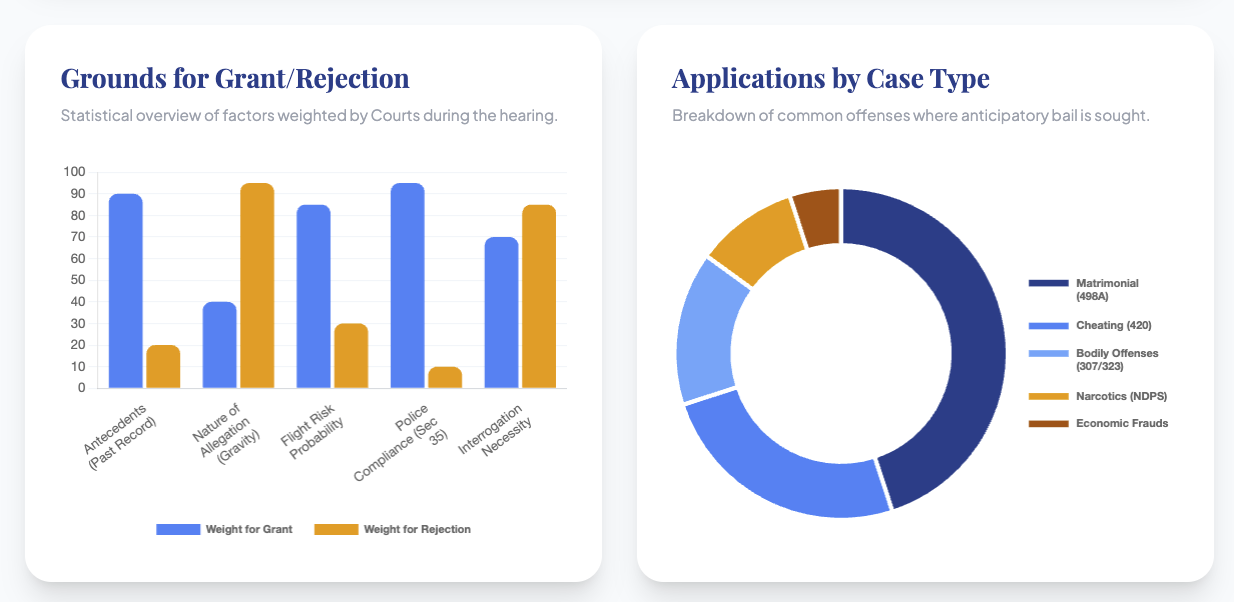
Navigating the appellate side of the Calcutta High Court requires precision. The process involves drafting, service, filing, and listing, all governed by the Appellate Side Rules and the new SARTHAC system.
4.1 Concurrent Jurisdiction: High Court vs. District Court
Section 482 BNSS (like Sec 438 CrPC) gives concurrent jurisdiction to the High Court and the Court of Session (District Court).
- Can you file directly in the High Court?
- Should you?
- Judicial Preference: Courts prefer litigants to approach the Sessions Court first. This prevents the High Court from being flooded and allows for a “filter” mechanism.15
- Strategic Advantage: At Patra’s Law Chambers, we often advise moving the Sessions Court first. If granted, the matter ends. If rejected, we move the High Court with the advantage of knowing the police’s arguments. A direct rejection from the High Court leaves only the Supreme Court as an option, which is geographically and financially more burdensome.
- Exceptions: In cases of high-profile political vendetta or where the district atmosphere is hostile/unsafe for the accused, a direct move to the High Court is justified and accepted.
4.2 The Step-by-Step Process
Step 1: Drafting the Petition
The petition must be drafted by an expert criminal lawyer. It includes:
- Cause Title: In the matter of Section 482 BNSS…
- The “Suppression” Clause: A mandatory averment that no other application is pending.
- Statement of Facts: Brief summary of the FIR and the petitioner’s defense (e.g., alibi, civil dispute dressed as criminal).
- Grounds: Legal arguments (parity, age, health, lack of evidence).
Step 2: Service to the Government Leader (Public Prosecutor)
Before the petition can be filed, it must be served on the State.17
- Process: A copy of the petition is physically taken to the Office of the Public Prosecutor (Government Leader) within the High Court premises.
- Receipt: The PP’s clerk stamps the “Presentation Form” or the back of the petition. This stamp is the “ticket” to filing. Without it, the Registry will reject the filing.
- Purpose: This serves as notice to the State to call for the Case Diary from the concerned Police Station.
Step 3: Filing and Classification (CRM(M) vs. CRM(R))
Effective April 1, 2025, the Calcutta High Court has introduced specific classifications to streamline listing 18:
- CRM(M): For anticipatory bail applications where the prescribed punishment is more than 7 years (Heinous offences).
- CRM(R): For “Residuary” matters (Offences <7 years).
- Filing Venue: The petition is filed at the Central Filing Section.
- SARTHAC System: Under the Systemized Administration & Regulation of Tendering and Handling All Court Cases (SARTHAC), files submitted before 1:30 PM are scanned and sent to the court the same day/next day. Late filings are processed subsequently.17
Step 4: Checking the Cause List
Once filed, the case is assigned a number (e.g., CRM(A) 505 of 2025).
- Daily Check: The lawyer must monitor the “Daily Cause List” on the High Court website.
- Listing: Cases appear under the heading “Motion” or “New Applications.”
- Appearance: On the listed day, the advocate must be present. If the lawyer misses the call, the case may be “Dismissed for Default.”
V. The Hearing: Case Diary and Interim Orders
The actual hearing in the Calcutta High Court is a dynamic process centered on the Case Diary (CD).7
5.1 The Case Diary (CD)
The CD is the daily record of the investigation maintained by the Investigating Officer (IO).
- Production: The Public Prosecutor hands over the CD to the Judges on the bench.
- Judicial Scrutiny: The Judges read the CD to check for:
- Statements of witnesses (Sec 180 BNSS/161 CrPC).
- Medical reports (injury reports in assault cases).
- Seizure lists.
- Confidentiality: The accused is not entitled to see the CD. It is privileged. However, the Judge often orally confronts the defense lawyer with materials found in the CD (“Counsel, the witness at page 40 says your client was present with a sword. What do you say?”).20
5.2 Interim Stay Orders
Often, the CD is not available on the first date of hearing because the police station is far away or the notice was short.
- Interim Protection: In such cases, the Court may grant an “Interim Stay of Arrest” or direct “No Coercive Steps” for a period (e.g., 2 weeks) until the CD is produced.
- Condition: The petitioner is usually directed to meet the IO once a week during this period.
5.3 Grant or Rejection
- Grant: If the Court finds the materials insufficient to warrant custody, it allows the prayer. “In the event of arrest, the petitioner shall be released on bail upon furnishing a bond…”
- Rejection: If the CD reveals incriminating material necessitating custody, the prayer is rejected.
VI. Police Compliance: Section 35 BNSS
The introduction of Section 35 of the Bharatiya Nagarik Suraksha Sanhita (BNSS) (replacing Section 41A CrPC) has revolutionized the pre-arrest landscape.
6.1 The “Notice of Appearance” Regime
For offences punishable with imprisonment of less than 7 years:
- No Automatic Arrest: The police are statutorily barred from mechanically arresting the accused.
- Mandatory Notice: The IO must issue a “Notice of Appearance” under Section 35(1) BNSS.
- Compliance: The accused must comply with the notice by appearing before the IO.
- Protection: Subsection (3) guarantees that if the person complies with the notice, they shall not be arrested unless the IO records specific reasons (e.g., the accused is tampering with evidence or intimidating witnesses).21
6.2 Relevance to Anticipatory Bail
- Strategic Argument: If the police attempt to arrest without issuing a Section 35 notice in a <7-year case, the High Court will almost always grant anticipatory bail or stay the arrest, citing violation of the Arnesh Kumar guidelines and statutory procedure.21
- The “Non-Cooperation” Trap: Conversely, if the accused ignores the notice, the PP will argue that the accused is “non-cooperative,” providing a valid ground for the High Court to reject bail and permit arrest.22
- Our Advice: At Patra’s Law Chambers, we ensure our clients respond to these notices formally, often accompanying them to the police station to ensure their “cooperation” is documented, thereby fortifying their claim for bail.
VII. Is Aid Required? (Legal Representation vs. Party in Person)
Is it mandatory to have a lawyer?
- Technically, No. The law permits a “Party in Person.”
- Practically, Yes.
- Complexity: Bail arguments in the High Court are not about “I didn’t do it.” They are about technicalities: “Is the notice under Section 35 compliant?” “Does the Case Diary substantiate the charge under Section 307 (Attempt to Murder) or merely Section 324 (Hurt)?” A layperson cannot effectively argue these points against a seasoned Public Prosecutor.
- Calcutta HC Rules: The Calcutta High Court Rules (like those in Bombay) require a Party in Person to be vetted by a Committee to ensure they can maintain court decorum and articulate their case. This process consumes time—time that an accused fearing arrest does not have.23
- Emotional Detachment: An accused arguing their own case often becomes emotional. A lawyer provides the necessary professional detachment to focus on legal merits.
VIII. Appellate Remedy: SLP to the Supreme Court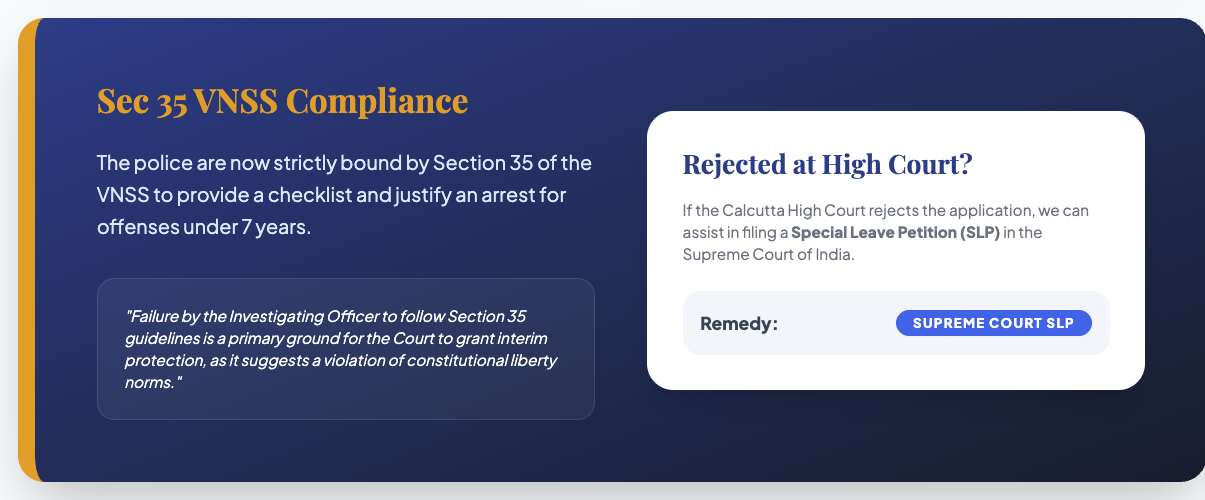
If the Calcutta High Court rejects the anticipatory bail, the final recourse is the Supreme Court of India. This is done via a Special Leave Petition (SLP) (Criminal) under Article 136 of the Constitution.
8.1 The SLP Filing Process
Filing an SLP is a highly specialized task handled by our Delhi office.
A. Timeline and Limitation
- Deadline: The SLP must be filed within 90 days from the date of the High Court’s rejection order.24
- Urgency: In bail matters, we typically file within 48-72 hours of the rejection to prevent arrest.
B. Documents Required
- Certified Copy: Of the High Court’s rejection order (Impugned Order).
- High Court Paperbook: All documents filed in the High Court (Petition, Annexures).
- List of Dates: A chronological sequence of events.
- Translation: If the FIR or any lower court document is in Bengali, it must be translated into English.25
C. The “Exemption from Surrender” Rule
Historically, a petitioner had to surrender to custody before the Supreme Court would hear their appeal. However, for Anticipatory Bail, the rules are different.
- Justice Narasimha’s Clarification: The Supreme Court has clarified that for SLPs against the cancellation or rejection of bail, the petitioner is not required to surrender as a pre-condition. The requirement to surrender applies primarily to appeals against conviction (sentencing).
- Exemption Application: Nonetheless, as a procedural safeguard, we file an “Application for Exemption from Surrendering” to ensure the Registry processes the file smoothly.26
D. The Role of the Advocate on Record (AOR)
An SLP can only be filed by an Advocate on Record (AOR)—a lawyer who has passed a rigorous examination conducted by the Supreme Court. Patra’s Law Chambers has dedicated AORs to handle these filings instantly.27
IX. How Patra’s Law Chambers Helps You
When facing the threat of arrest, time is the most critical resource. A delay of a single day in filing or a minor defect in the petition can lead to the police executing the arrest warrant.
Patra’s Law Chambers offers a seamless, end-to-end defense strategy:
- Immediate Assessment: We analyze the FIR to determine if the offence attracts the Section 35 BNSS protection or requires immediate High Court intervention.
- Drafting and Filing: Our teams in Kolkata are adept at the SARTHAC filing system, ensuring your matter is listed before the appropriate Bench (CRM-M or CRM-R) without delay.
- Case Diary Analysis: Our experienced counsel can anticipate the contents of the Case Diary and prepare rebuttals regarding “custodial interrogation” needs.
- Supreme Court Connectivity: If the High Court relief is denied, our Delhi office (Paharganj) activates immediately to file the SLP, ensuring there is no gap in your legal protection.
Contact Us

#image_title
For urgent assistance with Anticipatory Bail, transit bail, or Supreme Court SLPs:
Patra’s Law Chambers
- Kolkata Office: NICCO HOUSE, 6th Floor, 2, Hare Street, Kolkata-700001 (Near Calcutta High Court)
- Delhi Office: House no: 4455/5, First Floor, Ward No. XV, Gali Shahid Bhagat Singh, Main Bazar Road, Paharganj, New Delhi-110055
- Website: patraslawchambers.com
- Email: [email protected]
- Phone: +91 890 222 4444 / +91 9044 04 9044
(Note: This content is for informational purposes and does not constitute a client-attorney relationship. Legal outcomes depend on the specific facts of each case.)
X. Summary of Key Data Points
| Feature | Regular Bail | Anticipatory Bail | Transit Anticipatory Bail |
| Legal Basis | Sec 439 CrPC / 483 BNSS | Sec 438 CrPC / 482 BNSS | Judicial Interpretation |
| Timing | Post-Arrest (Custody) | Pre-Arrest (Apprehension) | Pre-Arrest (During Travel) |
| Court | Magistrate/Sessions/HC | Sessions/HC | High Court (usually) |
| Duration | Trial Conclusion | Open-ended (Sushila Aggarwal) | Limited (2-4 weeks) |
| Primary Test | Presence at trial | Need for Custodial Interrogation | Jurisdiction Transfer |
Checklist for Clients
- [ ] Copy of FIR / Complaint.
- [ ] Date of occurrence of the alleged offence.
- [ ] Any Notice received under Sec 35 BNSS / 41A CrPC.
- [ ] Medical documents (if claiming health grounds).
- [ ] Details of any previous bail applications (to avoid suppression).
© Patra’s Law Chambers. All Rights Reserved.
Works cited
- SUSHILA AGGARWAL and others Vs. STATE (NCT OF DELHI) and another – The Advocates League, accessed on December 26, 2025, https://theadvocatesleague.in/assets/pdf/papers/CASE_COMMENT_SUSHILA_AGGARWAL_V__NCT_DELHI.pdf
- Sushila Aggarwal vs State (Nct Of Delhi) on 15 May, 2018 – Indian Kanoon, accessed on December 26, 2025, https://indiankanoon.org/doc/86652428/
- CRIMINAL MISC ANTICIPATORY BAIL APPLICATION U/S 438 CR.P.C. No. – eLegalix, accessed on December 26, 2025, https://elegalix.allahabadhighcourt.in/elegalix/WebDownloadOriginalHCJudgmentDocument.do?translatedJudgmentID=5508
- REPORTABLE IN THE SUPREME COURT OF INDIA CRIMINAL APPELLATE JURISDICTION SPECIAL LEAVE PETITION (CRIMINAL) NOS.7281, accessed on December 26, 2025, https://api.sci.gov.in/supremecourt/2017/28027/28027_2017_3_1501_20088_Judgement_29-Jan-2020.pdf
- Anticipatory Bail – Lawsikho Blog, accessed on December 26, 2025, https://lawsikho.com/blog/anticipatory-bail/
- Bail – Gujarat State Judicial Academy, accessed on December 26, 2025, https://gsja.nic.in/gsjanew/files/Bail%20-%20The%20Balance%20of%20Liberty%20and%20Justice.pdf
- 2022~crm(ndps)_355_e.pdf – Calcutta High Court, accessed on December 26, 2025, https://calcuttahighcourt.gov.in/Show-Judgment-File/2022~crm(ndps)_355_e.pdf
- The SC on bail under UAPA and PMLA: a dataset from 2024 and 2025, accessed on December 26, 2025, https://www.scobserver.in/journal/the-sc-on-bail-under-uapa-and-pmla-a-dataset-from-2024-and-2025/
- Grounds for Rejection of Bail: Common Reasons & How to Avoid Them, accessed on December 26, 2025, https://www.advdharmendraassociates.in/post/grounds-for-rejection-of-bail-common-reasons-and-how-to-avoid-them
- Guide to Anticipatory Bail: Know Your Rights Before Arrest, accessed on December 26, 2025, https://www.kaleeyantey.com/guide-to-anticipatory-bail-know-your-rights-before-arrest/
- AT JABALPUR – Mphc.gov.in, accessed on December 26, 2025, https://mphc.gov.in/upload/jabalpur/MPHCJB/2022/MCRC/25252/MCRC_25252_2022_FinalOrder_27-02-2025.pdf
- Surrender to Safeguard Study of Judicial Discretion of Pre-Arrest Bail to a Proclaimed Offender – SCC Online, accessed on December 26, 2025, https://www.scconline.com/blog/post/2025/12/05/surrender-to-safeguard-study-of-judicial-discretion-of-pre-arrest-bail-to-a-proclaimed-offender/
- 06-12-2025 (txt) – Delhi High Court, accessed on December 26, 2025, https://delhihighcourt.nic.in/app/showFileJudgment/67906122025CRLMM41242025_191317.txt
- IN THE HIGH COURT AT CALCUTTA, accessed on December 26, 2025, https://calcuttahighcourt.gov.in/Notice-Files/general-notice/10467
- Note on Concurrent Jurisdiction (1) | Section 438 of the Code of Criminal Procedure, 1973 as amended by the Code of Criminal Procedure (Amendment) Act, 2005 – Anticipatory Bail | Law Commission of India Reports – AdvocateKhoj, accessed on December 26, 2025, https://www.advocatekhoj.com/library/lawreports/criminalprocedure/10.php?Title=Section%20438%20of%20the%20Code%20of%20Criminal%20Procedure
- SC on direct filing of anticipatory bail applications before Sessions Court – SCC Online, accessed on December 26, 2025, https://www.scconline.com/blog/post/2025/10/01/sc-on-direct-filing-of-anticipatory-bail-applications-before-sessions-court/
- PRACTICE DIRECTION WITH REGARD TO FILING OF CRIMINAL …, accessed on December 26, 2025, https://www.calcuttahighcourt.gov.in/Notice-Files/general-notice/10554
- IN THE HIGH COURT AT CALCUTTA NOTICE No. 2323 RG(IT …, accessed on December 26, 2025, https://www.calcuttahighcourt.gov.in/Notice-Files/general-notice/13775
- IN THE HIGH COURT AT CALCUTTA, accessed on December 26, 2025, https://images.assettype.com/barandbench-hindi/2024-09-30/kbx4jomy/X__Victim__v__The_State_of_West_Bengal_and_Ors_.pdf
- the code of criminal procedure, 1973 ______ arrangement of sections, accessed on December 26, 2025, https://www.indiacode.nic.in/bitstream/123456789/15272/1/the_code_of_criminal_procedure,_1973.pdf
- a) Duties and powers of Judicial Magistrates to examine prima facie case, accessed on December 26, 2025, https://cdnbbsr.s3waas.gov.in/s3ec03333cb763facc6ce398ff83845f22/uploads/2025/10/2025100720.pdf
- Section 35 BNSS: The New Law on Police Notices in India – A Complete Guide, accessed on December 26, 2025, https://kapildixitco.com/section-35-bnss-police-notice-guide/
- Rules for litigants to appear in person before court not contrary to fundamental rights: Bombay HC – The Hindu, accessed on December 26, 2025, https://www.thehindu.com/news/national/rules-for-litigants-to-appear-in-person-before-court-not-contrary-to-fundamental-rights-bombay-hc/article68149189.ece
- SLP Filing Supreme Court – SSRANA, accessed on December 26, 2025, https://ssrana.in/litigation/special-leave-petition-india/slp-special-leave-petition-filing-supreme-court/
- Checklist – Supreme Court Legal Services Committee, accessed on December 26, 2025, https://sclsc.gov.in/Application/Checklist
- Registry officers must know rules like back of one’s hand, says SC – Economic Times Legal, accessed on December 26, 2025, https://legal.economictimes.indiatimes.com/news/industry/registry-officers-must-know-rules-like-back-of-ones-hand-says-sc/88847104
- SLP Filing in Supreme Court | Article 136 Guide and Procedure, accessed on December 26, 2025, https://www.duasnduas.com/resources/slp-filing-process-supreme-court-india/