Two tax calendars, one taxpayer, and a ₹10 Lakh penalty for a blank Schedule FA.
An H-1B professional is taxed on a January–December clock in the United States and an April–March clock in India, while Schedule FA of the Indian return demands disclosure on a third window altogether. This guide sets out the residency tests, the DTAA tie-breaker, RSU and ESPP taxation, the Foreign Tax Credit machinery under Rule 128, and the Black Money Act penalties — together with the judicial defences that have actually succeeded before the Tribunals.
The architecture of the problem
The cross-border employment of Indian professionals under the H-1B non-immigrant visa programme creates a dual-jurisdictional tax landscape. The operational tension is structural rather than accidental: the United States assesses tax on a calendar year running from 1 January to 31 December, whereas India assesses on a financial year running from 1 April to 31 March. Every reconciliation an H-1B holder performs — salary apportionment, foreign tax credit computation, capital gains sequencing — must cross that boundary.
Layered onto the misalignment is automated information exchange. The Foreign Account Tax Compliance Act (FATCA) and the Common Reporting Standard (CRS) now feed foreign account and asset data directly into the Indian Annual Information Statement. What was once an undetected omission is today a system-generated mismatch. The exposure is no longer only double taxation; it is penalty exposure under the domestic penal statutes of both countries.
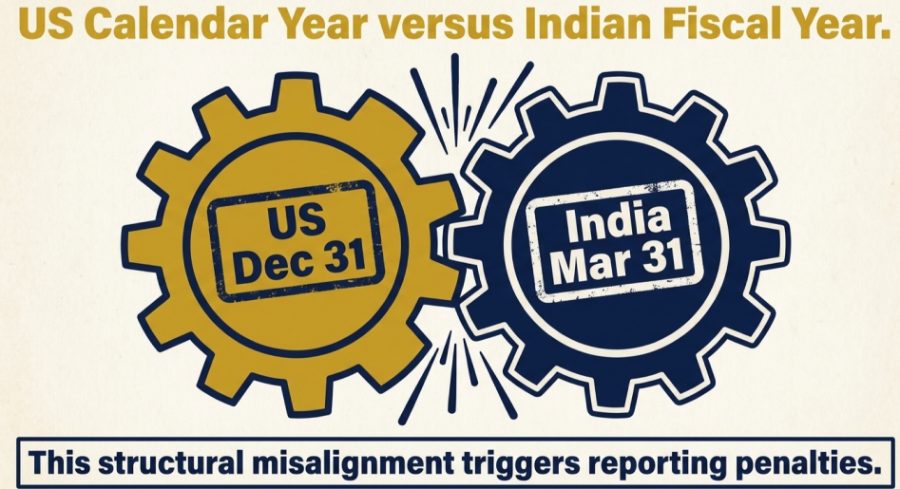
A precise reading of residency, sourcing, equity compensation and asset disclosure is not optional refinement. It is the difference between a reconciliation letter and a strict-liability penalty proceeding.
Residency: three tests, in sequence
Residency is decided jurisdiction by jurisdiction before any treaty is opened. The United States applies its own statutory day-count; India applies Section 6(1) of the Income-tax Act, 1961; only where both answer “resident” does Article 4(2) of the India–US Double Taxation Avoidance Agreement break the tie. Select a test to read it.

The Substantial Presence Test
The Internal Revenue Service classifies foreign nationals as either resident aliens, taxed on worldwide income, or nonresident aliens, taxed only on US-source income. H-1B holders — unlike F-1 students or J-1 scholars — are never “exempt individuals”: every day of physical presence counts from the first date of arrival.
The test is satisfied where the individual is present for at least 31 days in the current calendar year and accumulates a weighted total of at least 183 days across a three-year lookback — all days of the current year, one-third of the days of the first preceding year, and one-sixth of the days of the second preceding year. Any fraction of a day, including arrival and departure days, counts as a full day. Most H-1B workers meet the test within their first full calendar year of employment.
Two elections modify the outcome in a transition year. The first-year choice permits a dual-status alien present for at least 31 consecutive days in the arrival year to be treated as a resident from the start of that period. Under IRC Section 6013(g), a dual-status individual married to a US citizen or resident alien at year end may elect full-year resident treatment and file jointly — a lower effective rate and a full standard deduction, at the price of reporting worldwide income for the entire year.
Even where the day-count is met, the closer connection exception on Form 8840 can restore nonresident status: presence under 183 days in the current year, a tax home maintained in a foreign country for the whole year, and closer personal and economic ties to that country than to the United States.
Section 6(1), Income-tax Act, 1961
An individual is a tax resident of India in a previous year on satisfying either limb: physical presence in India of 182 days or more in the financial year; or presence of 60 days or more in the financial year together with 365 days or more across the four preceding financial years.
For Indian citizens leaving the country for employment abroad — the newly placed H-1B holder — and for Indian citizens visiting India, the 60-day limb is relaxed to 182 days. This relaxation is what ordinarily preserves non-resident status through a departure year.
A resident must then be tested under Section 6(6) to establish whether the status is Resident and Ordinarily Resident (ROR) or Resident but Not Ordinarily Resident (RNOR). The distinction governs everything that follows: only an ROR is liable to Indian tax on global income and carries mandatory foreign asset disclosure obligations in Schedule FA.
Where both jurisdictions claim you
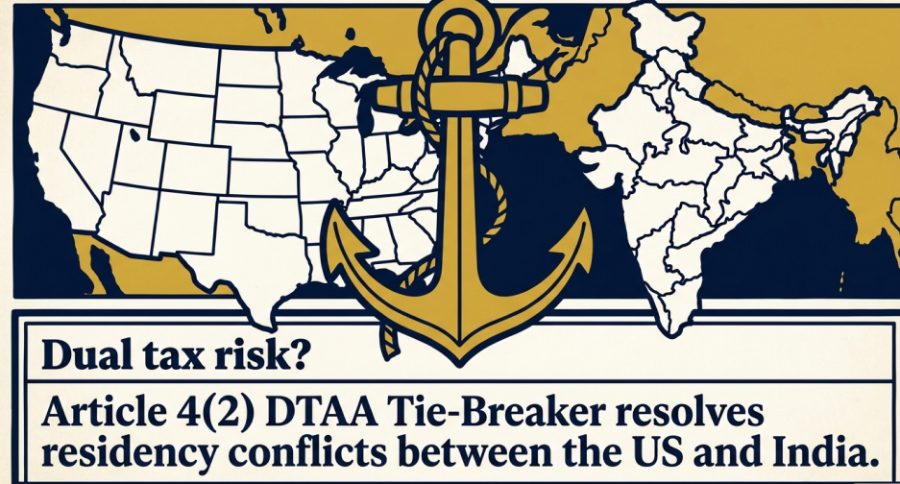
An H-1B holder physically split between both countries in a single year can trigger residence under US domestic law through the Substantial Presence Test and under Indian domestic law through Section 6(1) simultaneously. That conflict is not resolved by choice. It is resolved by the hierarchical tie-breaker in Article 4(2) of the India–US DTAA, applied in strict order and stopping at the first test that yields an answer.
The ladder is set out below. Each rung is fact-intensive, and the Tribunals have decided residency on precisely these facts — where the nuclear family lived, whether commercial involvement was active or passive, and whether the centre of interests had genuinely shifted.
Indian residency for a departing or returning professional, applying Section 6(1) with the relaxation available to an Indian citizen who leaves for employment abroad.
Test further under Section 6(6). An ROR is taxed on global income and must file Schedule FA, FSI and TR; an RNOR is not taxed on foreign income and carries no Schedule FA duty.
Global income in charge → Schedule FA appliesThe 60-day plus 365-day limb does not apply: for an Indian citizen leaving for employment abroad, that threshold is relaxed to 182 days. Only Indian-source income is in charge.
US salary & US share gains outside the chargeThe Article 4(2) tie-breaker ladder
Article 4(2) is applied sequentially. If a rung produces a determinate answer, the enquiry ends there and the individual is a resident of that State for treaty purposes; only an inconclusive rung passes the question downward.
Permanent home
Is a permanent home available to the individual in only one Contracting State? A home available in one State alone decides the matter without more.
Available in one State → resident of that StateCentre of vital interests
Where homes exist in both States, residence follows the State with which personal and economic relations are closer. The Tribunals weigh the residential nucleus of the immediate family and active commercial participation far above passive holdings.
Closer personal & economic ties → that StateHabitual abode
Where vital interests are genuinely balanced, the test becomes where the individual habitually resides — a question of the pattern and frequency of stay rather than a single year’s count.
State of habitual residenceNationality
Only where the preceding rungs remain inconclusive does nationality decide; failing that, the competent authorities settle the question by mutual agreement.
State of citizenshipTreating “more than 182 days abroad” as conclusive. It is not. Where the permanent home, the family and the business control remain in India, the tie-breaker resolves in India’s favour and the entire US salary becomes taxable here.
Three clocks, one return
The Indian return reports income earned in the financial year. Schedule FA, however, requires disclosure of assets held during the calendar year that ends within that financial year. The two windows do not coincide, and the gap is where omissions are manufactured.
Worked consequence. An asset acquired in February 2025 falls in calendar year 2025, which closes inside financial year 2025-26 — so it is disclosed in the return for FY 2025-26 (AY 2026-27). An asset acquired in February 2026 falls in calendar year 2026 and is not reported until the return for FY 2026-27 (AY 2027-28).

Five fixed dates govern a cross-border filing year. Miss the Form 67 point and the Foreign Tax Credit is denied at processing, whatever the merits.
Valuation and conversion protocol
All foreign asset values are converted to Indian Rupees using the Telegraphic Transfer Buying Rate (TTBR) of the State Bank of India, taken on three distinct dates: the date of investment or acquisition for initial value; the date on which the account or asset reached its highest balance during the calendar year for peak value; and the last day of the foreign accounting period, ordinarily 31 December, for closing value. Using a single average rate across all three is one of the most common grounds on which a departmental valuation is later successfully challenged — and equally, one of the most common self-inflicted errors.
Heads of income and dual-taxation dynamics
Income must be segmented head by head and analysed in both jurisdictions. Both systems source employment income to the place where the services are physically rendered — Section 861(a)(3) of the Internal Revenue Code for the United States, and Section 9(1)(ii) of the Income-tax Act, 1961 for India.
Dependent personal services
Article 15(1) taxes employment income only in the State of residence unless the employment is exercised in the other State, in which case that other State retains primary taxing rights. Article 15(2) returns exclusive taxing rights to the State of residence only where all three conditions hold together: presence in the other State not exceeding 183 days in aggregate in the taxable year, remuneration paid by or on behalf of an employer who is not a resident of that other State, and remuneration not borne by a permanent establishment or fixed base there.
Working from India for a US employer
On repatriation, continued remote service for a US employer requires Form W-8BEN to be furnished to that employer to prevent mandatory 30% US withholding. Because the services are physically rendered in India, the salary accrues in India under Section 9(1)(ii) and is taxed at Indian rates. Under CBDT Circular No. 13/2017, mere remittance of foreign-earned salary into an NRE or NRO account does not itself create Indian taxability, provided the right to receive it arose and vested outside India.
Indian mutual funds are PFICs
For an H-1B holder who is a US tax resident, an Indian mutual fund is a Passive Foreign Investment Company. Distributions attract punitive treatment — taxation up to the maximum ordinary income tier of 37% plus deferred interest charges on excess distributions — unless a timely Mark-to-Market or Qualified Electing Fund election is made on IRS Form 8621. This is the single most frequently overlooked item in an otherwise well-managed portfolio.
Dividends and interest
Passive income is subject to a maximum withholding rate of 15% in the source country under Article 10 for dividends and Article 11 for interest. The residence country retains primary taxing rights but must grant a Foreign Tax Credit for tax paid at source. NRE interest remains exempt in India; NRO interest is fully taxable and ordinarily suffers 30% withholding, reducible to the treaty rate on production of a Tax Residency Certificate.
Equity compensation taxes twice, in two stages
Restricted Stock Units, Employee Stock Option Plans and Employee Stock Purchase Plans are core components of technology compensation and the most litigated item in cross-border assessments. They trigger a two-stage charge in both jurisdictions.
Vesting or exercise — taxed as salary
The fair market value of the shares on the vesting date, less any price paid, is ordinary salary income — perquisite value. In India it suffers TDS under Section 192, valued on the vesting-date FMV; for foreign unlisted parent shares the valuation must be supported by a category-I merchant banker or equivalent (for instance a 409A valuation).
In the United States, the employer withholds federal and state tax, commonly by sell-to-cover, together with FICA at 6.2% Social Security up to the wage base and 1.45% Medicare.
Disposition — taxed as capital gains
On sale, the difference between sale proceeds and the acquisition cost — the FMV already taxed at vesting — is capital gains. Foreign company shares are treated as unlisted securities in India and therefore do not get the 12-month concessional holding period of Indian listed equity.
Under the Finance (No. 2) Act, 2024, the qualifying long-term holding period is 24 months; short-term gains are taxed at slab rates up to 30% plus surcharge and cess, and long-term gains at a flat 12.5%, indexation having been abolished for transfers on or after 23 July 2024.
Foreign company shares are unlisted securities in India. They wait twice as long for long-term treatment and, sold early, are taxed at slab rates rather than a concessional flat rate.
The perquisite value in Form 16 is computed on the vesting-date SBI TTBR. A broker statement converted at a year-average rate will never match it — and the mismatch is exactly what a Section 143(1)(a) notice is generated to flag.
Mandatory disclosures on both sides
Failure to file the mandatory international asset and income disclosures is the most common trigger for audit and penalty in both countries. A US person — which includes an H-1B holder meeting the Substantial Presence Test — holding a financial interest in, or signature authority over, foreign financial accounts carries two parallel obligations; a returning ROR carries four Indian schedules. Open a card for the detail.
FBAR — FinCEN Form 114
Filed with the Financial Crimes Enforcement Network through the BSA E-Filing System, independently of Form 1040. Triggered where the aggregate value of foreign financial accounts exceeds $10,000 at any point in the calendar year.
Tap for penalty exposureCovers foreign bank accounts, custodial accounts, mutual funds, foreign brokerage and cash-value insurance, and foreign pension plans. Penalties run from $10,000 for a non-wilful failure to 50% of the account balance per year for a wilful one.
FATCA — IRS Form 8938
Attached directly to Form 1040. Thresholds vary by filing status and residency — for a single filer resident in the United States, value exceeding $50,000 on the last day of the tax year or $75,000 at any point during it.
Tap for scopeCovers foreign financial accounts, directly held foreign stock, foreign partnership interests, foreign trusts and foreign contracts — a wider asset class than FBAR, which it does not replace. Both filings are ordinarily required, on the same underlying assets, to different agencies.
The four Indian schedules
Schedule FA
Schedule FSI
Schedule TR
Schedule AL
Foreign Tax Credit: Rule 128 and Form 67
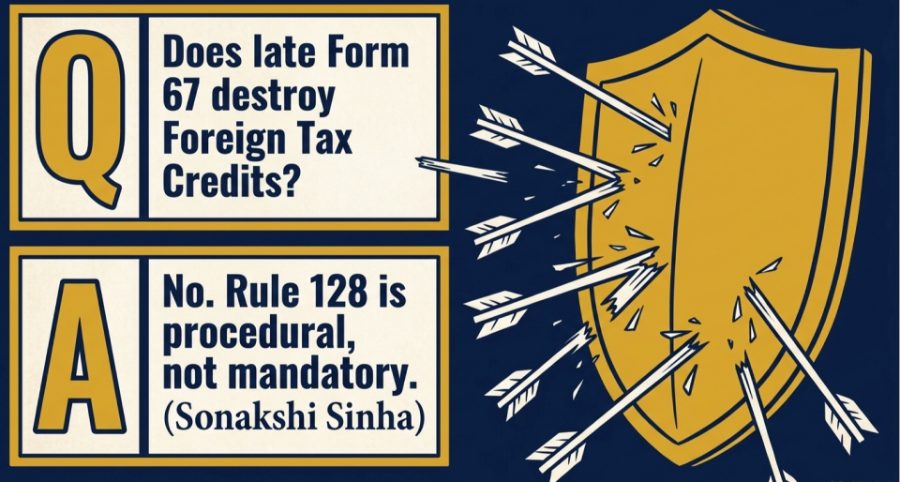
Relief from double taxation is claimed under Section 90 where a treaty applies, or Section 91 unilaterally where none does. Under Rule 128 of the Income-tax Rules, 1962, the claim must be supported by Form 67 together with proof of foreign tax payment such as an IRS transcript or Form W-2. Following the Income-tax (Twenty-seventh Amendment) Rules, 2022, Form 67 must be furnished on or before the end of the assessment year relevant to the previous year in which the foreign income is offered to tax, provided the return itself is filed within Section 139(1) or 139(4).
Which notice actually arrives
Indian assessment is now largely automated. The Annual Information Statement and Taxpayer Information Summary are matched against the filed return, and a variance generates a notice without human review. The distribution below reflects where cross-border filers are most exposed — heavily weighted to the automated end, where the cause is almost always a reconciliation failure rather than a dispute on law.
Indicative distribution across notice types, by frequency of occurrence rather than by severity. The rarest notice carries the gravest consequence.
Trigger: variance between salary or perquisite in Form 16 and Form 12BA and the return’s salary schedules — almost always TTBR conversion or split-year apportionment. Answer: a date-by-date reconciliation schedule; rectification under Section 154 where warranted.
Trigger: incomplete schedules, missing Form 67, or self-assessment tax unpaid at filing. Answer: respond within 15 days under E-Proceedings, supplying the missing schedule or paying the shortfall.
Trigger: particulars called for on foreign accounts, remittances or equity holdings. Answer: answer narrowly and on the record — broker statements, TTBR tables, W-2 and IRS transcript.
Trigger: FATCA or CRS data showing foreign assets absent from Schedule FA, or high-value remittances without declared income. Answer: jurisdiction first — assessment year, limitation, recorded reason to believe — before any explanation of facts.
Controlling precedent
Residency under Article 4(2), the directory character of Rule 128, and the discretionary character of the Black Money Act penalties have all been settled by reasoned Tribunal and High Court authority. These are the decisions on which a defence is built.
Ashok Kumar Pandey v. ACIT
ITAT Mumbai, 2023Though the taxpayer held substantial passive financial investments in the United States, his active commercial involvements, the management of Indian assets and the residential nucleus of his immediate family were located in India.
The Tribunal held that a nuclear family connection carries greater evidentiary weight than extended family, and that active commercial participation outbalances passive investment. The tie-breaker resolved in favour of Indian residency, rendering the US-source income taxable in India.

DCIT v. Shri Kumar Sanjeev Ranjan
ITAT Bangalore, 2019The taxpayer relocated to India on assignment but retained a permanent home, a driver’s licence and voting rights in the United States, where the spouse and children remained.
Personal and economic relations were held to be long-term, continuous relationships that cannot be fragmented year by year. The presence of the nuclear family in the United States established that the centre of vital interests remained there, and treaty-based non-resident status in India was granted under Article 16.
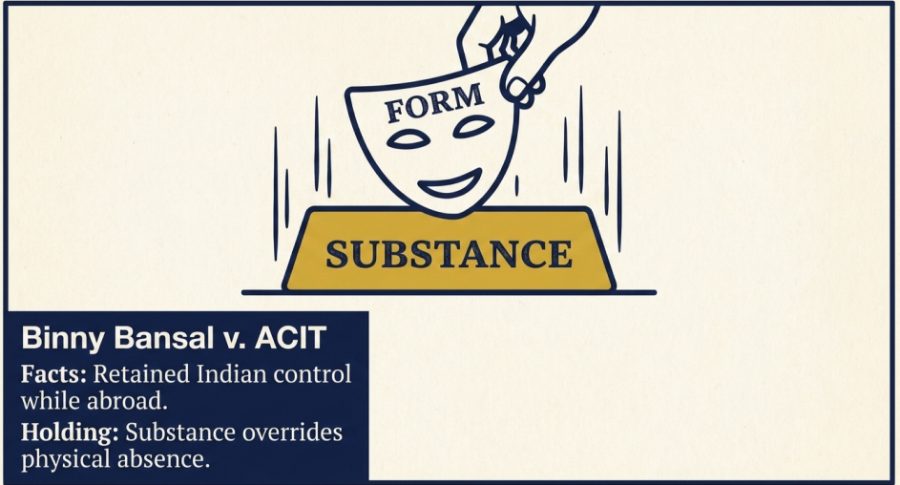
Binny Bansal v. ACIT
ITAT Bangalore, 2026Establishing residency in an overseas jurisdiction requires proof that the actual centre of personal and economic interests has legitimately shifted.
Substantial real estate holdings and retained business control in India, despite physical residence abroad for more than 182 days, resulted in the taxpayer being tie-broken as an Indian resident under Article 4 of the applicable treaty.
Sonakshi Sinha v. CIT & Anuj Bhagwati v. DCIT
ITAT Mumbai, 2022Section 90 confers a substantive right to treaty relief from double taxation; a procedural rule such as Rule 128 cannot override the substantive provisions of the Act or of the treaty.
Foreign Tax Credit was therefore allowed notwithstanding that Form 67 had not been filed by the due date of the return. Reported at Indian Kanoon in the line of cases following this reasoning.
Nirmala Murli Relwani v. ADIT
ITAT Mumbai, 2022Rule 128(9) prescribes a preferred procedure but attaches no negative or punitive consequence to non-compliance — it nowhere states that credit shall be denied on late filing.
Belated filing of Form 67 during assessment or rectification proceedings is accordingly valid and must be accepted.
Duriaswamy Kumaraswamy v. ITO
Madras High Court, 2022Filing Form 67 is directory. Denying Foreign Tax Credit for a procedural delay offends Article 265 of the Constitution of India, which forbids the collection of tax without authority of law.
The decision supplies the constitutional footing for the Tribunal line above and is the strongest single authority in a rectification petition.
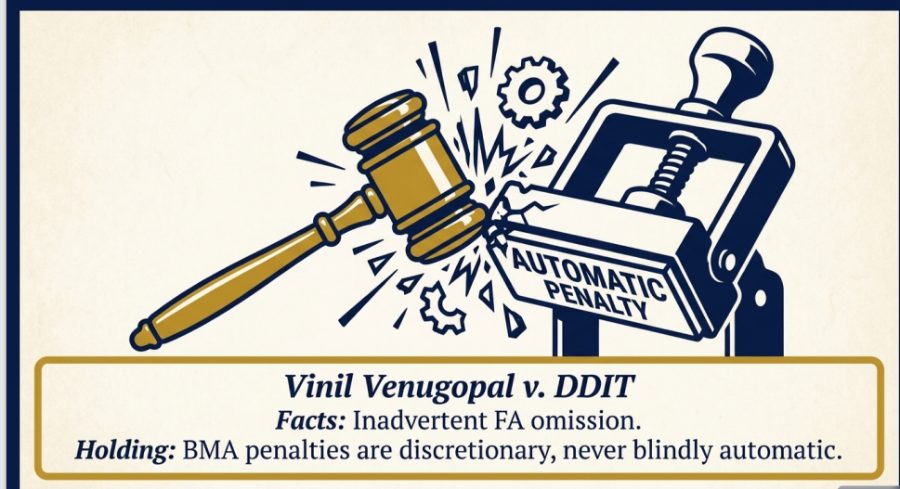
Vinil Venugopal v. DDIT (Inv.)
ITAT Mumbai, Special Bench, 2025Section 43 of the Black Money Act provides that the Assessing Officer “may direct” payment of penalty. The legislative choice of “may” makes imposition discretionary, not automatic.
Section 46(3) requires an opportunity of being heard before any penalty order; were the penalty automatic, that requirement would be redundant. Where the omission is a bona fide, inadvertent oversight with no underlying undisclosed income and no intent to evade, the Officer must exercise discretion judicially and decline to impose the ₹10 Lakh penalty.
Tejal Ashish Mehta v. Addl. CIT
ITAT Mumbai, 2022A surrendered foreign life insurance policy was not disclosed in Schedule FA, but the entire surrender receipt had been declared as income in the body of the return.
The Tribunal deleted the Section 43 penalty: the taxpayer held a bona fide belief that a surrendered policy was no longer an asset, and full income disclosure constituted reasonable cause.
Ocean Diving Centre Ltd. v. CIT
ITAT Mumbai, 2023Schedule FA was left unfilled, but the investments in foreign subsidiaries stood disclosed in the audited balance sheet and Schedule A-BS of the return.
Because the particulars were readily accessible within the return itself, there was no intent to conceal; the discretion under Section 43 had to be exercised reasonably and the penalty was deleted.
Krishna Das Agarwal v. DDIT
ITAT Jaipur, 2022Penalty was sought on an individual for assets held by a UAE-registered entity in which he held an interest.
The entity was a distinct legal persona and the investments belonged to it, not to the individual. Not qualifying as beneficial owner under Section 2(11), the non-disclosure penalty was deleted.
Vikas Marda v. ACIT
ITAT Kolkata, 2024A reassessment notice citing the wrong assessment year is a fatal jurisdictional defect.
It is not curable by the saving provisions of Section 292B of the Income-tax Act, nor by Section 81 of the Black Money Act. This is the first point to verify on any notice received.
The Black Money Act exposure, quantified
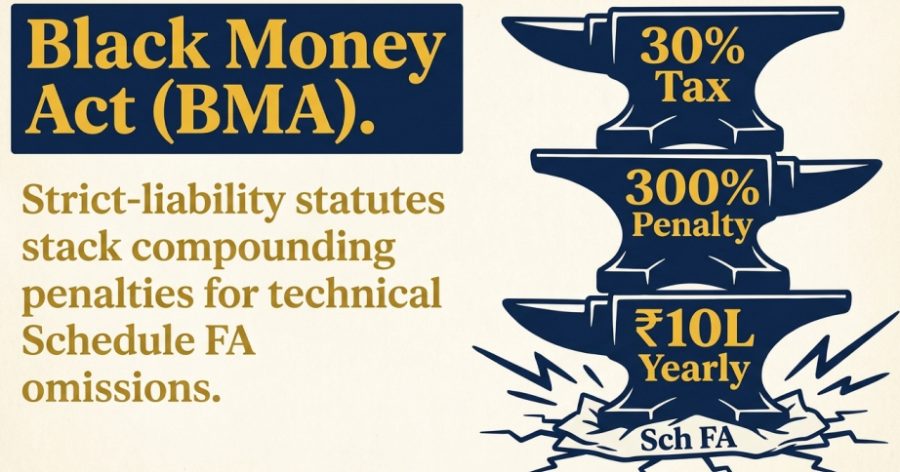
The Black Money (Undisclosed Foreign Income and Assets) and Imposition of Tax Act, 2015 is a strict-liability statute. Unlike the Income-tax Act, it draws no distinction between avoidance and evasion, and imposes penalties even for inadvertent or purely technical omissions in Schedule FA. The statutory text is available on India Code.
Section 3 & 10 — assessment
Section 41 — penalty
Section 42 — non-filing
Section 43 — misdisclosure
On the left, a single asset assessed under Sections 10 and 41. On the right, the same ₹10 Lakh Section 43 penalty applied year on year for an omission that was never corrected.
Penalties stack per year, not per asset. Undisclosed foreign shares held for five years and omitted from Schedule FA in each of them attract five separate Section 43 penalties — ₹50 Lakh — entirely independent of any tax or valuation-based penalty under Sections 3 and 41. Criminal prosecution under Sections 49 and 50, carrying rigorous imprisonment of three to ten years, runs as a parallel track.
Statutory reliefs that genuinely apply
₹5 Lakh, bank accounts only
No penalty falls under Sections 42 or 43 where the undisclosed foreign asset consists strictly of one or more bank accounts and the aggregate balance of all such accounts did not exceed ₹5 Lakh at any point during the previous year. The exemption is confined to bank accounts: it does not extend to securities, unlisted shares, RSUs or immovable property.
The ₹20 Lakh rationalisation
To protect genuine taxpayers from disproportionate consequences for inadvertent error, the Finance Act, 2024 raised the exemption threshold for assets other than immovable property. For returns filed on or after the effective date, the Assessing Officer shall not impose the ₹10 Lakh penalty under Section 42 or 43 where the aggregate value of the undisclosed foreign assets, excluding real estate, does not exceed ₹20 Lakh during the year.
What ITR-U does not cure
An Updated Return may be filed within 24 months of the end of the relevant assessment year on payment of additional tax of 25% to 50%. It is not an amnesty. Filing ITR-U to report omitted foreign income does not regularise a historical Schedule FA omission; the disclosure requirement remains absolute and the ₹10 Lakh exposure under Section 43 survives.
When ITR-U closes
ITR-U cannot be filed at all where a search under Section 132 or survey under Section 133A has been initiated; where assessment, reassessment or revision proceedings are pending or completed; or where the department has received information under FATCA, CRS or another international agreement and has acted on or notified it. Once the data enters the AIS risk engine, the window for voluntary compliance has closed.
On receiving a notice: the four-step protocol
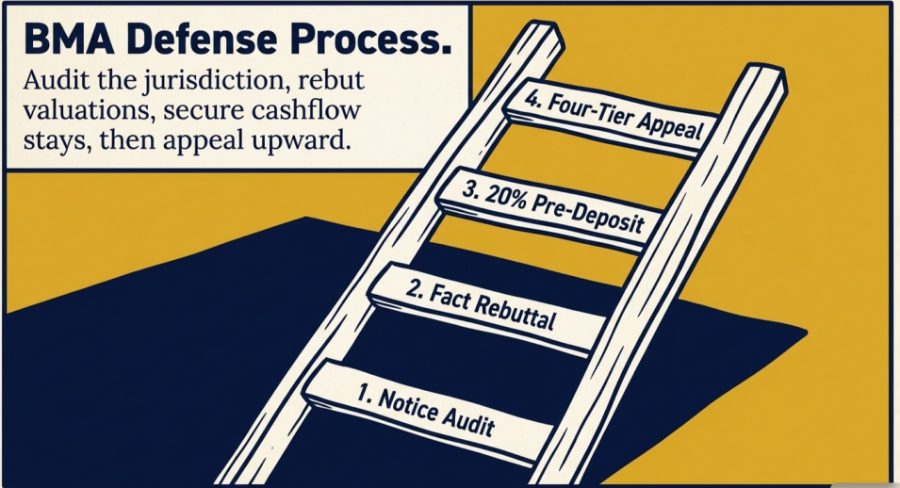
A show-cause notice under Section 46 of the Black Money Act, or a reassessment notice under Section 148 of the Income-tax Act, must be met in a fixed order. Jurisdiction is examined before facts, facts before valuation, and cash flow is protected before the appeal is argued. Open a step for the detail.
Measured from the end of the relevant assessment year. Step one of the protocol below is checking the notice against this scale — a notice outside it is not merely weak, it is void.
No Section 148 notice may issue beyond three years from the end of the relevant assessment year.
The outer limit opens to ten years only where the income escaping assessment exceeds ₹50 Lakh — a threshold the department must establish, not assume.
Under Section 81 of the Black Money Act, formal or typographical defects — a misspelt name or address — do not invalidate an assessment where the notice is in substance and intent aligned with the statute. Three defects are, however, incurable.
Wrong assessment year. A fatal jurisdictional defect, not saved by Section 292B of the Income-tax Act or Section 81 of the Black Money Act, on the standard laid down in Vikas Marda.
Time-bar violation. An assessment or penalty order passed after the limits in Section 11 of the Black Money Act have expired. Under the reassessment framework, a Section 148 notice cannot issue after three years from the end of the relevant assessment year unless the income escaping assessment exceeds ₹50 Lakh, in which case the outer limit is ten years.
Absence of record. Failure by the Assessing Officer to record the mandatory “reason to believe”, on tangible and fresh information, before issuing the Section 10 or Section 148 notice.
Challenge the valuation methodology before conceding the asset. Under Section 5 of the Black Money Act, contest the valuation date adopted and the market rate applied to it.
Then contest conversion. Rupee values must rest on the SBI Telegraphic Transfer Buying Rate on the exact date of investment, of peak balance and of the close of the foreign accounting period — not on an arbitrary or averaged rate. Where the department has averaged, the computed liability is wrong on its own arithmetic.
For a Section 143(1)(a) mismatch, the rebuttal is a reconciliation: a schedule showing how vesting-date TTBR conversion, or dual-status split-year apportionment, accounts for every rupee of the variance between Form 16 or Form 12BA and the salary schedules of the return.
An assessment order under the Black Money Act triggers immediate recovery of 30% tax and 300% penalty. A stay is not a formality; it is the difference between litigating and settling.
Before the CIT(A). A 20% pre-deposit of the demand is the ordinary administrative expectation, but the Commissioner or the Assessing Officer may waive or reduce it on genuine financial hardship. A stay application must therefore be supported by financial statements and liability schedules that prove hardship rather than assert it.
Before the ITAT. The Tribunal may grant an initial stay for up to 180 days, extendable to a maximum of 365 days, on a strong prima facie case.
Commissioner of Income Tax (Appeals) — under Section 15 of the Black Money Act, within 30 days of the demand notice. This is the critical stage for introducing fresh factual evidence under Section 16.
Income Tax Appellate Tribunal — under Section 17, within 60 days of the CIT(A) order. The Tribunal is the final fact-finding authority; a fact not established here is generally lost.
High Court — under Section 19, within 120 days of the ITAT order, and only on a substantial question of law.
Supreme Court of India — by Special Leave Petition under Article 136 of the Constitution, within 90 days of the High Court judgment.
Practice guidelines
The compliance posture that survives an AIS-driven enquiry is built before the notice, not after it. Switch between what to do and what to stop doing.
Run a multi-jurisdictional tax health check every year. Cross-reference historical Schedule FA entries against the FATCA and CRS data already visible in your AIS and TIS profiles, and rectify before the department issues a notice.
Maintain an equity dossier for every grant. Grant letters, vesting schedules, foreign broker statements, cash-settlement reports, SBI TTBR conversion tables and proof of withholding — the documents that reconcile perquisite value and capital gains under audit.
Align calendar to fiscal deliberately. Report assets in Schedule FA on the January–December window and the associated income and gains on the April–March year, and keep the working papers that show the bridge.
File Form 67 before the return, every time. Where a delay has already occurred, file it during assessment or rectification and rely on Sonakshi Sinha and Nirmala Murli Relwani for its directory character.
Plead discretion, not merely innocence, against a BMA penalty. Build on the Special Bench in Vinil Venugopal that “may” confers discretion, and pair it with evidence of full income disclosure in the primary schedules.
Don’t treat 182 days abroad as the end of the enquiry. Where the permanent home, the family and business control remain in India, the Article 4(2) tie-breaker can still make you an Indian resident on global income.
Don’t convert broker statements at an average annual rate. Schedule FA and perquisite valuation both demand date-specific SBI TTBR. An averaged figure guarantees a mismatch notice.
Don’t assume ITR-U regularises a Schedule FA omission. It does not, and it becomes unavailable altogether once FATCA or CRS data has been received and acted upon.
Don’t hold Indian mutual funds unexamined while a US tax resident. They are PFICs. Without a timely Form 8621 election the US charge can reach the top ordinary rate plus deferred interest.
Don’t leave a closed account or surrendered policy out of Schedule FA. An asset held for a single day in the calendar year is reportable, and the omission is penalised per year of omission.
Where cases are actually lost
Form 67 filed after the return
The most frequent single cause of an instant Foreign Tax Credit denial and a consequential demand. The jurisprudence will usually recover the credit, but only after an appeal that was entirely avoidable.
Vested RSUs omitted from Schedule FA Table A3
Vested foreign equity is a reportable foreign asset from the vesting date, whether or not it has been sold and whether or not it has moved out of the employer’s broker account.
Applying the 12-month holding period to US shares
Foreign company shares are unlisted securities in India. The long-term threshold is 24 months, and indexation is unavailable for transfers on or after 23 July 2024.
Filing FBAR and treating Form 8938 as satisfied
They are separate obligations to separate agencies, with different thresholds and a different asset universe. Both are ordinarily required on the same underlying holdings.
Responding to a notice on facts before checking jurisdiction
Once the assessment year, the limitation period and the recorded reason to believe are conceded by silence, an incurable defect that would have ended the proceeding is very hard to revive.
Cross-border tax notices, argued properly
Patra’s Law Chambers advises H-1B professionals, returning NRIs and their families on residency determination and treaty tie-breaker positions, Schedule FA and Schedule FSI disclosure, Foreign Tax Credit claims and Form 67 rectifications, RSU and ESPP reconciliation against Form 16, and the defence of Section 143(1)(a), Section 148 and Black Money Act Section 42 and 43 proceedings before the Assessing Officer, the CIT(A), the Income Tax Appellate Tribunal and the Calcutta High Court.
If a notice has already issued, the limitation clock is running. Bring the notice, the return, the AIS and TIS extracts and the broker statements to the first consultation.
Established by a distinguished alumnus of IIT Kharagpur, Patra’s Law Chambers stands as a beacon of legal expertise in Kolkata & Delhi. Know more →

Patra’s Law Chambers, NICCO HOUSE, 6th Floor, 2 Hare Street, Kolkata – 700001. Near the Calcutta High Court.
Patra’s Law Chambers, House No. 4455/5, First Floor, Gali Shahid Bhagat Singh, Main Bazar Road, Paharganj, New Delhi – 110055.
Frequently asked
If you are a non-resident under Section 6(1), only income accruing or arising in India is taxable, and a return is required where that Indian income exceeds the basic exemption or where you wish to claim a refund of tax deducted at source — typically on NRO interest, Indian rent or Indian capital gains. Your US salary and gains on US shares are outside the Indian charge for that year, and Schedule FA does not apply to a non-resident.
Act before the department does. Compare each year’s Schedule FA against your AIS and TIS and against the broker records, and quantify the exposure. Where the aggregate value of non-immovable foreign assets stayed within ₹20 Lakh, the Finance Act, 2024 threshold may bar the penalty outright. Where it did not, the defence rests on the discretion recognised in Vinil Venugopal and on evidence that the underlying income was fully disclosed in the primary schedules, as in Tejal Ashish Mehta. Note that ITR-U will not by itself cure the Schedule FA omission.
Yes, on established authority. Rule 128 is procedural and directory: it prescribes a preferred procedure but attaches no consequence of denial. Sonakshi Sinha, Anuj Bhagwati and Nirmala Murli Relwani allowed credit on belated filing, and the Madras High Court in Duriaswamy Kumaraswamy held that denial for procedural delay offends Article 265 of the Constitution. Form 67 may be filed during assessment or rectification proceedings.
In two stages. At vesting, the fair market value less any amount paid is perquisite salary, subject to TDS under Section 192 and valued on the vesting-date SBI TTBR. On sale, the gain over that already-taxed value is capital gains — long-term only after 24 months, taxed at a flat 12.5% without indexation for transfers on or after 23 July 2024, and otherwise at slab rates. The holding is also reportable in Schedule FA Table A3 from the year of vesting.
No, not by reason of the remittance. Under CBDT Circular No. 13/2017, mere receipt of foreign-earned salary in an NRE or NRO account does not create Indian taxability, provided the right to receive the salary arose and vested outside India. Taxability turns on where the services were rendered and on your residential status, not on where the money landed.
Jurisdiction, before any explanation of facts. Verify the assessment year cited — a wrong year is a fatal defect on the standard in Vikas Marda and is not saved by Section 292B. Then verify limitation: no notice beyond three years from the end of the relevant assessment year unless the escaped income exceeds ₹50 Lakh, where the outer limit is ten years. Then verify that a recorded “reason to believe”, resting on tangible fresh information, exists on the file.
They are Passive Foreign Investment Companies under IRC Sections 1291 to 1298. Without a timely Mark-to-Market or Qualified Electing Fund election on IRS Form 8621, distributions and disposals can be taxed at the maximum ordinary income tier of 37% together with deferred interest charges on excess distributions. Review the holdings before the first US filing rather than after it.
No. The Special Bench of the Mumbai ITAT in Vinil Venugopal (2025) held that Section 43 says the Assessing Officer “may direct” payment — making imposition discretionary. Section 46(3) requires an opportunity of being heard, which would be redundant if the penalty were automatic. For a bona fide, inadvertent omission with no undisclosed income and no intent to evade, that discretion must be exercised in the taxpayer’s favour.
This page is general legal information on Indian and United States tax law and is not advice on any particular set of facts. Statutory thresholds, rates and limitation periods change; positions turn on documents and dates. Obtain advice on your own record before filing or replying to a notice.
Creditor and contributor: © Patra’s Law Chambers © 2026
Patra’s Law Chambers is a litigation law firm in Kolkata and Delhi handling all kinds of Supreme Court and High Court matters, including civil, criminal, banking, service, taxation, import-export, property, and inheritance matters.