Adverse Remarks in APAR Blocking Your Promotion? Know Your Legal Remedy
An adverse entry or a low grading in your APAR/ACR can quietly stop a promotion. The law requires such remarks to be communicated, lets you represent against them, and allows a challenge before the Central Administrative Tribunal in the right case. This guide explains each step in plain English.
Adverse Remarks in APAR: What They Mean and What You Can Do
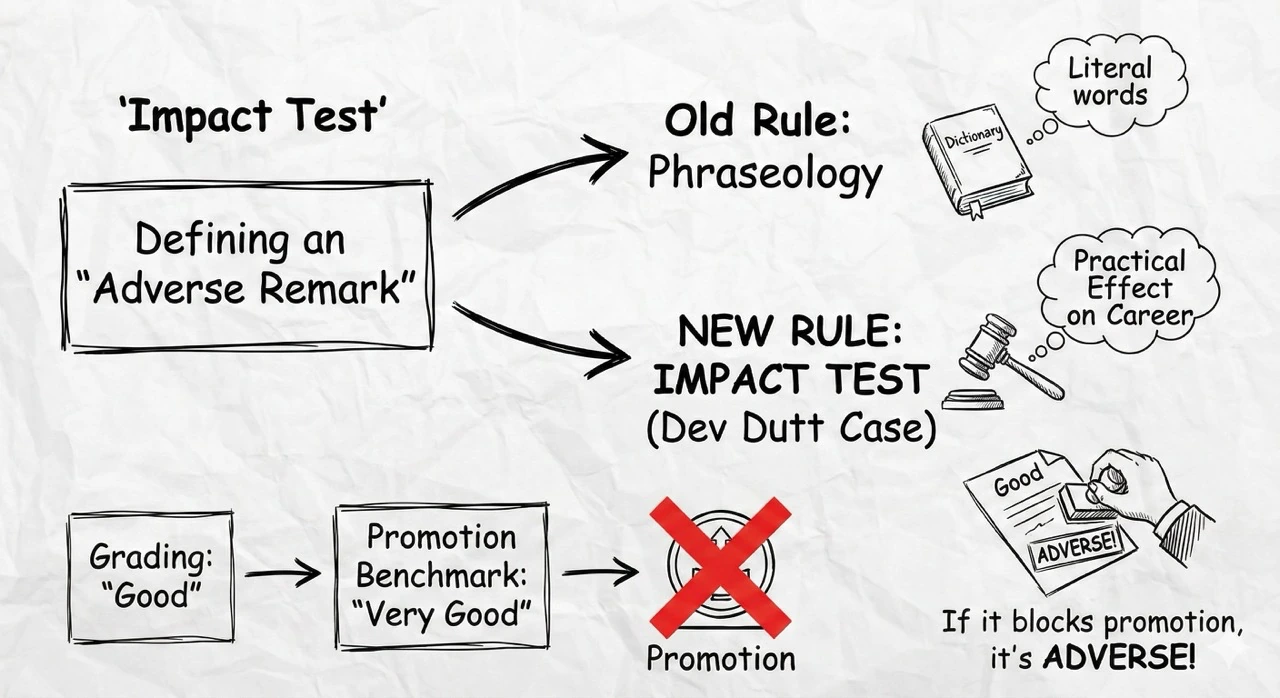
Annual Performance Appraisal Reports (APAR, earlier called Annual Confidential Reports or ACR) decide whether a government employee is considered fit for promotion, confirmation and retention. An adverse remark is not only a harsh comment. Under the Supreme Court’s impact test in Dev Dutt v Union of India, (2008) 8 SCC 725, even a grading such as “good” is adverse if the promotion benchmark is “very good”. Service rules and instructions are issued by the Department of Personnel and Training; always read the rules that govern your own service.
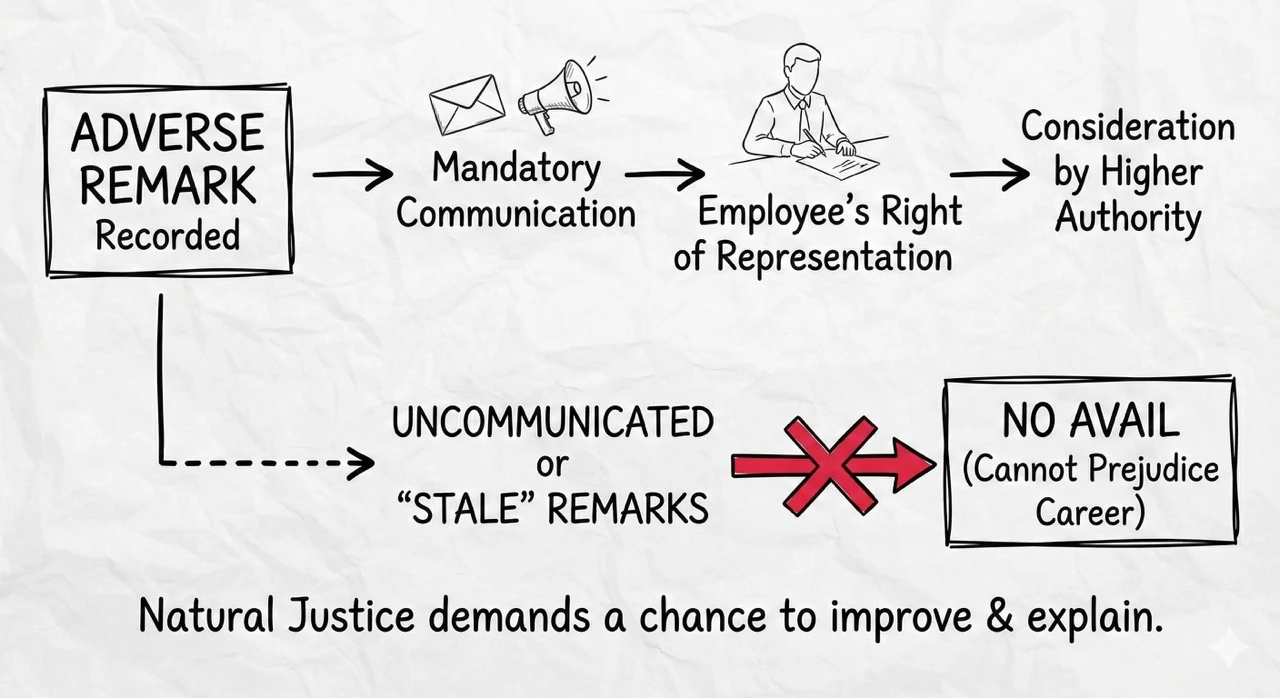
If a remark is recorded, it must be communicated to you so that you can make a representation, which must be decided by an authority higher than the one who wrote it. An uncommunicated remark cannot be used to deny you promotion. If the representation fails or is ignored, you may approach the Tribunal with the help of a service matters advocate in Kolkata. You may also read our guides on how to challenge promotion denial and seniority disputes.
The tribunal clock for an APAR challenge
Section 20 and Section 21 of the Administrative Tribunals Act, 1985 set the periods for central employees. Verify the dates for your own case.
Short explainers from Adv. Sudip Patra
More short explainers on our YouTube channel: Patra’s Law Chambers on YouTube ↗
What has happened with your APAR so far?
Pick the line that matches your latest position. This is general information on the usual route, not advice on your file.
Choose one of the options above.
From adverse entry to tribunal: the usual path
The order below is the common sequence in central service. State services follow their own rules, so verify those first.
The reporting and reviewing officers record the APAR. An adverse remark, or an entry that falls below the promotion benchmark, must be communicated to you so that you can respond.
File a written representation with facts, supporting records and a request for expunction. The authority deciding it must be higher than the one who made the entry, as explained in Dev Dutt.
The order should give reasons. If it is rejected without reasons, or not decided at all, this becomes the ground for the next step. A service law advocate can read the order against your rules.
An RTI application can show the file status and the DPC grading that blocked you. If the entry is expunged, ask for a review DPC to reconsider your promotion.
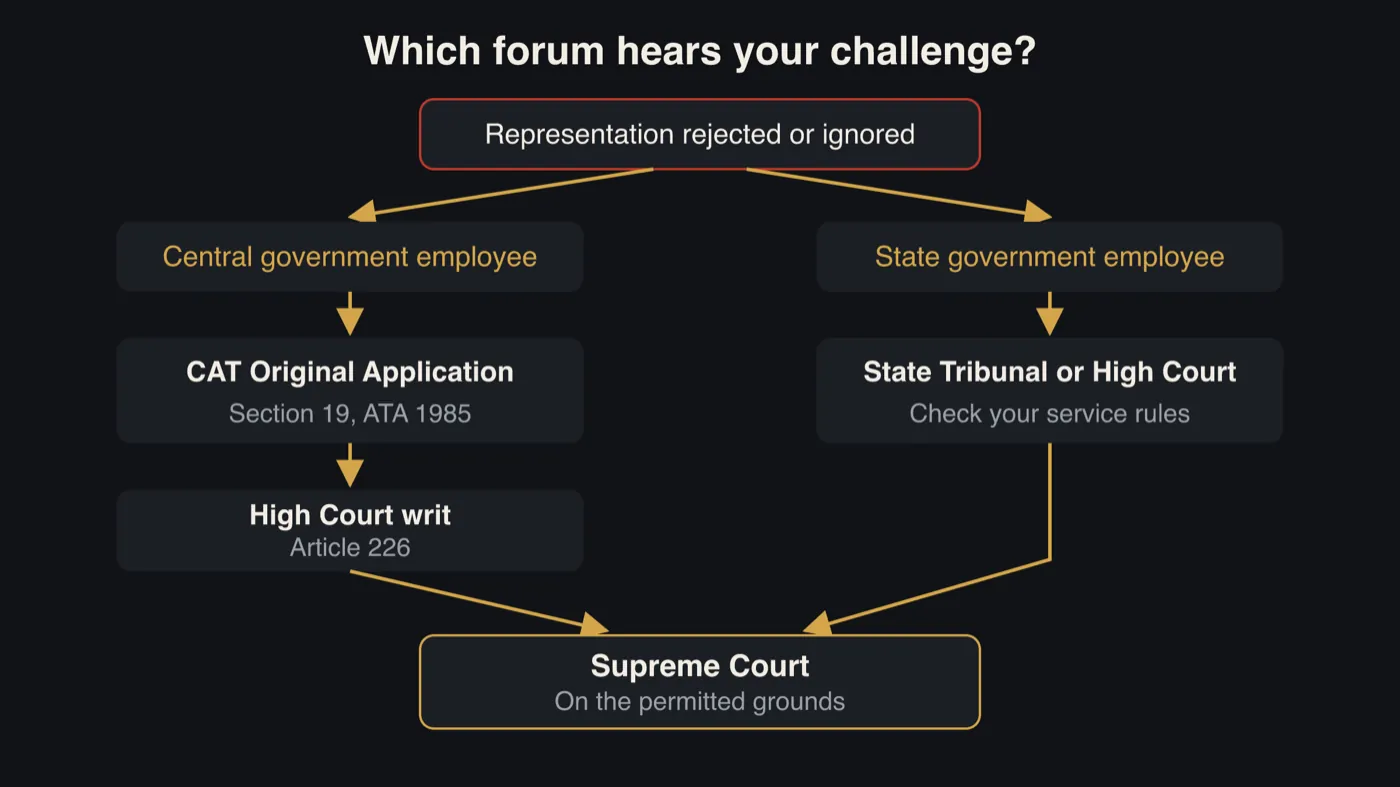
Central employees approach the CAT, and state employees the State Tribunal or the High Court. See the Calcutta High Court page for writ options.
A final order of the tribunal or High Court can be taken further to the Supreme Court on the permitted grounds.
Four ideas behind every APAR dispute: tap a card
The label on the entry matters less than its effect. If “good” keeps you out of a “very good” benchmark, it works as an adverse remark (Dev Dutt v Union of India).
An uncommunicated adverse entry cannot be used to deny promotion (Gurdial Singh Fijji v State of Punjab). Communication lets you improve or explain.
Remarks communicated after several years defeat the very purpose of communication. The Supreme Court in Baidyanath Mahapatra held that such entries cannot be relied on to your prejudice.
Where an APAR Dispute Can Take You
Representation Against Adverse Remarks
After the remark is communicated, you can make a written representation within the time your service rules allow. It must be considered by a higher authority, and the grounds, such as bias, no basis or procedural lapse, should be stated clearly with supporting records.
Challenge Before the CAT
If the representation is rejected or not decided, the Central Administrative Tribunal can examine arbitrariness, bias, and failure to communicate. Courts rarely substitute their own assessment, but they do intervene for patent illegality or violation of procedure.
Review DPC and Restored Seniority
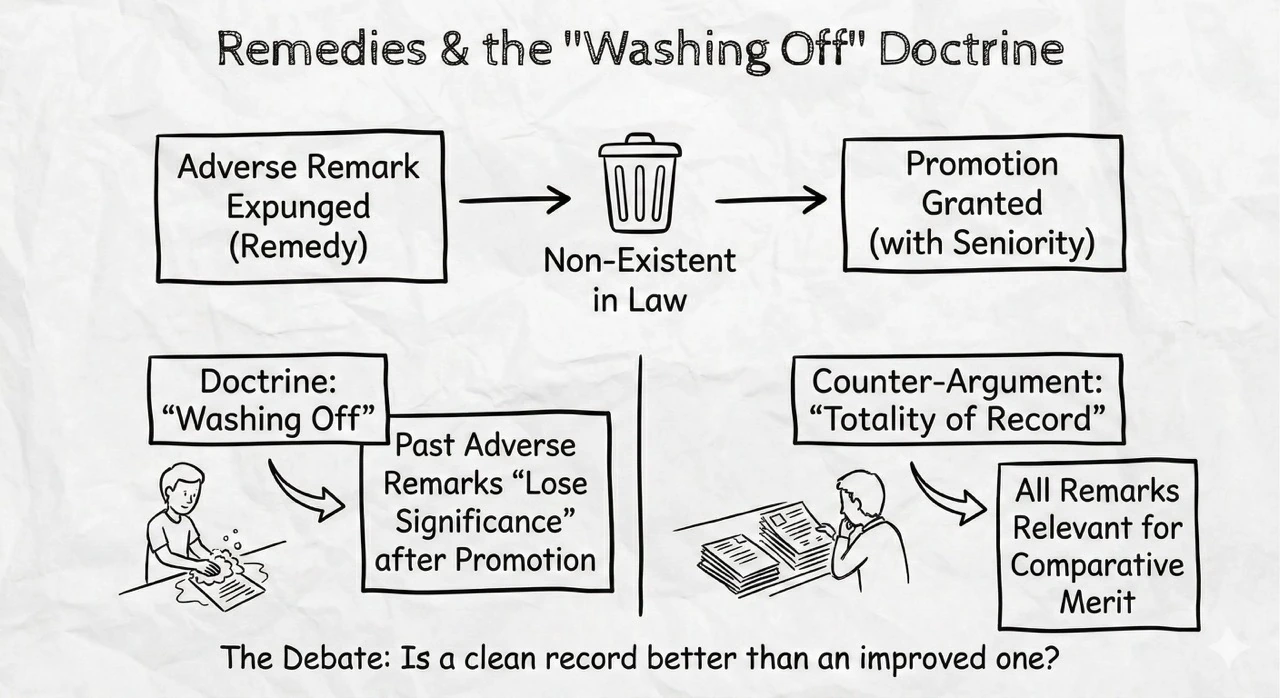
When a remark is expunged, it is treated as non-existent in law. A promotion denied because of it can be reconsidered by a review DPC, and seniority may be restored from the date juniors were promoted, subject to the facts and rules of your case.
Uncommunicated and Stale Entries
Following Gurdial Singh Fijji v State of Punjab and Baidyanath Mahapatra v State of Orissa, uncommunicated or very belatedly communicated remarks cannot be relied on to your prejudice in promotion decisions. Each case depends on its own facts, so verify before acting.
Documents to Keep Ready for an APAR Dispute
- The APAR/ACR entry and the communication letter, with the date you received it
- Your representation and proof of when it was submitted
- Promotion benchmark and DPC proceedings, if obtained through RTI
- Your appointment order, service book and earlier APARs for comparison
- Orders showing juniors promoted over you, if any
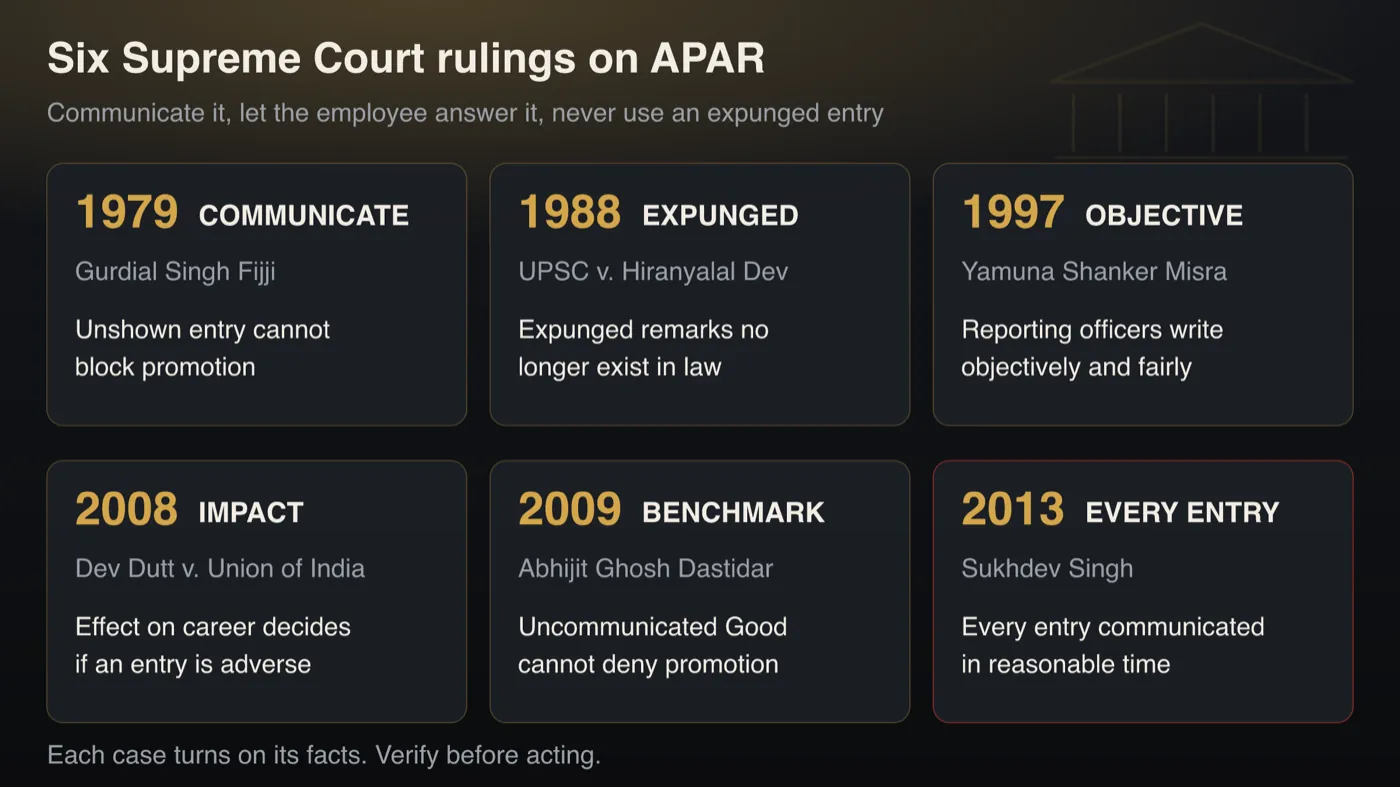
Supreme Court rulings on adverse APAR remarks and promotion
These six Supreme Court decisions set the rules on adverse entries. An entry has to be communicated, the employee has a right to answer it, and an entry that has been expunged cannot be used against them.
1979
An adverse entry not shown to you cannot block promotion
A bench led by Chandrachud CJ held that, under the rules of natural justice, an adverse report in a confidential roll cannot be used to deny promotion unless it has been communicated to the officer. The officer must get a chance to improve or to explain. The Court said this opportunity is not an empty formality: the higher authority must consider the explanation and decide whether the adverse report was justified.
1988
Expunged remarks cannot be used by the selection committee
An Assam Police Service officer was left out of the IPS select list. The Selection Committee had relied on adverse remarks that were later expunged on his representation. The Supreme Court held that it was wrong for the Committee to consider them: once expunged, the remarks no longer exist in law and cannot count against the officer’s selection.
1997
Reporting officers must write objectively and fairly
The Court dismissed the State’s appeal and upheld the quashing of adverse remarks that had held back the officer’s promotion. It said reporting officers carry a serious duty to keep out personal bias and to assess work and conduct objectively, fairly and constructively. Remarks must be communicated, and the officer should first be given a chance to correct any shortcomings.
2008
A below-benchmark entry is adverse in effect
The Supreme Court held that whether an entry is adverse depends on its effect on the career, not on its wording. If promotion needs a Very Good grading, an uncommunicated Good grading effectively shuts the employee out. Not communicating it is arbitrary under Article 14, and the employee must get a chance to make a representation to a higher authority.
2009
An uncommunicated Good grading cannot be held against you
The Court followed Dev Dutt. Where the benchmark for promotion was Very Good, a Good entry that was never communicated could not be used to deny the officer promotion. Tribunals and High Courts often rely on this case to order that such entries be ignored when a review DPC reconsiders promotion.
2013
Every APAR entry must be communicated in reasonable time
A three-judge bench approved Dev Dutt and held that every entry in the annual report (poor, fair, average, good or very good) must be communicated to the employee within a reasonable period. It declared that earlier contrary decisions, such as Satya Narain Shukla and K.M. Mishra, no longer lay down good law.
How to challenge an adverse APAR remark, step by step
Get a full copy of the APAR
Ask in writing for the complete APAR for each year in question, including the grading and the remarks of the reporting, reviewing and accepting authorities. If the office has not communicated it, ask for it under the Right to Information Act, 2005, along with the benchmark that applied to the promotion.
File a representation within the time allowed
Write to the competent authority named in your service rules, usually one higher than the officer who wrote the entry. Point out the facts the officer ignored, any bias, a sudden downgrade without warning, and your actual work record. Check the deadline in your rules and file on time, keeping proof that you filed.
Ask for expunction or upgradation and a review DPC
Ask the authority to expunge the remark or upgrade the grading. If it does, ask for a review DPC so that your promotion is reconsidered from the date your juniors were promoted, with seniority. See our guide on how to challenge promotion denial in government.
Collect the DPC record
Through RTI or a written request, get the DPC minutes, the years of APARs the committee looked at, and the benchmark it applied. These papers show whether an uncommunicated or expunged entry was used against you, which is the core of most challenges.
Approach the Tribunal
If the representation is rejected or not decided, central government employees can file an Original Application before the Central Administrative Tribunal under Section 19 of the Administrative Tribunals Act, 1985, within the limitation in Section 21. Our service matters advocates in Kolkata handle CAT and SAT matters.
Writ before the High Court if needed
A party unhappy with the Tribunal’s order can file a writ petition under Article 226 before the High Court that has jurisdiction, such as the Calcutta High Court. For employees not covered by a tribunal, the writ may be the first court remedy. Check which forum applies to your service.
How a promotion-blocking remark is challenged
The usual sequence, from the first communication to the tribunal.
Entry communicated
You receive the adverse or below-benchmark entry in writing.
Representation filed
A written request for expunction goes to the competent authority.
Reasoned order
A higher authority decides and gives reasons.
Review DPC request
If the entry is expunged, ask for reconsideration for promotion.
CAT or High Court
An unreasoned or rejected decision is challenged within limitation.
Mistakes that weaken an APAR challenge
Ignoring a Good grading because it sounds positive If promotion needs Very Good, a Good grading works as an adverse entry (Dev Dutt). Treat it as one and make a representation on time.
Missing the representation deadline Your service rules fix the time for a representation. A late one may simply be filed away, and you will then have to explain the delay to the Tribunal.
Writing an emotional or abusive representation Stick to facts, dates, work done and the documents that prove them. Personal attacks on the reporting officer seldom help, and a representation in that tone can itself land on your record.
Going to the Tribunal without the papers or too late File with the APAR copy, your representation, the order on it and the DPC record. Keep the limitation under Section 21 of the Administrative Tribunals Act, 1985 in mind, and do not wait years after the cause of action arises.
Speak to a Service Law Advocate About Your APAR
Every APAR dispute turns on its own facts: the rules that apply to your service, the date of communication, the benchmark for promotion and the time left to act. Patra’s Law Chambers, with offices in Kolkata and Delhi, appears in service matters before the Central Administrative Tribunal and the High Court. Bring your papers, and we will explain the options and the limitation period in plain terms. No result can be promised in any legal matter.
Book a ConsultationEstablished by a distinguished alumnus of IIT Kharagpur, Patra’s Law Chambers stands as a beacon of legal expertise in Kolkata & Delhi. Know more →

Kolkata Office
NICCO House, 6th Floor, 2 Hare Street
Kolkata-700001 (Near Calcutta High Court)
Delhi Office
4455/5, First Floor, Gali Shahid Bhagat Singh
Main Bazar Road, Paharganj, New Delhi-110055
Contact
[email protected]
+91 890 222 4444 / +91 7003 715 325
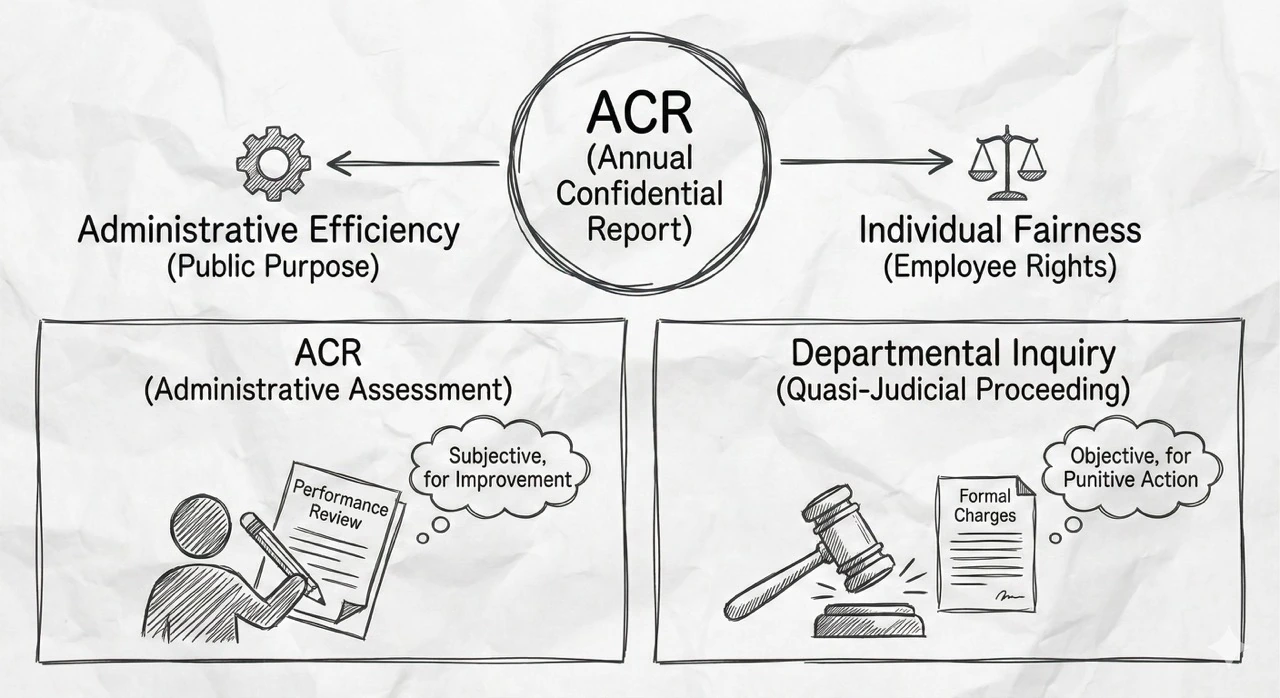
ACR versus departmental enquiry
Puran Singh v State of Punjab draws this line clearly.
Frequently asked questions on adverse APAR remarks
It is an entry that shows defects in your work or conduct. Under the Dev Dutt impact test, an entry that is low only in effect, such as “good” where the benchmark is “very good”, also counts as adverse because it blocks promotion.
Yes. An adverse entry must be communicated so that you can explain or improve, as held in Gurdial Singh Fijji. An uncommunicated entry cannot be used to deny you promotion. Keep a record of the date you first received it.
If the promotion benchmark is higher, such as ‘very good’, the Supreme Court in Dev Dutt treated the ‘good’ entry as adverse in effect, so you can represent. Check your department’s current rules and the benchmark for your post.
An authority higher than the one who recorded the entry should consider it, and the order should give reasons. If the decision is unreasoned or does not come, this may be challenged before the tribunal or High Court.
Section 21 of the Administrative Tribunals Act, 1985 generally allows one year from the final order. If a representation is not decided, the tribunal can be approached after six months, within one year from the end of that six months. Verify the exact dates for your case.
As Puran Singh v State of Punjab explains, an ACR is subjective and administrative, while a departmental enquiry is objective and quasi-judicial, aimed at punishment. Each has separate procedure and remedies.
If it was communicated only after several years, it may be challenged as a stale entry. Baidyanath Mahapatra held such entries cannot be relied on to your prejudice, since you could not respond effectively.
Not automatically. It removes the obstacle, and you may then ask for a review DPC to reconsider your case. Outcomes depend on the record and the rules, and no result can be promised.