Anticipatory Bail Under Section 482 BNSS: What Changed from Section 438
Since 1 July 2024, anticipatory bail is governed by Section 482 of the Bharatiya Nagarik Suraksha Sanhita, 2023, which replaced Section 438 of the CrPC. This guide explains what stayed, what was dropped, and how the process runs in Kolkata and the Calcutta High Court.
What is anticipatory bail?
Anticipatory bail is a direction from a court that, if a person is arrested for a non-bailable offence, they must be released on bail. A person who has reason to believe they may be arrested can ask the High Court or the Court of Session for it. It was Section 438 of the Code of Criminal Procedure, 1973. From 1 July 2024 it is Section 482 of the BNSS, 2023 (Act 46 of 2023). The text of the Act can be read on India Code.
The core is the same: the same two courts, the same kind of offence, and the same standard conditions, such as being available for police questioning, not threatening witnesses and not leaving India without the court’s permission. What changed is in the details, and many people searching for ‘Section 438 CrPC’ still need to know this. For a case-specific discussion, see our anticipatory bail advocate page. This article is general information, not advice on any one case.
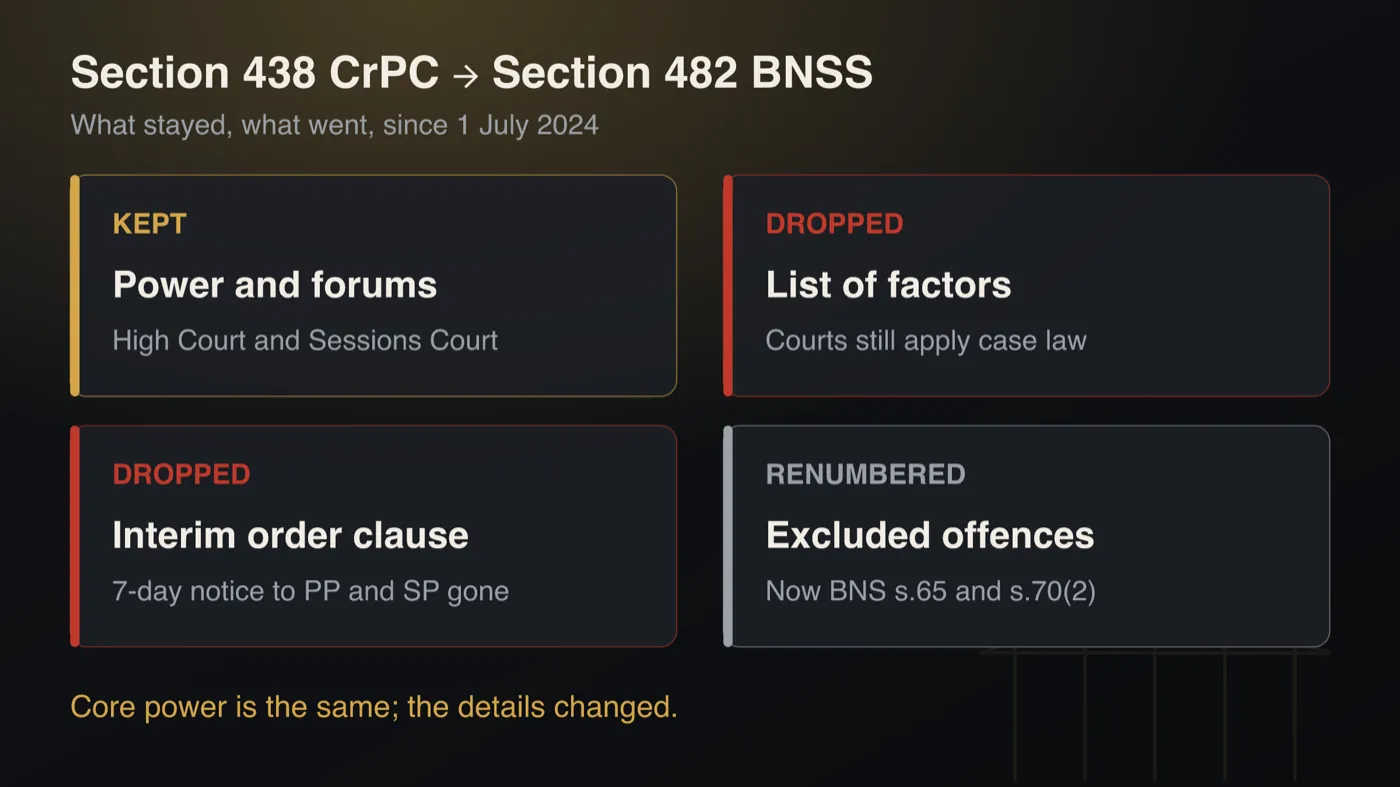
Section 438 CrPC against Section 482 BNSS
The core power is the same, but four points of the old section are missing from the new text.
Short explainers from Adv. Sudip Patra
More short explainers on our YouTube channel: Patra’s Law Chambers on YouTube ↗
What is your situation right now?
Pick the option closest to what has happened. This is general information, not legal advice, and the right step depends on the actual FIR or complaint.
Choose one of the options above.
How anticipatory bail law developed, from s.438 CrPC to s.482 BNSS
A short history helps explain why searches for the old section still bring people here. Verify the latest position before relying on any item.
The Code of Criminal Procedure, 1973 introduced anticipatory bail. A person fearing arrest for a non-bailable offence could ask the High Court or Court of Session for a direction to be released on bail if arrested.
In Gurbaksh Singh Sibbia v. State of Punjab, (1980) 2 SCC 565, a Constitution Bench held that s.438 is to be read liberally. The fear of arrest must be reasonable, not vague.
An amendment barred anticipatory bail for IPC 376(3), 376AB, 376DA and 376DB. These exclusions were later renumbered under BNS in s.482(4) BNSS.
In Sushila Aggarwal v. State (NCT of Delhi), (2020) 5 SCC 1, a five-judge Bench held that protection need not be time-bound. Filing of the charge-sheet does not end it by itself. The court may still limit it in a given case.
The BNSS replaced the CrPC. The core power stayed, but the list of factors, the interim-order clause and the 7-day notice were left out. See the comparison tables at CrPC to BNSS and the anticipatory bail advocate page.
Anticipatory bail applications in the Calcutta High Court now go before a Single Bench under the amended Rule 9(2) of the Appellate Side Rules. A question on bypassing the Sessions Court is pending before a larger Supreme Court Bench in Mohammed Rasal C v. State of Kerala. Verify its status.
Common doubts about anticipatory bail, tap a card
The law sets no limitation period. But the remedy exists only until arrest, so delay can let an arrest happen first.
Not automatically. Under Sushila Aggarwal (2020), protection can continue, though the court may limit it in a particular case.
Courts should not grant bail on an undertaking to deposit money, as the Supreme Court held in Gajanan Dattatray Gore (2025). Do not offer repayment to obtain bail.
Section 482 BNSS compared with Section 438 CrPC
The power and the forums
A person with reason to believe they may be arrested for a non-bailable offence can apply. The High Court and the Court of Session still share the power, and the standard conditions in 482(2) follow those in 438(2).
The list of factors
Section 438(1) listed the gravity of the accusation, the applicant’s record, the risk of fleeing and whether the case aims to injure or humiliate. The BNSS text has no list, but courts still apply Supreme Court case law.
Interim order, notice and presence
The express interim-order clause, the 7-day notice to the Public Prosecutor and Superintendent of Police, and the rule on presence at the final hearing are not in s.482. In practice courts still hear the Public Prosecutor and consider interim protection.
Excluded offences
Section 482(4) bars anticipatory bail for BNS s.65 (rape of a girl under 16 or 12) and s.70(2) (gang rape of a girl under 18), replacing the IPC provisions listed in 438(4).
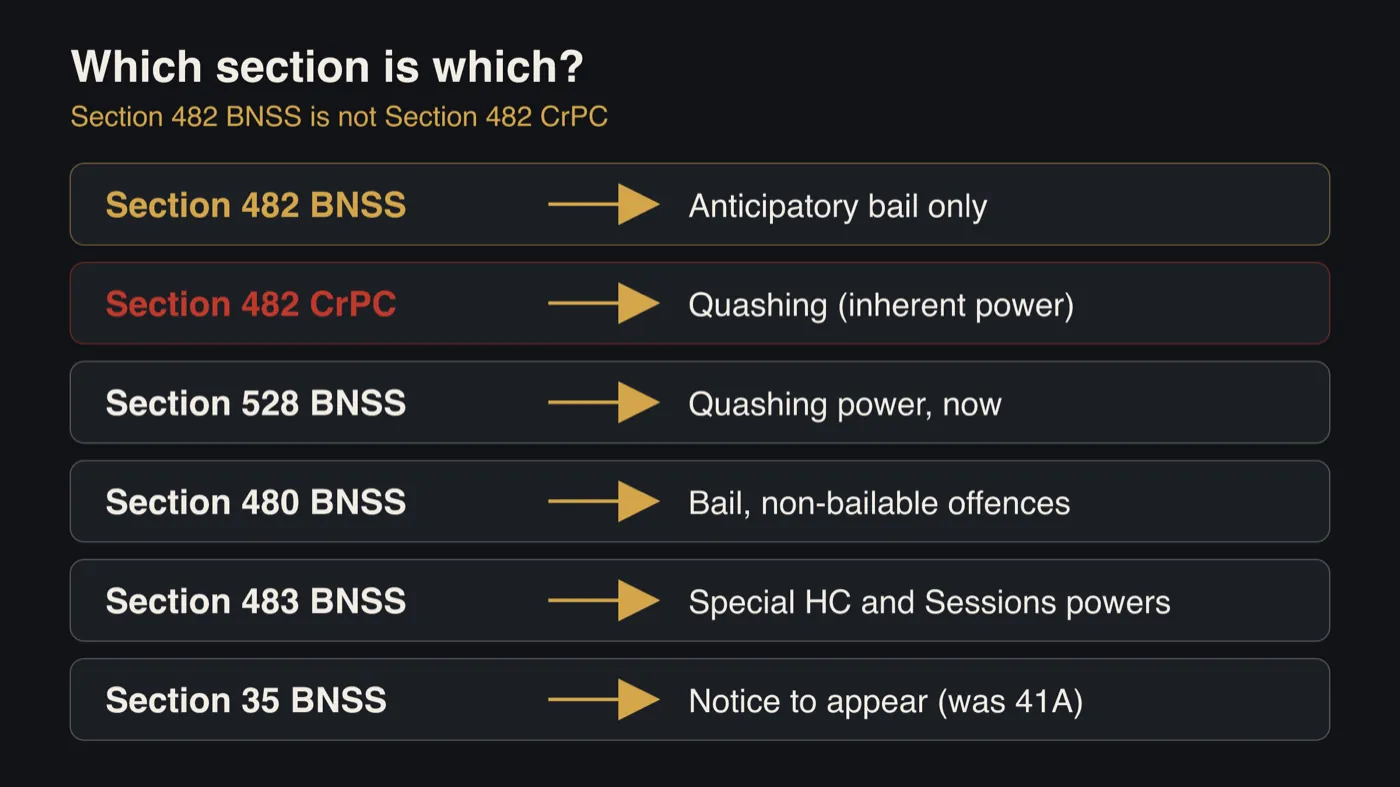
Section 482 BNSS is not Section 482 CrPC
- Section 482 CrPC was the High Court’s inherent power, used for quashing.
- The quashing power is now Section 528 BNSS.
- Section 482 BNSS is anticipatory bail only.
- Bail in non-bailable offences is Section 480 BNSS; special High Court and Sessions Court powers are Section 483 BNSS.
- Notice to appear instead of arrest is Section 35 BNSS, earlier Section 41A CrPC.
Leading judgments on anticipatory bail that still apply under Section 482 BNSS
Section 482 BNSS keeps the power that Section 438 CrPC gave, so the Supreme Court’s rulings under the old section still guide courts today. These six decisions shape most anticipatory bail hearings in Kolkata and across India.
1980
Reasonable belief, not vague fear, required
The Constitution Bench held that the power to grant anticipatory bail must be read liberally, and courts must not add limits the statute does not contain. The applicant’s belief that they may be arrested must rest on grounds the court can examine objectively. A mere fear is not enough. An FIR need not be registered first, and relief remains available after an FIR until arrest.
2020
Protection is not time-bound by default
A five-judge Bench held that anticipatory bail need not be limited to a fixed period. It does not end automatically when the charge-sheet is filed or when the accused is summoned, and it can continue until the end of the trial. The court may still impose a time limit or special conditions where the facts of a particular case call for it.
2019
Refusal where custodial interrogation is genuinely needed
In the INX Media money-laundering case, the Supreme Court refused anticipatory bail. It considered the material the Enforcement Directorate had collected and the stage of the investigation. It accepted that in serious economic offences, protection from arrest can hamper an effective investigation. Courts now weigh whether the police genuinely need custody, so real cooperation by the applicant matters.
2024
Person in custody can seek it elsewhere
A three-judge Bench held that being in custody in one case does not remove the fear of arrest in another. A person already in jail in one matter can therefore apply for anticipatory bail in a separate case and need not wait until released. The Court sent the application back to the High Court to be decided on its merits.
2024
Proclaimed offender status is not an absolute bar
In Srikant Upadhyay, the Court held that a pending anticipatory bail application does not stop proclamation proceedings, and that an accused who absconds ordinarily gets no relief. In Asha Dubey, the Court clarified that a proclamation (s.82 CrPC, now s.84 BNSS) is not an absolute bar. Each case turns on its own facts and on the reasons for the proclamation.
2025
No bail on promises to deposit money
The Supreme Court directed all High Courts and trial courts not to grant regular or anticipatory bail on the strength of an undertaking by the accused or their family to deposit money. Bail must be decided on the merits of the case. The Registry was told to circulate the ruling to every High Court, so offering repayment is not a route to bail.
How an anticipatory bail application moves in Kolkata and West Bengal
Assess the risk of arrest
Get a copy of the FIR or complaint and note each BNS section. If every offence is bailable, anticipatory bail is not needed. Check whether BNS s.65 or s.70(2), or a special Act such as the SC/ST Act, PMLA or UAPA, applies. If a Section 35 BNSS notice has come instead, appearing and cooperating may be the right course.
Choose the forum
Both the Court of Session and the High Court have the power. For a Kolkata Police area, the usual first forum is the City Sessions Court, Calcutta. In the districts, it is the District and Sessions Judge of the district where the police station is. Since 1 April 2025, a Single Bench hears these applications in the Calcutta High Court. Check the latest Supreme Court position on approaching the High Court directly.
Draft and file under Section 482 BNSS
The application should set out the case details, the specific reasons for fearing arrest, the facts, the applicant’s roots in the community and record, and willingness to accept conditions. Disclose any earlier application and what happened to it. High Court matters can be filed electronically; see e-filing cases at the Calcutta High Court. Check court fees with the West Bengal court fee calculator.
Hearing and interim protection
A copy is served on the Public Prosecutor, and the court usually calls for the case diary or a police report. BNSS no longer contains an express interim-order clause, so there is no automatic protection while the application is pending. Ask for interim protection at the first hearing. The court decides at its discretion.
Order, conditions and certified copy
If bail is granted, the court attaches conditions under Section 482(2) BNSS, such as being available for questioning, not threatening witnesses and not leaving India without permission. A personal bond with sureties is usual. Get a certified copy, keep it with you, and follow every condition. If you are arrested, you are released on bail under Section 482(3).
If the application is refused
After a refusal by the Sessions Court, apply to the Calcutta High Court. After a refusal by the High Court, the next remedy is a special leave petition; see the guide to filing an SLP for anticipatory bail in the Supreme Court. A fresh application on the same facts is disfavoured. It needs a material change in circumstances.
From fear of arrest to the right court
A simple order of checks before any application is filed.
Get the FIR or complaint
Note every BNS section charged and whether each is bailable.
Check for a s.35 BNSS notice
If a notice has come, appearing and cooperating may be the right first step.
Check the excluded offences
See whether s.482(4) BNSS or a special Act such as PMLA or SC/ST Act applies.
Apply to the Sessions Court
This is the usual first forum, subject to the pending Supreme Court question.
Approach the High Court
If refused, apply to the Calcutta High Court Single Bench.
SLP in the Supreme Court
A last remedy against a High Court refusal.
First-check guide: should you apply under Section 482 BNSS?
Answer the questions one by one. This is a general guide to the usual route, not legal advice, and the court decides each case.
How anticipatory bail law developed
Key dates from Section 438 to Section 482 BNSS.
- 1973 Section 438 CrPC introduced.
- 1980 Sibbia: Constitution Bench reads Section 438 liberally.
- 2005 Factors added to Section 438(1) by Act 25 of 2005 (verify commencement date).
- 2018 Certain child-rape offences excluded by Section 438(4).
- 2020 Sushila Aggarwal: protection not time-bound by default.
- 1 Jul 2024 Section 482 BNSS replaces Section 438 CrPC.
- 1 Apr 2025 Calcutta High Court: Single Bench hears anticipatory bail.
- Pending Mohammed Rasal: can the High Court be approached directly?
Common mistakes that weaken an anticipatory bail application
Filing on a vague fear Under Sibbia, the belief that you may be arrested must rest on specific facts the court can examine, such as an FIR, a complaint, a police call or a threat. An application made only “on information”, with nothing to back it, is often refused.
Hiding an earlier application or a proclamation Not disclosing an earlier anticipatory bail application and its result, or a proclamation, is treated as suppression of material facts. It can lead to dismissal or later cancellation, even where the case is otherwise strong.
Offering to deposit money to get bail Since Gajanan Gore (2025), courts must not grant bail on an undertaking to pay or deposit an amount. Offering repayment in a private cheating case does not replace arguments on the merits and can backfire.
Breaking the conditions after the order Missing dates with the investigating officer, contacting witnesses or travelling abroad without permission can lead to cancellation of bail under Section 483 BNSS. Keep a record of each appearance. For help with conditions or a fresh case, see the firm’s anticipatory bail and FIR advice page and the CrPC to BNSS section guide.
Facing a possible arrest in Kolkata?
Every case turns on its own FIR, sections and facts. If you want the papers reviewed and the forum, the risk and the likely conditions explained, you can book a consultation with Patra’s Law Chambers. Our anticipatory bail advocate and criminal lawyer pages describe how we handle these matters. No outcome can be promised; the court decides each application on its merits.
Book a ConsultationEstablished by a distinguished alumnus of IIT Kharagpur, Patra’s Law Chambers stands as a beacon of legal expertise in Kolkata & Delhi. Know more →

Kolkata Office
NICCO House, 6th Floor, 2 Hare Street
Kolkata-700001 (Near Calcutta High Court)
Delhi Office
4455/5, First Floor, Gali Shahid Bhagat Singh
Main Bazar Road, Paharganj, New Delhi-110055
Contact
[email protected]
+91 890 222 4444 / +91 7003 715 325
Papers to keep ready for an application
Having these ready saves time when an application has to be moved quickly.
Also keep any police notice and GD entry or correspondence.
Add surety documents, as bonds with sureties are common.
Disclose any earlier anticipatory bail application and its result.
Civil dispute papers, chats and payment records that support your case.
Needed only if age or health is relied on.
Travel conditions are common, so keep these at hand.
Court fees apply; check amounts with the court fee calculator.
Frequently asked questions on anticipatory bail under s.482 BNSS
Yes. It is now Section 482 of the Bharatiya Nagarik Suraksha Sanhita, 2023, in force from 1 July 2024. It replaced Section 438 CrPC. The High Court and the Court of Session both have this power.
BNSS left out the listed factors, the express interim-order clause, the 7-day notice to the Public Prosecutor and the presence-at-hearing clause. The excluded offences were renumbered. The core power is the same, and courts still apply Supreme Court case law.
Possibly. The fear of arrest must be genuine, reasonable and backed by facts. Applications made only on information, with no FIR or complaint, are often refused. Each case depends on its own facts, so verify with an advocate.
Both have the power. The usual practice is the Sessions Court first, then the High Court if refused. Whether the High Court can be approached directly is before the Supreme Court in Mohammed Rasal C v. State of Kerala. Check the latest position.
There is no automatic end. Under Sushila Aggarwal (2020), protection need not be time-bound and does not end merely on the charge-sheet. A court can still fix a time limit in a particular case.
Common conditions under s.482(2) BNSS are being available for police questioning, not threatening or influencing witnesses, and not leaving India without permission. A personal bond with sureties is typical. Breach can lead to cancellation of bail.
Section 482(4) BNSS bars anticipatory bail for BNS s.65 and s.70(2). Special laws such as the SC/ST Act (s.18), PMLA (s.45) and UAPA (s.43D(4)) also restrict it. Verify the exact sections in your FIR.
No. Section 482 CrPC dealt with the High Court’s inherent powers, used for quashing. That power is now Section 528 BNSS. Section 482 BNSS is anticipatory bail. People often mix the two numbers when searching.