Arbitration and Conciliation Lawyer in Kolkata for Sections 9, 11, 34 and 36 Calcutta High Court
Sudip Patra argues arbitration and conciliation matters himself in the Calcutta High Court and the commercial courts. This page explains interim relief, appointment of arbitrators, challenges to awards and enforcement under the Arbitration and Conciliation Act, 1996, and the deadlines that decide each step.
Arbitration matters in the Calcutta High Court and Commercial Courts
Arbitration is the way many contract, loan, construction and supply disputes in West Bengal are decided. The Arbitration and Conciliation Act, 1996 (India Code) gives the court a limited role: interim protection under Section 9, appointment of an arbitrator under Section 11, a narrow challenge to the award under Section 34, and enforcement under Section 36. In Kolkata these court applications usually go to the Commercial Division of the Calcutta High Court (Original Side) or to the Commercial Courts at the City Civil Court. Outside Kolkata they go to the district commercial court. The value limits are set by notification and must be checked for each matter.
Sudip Patra, an IIT Kharagpur and IIM Calcutta alumnus with over 10 years of professional legal experience, appears in these matters himself. Where a case reaches the Supreme Court, such as a Section 11 application in an international commercial arbitration, it is filed through his Supreme Court connection; see the Supreme Court advocate consultation page. High Court work is described on the Calcutta High Court advocate page. In short: a Section 34 petition must be filed within 3 months of receiving the award, with at most 30 more days allowed by the court, so the first step is always to read the clause and count the days.
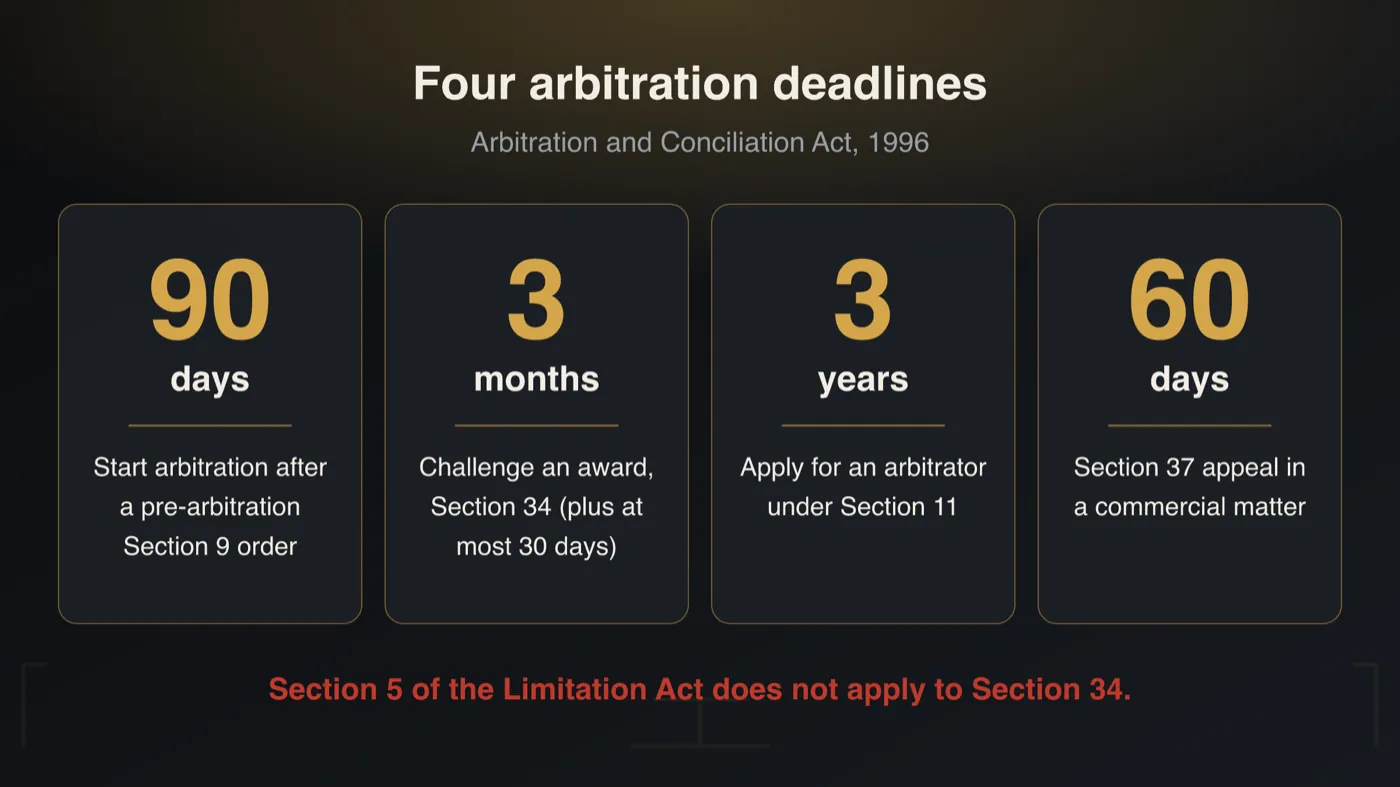
Four deadlines that decide an arbitration
Missing any of these can end a remedy, so note the date you receive each paper.
Short explainers from Adv. Sudip Patra
More short explainers on our YouTube channel: Patra’s Law Chambers on YouTube ↗
What stage is your arbitration dispute at?
Pick the line that matches your situation to see the forum and the usual remedy. This is general information, not advice on your papers.
Choose one of the options above.
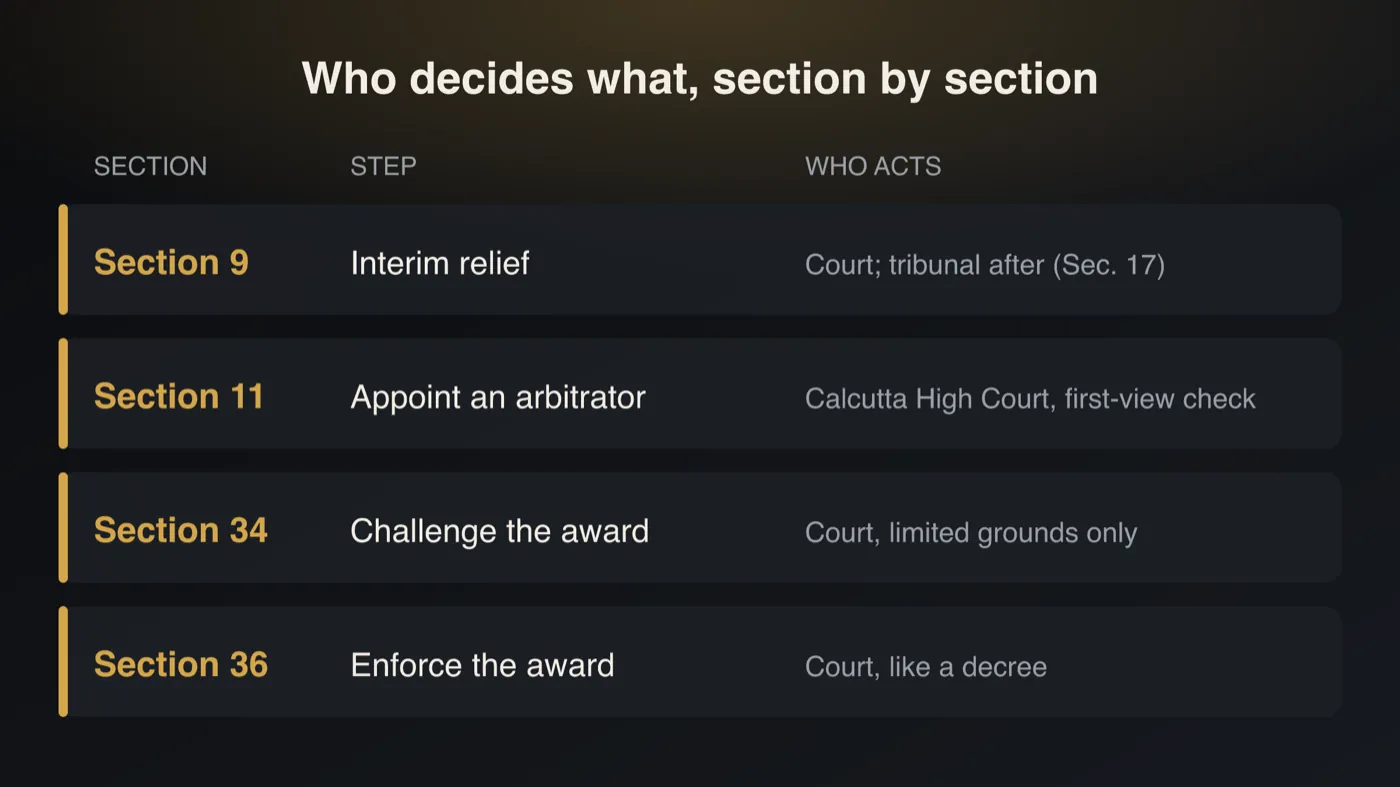
How an arbitration moves from clause to execution
The usual order of events under the Arbitration and Conciliation Act, 1996. Your contract may add its own steps, so check it first.
Find the seat and venue, the way the arbitrator is to be appointed, and any notice or mediation steps that come first. Check whether the agreement is stamped, using the stamp duty calculator.
A court can protect the subject matter before the tribunal exists. If it does, arbitration must start within 90 days. Once the tribunal is in place, the court usually sends the party to Section 17.
The notice invoking arbitration proposes an arbitrator. If there is no agreement within 30 days, a Section 11 petition goes to the Calcutta High Court, within 3 years. International commercial matters go to the Supreme Court, filed through Sudip’s Supreme Court connection.
Pleadings should be complete within 6 months. The award is due within 12 months of that, extendable by 6 months by consent. After that only the court can extend the time under Section 29A.
A Section 33 correction request must be made within 30 days. A Section 34 challenge must be filed within 3 months, with at most 30 more days. A Section 37 appeal in a commercial matter has 60 days.
A domestic award is enforced like a decree where the debtor’s assets are. If a bank loan is also in dispute, see the DRT matters page for the other forum.
Three things people get wrong about arbitration, tap a card
Not since 2015. The award stays enforceable unless the court grants a stay under Section 36(2), usually on a deposit or security. The State is not exempt (Pam Developments, 2019).
A 7-judge bench held in 2023 that an unstamped agreement is not void. It cannot be used as evidence until stamped and any penalty is paid, and the tribunal decides the stamp objection.
A waiver under the Section 12(5) proviso must be an express agreement in writing made after the dispute arises. Taking part alone is not enough (Bharat Broadband, 2019).
What we handle in arbitration and conciliation
Interim relief before or after the tribunal
Petitions for injunction, deposit, attachment or a receiver to protect the subject matter of the dispute. If the court grants relief before arbitration begins, arbitration must start within 90 days. Once a tribunal is in place, the court usually sends the party to the tribunal under Section 17.
Appointment of an arbitrator
Where the other side does not agree on an arbitrator within 30 days of the notice, an application can be made to the Calcutta High Court for a domestic arbitration. It must be filed within 3 years. At this stage the court mainly checks whether an arbitration agreement exists on a first view.
Challenging an award and appeals
A Section 34 petition is limited to the grounds in the Act, such as patent illegality in domestic awards, and is not a re-hearing on merits. The time limit is strict, and Section 5 of the Limitation Act does not apply. Appeals under Section 37 are also limited, with 60 days in commercial matters.
Enforcement of domestic and foreign awards
A domestic award is enforced like a decree, and execution can be filed where the debtor’s assets are. Filing a Section 34 petition does not stop enforcement by itself; a stay must be sought, usually against deposit or security. Foreign awards under the New York Convention are enforced through the High Court.
Related arbitration and conciliation work
- Notice invoking arbitration under Section 21 and reply to such a notice
- Objections to an arbitrator under Section 12(5) and the Seventh Schedule
- Appearing before the tribunal: pleadings, Section 16 jurisdiction pleas, Section 17 interim measures
- Extension of the tribunal’s time under Section 29A
- Conciliation under Part III of the 1996 Act and mediation, including Section 12A of the Commercial Courts Act
- Execution objections under Section 36 where an award was made by a unilaterally appointed arbitrator
Supreme Court rulings that decide arbitration cases in Kolkata
These are the decisions the Calcutta High Court and the Commercial Courts apply most often in Section 11, Section 34 and Section 36 matters. Each one is binding, and each turns on a point that clients often get wrong.
2019
Interested party cannot name sole arbitrator
Under the contract, HSCC’s Managing Director alone could appoint the sole arbitrator. The Supreme Court held that a party with an interest in the outcome of a dispute cannot have the power to appoint a sole arbitrator by itself, and it appointed an independent arbitrator under Section 11. Borrowers in West Bengal now rely on this ruling against lender-appointed arbitrators.
2024
Unilateral and curated-panel appointments are impermissible
A five-judge bench held that the parties must be treated equally at every stage of an arbitration, including the appointment of the tribunal. A clause that lets one side appoint the arbitrator alone, or forces the other side to choose from a panel that side has picked, is not allowed. In public-private contracts such clauses also breach Article 14. The bench overruled its 2020 CORE decision.
2024
Section 11 court checks only existence
A court hearing a Section 11 application only asks, on a first look, whether an arbitration agreement exists. Questions such as accord and satisfaction, a signed discharge voucher, or whether the claim has merit are for the arbitral tribunal to decide. The appointment stage is therefore a short hearing, not a trial of the dispute.
2001
Section 5 delay condonation not available
Section 5 of the Limitation Act cannot be used to extend the time for a Section 34 challenge. Section 34(3) allows three months from receipt of the award, and the court may add at most thirty days for sufficient cause, “but not thereafter”. Once that period has run out, no court can hear the challenge, however strong the grounds.
2025
No holiday benefit for 30-day grace
Section 4 of the Limitation Act helps a party only when the three-month period itself ends on a day the court is closed. The extra thirty-day period gets no such benefit, even if it ends during a court vacation. The Section 34 petition in this case had been filed after the vacation and was dismissed as time-barred.
2019
No automatic stay, even for government
The Calcutta High Court had stayed an award against the State of West Bengal without asking for any security. The Supreme Court set that stay aside. Section 36 gives the government no special treatment, and Order XXVII Rule 8A CPC does not excuse it from making a deposit. A court can attach conditions, such as a deposit or security, to any stay of an award.
How an arbitration matter moves in Kolkata, from clause to execution
Read the clause and fix the seat
Check the arbitration clause for the seat or venue, how the arbitrator is to be appointed, and any steps that must come first, such as negotiation or mediation. Look closely for a clause that lets one party appoint the arbitrator alone. The seat decides which court has jurisdiction, and under Section 42 every later application must go to the same court.
Urgent protection under Section 9
If assets, goods or property may be lost, apply for interim measures under Section 9 before the Commercial Division of the Calcutta High Court or the Commercial Court with jurisdiction. If the court grants protection before the arbitration starts, the arbitration must begin within 90 days.
Notice invoking arbitration under Section 21
Send a written notice that sets out the dispute and proposes an arbitrator or asks the other side to agree on one. Under Section 21 the arbitration begins on the date the respondent receives this request. Keep proof of delivery.
Section 11 application if appointment fails
If the other side does not agree on an arbitrator within 30 days, or tries to appoint one alone, apply to the High Court under Section 11. The court checks only whether an arbitration agreement exists. File within three years. In an international commercial arbitration the application goes to the Supreme Court.
Proceedings before the tribunal
Challenge the arbitrator within 15 days under Section 13. Raise any objection to jurisdiction no later than the statement of defence (Section 16). Complete pleadings within six months, and seek interim measures from the tribunal under Section 17 where needed. Under Section 29A the award is due within 12 months of the close of pleadings, extendable by six months by consent and after that only by the court.
After the award: Section 34, Section 37 and execution
A request for correction under Section 33 must be made within 30 days. A Section 34 challenge must be filed within three months, plus at most 30 days, with prior notice under Section 34(5) and a stay application under Section 36(2). An appeal under Section 37 in a commercial matter lies within 60 days. An award that is not stayed can be executed wherever the debtor’s assets are.
Lender-appointed arbitrator: before and after the award
The remedy for a unilateral appointment changes with the stage of the case.
Mistakes that lose arbitration cases
Counting the Section 34 deadline loosely The three months plus at most 30 days cannot be stretched, and a court vacation does not extend the 30-day period. Count from the date you received the signed award, or from the date a Section 33 request was decided, and file well before the last day.
Taking part before a lender-appointed arbitrator without objecting Raise the objection under Section 12(5) and the Seventh Schedule at the first hearing, and never sign a waiver after the dispute has arisen. Our post on challenging unilateral arbitration clauses in loan agreements explains the remedy at each stage.
Assuming a Section 34 petition stops recovery Since 2015, filing a challenge does not automatically suspend the award. Apply separately for a stay under Section 36(2), and be ready to offer a deposit or security. Without a stay, the award holder can execute it as a decree.
Filing in the wrong court Seat and venue are often confused, and once a court has dealt with an application, Section 42 sends every later application to that same court. A wrong first choice can cost months. The matter may also overlap with a DRT or NCLT proceeding, which should be checked at the start.
Discuss your arbitration matter with the chambers
If you have an arbitration clause, a notice, a tribunal order or an award, bring the agreement and every paper with dates. Time limits under the 1996 Act are short and some cannot be extended, so the dates are checked first. After that, the forum, the available remedy and the documents needed are explained in plain language. Every matter is different, and no result can be promised. Clients abroad can give instructions through a power of attorney and attend hearings online where the court allows.
Book a ConsultationEstablished by a distinguished alumnus of IIT Kharagpur, Patra’s Law Chambers stands as a beacon of legal expertise in Kolkata & Delhi. Know more →

Kolkata Office
NICCO House, 6th Floor, 2 Hare Street
Kolkata-700001 (Near Calcutta High Court)
Delhi Office
4455/5, First Floor, Gali Shahid Bhagat Singh
Main Bazar Road, Paharganj, New Delhi-110055
Contact
[email protected]
+91 890 222 4444 / +91 7003 715 325
Papers to gather before the first meeting
Having these ready saves time, especially when a deadline is running.
With the arbitration clause marked and the stamp status noted.
Every notice, reply, email and letter exchanged with the other side.
The documents that prove the amount or loss being claimed.
Appointment letter, pleadings, orders and the signed award with the date of receipt.
Board resolution or authority letter, and the registered address of the other side.
Notarised and apostilled or consularised, if you live abroad.
Frequently asked questions on arbitration and conciliation in Kolkata
Three months from receiving the signed award under Section 34(3). The court can allow at most 30 more days if sufficient cause is shown, and nothing beyond that. Section 5 of the Limitation Act does not apply, so count the dates carefully and act early.
A party interested in the outcome cannot appoint a sole arbitrator on its own, as held in Perkins Eastman (2020) and the 2024 Constitution Bench decision in CORE. The Calcutta High Court has set aside or refused to enforce some awards made this way. Verify your facts against the cases.
Yes. Section 9 lets the court grant interim measures such as an injunction, attachment, deposit or a receiver. If the court orders relief before arbitration begins, arbitration must start within 90 days under Section 9(2).
For a domestic arbitration, the Calcutta High Court under Section 11, if the parties do not agree within 30 days of the notice. For international commercial arbitration it is the Supreme Court. The application must be filed within 3 years.
No. Since the 2015 amendment, a separate stay application under Section 36(2) is needed. Courts usually ask for a deposit or security. An unconditional stay is possible only in cases of fraud or corruption under the proviso to Section 36(3).
Yes, it is not void. A 7-judge bench held in 2023 that the agreement is inadmissible as evidence until it is stamped and any penalty is paid. The stamp objection is decided by the tribunal, so it is no ground to refuse a Section 11 reference.
Usually the Commercial Division of the Calcutta High Court (Original Side) or the Commercial Courts at the City Civil Court, depending on value and the seat. Value limits are fixed by notification, so verify the current one. Under Section 42, later applications go to the same court.
Yes. Instructions can be given through a notarised and apostilled or consularised power of attorney, and hearings are often online. A foreign award under the New York Convention is enforced by a Part II petition in the High Court, within 3 years (Vedanta, 2020).
Not exactly. Conciliation is governed by Part III of the 1996 Act, and a settlement agreement has the status of an arbitral award (Section 74). The Mediation Act, 2023 is meant to replace it, but its main provisions were not in force on the sources checked, so verify the current status.
Yes. Section 12A of the Commercial Courts Act makes pre-institution mediation compulsory, unless urgent interim relief is genuinely needed (Patil Automation, 2022). A plaint filed without it can be rejected. Courts may check whether the urgency is real.