Jurisprudential Analysis of Unilateral Appointment of Arbitrators in India: Statutory Mandates, Judicial Evolution, and Strategic Challenges
Creditor and contributor of this article:
Patra’s Law Chambers:
About Us:
Patra’s Law Chambers is a law firm with offices in Kolkata & Delhi, offering comprehensive legal services across various domains. Established in 2020 by Advocate Sudip Patra (Advocate, Supreme Court of India & Calcutta High Court) an alumnus of the Prestigious Rajiv Gandhi School of Intellectual Property Law, IIT Kharagpur ,with Post Graduate diploma in Business Law from IIM Calcutta, the firm specializes in Civil, Criminal, Writs,High Court Matters, Trademark, Copyright, Company, Tax, Banking, Property disputes, Service law, Family law, and Supreme Court matters.You can know more about us in here
Kolkata Office:
NICCO HOUSE, 6th Floor, 2, Hare Street, Kolkata-700001 (Near Calcutta High Court)
Delhi Office:
House no: 4455/5, First Floor, Ward No. XV, Gali Shahid
Bhagat Singh, Main Bazar Road, Paharganj, New Delhi-110055
Website: www.patraslawchambers.com
Email: [email protected]
Phone: +91 890 222 4444/ +91 7003 715 325
To get a PDF version of this particular article,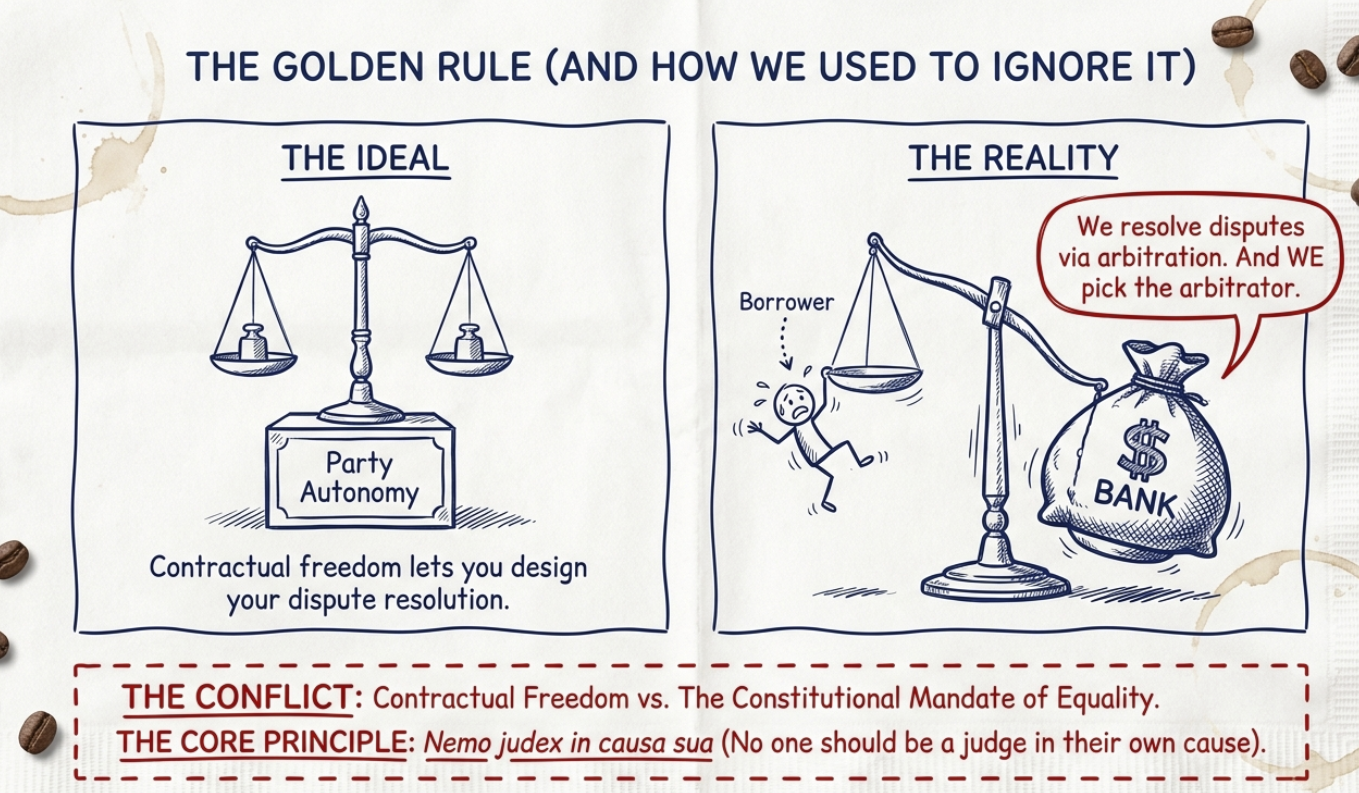
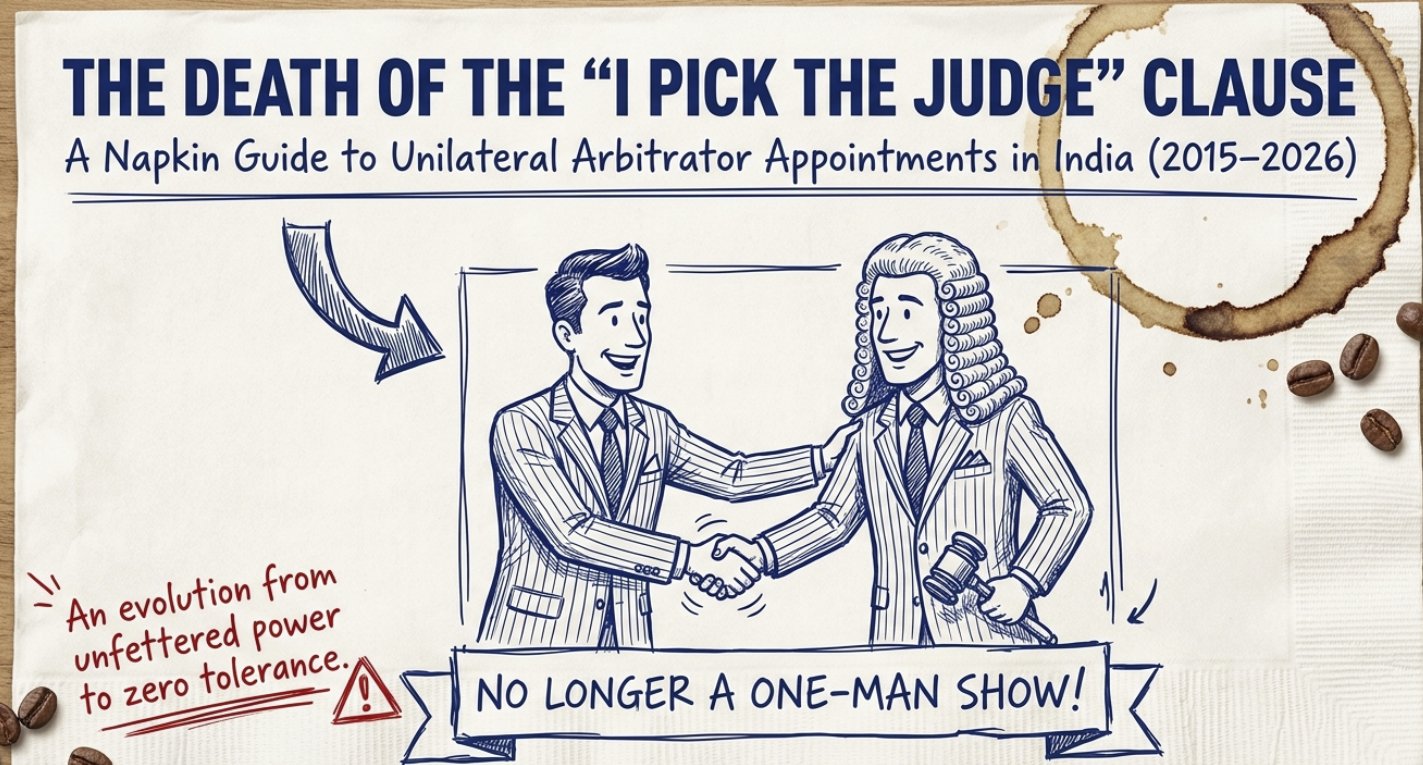
The doctrine of party autonomy has long served as the cornerstone of arbitration, permitting parties to design their dispute resolution frameworks. However, in the Indian context, this autonomy has frequently collided with the fundamental principles of neutrality, impartiality, and the constitutional mandate of equality. The practice of unilateral appointment—where one party, typically a lender, government entity, or superior commercial actor, reserves the exclusive right to appoint a sole arbitrator—has been a focal point of intense judicial scrutiny over the last decade. From the 2015 amendments to the Arbitration and Conciliation Act, 1996, to the definitive 2024 Constitution Bench ruling in the CORE-II case, the legal landscape has shifted from a regime of unfettered contractual freedom to one characterized by rigorous statutory and judicial checks against bias. This transition is particularly relevant in the banking and financial services sectors, where standard-form contracts often incorporate such clauses, raising significant questions about duress, unconscionability, and the binding nature of resultant awards.
The Statutory Paradigm: Section 12(5) and the Seventh Schedule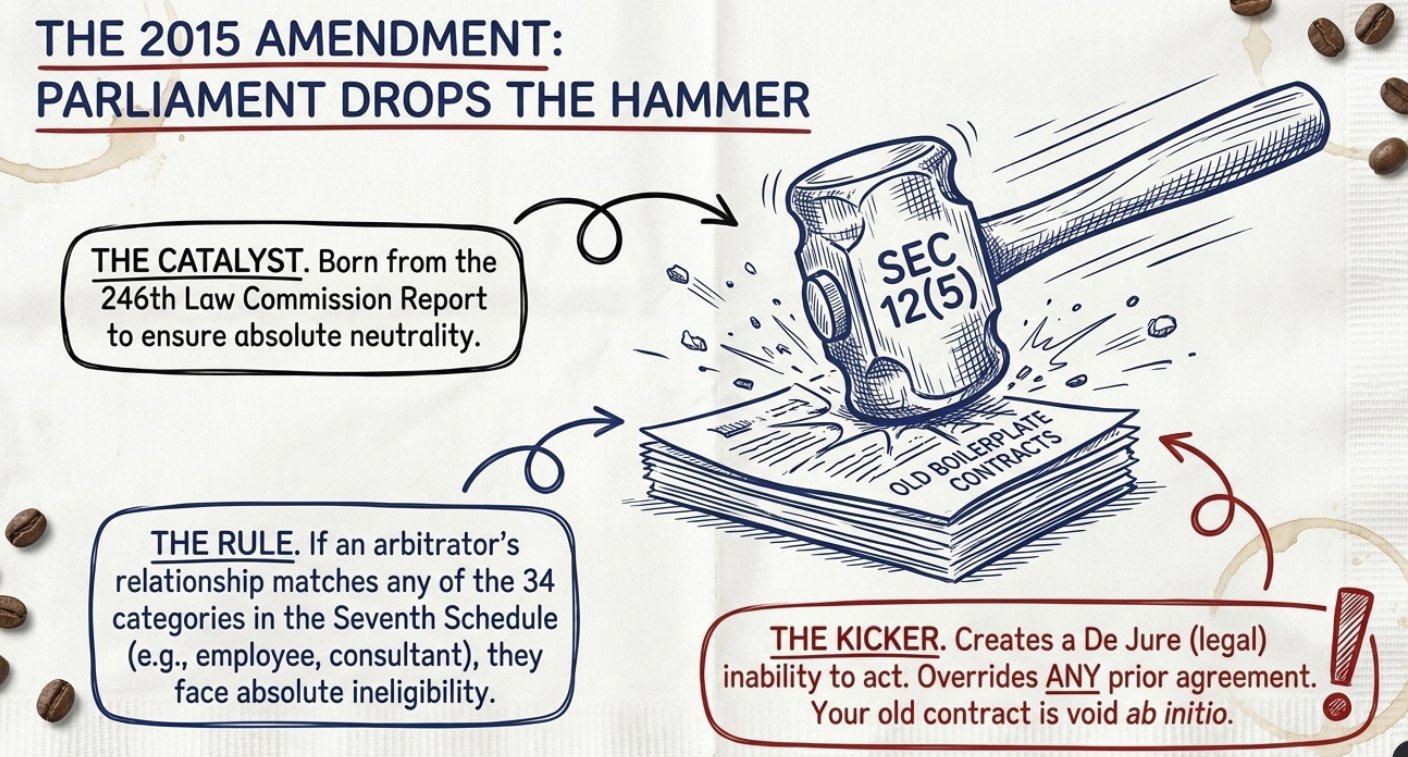
The modern framework for challenging unilateral appointments is rooted in the 2015 Amendment Act, which introduced Section 12(5) as a mandatory safeguard for arbitral integrity.1 This provision stipulates that notwithstanding any prior agreement to the contrary, any person whose relationship with the parties, their counsel, or the subject matter of the dispute falls within the categories specified in the Seventh Schedule shall be ineligible to be appointed as an arbitrator.1 This legislative intervention was a direct response to the 246th Law Commission Report, which emphasized that a person with a vested interest in the outcome of a dispute should not be permitted to adjudicate it, nor should an interested party have the exclusive power to select the adjudicator.4
The Seventh Schedule lists thirty-four categories of relationships that trigger absolute ineligibility.1 These are broadly divided into relationships with the parties, relationships with the counsel, and relationships with the dispute itself. A critical feature of Section 12(5) is that it creates a de jure inability to perform the functions of an arbitrator, meaning the ineligibility is statutory and automatic.1 This overrides any contractual clause signed before the dispute arose, rendering even the most explicitly worded unilateral appointment provisions subject to the higher mandate of neutrality.1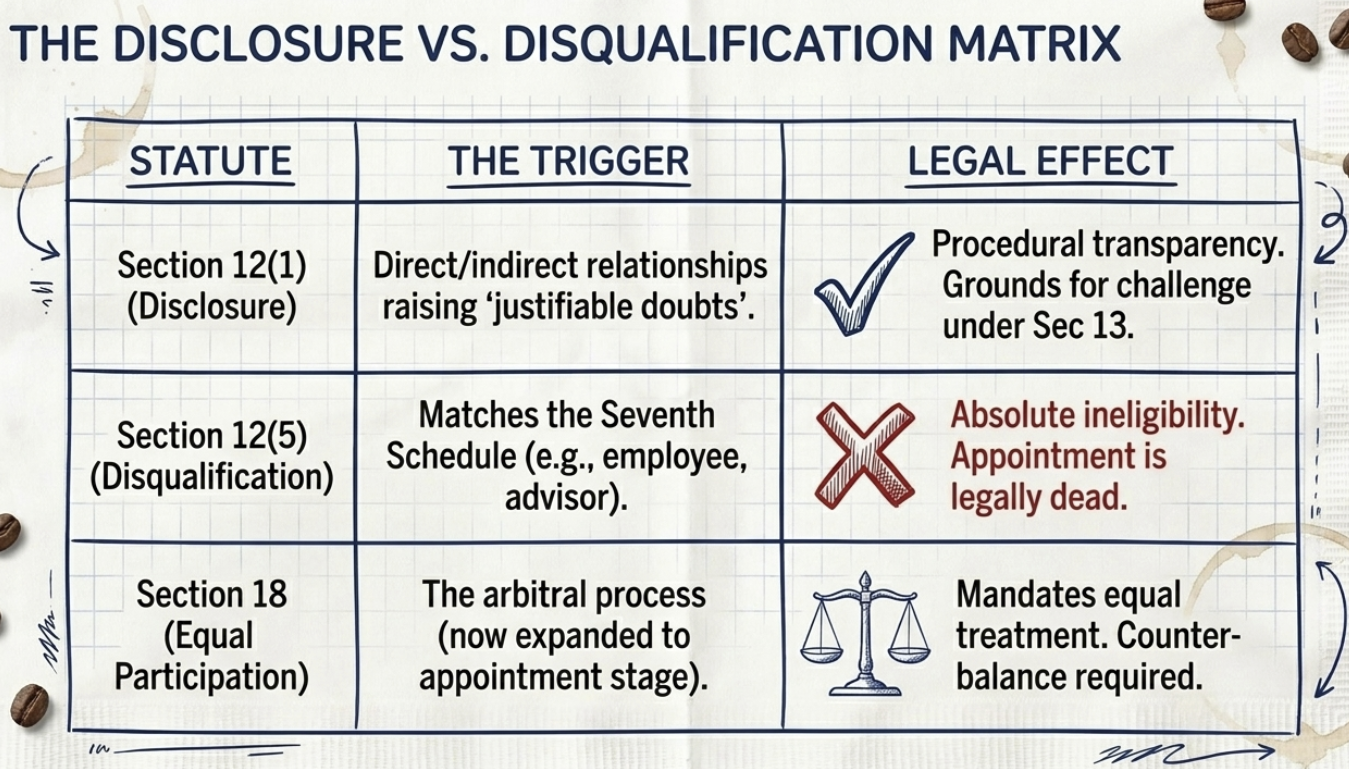
| Statutory Provision | Scope and Applicability | Legal Effect |
| Section 12(1) | Requires written disclosure of any direct or indirect relationship raising “justifiable doubts” as to impartiality. | Procedural transparency; grounds for challenge under Section 13. |
| Section 12(5) | Absolute ineligibility based on relationships defined in the Seventh Schedule. | Overrides prior agreements; rendering the appointment void ab initio. |
| Seventh Schedule | Lists 34 categories including employees, consultants, and advisors of a party. | Statutory disqualification that cannot be waived except by post-dispute written agreement. |
| Section 18 | Mandates equal treatment of parties throughout the arbitral process. | Extended by the 2024 SC ruling to cover the appointment stage. |
The only escape from this statutory ineligibility is the proviso to Section 12(5), which allows parties to waive the disqualification only by an “express agreement in writing” executed after the disputes have arisen.1 The courts have interpreted this requirement with extreme stringency. Mere participation in proceedings, silence, or the filing of a Statement of Defence does not constitute a waiver.7 The rationale is that a waiver must be a conscious, informed choice made in the context of an existing conflict, ensuring that a party does not inadvertently signed away their right to a neutral tribunal through boilerplate clauses in a pre-dispute contract.2
The Evolution of Judicial Doctrine: From TRF to CORE-II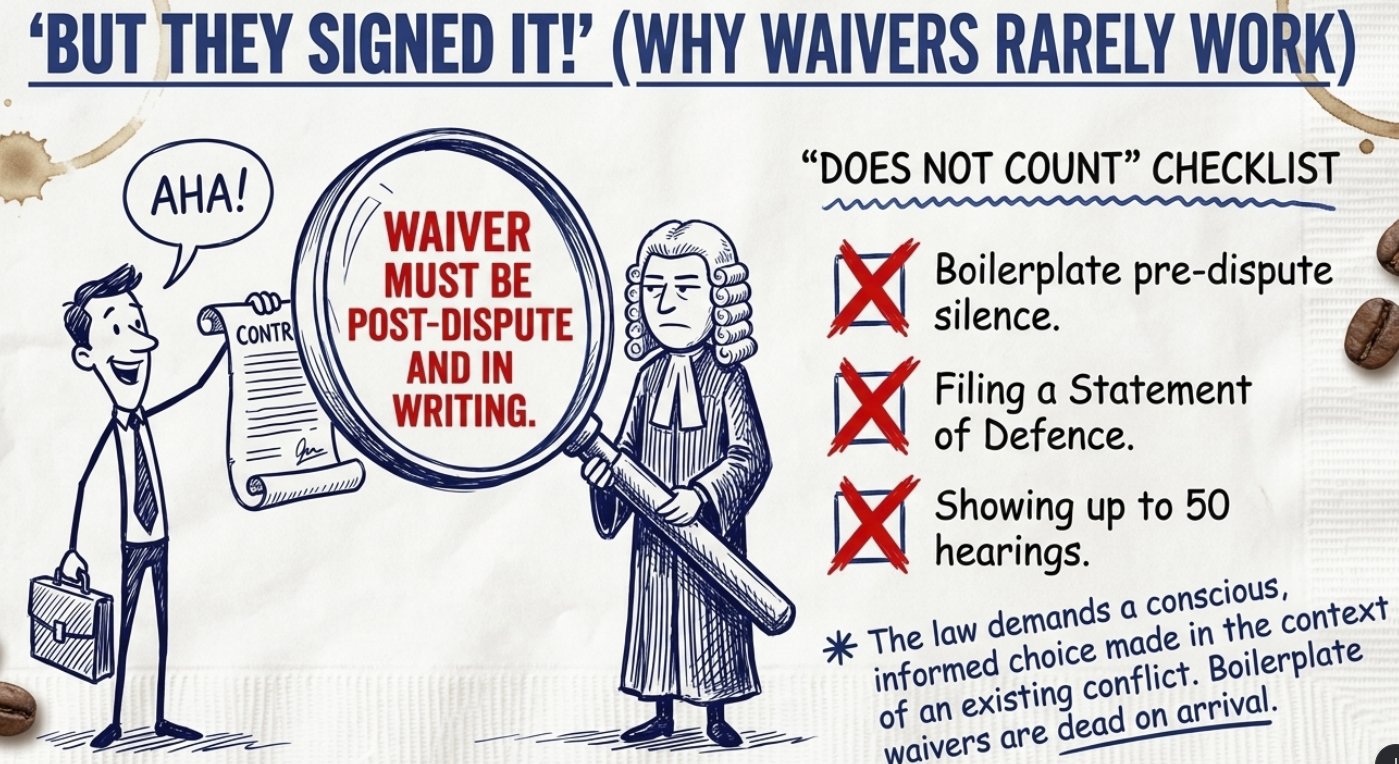
The invalidity of unilateral appointments has been established through a trilogy of landmark Supreme Court judgments that progressively narrowed the scope of party autonomy in favor of neutral adjudication.
The Doctrine of Derivative Ineligibility in TRF Ltd.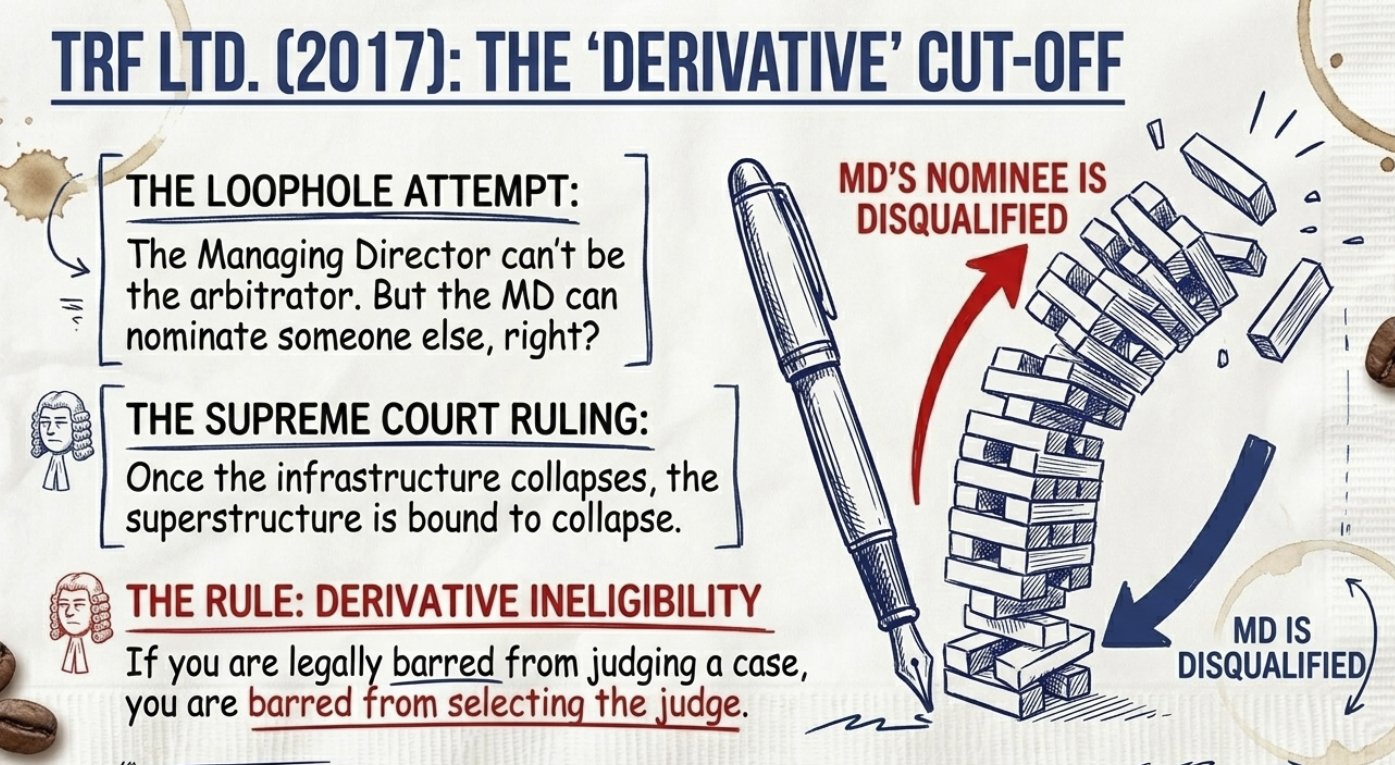
In TRF Ltd. v. Energo Engineering Projects Ltd. (2017), the Supreme Court addressed a clause where the Managing Director (MD) of one party was named as the sole arbitrator or empowered to nominate another person.10 The Court ruled that since the MD, as an employee of a party, was himself ineligible to be an arbitrator under the Seventh Schedule, he was also disqualified from nominating anyone else to act as an arbitrator.11 This established the principle that “once the infrastructure collapses, the superstructure is bound to collapse”.10 If a person is legally barred from judging a case due to potential bias, they cannot be allowed to select the judge, as the appointee would be viewed as an extension of the interested party’s influence.11
The Expansion in Perkins Eastman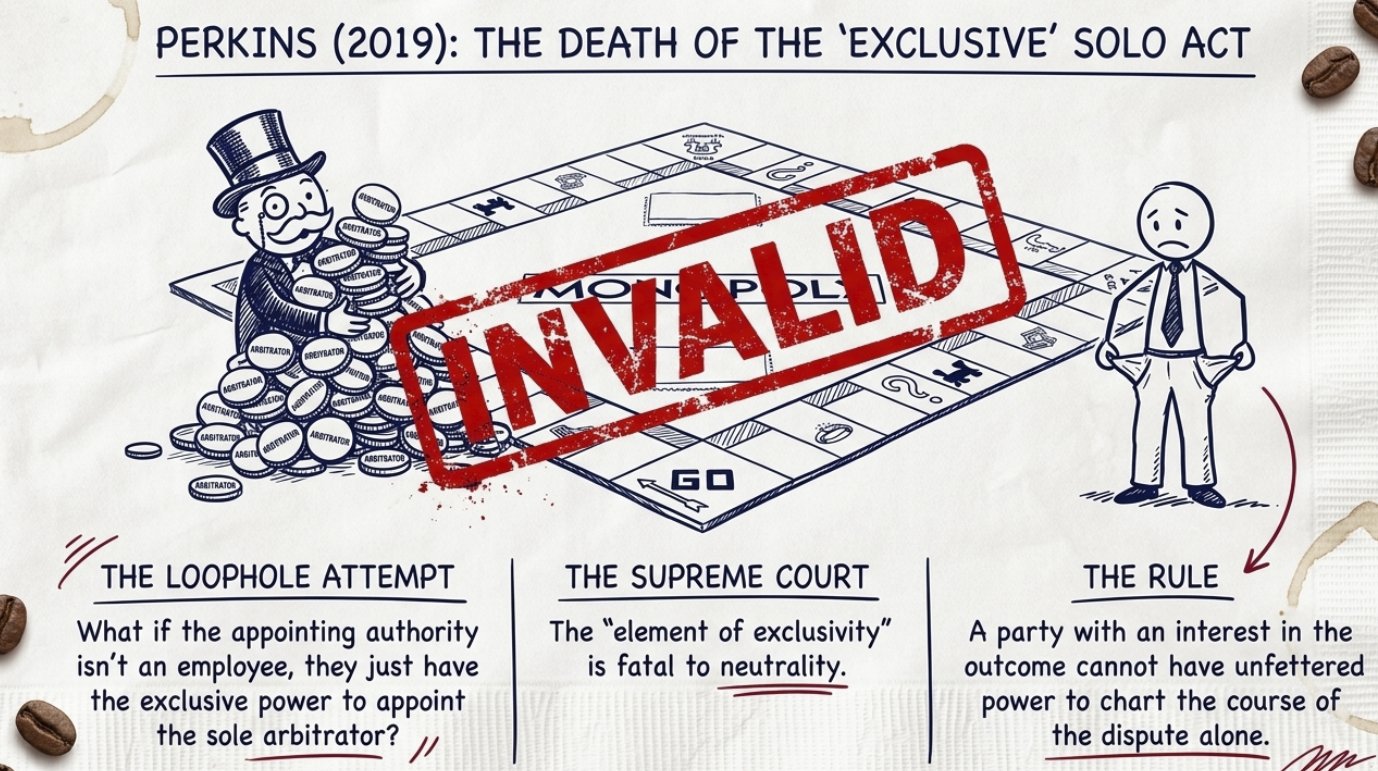
The Perkins Eastman Architects DPC v. HSCC (India) Ltd. (2019) judgment took this a step further. Unlike TRF, the MD in Perkins was not himself the arbitrator but held the exclusive power to nominate the sole arbitrator.12 The Court held that even if the appointing authority is not personally disqualified from being an arbitrator, the “element of exclusivity” in the appointment process is fatal to the neutrality of the tribunal.13 The Court observed that a party who has an interest in the outcome of the dispute must not have the power to appoint a sole arbitrator, as this allows them to “chart the course” of the dispute resolution process to their advantage.5 This judgment effectively invalidated all clauses in commercial contracts that gave one party the unfettered right to appoint a sole arbitrator.3
The 2024 Constitution Bench: CORE-II and the Principle of Equal Participation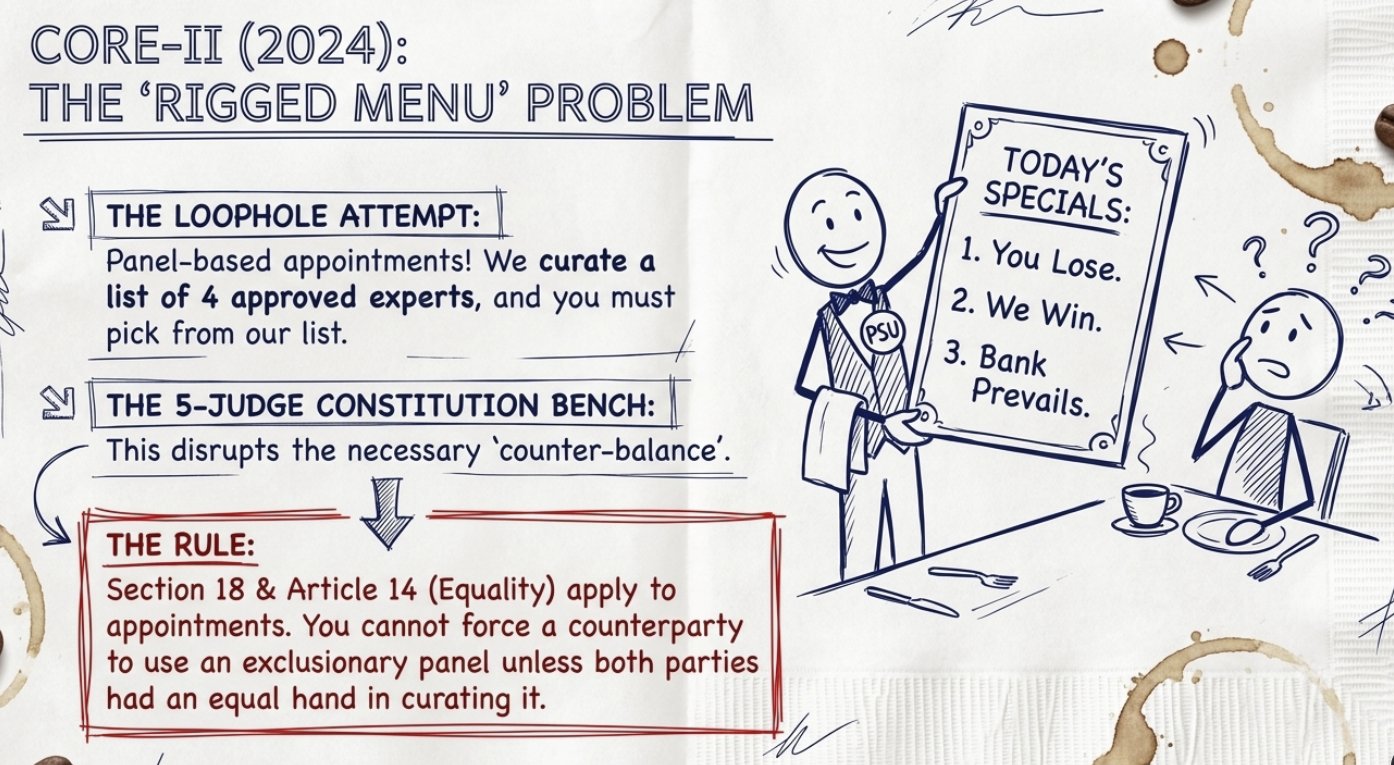
The most definitive and recent development is the 2024 Constitution Bench judgment in Central Organisation for Railway Electrification (CORE) v. M/s ECI SPIC SMO MCML (JV) (referred to as CORE-II).10 This case resolved a systemic conflict regarding “panel-based” appointments, where a public entity would curate a list of potential arbitrators and force the counterparty to select their nominee from that limited list.3
The Constitution Bench ruled that the principle of equal treatment of parties, enshrined in Section 18 of the Act, applies not only during the conduct of the proceedings but also at the stage of appointing the tribunal.3 The Court held that a clause allowing one party to curate an exclusive panel and mandate the other party to choose from it disrupts the “counter-balance” necessary for a fair process.6 While PSUs and government entities are not prohibited from maintaining panels of experts, they cannot force a counterparty to restrict their selection to such a panel unless both parties participate equally in the curation or have the freedom to choose from a broad-based, non-exclusionary list.6 Furthermore, the Court applied Article 14 of the Constitution to these commercial contracts, holding that the state cannot grant itself an undue advantage in the appointment process, as this violates the constitutional mandate of equality.14
| Landmark Case | Year | Core Ruling | Impact on Unilateralism |
| TRF Ltd. v. Energo | 2017 | Ineligible persons cannot nominate arbitrators. | Ended appointments by MDs/Employees. |
| Perkins Eastman v. HSCC | 2019 | Exclusive power to appoint a sole arbitrator is invalid. | Invalidated sole arbitrator clauses in one-sided contracts. |
| Bharat Broadband v. United Telecoms | 2019 | Statutory ineligibility leads to automatic termination of mandate. | Clarified the de jure nature of Section 12(5) challenges. |
| CORE-II (5-Judge Bench) | 2024 | Equal treatment applies to appointments; curated panels are restrictive. | Mandated equal say in tribunal composition in public-private contracts. |
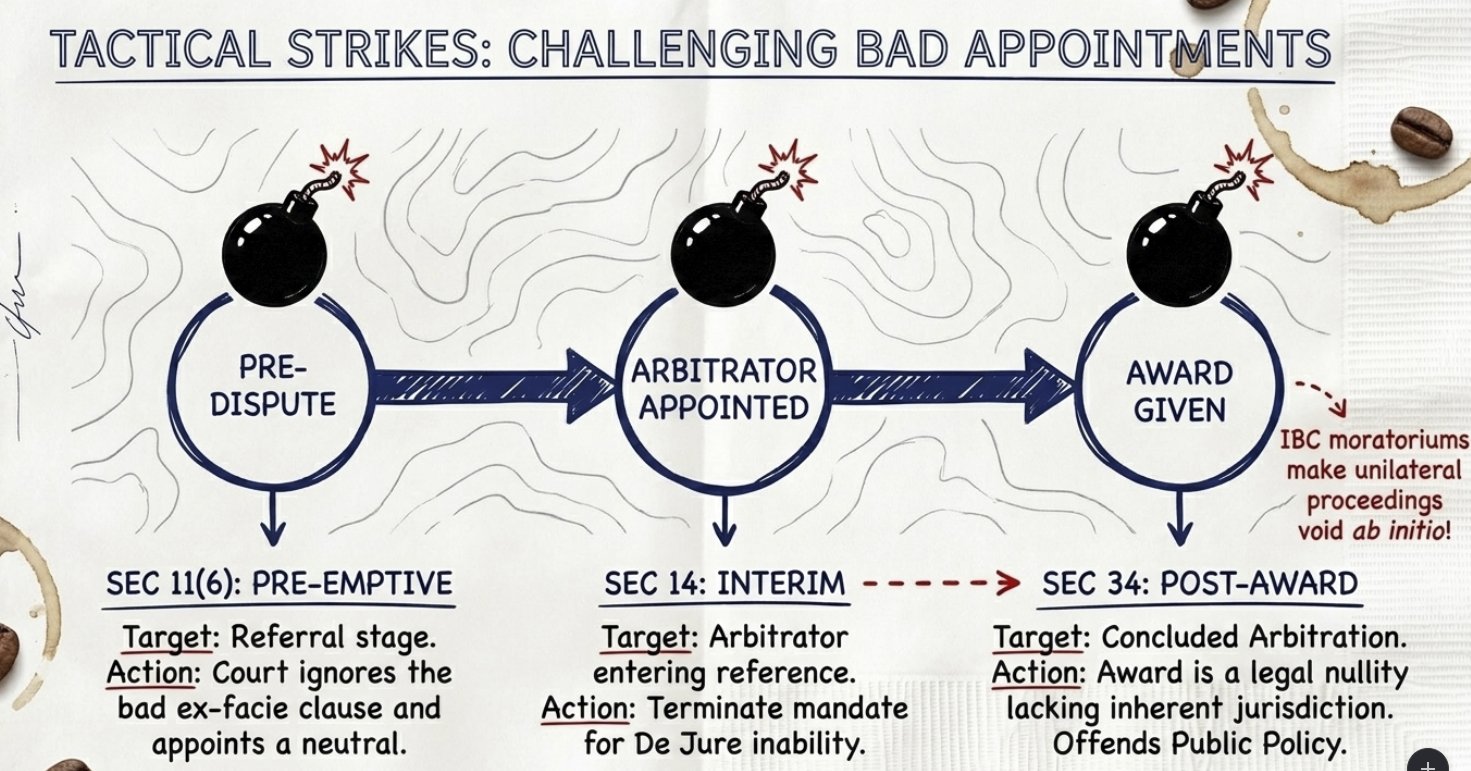
Challenging Unilateral Appointments: Stages and Mechanisms
A party faced with a unilateral appointment has several legal pathways, each governed by different procedural thresholds and timelines.
Pre-emptive Challenge: Section 11(6)
The most effective way to challenge a unilateral appointment is at the referral stage itself. When one party invokes an invalid unilateral appointment clause, the other party can approach the High Court (or Supreme Court in international commercial arbitrations) under Section 11(6) for the appointment of a neutral arbitrator.13 The Court, in such cases, ignores the invalid contractual procedure and exercises its jurisdiction to ensure a neutral appointment.13 The Supreme Court in Perkins emphasized that judicial intervention at this stage is necessary to satisfy the court that the appointment procedure is ex-facie valid and impartial.13
Interim Stage: Section 14 and De Jure Ineligibility
If an arbitrator has already been appointed unilaterally and has entered reference, the aggrieved party can file a petition under Section 14(1)(a) to terminate their mandate.19 Because Section 12(5) ineligibility is a “legal incapacity,” it results in a de jure inability to perform functions.5
- Automatic Termination: Unlike Section 13, which requires a challenge to be filed first before the arbitrator, a Section 14 challenge can be filed directly in court because the termination is considered automatic by operation of law.5
- Moratorium Impact: In the context of the Insolvency and Bankruptcy Code (IBC), any unilateral appointment or arbitral proceedings initiated during a moratorium are considered non-est and void ab initio, further reinforcing the statutory bar.20
Post-Award Stage: Section 34 Challenges and the Nullity of the Award
If the arbitration concludes and an award is rendered by a unilaterally appointed arbitrator, the award remains vulnerable to being set aside under Section 34.21
- Public Policy and Jurisdiction: Courts have consistently held that an award passed by an ineligible arbitrator is a nullity and lacks inherent jurisdiction.9 Such an award necessarily offends the public policy of India, as it violates the fundamental principles of neutrality and independence.9
- Retrospective Application: Significantly, the Delhi High Court in Engineering Projects India Ltd. v. Allied Construction (2026) clarified that the legal principles regarding Section 12(5) and unilateral appointments operate retrospectively.21 This means even older awards can be challenged if the appointment was fundamentally flawed and no valid post-dispute waiver was executed.9
Banking, NBFCs, and Contracts of Adhesion
The issue of unilateral appointment is acutely prevalent in banking and NBFC loan agreements. These are typically “standard-form contracts” or “contracts of adhesion,” where the borrower is presented with terms on a “take-it-or-leave-it” basis.23
The Disparity of Power and Duress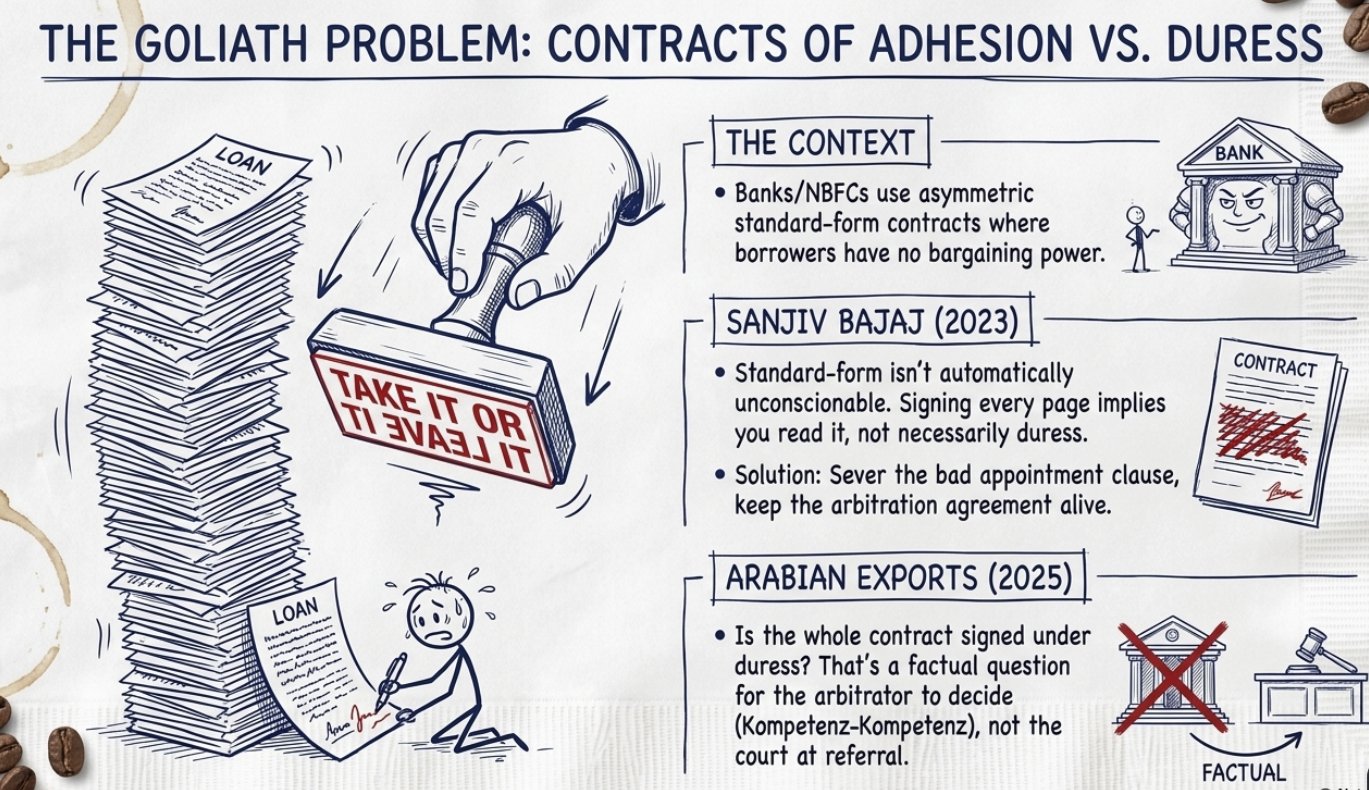
In these agreements, the lender often reserves the unilateral right to appoint an arbitrator or chooses between arbitration and litigation (asymmetric clauses).23 Borrowers often sign these agreements under financial pressure or oversight, which raises the question of duress. While the Brojo Nath Ganguly doctrine establishes that unconscionable clauses in contracts with a gross disparity in power are void under Section 23 of the Contract Act, Indian courts have been cautious in applying this to purely commercial transactions.24
In the case of Sanjiv Bajaj & Anr. vs. Dr. Inder Sanjeev Verma (2023), the Delhi District Court addressed whether a banking arbitration clause was unconscionable because the borrower signed every page under the lender’s superior bargaining power.27 The court ruled that:
- Standard-form commercial contracts are generally binding and do not automatically imply unconscionability.27
- The act of signing every page is viewed as evidence that the party had the opportunity to read the terms, rather than as a proof of duress.27
- However, even if the “unilateral appointment” mechanism in the contract is invalid under the Perkins principle, the underlying agreement to arbitrate remains valid. The court can simply sever the offending appointment procedure and appoint a neutral arbitrator under Section 11.18
Duress and Arbitrability
The Supreme Court in Arabian Exports Pvt. Ltd. v. National Insurance Co. Ltd. (2025) recently clarified the interaction between allegations of duress and arbitration.28 The Court held that whether a document (like a discharge voucher or a contract) was signed under economic duress or coercion is a question of fact that must be decided by the arbitral tribunal, not the court at the referral stage.28 This strengthens the Kompetenz-Kompetenz doctrine, ensuring that arbitration remains the primary forum for resolving these factual disputes even when the validity of the contract is challenged.28
The Notice Principle and the Effect of Inaction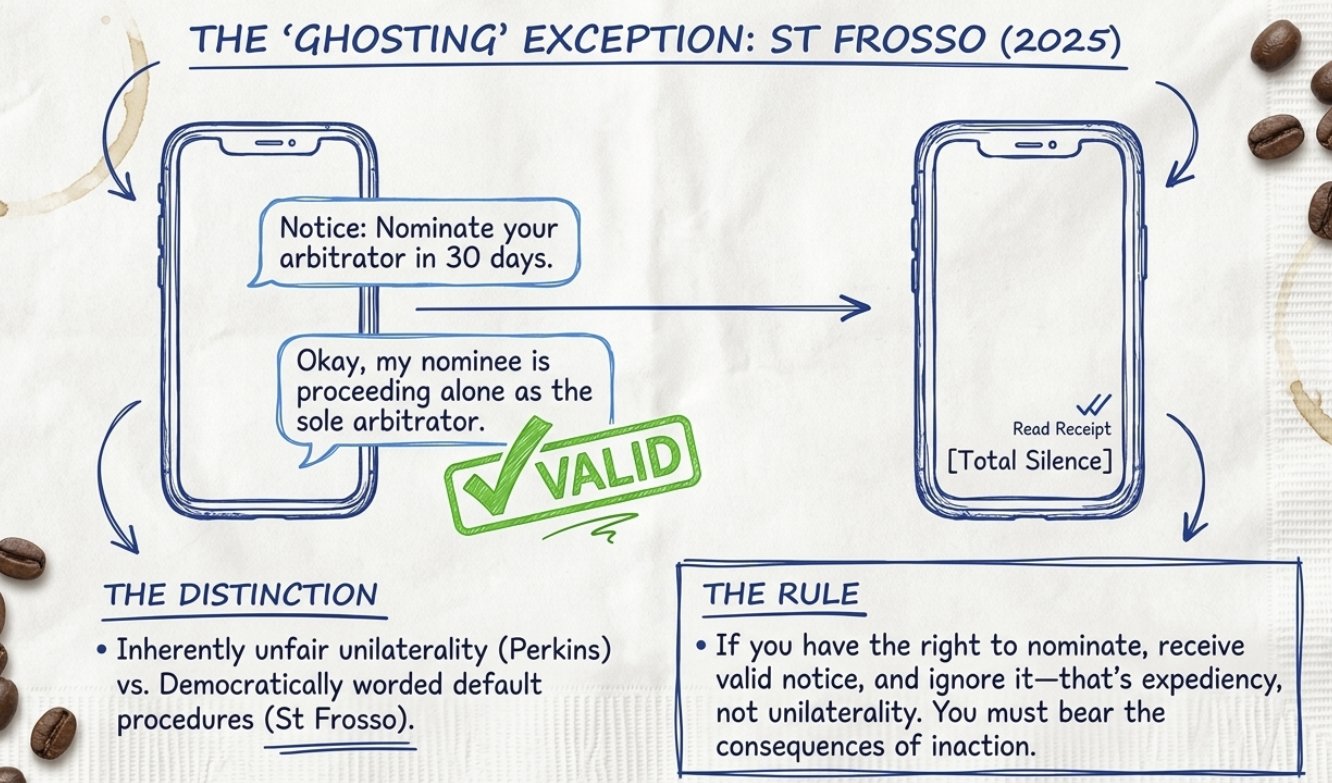
A critical area of recent jurisprudential development is the “notice principle,” which examines whether a notice for a unilateral appointment is sufficient to validate the process if the other party remains silent.
Distinguishing Unilaterality from Default Procedure
In St Frosso Shipping Corporation v. M/s Eastern Multitrans Logistics (2025), the Telangana High Court distinguished between an inherently unfair one-sided clause and a “democratically worded” default procedure.29
- Democratically Worded Clauses: If an agreement gives both parties the right to nominate an arbitrator and provides that if one party fails to do so after receiving notice, the first party’s nominee will proceed as the sole arbitrator, such an appointment is generally valid.29
- The Element of Choice: The Court reasoned that in such cases, the counterparty was not deprived of their right to participate; they simply failed to exercise it.29 This is a matter of “expediency” rather than “unilaterality”.29
- Consequences of Silence: A party that chooses silence following a valid notice of appointment must bear the consequences of their inaction. They cannot later use the Perkins principle as a shield to challenge an award if they had a fair opportunity to participate but deliberately avoided it.29
| Scenario | Validity of Appointment | Legal Rationale |
| Clause gives Party A exclusive power to appoint a Sole Arbitrator. | Invalid | Violates Perkins principle of exclusivity and neutrality. |
| Party A MD nominates an Arbitrator. | Invalid | Violates TRF principle of derivative ineligibility. |
| Both parties have right to nominate; Party B fails to respond to notice. | Valid | Viewed as a default procedure/expediency under St Frosso. |
| Party B participates in 50 sittings without written objection. | Invalid | Section 12(5) waiver must be express and in writing; participation is not enough. |
The Binding Nature of Unilateral Clauses and Future Prospects
For a “new” unilateral appointment of an arbitrator today, the binding nature is fragile. While the underlying agreement to refer disputes to arbitration is likely to survive, the specific unilateral procedure is almost certainly unenforceable.18
Retrospective Vulnerability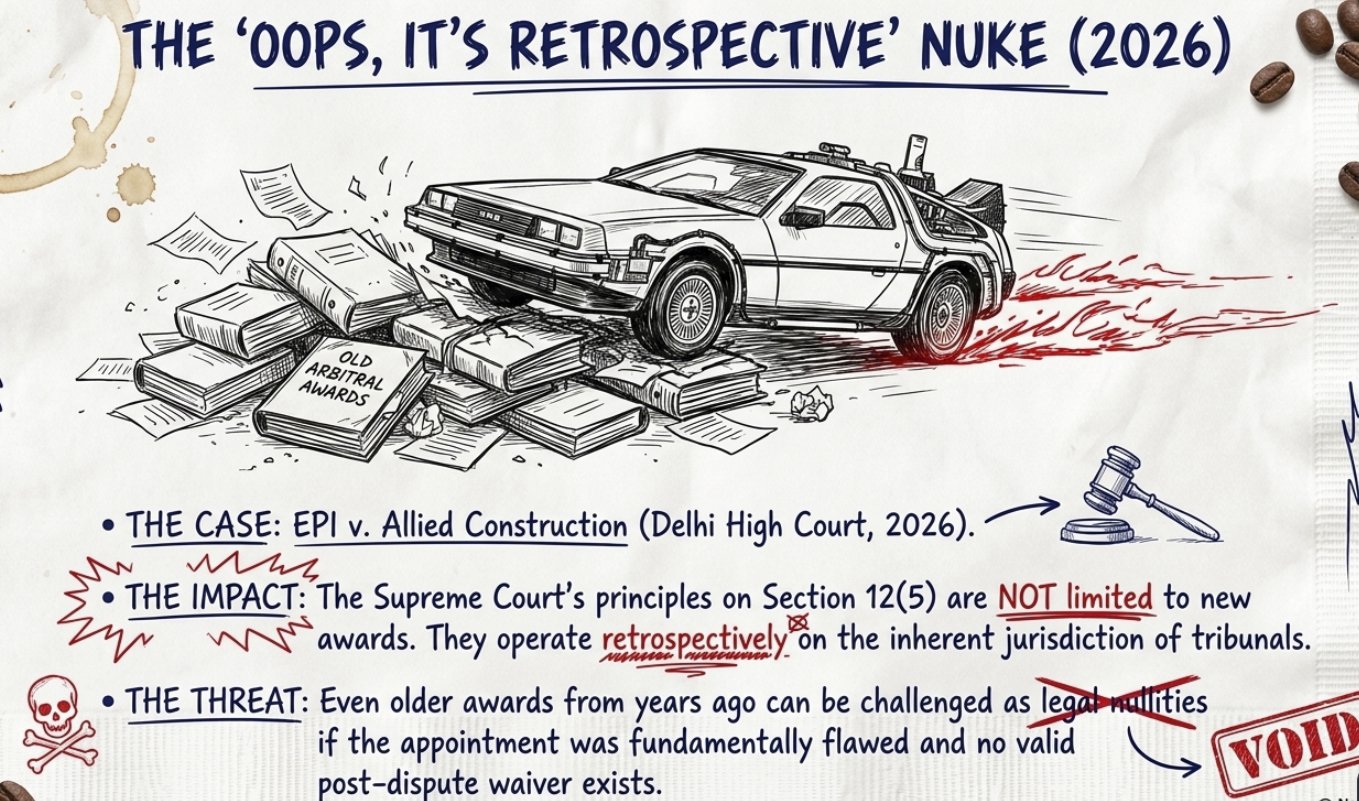
The most significant “prospect” for parties involved in ongoing or past arbitrations is the potential for awards to be declared nullities. As clarified in EPI v. Allied Construction (2026), the law laid down by the Supreme Court on Section 12(5) is not limited to awards passed after the relevant judgments; it has a retrospective effect on the inherent jurisdiction of the tribunal.21 This opens the door for new objections in pending challenges to arbitral awards.2
Strategic Litigation Advice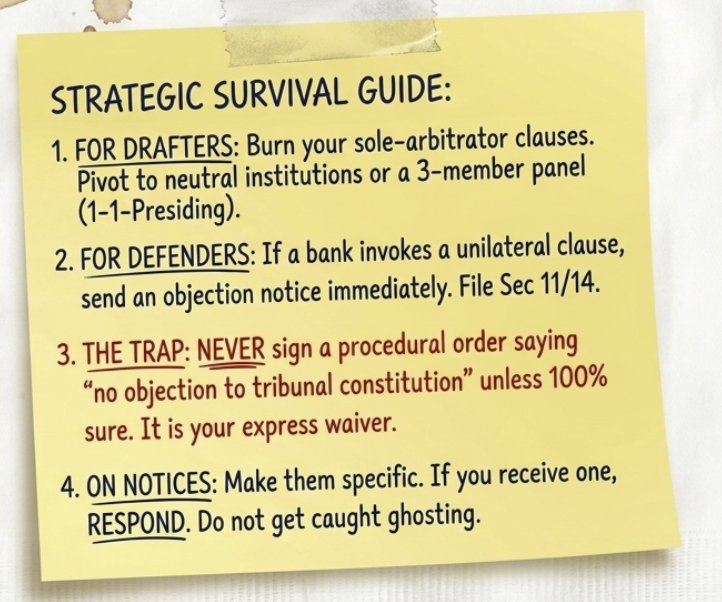
For practitioners and parties:
- Drafting: Move away from sole-arbitrator clauses that favor one party. Instead, utilize neutral institutional appointments or a three-member panel where each party appoints one arbitrator and the two appointees choose the presiding arbitrator.8
- Invocation: If a bank or NBFC attempts a unilateral appointment, immediately serve a notice of objection and approach the court for a Section 11 or Section 14 remedy.8
- Waiver: Be extremely cautious about signing any procedural order that records “no objection” to the tribunal’s constitution unless you are certain of the arbitrator’s independence. Such a recording may later be argued as an “express agreement in writing”.5
- Notice: Ensure that any notice for appointment is specific, identifies the disputes, and adheres strictly to the contractual timelines. Failure to respond to a notice for a multi-party appointment can lead to a valid default sole arbitrator under the St Frosso rule.9
Conclusion
The legal framework regarding the unilateral appointment of arbitrators in India has reached a point of zero tolerance for one-sided procedures that compromise adjudicatory neutrality. The statutory mandate of Section 12(5), reinforced by the TRF, Perkins, and CORE-II judgments, ensures that the principle of “nemo judex in causa sua” (no one should be a judge in their own cause) is strictly applied not only to the arbitrator but to the very process of appointment. While banking and NBFC agreements continue to utilize standard-form contracts, the courts have provided a robust mechanism for borrowers to challenge these clauses, either through pre-emptive Section 11 petitions or by declaring resulting awards as nullities under Section 34. The future of Indian arbitration lies in fostering a level playing field where party autonomy is balanced against the fundamental constitutional right to an equal and impartial hearing. As the 2026 jurisprudence from the Delhi High Court suggests, this is a fundamental policy shift that affects past, present, and future disputes, cementing India’s commitment to a fair and transparent arbitral regime.
Works cited
- Section 12(5) & Seventh Schedule: Arbitrator Ineligibility Guide – Supreme Today AI, accessed on April 18, 2026, https://supremetoday.ai/issue/section-12-5-seventh-schedule-arbitrator-ineligibility
- From Bias to Balance: Indian Supreme Court’s Stand on Unilateral Arbitrator Appointments, accessed on April 18, 2026, https://legalblogs.wolterskluwer.com/arbitration-blog/from-bias-to-balance-indian-supreme-courts-stand-on-unilateral-arbitrator-appointments/
- Balancing party autonomy and equal treatment of parties: Indian Supreme Court’s decision on unilateral arbitrator appointments | Herbert Smith Freehills Kramer | Global law firm, accessed on April 18, 2026, https://www.hsfkramer.com/notes/arbitration/2024-posts/Balancing-party-autonomy-and-equal-treatment-of-parties–Indian-Supreme-Court-s-decision-on-unilateral-arbitrator-appointments-
- Perkins and TRF Principles in Arbitration | PDF – Scribd, accessed on April 18, 2026, https://www.scribd.com/document/498464516/The-Perkins-principle-and-The-TRF-principle
- Express Written Waiver as the Sole Cure for Section 12(5) Ineligibility: Unilateral Appointment Void and Challengeable Even Under Section 34 – CaseMine, accessed on April 18, 2026, https://www.casemine.com/commentary/in/express-written-waiver-as-the-sole-cure-for-section-12(5)-ineligibility:-unilateral-appointment-void-and-challengeable-even-under-section-34/view
- Trilegal Update | Supreme Court holds unilateral arbitrator …, accessed on April 18, 2026, https://trilegal.com/knowledge_repository/trilegal-update-supreme-court-holds-unilateral-arbitrator-appointments-not-permissible/
- To Perkins or Not to Perkins – Argus Partners, accessed on April 18, 2026, https://www.argus-p.com/papers-publications/thought-paper/to-perkins-or-not-to-perkins/
- The Battle Over Unilateral Appointments in India – Anhad Law, accessed on April 18, 2026, https://www.anhadlaw.com/post/the-battle-over-unilateral-appointments-in-india
- Arbitration Newsletter| March 2026 – Dentons Link Legal, accessed on April 18, 2026, https://www.dentonslinklegal.com/en/insights/newsletters/2026/april/14/arbitration/arbitration-newsletter-march-2026
- Unilateral Appointment of Arbitrator in India – Neeti Niyaman, accessed on April 18, 2026, https://neetiniyaman.com/unilateral-appointment-arbitrator-india/
- TRF Limited V Energo Engineering Projects Ltd (201 – Legal Heights, accessed on April 18, 2026, https://legalheights.in/blog-single.php?b_id=126
- Case analysis of Perkins Eastman architects DPC & ANR. V. HSCC (India) LTD – International Journal of Law, accessed on April 18, 2026, https://www.lawjournals.org/assets/archives/2020/vol6issue4/6-4-74-245.pdf
- Perkins Eastman Architects Dpc & Another v. HSCC (India) Ltd. | Mapping ADR, accessed on April 18, 2026, https://jgu.edu.in/mappingADR/perkins-eastman-architects-dpc-another-v-hscc-india-ltd/
- From Bias to Balance: Supreme Court Levels the Playing Field in Unilateral Appointment of Arbitrator, accessed on April 18, 2026, https://ccadr.cnlu.ac.in/blog/arbitration/unilateral-arbitrator-appointment-supreme-court/
- “Supreme Court’s Landmark Judgment on Arbitrator Appointment in Public-Private Contracts” “Balancing Party Autonomy and Equality in Arbitration Proceedings” – Lawtext, accessed on April 18, 2026, https://www.lawtext.in/judgement.php?bid=1155&ref=LT000008
- Unilateral appointment of arbitrators case | An issue for public or private law? – Supreme Court Observer, accessed on April 18, 2026, https://www.scobserver.in/journal/unilateral-appointment-of-arbitrators-case-an-issue-for-public-or-private-law/
- Arbitration Edge – Kochhar, accessed on April 18, 2026, https://kochhar.com/wp-content/uploads/2025/02/KCo_Arbitration-Edge-1.pdf
- Enforceability Of Arbitration Clauses Which Provide Unilateral Appointment Procedures | Kochhar, accessed on April 18, 2026, https://kochhar.com/wp-content/uploads/2025/10/Enforceability-Of-Arbitration-Clauses-Which-Provide-Unilateral-Appointment-Procedures.pdf
- Mahua Bhaumik And Anr vs Urgo Capital Limited on 19 December, 2025 – Indian Kanoon, accessed on April 18, 2026, https://indiankanoon.org/doc/172086081/
- Unilateral Arbitrator Appointment Invalid Under Arbitration Law – Mahendra Bhavsar & Co., accessed on April 18, 2026, https://mahendrabhavsar.com/unilateral-arbitrator-appointment-invalid-under-arbitration-law/
- Delhi High Court Holds Unilateral Appointment of Arbitrator by Party …, accessed on April 18, 2026, https://ibclaw.in/delhi-high-court-holds-unilateral-appointment-of-arbitrator-by-party-employee-void-ab-initio-under-section-125-of-arbitration-act/
- * IN THE HIGH COURT OF DELHI AT NEW DELHI % Judgment delivered on: 31.05.2025 + FAO (COMM) 170/2023 M/s MAHAVIR PRASAD GUPTA A, accessed on April 18, 2026, https://delhihighcourt.nic.in/app/showFileJudgment/68731052025FAOC1702023_093626.pdf
- UNILATERAL CLAUSES IN ARBITRATION: VALIDITY AND ENFORCEMENT – NLIU Law Review, accessed on April 18, 2026, https://nliulawreview.nliu.ac.in/wp-content/uploads/2021/12/Volume-IV-Issue-II-53-72.pdf
- LEGALITY OF UNILATERAL ARBITRATION CLAUSES IN INDIA: A …, accessed on April 18, 2026, https://gnlusrdcadrmagazine.com/wp-content/uploads/2024/02/10.-Article-3.pdf
- unequal+bargaining+power | Indian Case Law – CaseMine, accessed on April 18, 2026, https://www.casemine.com/search/in/unequal%2Bbargaining%2Bpower
- Central Inland Water Transport Corporation Ltd. & Anr. Etc. Vs. Brojo Nath Ganguly & Anr. Case Summary You Can Listen To on Caseon, accessed on April 18, 2026, https://www.caseon.in/case/central-inland-water-transport-corporation-ltd-anr-etc-vs-brojo-nath-ganguly-anr
- Sanjiv Bajaj & Anr. vs . Dr. Inder Sanjeev Verma on 17 August, 2023, accessed on April 18, 2026, https://indiankanoon.org/doc/37790016/
- When “Full and Final” is Not Final: Supreme Court on Economic Duress and Arbitration, accessed on April 18, 2026, https://indiacorplaw.in/2025/09/04/when-full-and-final-is-not-final-supreme-court-on-economic-duress-and-arbitration/
- Not All Unilateral Appointments are Unfair: Lessons from St Frosso, accessed on April 18, 2026, https://www.irccl.in/post/not-all-unilateral-appointments-are-unfair-lessons-from-st-frosso
- No Setting Aside Of An Arbitral Award On Basis Of Unilateral Appointment By A Party That Unequivocally Waived Its Right to Object/Failed to Challenge the Appointment of Sole Arbitrator – AZB & Partners, accessed on April 18, 2026, https://www.azbpartners.com/bank/no-setting-aside-of-an-arbitral-award-on-basis-of-unilateral-appointment-by-a-party-that-unequivocally-waived-its-right-to-object-failed-to-challenge-the-appointment-of-sole-arbitrator/