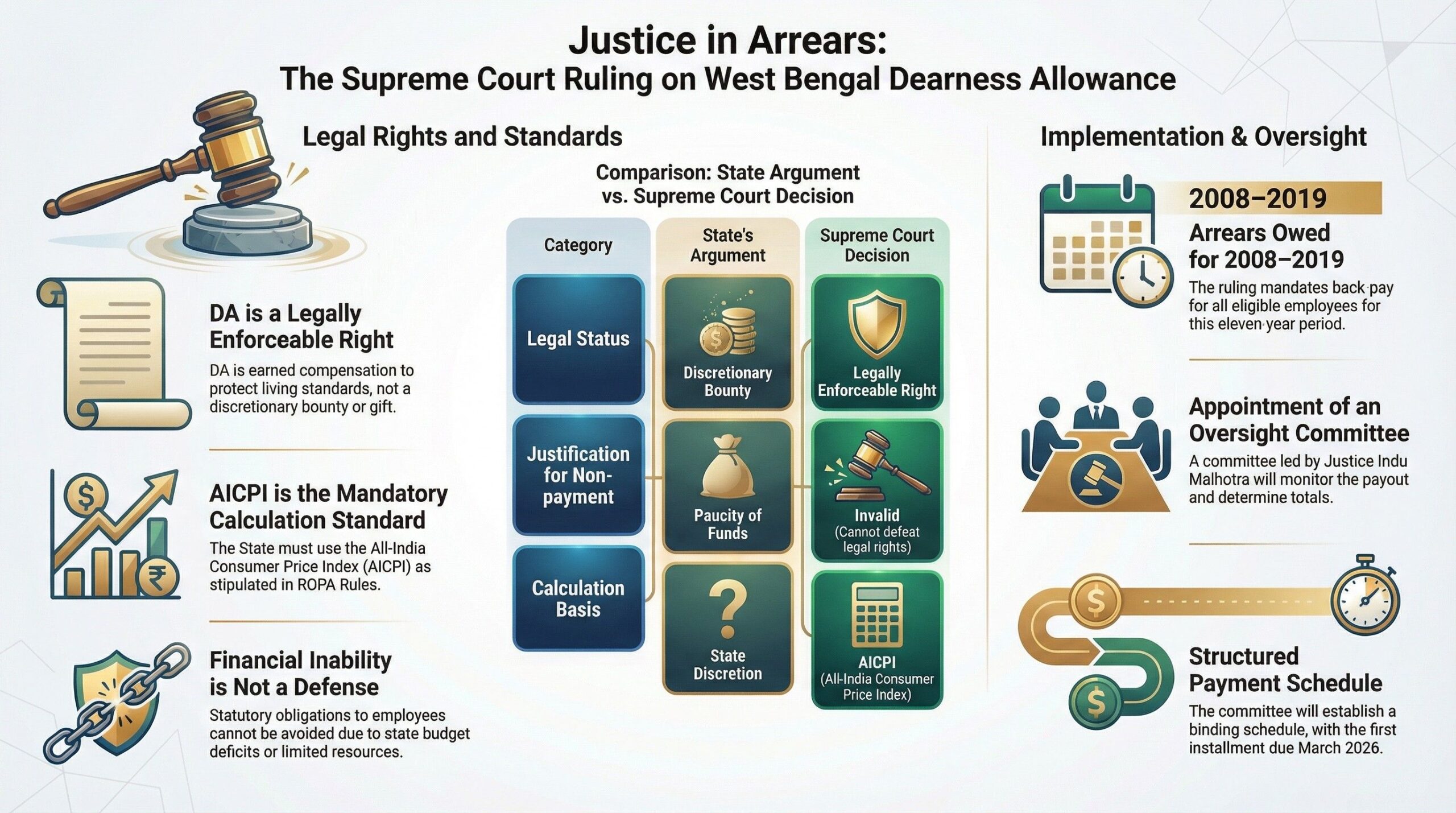
- Supreme Court (2026) reaffirmed DA as a legally enforceable, vested right under Article 21, not a discretionary bounty.
- RoPA Rules 2009 incorporated the AICPI index, creating a statutory anchor for DA calculations.
- The State’s administrative memoranda deviating from the AICPI anchor were held ultra vires and manifestly arbitrary.
- The Court rejected paucity of funds as a defence; DA is a State’s debt, not a charitable relief.
- Arrears for 2008–2019 mandated; retired employees during litigation are entitled to benefits.
- A high-level Monitoring Committee (Chair: Justice Indu Malhotra) to determine dues and enforce a payment schedule.
- The Court denied mandatory twice-a-year DA payments; frequency remains administrative discretion, not statutory.
The West Bengal Dearness Allowance Judgment (2026 INSC 123)
Creditor and contributor of this article:
Patra’s Law Chambers:
About Us:
Patra’s Law Chambers is a law firm with offices in Kolkata & Delhi, offering comprehensive legal services across various domains. Established in 2020 by Advocate Sudip Patra (Advocate, Supreme Court of India & Calcutta High Court) an alumnus of the Prestigious Rajiv Gandhi School of Intellectual Property Law, IIT Kharagpur , the firm specializes in Civil, Criminal, Writs,High Court Matters, Trademark, Copyright, Company, Tax, Banking, Property disputes, Service law, Family law, and Supreme Court matters.You can know more about us in here
Kolkata Office:
NICCO HOUSE, 6th Floor, 2, Hare Street, Kolkata-700001 (Near Calcutta High Court)
Delhi Office:
House no: 4455/5, First Floor, Ward No. XV, Gali Shahid
Bhagat Singh, Main Bazar Road, Paharganj, New Delhi-110055
Website: www.patraslawchambers.com
Email: [email protected]
Phone: +91 890 222 4444/ +91 7003 725 325
The resources:
West Bengal DA judgement.PDF
KEY DIRECTIONS INFOGRAPHICS.PDF
-
Exordium: The Welfare State and the Constitutional Promise of Dignity:
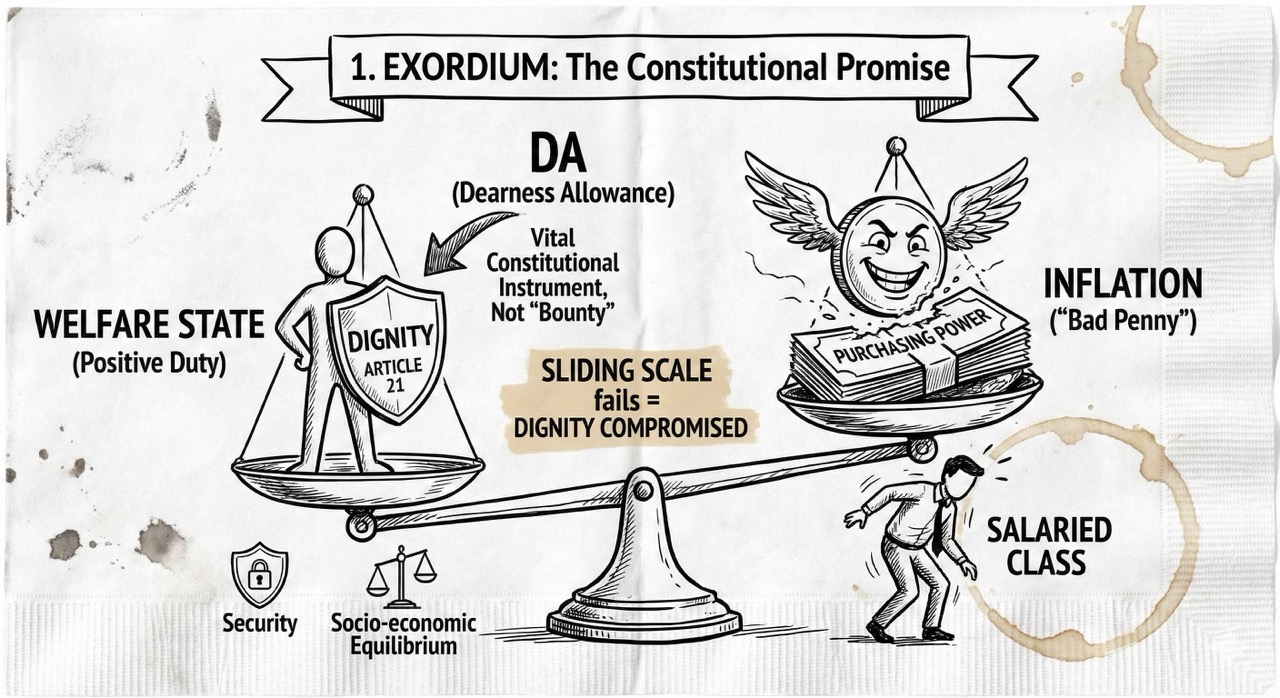
In the contemporary landscape of Indian administrative jurisprudence, the “Welfare State” is not a mere rhetorical flourish but a foundational mandate that imposes a positive duty upon the State to ensure the socio-economic equilibrium of its citizenry. In State of West Bengal v. Confederation of State Government Employees, the Supreme Court reaffirms that the role of the State transcends the minimalist “night-watchman” functions of law and order, extending into the proactive creation of conditions where individuals live with security and dignity.
The Court strategically characterizes inflation as the “bad penny” of modern economics—a persistent threat that erodes purchasing power and strikes at the heart of the salaried class. By synthesizing the “model employer” doctrine with human rights, the Court anchors the payment of Dearness Allowance (DA) within the expansive ambit of Article 21. Drawing upon the felicitous articulation of P.N. Bhagwati J. in Francis Coralie Mullin, the judgment reminds us that the right to life is not a mandate for mere animal existence; it is the right to live with human dignity, encompassing the bare necessities of life. Dignity is compromised when the “sliding scale” of compensation fails to keep pace with the rising cost of living. Consequently, DA is not a “bounty” or an act of ex-gratia benevolence; it is a vital constitutional instrument for preserving the substance of a living wage. This philosophical grounding provides the necessary context for the legal dissection of the West Bengal Revision of Pay and Allowance (RoPA) Rules.
-
The Statutory Framework: RoPA Rules 2009 and the AICPI Anchor:
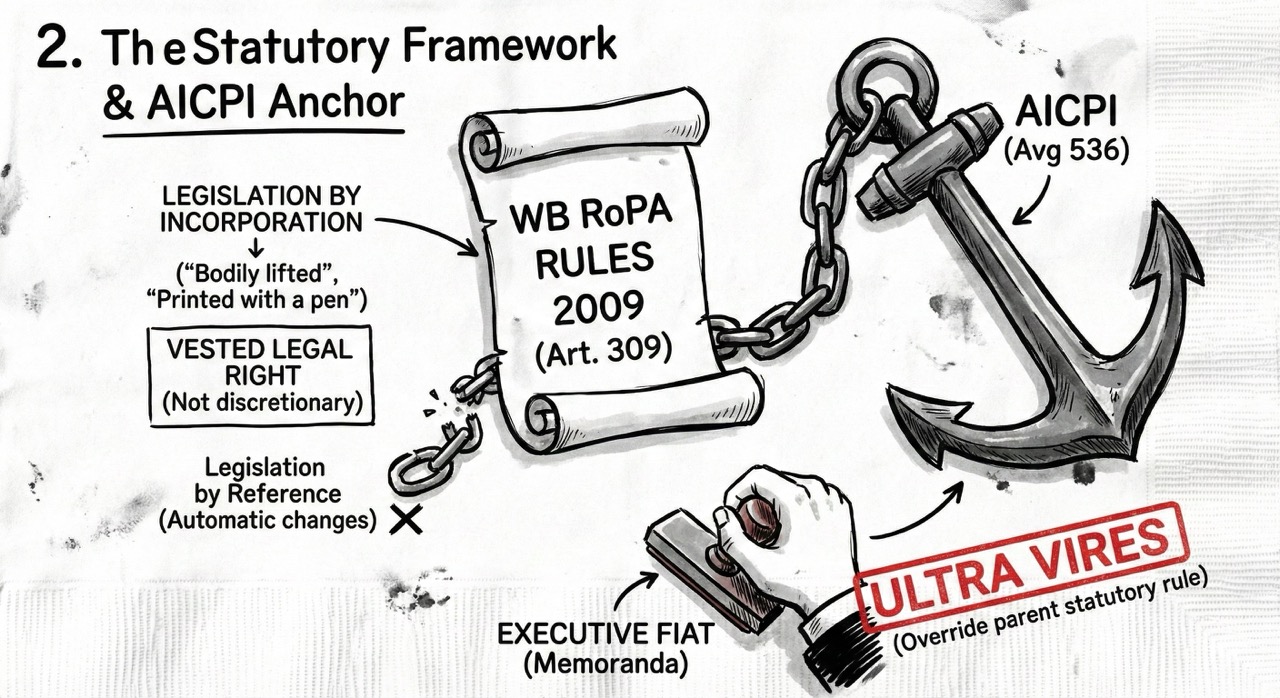
The epicenter of this controversy lies in the West Bengal Services (Revision of Pay and Allowance) Rules, 2009, promulgated under the proviso to Article 309 of the Constitution. These Rules, having retrospective effect from January 1, 2006, carry the full force of law, superseding previous executive instructions.
Vested Rights under Rule 3(1)(c): Rule 3(1)(c) defines “existing emoluments” with clinical precision, stating they mean the aggregate of:
- (i) existing basic pay;
- (ii) dearness pay appropriate to the basic pay; and
- (iii) dearness allowance appropriate to the basic pay plus dearness pay at index average 536 (1982=100).
The “So What?” Layer: Legislation by Incorporation The strategic legal significance here is the distinction between “legislation by reference” and “legislation by incorporation.” As articulated in Rakesh Vij v. Raminder Pal Singh Sethi and the Constitution Bench decision in Girnar Traders (3) v. State of Maharashtra, by “bodily lifting” the All-India Consumer Price Index (AICPI) average 536 from the Central Government’s rules, the State Legislature performed an act of incorporation.
Unlike mere reference—where subsequent changes in the parent law might apply automatically—incorporation writes the external provision into the new Act as if “printed with a pen.” By adopting this specific national anchor, the State effectively waived its fiscal autonomy regarding the method of calculation. This created a vested legal right rather than a discretionary benefit. The State’s subsequent administrative memoranda, which attempted to decouple DA rates from this statutory anchor, constitute an ultra vires attempt to override a parent statutory rule through inferior executive fiat.
-
Procedural Chronology: From the Tribunal to the Apex Court:
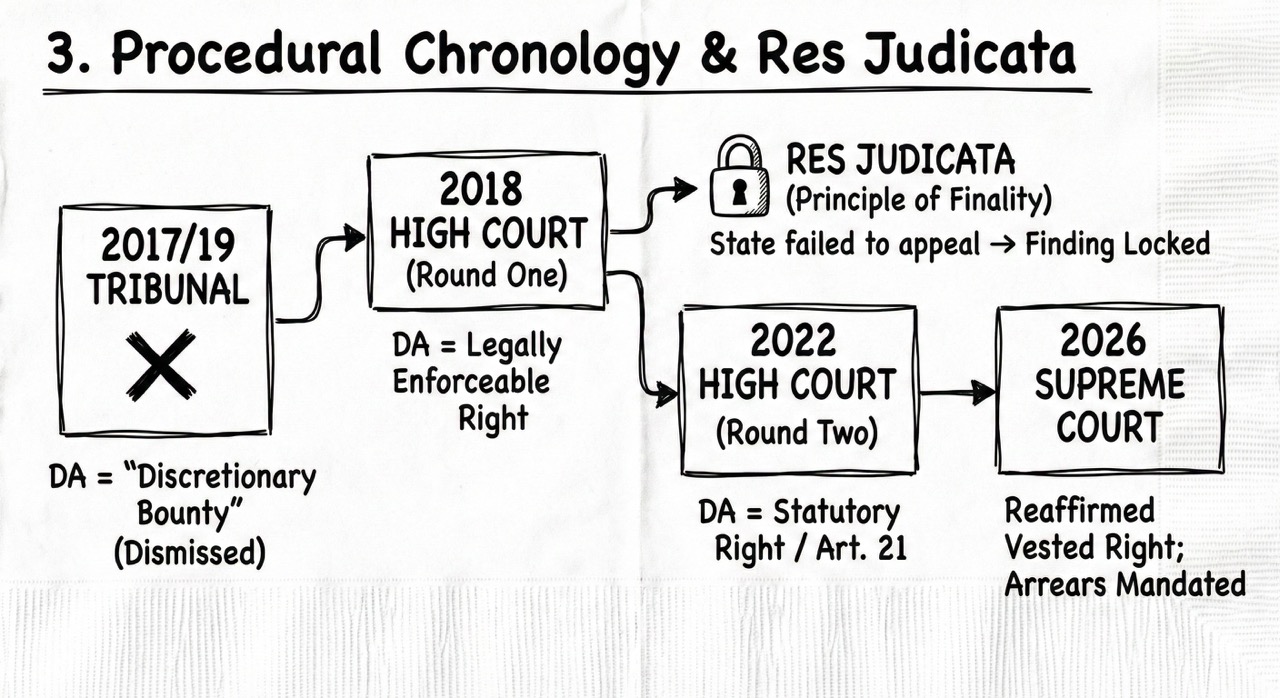
The litigation followed a tortured path through multiple forums, ultimately testing the principle of finality in judicial pronouncements.
| Phase | Forum | Finding on DA Status | Result |
| 2017/2019 | Administrative Tribunal | Characterized DA as a discretionary “bounty.” | Application initially dismissed. |
| 2018 (Round One) | High Court at Calcutta | Declared DA a Legally Enforceable Right and a component of pay. | Remanded for rate adjudication. |
| 2022 (Round Two) | High Court at Calcutta | Confirmed DA as a Statutory Right and a facet of Article 21. | State’s challenge dismissed. |
| 2026 | Supreme Court | Reaffirmed Vested Right; rejected State’s fiscal defenses. | Appeals partly allowed; Arrears mandated. |
Finality and Res Judicata The State’s failure to appeal the “Round One” judgment (2018) proved fatal. By merely seeking a review (which was dismissed), the State allowed the High Court’s finding—that DA is a legally enforceable right—to attain the status of res judicata. The Principle of Finality precluded the State from later reverting to the “discretionary bounty” argument before the Supreme Court.
The 13 Questions of Law The Supreme Court was required to resolve a comprehensive list of questions, including:
- The scope of power under Article 309.
- The consonance of subsequent memoranda with RoPA Rules.
- The impact of “legislation by incorporation.”
- Whether DA is static or dynamic.
- The presence of “manifest arbitrariness.”
- Conflict between List I Entry 70 and List II Entry 41.
- Impact of AICPI on State financial autonomy.
- The effect of findings in the first round of litigation.
- Entitlement to DA “twice a year.”
- Whether paucity of funds defeats a legal right.
- The extent of judicial review in fiscal policy.
- DA as a fundamental right under Article 21.
- The impact of delay and laches.
-
Rival Contentions: State Autonomy vs. Employee Entitlement
The rival arguments highlighted the friction between the State’s fiscal sovereignty and its obligations as a “model employer.”
The Appellant-State’s Three Pillars:
- Financial Incapacity: The State pleaded a “paucity of funds,” claiming an additional liability of ₹41,770.95 crores would destabilize the exchequer.
- Legislative Competence: Under List II Entry 41, the State asserted exclusive domain over its services, arguing it was not constitutionally bound to mimic Central Government rates.
- Geographic Differentiation: The State argued that higher DA for employees in New Delhi or Chennai was a permissible “class within a class” based on localized cost-of-living differences.
The Respondents’ Entitlement: The employees contended that DA is a “sliding scale” mechanism designed to prevent the erosion of real wages. They asserted the supremacy of Article 309 Rules over Article 162 Memoranda, arguing that once the State adopted the AICPI index in its statutory framework, any deviation without a formal amendment constituted “manifest arbitrariness.”
-
Ratio Decidendi: The Judicial Determination:
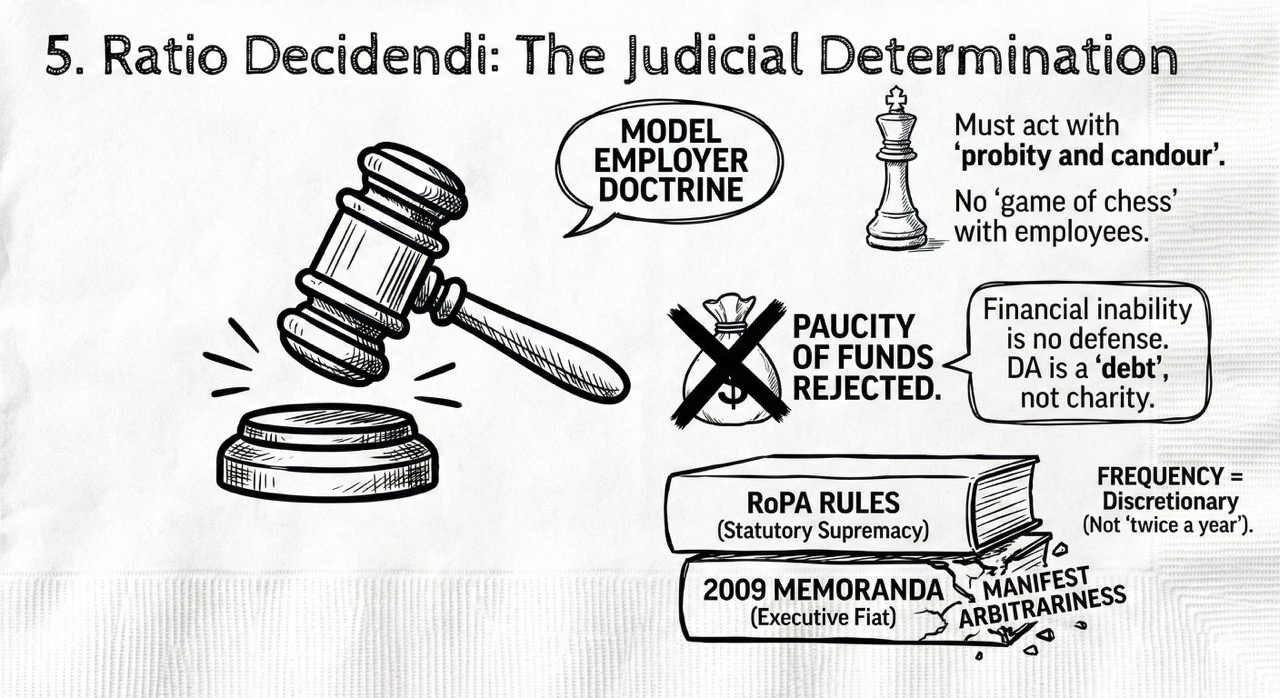
The Court’s ratio clarifies that while a State possesses the discretion to formulate policy, that discretion is fettered once crystallized into a statutory rule.
- The Model Employer Doctrine: The Court held that the State must conduct itself with “high probity and candour.” As a model employer, it cannot play a “game of chess” with the legitimate aspirations of its employees.
- Paucity of Funds Rejection: Citing G.S. Uppal and Dinavahi Lakshmi Kameswari, the Court forcefully held that financial inability is no defense against the payment of earned compensation. To allow such a plea would render the State’s legal obligations “illusory.” DA is a “debt of the State,” not a charitable handout.
- Statutory Supremacy and the Doctrine of Severance: Applying the Doctrine of Severance, the Court held that while the RoPA Rules remain valid, the 2009 Clarificatory Memoranda are hit by “manifest arbitrariness.” These executive documents were ex-facie unreasonable because they ignored the AICPI anchor mandated by the parent Rules without any independent, logic-based study by the State.
The Nuance on Frequency: The Court rejected the claim for “twice a year” payments. It found a “deliberate omission” in the RoPA Rules regarding a fixed schedule. While the calculation method (AICPI) was a binding statutory right, the frequency was a matter of administrative discretion, as the Rules did not explicitly mandate a biannual update.
-
Directions and Implementation: The 2026 Monitoring Committee:
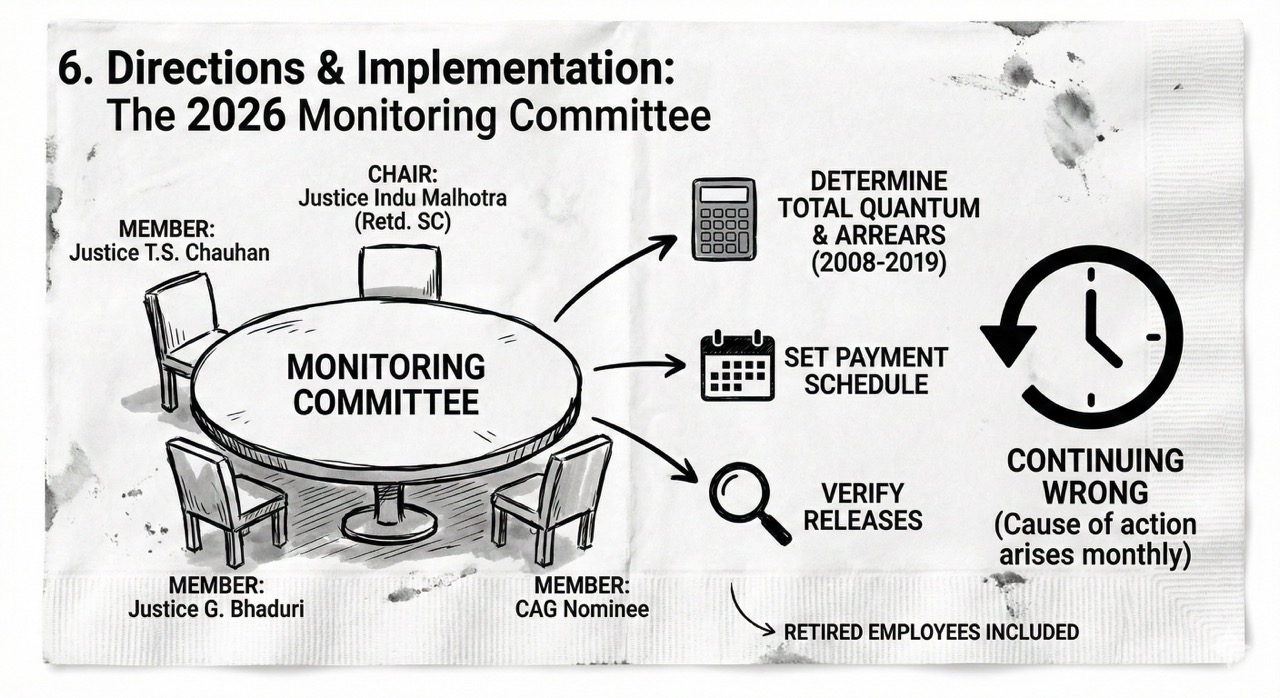
The Court rejected the defense of “delay and laches,” characterizing the non-payment as a “continuing wrong.” Since the cause of action arises every month a salary is underpaid, the employees’ challenge was deemed timely.
The Monitoring Committee To prevent the judgment from becoming a “paper victory,” the Court constituted a high-level Monitoring Committee to oversee the structured release of arrears.
- Chairperson: Hon’ble Ms. Justice Indu Malhotra.
- Members: Justice Tarlok Singh Chauhan, Justice Goutam Bhaduri, and a nominee from the Comptroller and Auditor General (CAG).
- Mandate: Determine the total quantum due, set a binding payment schedule, and verify releases.
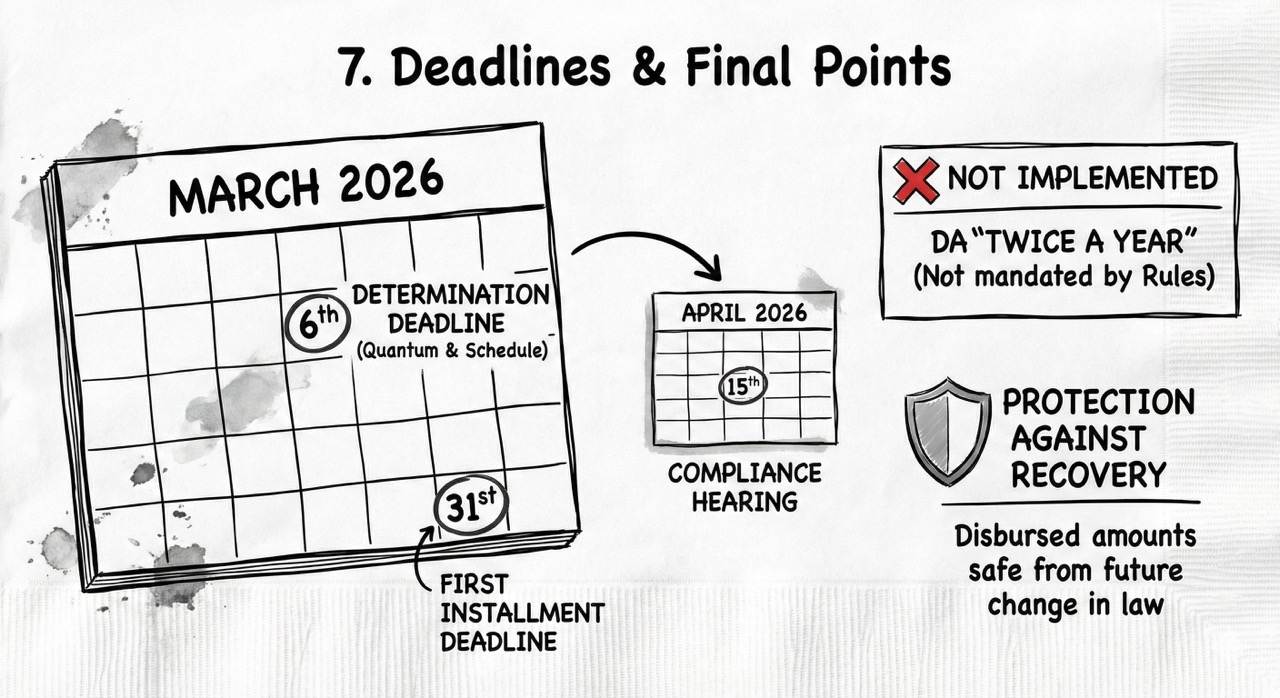
- Key Deadlines: Determination of dues by March 6, 2026; Disbursement of the first installment by March 31, 2026.
Based on the judgment delivered on February 5, 2026, the Supreme Court has laid out a specific framework for the implementation of the Dearness Allowance (DA) order. The Court established the employees’ legally enforceable right to DA and created a structured mechanism to ensure payment.
Here are the detailed directions regarding how the order is to be implemented:
-
Basis of Calculation and Rights:
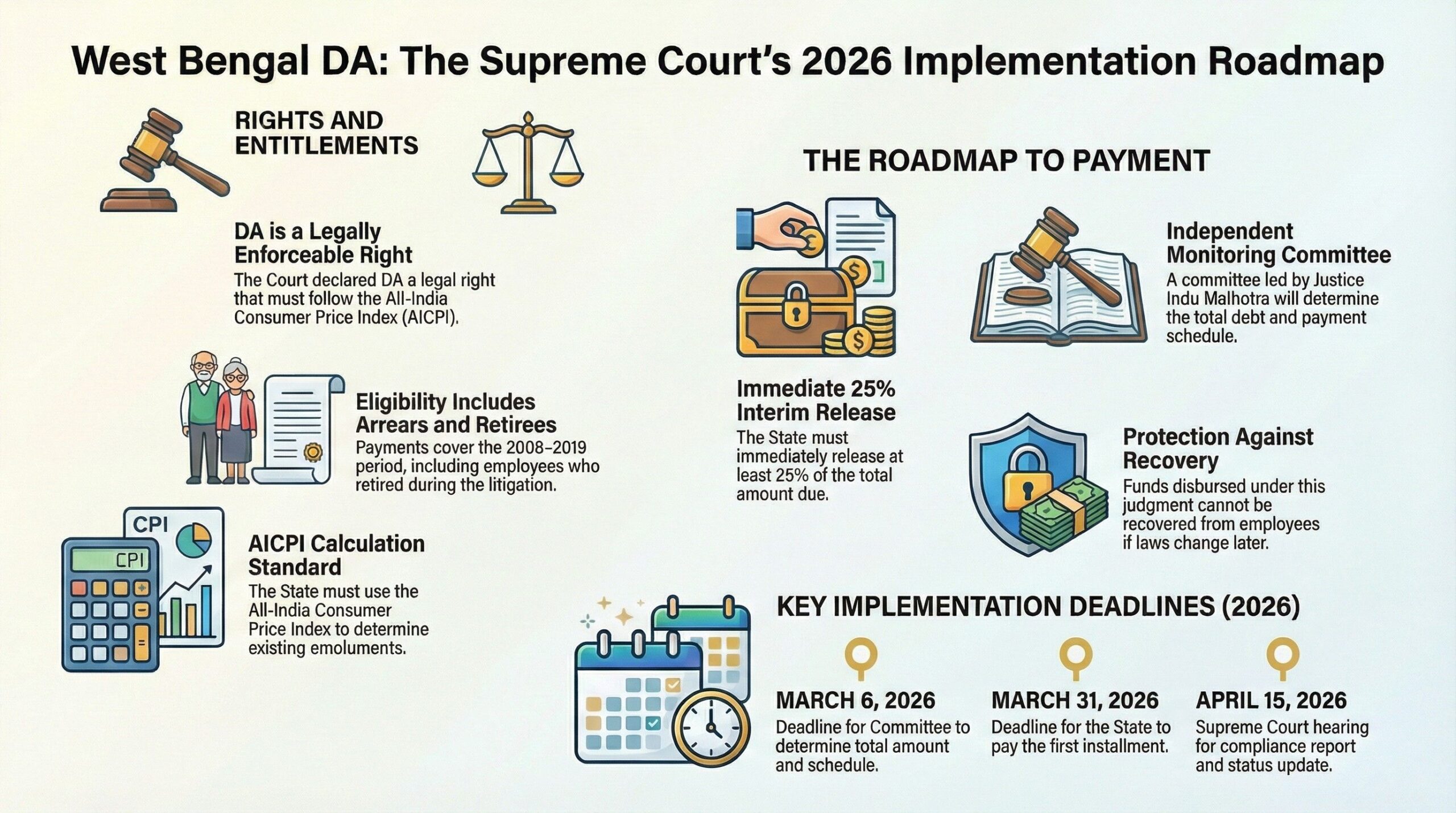
The Court has issued a declarative direction that receiving Dearness Allowance is a legally enforceable right for the employees of the State of West Bengal.
- The Standard: The State must strictly follow the All-India Consumer Price Index (AICPI) to determine “existing emoluments.” This is based on the finding that the State incorporated the AICPI into its Revision of Pay and Allowance (RoPA) Rules and cannot arbitrarily deviate from it.
- Arrears Period: The employees are entitled to the release of arrears specifically for the period between 2008 and 2019.
- Retired Employees: It is explicitly clarified that employees who retired during the pendency of this litigation are also entitled to these benefits.
-
Immediate Financial Compliance (Interim Order):
The Court reiterated an interim order passed earlier on May 16, 2025. The State is directed to comply with this immediately.
- Requirement: The State must release at least 25% of the amount due and payable to all employees.
- Context: This direction was given because the Court held that employees should not be kept waiting endlessly for their money while the legal issues regarding whether DA is a “fundamental right” were being deliberated.
-
Constitution of a Monitoring Committee:
Recognizing the significant financial implications and the need to balance the State’s exchequer with the employees’ rights, the Court has constituted a specific Committee to monitor the implementation.
Composition of the Committee:
- Chairperson: Hon’ble Ms. Justice Indu Malhotra (Retired Supreme Court Judge).
- Members: Justice Tarlok Singh Chauhan and Justice Goutam Bhaduri (Former Chief Justice/Judge of High Court).
- Member: The Comptroller and Auditor General (CAG) of India or a senior-most officer nominated by him.
Mandate and Tasks: The Committee is tasked with consulting State authorities to determine three specific things:
- The total amount to be paid.
- The schedule of payments, which the State will be bound to follow.
- Periodic verification of the release of funds.
Logistics:
- The State of West Bengal must bear all expenses and provide necessary logistical arrangements for the Committee.
- The remuneration for the Committee members is left to the wisdom of the Chairperson.
-
Deadlines and Timeline
The Court has set strict deadlines for this implementation process:
- Determination Phase: The Committee must complete the exercise of determining the total amount and the payment schedule by 6th March 2026.
- First Installment: Subject to the Committee’s determination, the State must pay the first installment by 31st March 2026.
- Compliance Reporting: The State must file a status report indicating the Committee’s determinations, the schedule adopted, and the status of the first payment.
- Next Hearing: The matter is listed for compliance on 15th April 2026.
-
What is NOT Implemented:
It is important to note that while the Court upheld the right to DA based on AICPI, it rejected the claim that DA must be paid twice a year. The judgment clarifies that the RoPA Rules do not mandate a specific frequency for DA payments, and the Tribunal’s earlier direction to pay DA twice a year was without the authority of law. Consequently, the implementation will focus on the rates based on AICPI, not necessarily the frequency of twice a year.
-
Protection Against Recovery:
The order clarifies that if there is any subsequent change in law, any amount disbursed in compliance with this judgment shall not be liable to be recovered from the employees.
The 2026 judgment stands as a powerful reaffirmation that earned compensation is an integral facet of the right to life and livelihood. For the State, acting as a model employer is the price of constitutional legitimacy. The formation of the Monitoring Committee provides the necessary remedy for a “continuing wrong,” ensuring that the promise of a living wage retains its substance against the corrosive force of inflation.