- BNSS, effective July 1, 2024, introduces pre-cognizance notices, altering India's criminal procedure law.
- Section 223 requires a Magistrate to give the accused the opportunity to be heard before taking cognizance.
- Pre-cognizance notices help prevent harassment from false complaints and ensure a fair legal process.
- Accused individuals must respond to pre-cognizance notices, either in person or through a pleader.
- In cheque bounce cases, procedures entail examining the complainant and issuing notices to the accused.
- The new provisions enhance access to justice and optimize judicial resources by filtering frivolous complaints.
- Overall, Section 223 represents a significant reform in safeguarding accused rights in complaint cases.
Pre-cognizance Notices under BNSS & Cheque Bounce Cases: All you need to know
The Bharatiya Nagarik Suraksha Sanhita (BNSS), 2023, which came into effect on July 1, 2024, has introduced significant changes to India’s criminal procedure law. One of the most notable innovations is the concept of “pre-cognizance summons” under Section 223, which represents a fundamental shift in how complaint cases, including those under the Negotiable Instruments Act, are processed.
Legal Provisions for Pre-cognizance Notice under BNSS
Section 223: The Foundation of Pre-cognizance Hearing
Section 223 of the BNSS establishes the legal foundation for pre-cognizance notice. The section reads:
“A Magistrate having jurisdiction while taking cognizance of an offence on complaint shall examine upon oath the complainant and the witnesses present, if any, and the substance of such examination shall be reduced to writing and shall be signed by the complainant and the witnesses, and also by the Magistrate:
Provided that no cognizance of an offence under this section shall be taken by the Magistrate without giving the accused an opportunity of being heard.”[1]
This provision represents a significant departure from the previous Code of Criminal Procedure, 1973, which did not provide the accused an opportunity to be heard at the pre-cognizance stage.
Meaning and Purpose of Pre-cognizance Notice
A pre-cognizance notice is a procedural safeguard that ensures both parties can present their respective positions before the court formally recognizes or “takes cognizance” of a case[2]. It serves as an initial checkpoint in the legal process with several important purposes:
- It prevents harassment through baseless, malicious, or concocted complaints by filtering them out early[2]
- It ensures fairness by giving the accused a chance to clarify their position before a case officially begins[2]
- It saves court time and resources by weeding out frivolous complaints[2]
⚖️ Discuss Your Cheque Bounce Case Free of cost with Experienced Advocates of Kolkata High Court & Supreme Court 🇮🇳
📌 Trusted Legal Guidance. Strong Courtroom Representation. Call Now (No hidden cost, free consultation)!
📍 Kolkata Office:🏢 NICCO HOUSE, 6th Floor, 📫 2, Hare Street, Kolkata – 700001📍 (Near Calcutta High Court)
📍 Delhi Office: 🏠 House No: 4455/5, First Floor, 🗺️ Ward No. XV, Gali Shahid Bhagat Singh, 🛣️ Main Bazar Road, Paharganj,📮 New Delhi – 110055
📞 Call Us Today: 📲 +91 890 222 4444 / 📲 +91 9044 04 9044
📧 Email:📨 [email protected]
🌐 Visit Our Website:🔗 https://patraslawchambers.com/best-criminal-lawyer-kolkata/
🧑⚖️ Criminal Law ⚔️ | 🧾 Tax Matters 💰 | 🏛️ Civil & Company Law 📑 | 👨👩👧👦 Matrimonial & Family Matters 💔 | 🕵️♂️ Cyber & IP Law 💻 | 🚨 Bail, Anticipatory Bail & Writs 📜 | 📌 Supreme Court & High Court Practice ⚖️
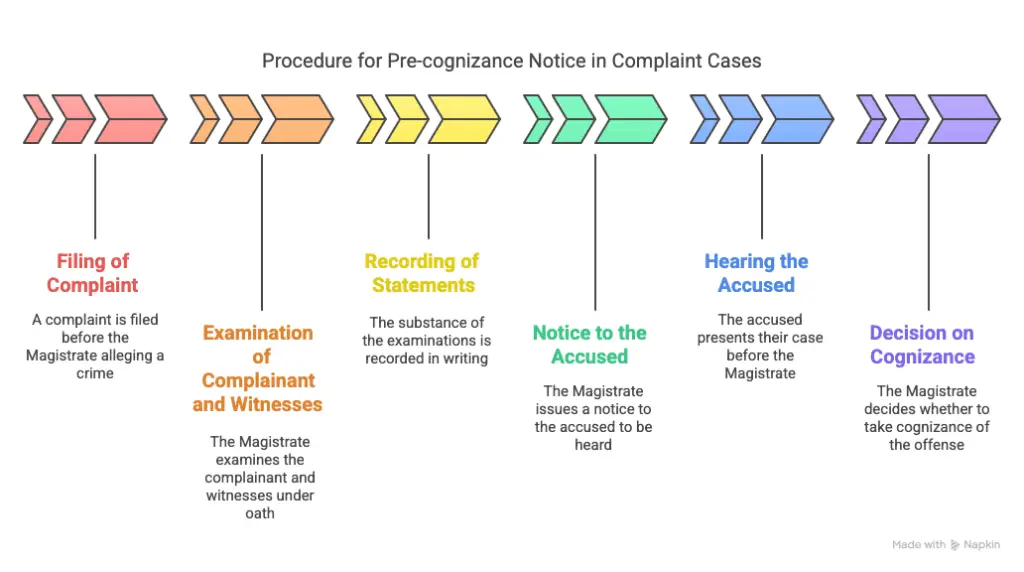
Procedure for Pre-cognizance Notice in Complaint Cases
Step-by-Step Process
The process for pre-cognizance notices follows these steps:
- Filing of Complaint: A complaint is filed before the Magistrate alleging that a crime has been committed[2]
- Examination of Complainant and Witnesses: The Magistrate examines the complainant and any witnesses present under oath[3]
- Recording of Statements: The substance of these examinations is reduced to writing and signed by the complainant, witnesses, and the Magistrate[1]
- Notice to the Accused: Before taking cognizance, the Magistrate must issue a notice to the accused giving them an opportunity to be heard[4]
- Hearing the Accused: The accused is provided an opportunity to present their case before the Magistrate[3]
- Decision on Cognizance: Based on all the evidence and arguments, the Magistrate decides whether to take cognizance of the offense or not
Karnataka High Court Interpretation
In a recent case, Sri Basanagouda R Patil v Sri Shivananda S Patil, the Karnataka High Court clarified that the opportunity to be heard under Section 223 is not merely a formality. The court held that the notice sent to the accused should be accompanied by the complaint and sworn statements of witnesses, enabling the accused to effectively present their case[4].
Application to Negotiable Instruments Act Cases (Cheque Bounce)
Section 138 of Negotiable Instruments Act
Cheque bounce cases are governed by Section 138 of the Negotiable Instruments Act, 1881, which provides for penal consequences when a cheque is dishonored due to insufficient funds[5][6]. While the substantive law remains unchanged, the procedural aspects are now governed by the BNSS.
The punishment for cheque bounce includes imprisonment for a term up to two years, a fine extending to twice the amount of the cheque, or both[7].
Pre-cognizance Procedure in Cheque Bounce Cases
When a complaint is filed for dishonor of a cheque under Section 138 of the Negotiable Instruments Act, the procedure under Section 223 of BNSS applies:
- The complainant files a complaint after completing the statutory requirements (sending demand notice, waiting for 15 days, etc.)
- The Magistrate examines the complainant and witnesses
- Before taking cognizance, the Magistrate must now issue a notice to the accused
- The accused has the opportunity to present their defense before the Magistrate decides to proceed with the case
What Should an Accused Do Upon Receiving a Pre-cognizance Notice?
Options and Best Practices
When a person receives a pre-cognizance notice, they have several options:
- Personal Appearance: The accused can appear in person before the Magistrate to present their case
- Representation through Pleader: Section 228 of BNSS allows the accused to appear through a pleader (lawyer) if the Magistrate permits it[8]
- Present Defense: The accused should present any defense they have against the allegations, such as:
- Evidence showing the complaint is false or malicious
- Technical defenses related to jurisdiction or limitation
- In cheque bounce cases, evidence showing the cheque was not for a legally enforceable debt or was issued as security
- Submit Documents: Present any relevant documents that support their defense
Benefits of the Pre-cognizance Provision
The introduction of Section 223 in BNSS has several significant benefits:
- Prevention of Harassment: It prevents the misuse of criminal complaints as pressure tactics in civil disputes[4]
- Early Resolution: Meritless cases can be dismissed at an early stage, saving valuable court time and resources
- Improved Access to Justice: It balances the rights of complainants and accused persons, ensuring a more equitable legal process
- Ease of Doing Business: By preventing vexatious litigation, it contributes to the ease of doing business in India[4]
Conclusion
The pre-cognizance notice provision under Section 223 of the BNSS represents a significant legal reform in India’s criminal procedure law. It introduces a crucial safeguard by ensuring that the accused has an opportunity to be heard before being subjected to criminal proceedings. This provision applies to all complaint cases, including those under the Negotiable Instruments Act.
For anyone receiving such a notice, it is advisable to take it seriously, prepare a comprehensive defense, and either appear personally or through a lawyer to present their case. This new procedural safeguard aims to filter out frivolous complaints while ensuring that genuine grievances continue to receive proper legal attention.
⁂
- https://law4u.in/top-answer/1189/what-is-bnss-section-223
- https://legalomega.com/pre-cognizance-summons-under-the-bharatiya-nagarik-suraksha-sanhita-2023/
- https://www.drishtijudiciary.com/current-affairs/section-223-of-bharatiya-nagarik-suraksha-sanhita-2023
- https://law.asia/bharatiya-nagarik-suraksha-sanhita/
- https://cdnbbsr.s3waas.gov.in/s3ec03333cb763facc6ce398ff83845f22/uploads/2024/09/2024091181.pdf
- https://lawbhoomi.com/section-138-of-negotiable-instruments-act-1881/
- https://cleartax.in/s/consequences-cheque-bounce-notice
- https://www.law4u.in/top-answer/1194/what-is-bnss-section-228