- Statutory basis: BSF, Border Security Force Act, 1968 and Border Security Force Rules, 1969 govern disciplinary framework.
- Preliminary inquiries like the Court of Inquiry (COI) are fact-finding and do not constitute formal disciplinary proceedings.
- Rule 45 empowers the Commandant to hear charges, remand for ROE, or order trial; Rule 46 prevents biased presiders.
- Rule 48 Record of Evidence (ROE) mandates witness examination in accused's presence and a mandatory caution; non-compliance often quashes trials.
- Security Force Courts: GSFC, PSFC, SSFC differ in composition and punishment; SSFC attracts strict judicial scrutiny.
- Rights: accused must receive charge-sheet and ROE 24 hours before trial, may cross-examine, and have a Friend of the Accused.
- Judicial review protects procedural purity; violations of Rule 48 or Rule 142 invite quashing and possible reinstatement.
Comprehensive Jurisprudential Analysis of Disciplinary Proceedings in the Border Security Force: A Holistic Legal Guide to Acts, Rules, and Judicial Review
Creditor and contributor of this article:
Patra’s Law Chambers:
About Us:
Patra’s Law Chambers is a law firm with offices in Kolkata & Delhi, offering comprehensive legal services across various domains. Established in 2020 by Advocate Sudip Patra (Advocate, Supreme Court of India & Calcutta High Court) an alumnus of the Prestigious Rajiv Gandhi School of Intellectual Property Law, IIT Kharagpur ,with Post Graduate diploma in Business Law from IIM Calcutta, the firm specializes in Civil, Criminal, Writs, High Court Matters, Trademark, Copyright, Company, Tax, IT, GST & Customs, Banking & DRT, Property disputes, Service law & CAT & High Court related service matters, Military Law, Family law, and Supreme Court matters. You can know more about us in here
Kolkata Office:
NICCO HOUSE, 6th Floor, 2, Hare Street, Kolkata-700001 (Near Calcutta High Court)
Delhi Office:
House no: 4455/5, First Floor, Ward No. XV, Gali Shahid
Bhagat Singh, Main Bazar Road, Paharganj, New Delhi-110055
Website: www.patraslawchambers.com
Email: [email protected]
Phone: +91 890 222 4444/ +91 7003 715 325
The disciplinary framework of the Border Security Force (BSF) represents a sophisticated intersection of military necessity and constitutional jurisprudence. Governed primarily by the Border Security Force Act, 1968, and the Border Security Force Rules, 1969, the system is designed to maintain the rigorous standards of an armed force of the Union while ostensibly upholding the principles of natural justice.1 This report examines the intricate procedural architecture of BSF inquiries, the substantive law governing offenses, and the evolving standards of judicial review in High Courts, particularly regarding stay orders and the quashing of dismissal proceedings.
Statutory Foundations and the Concept of Active Duty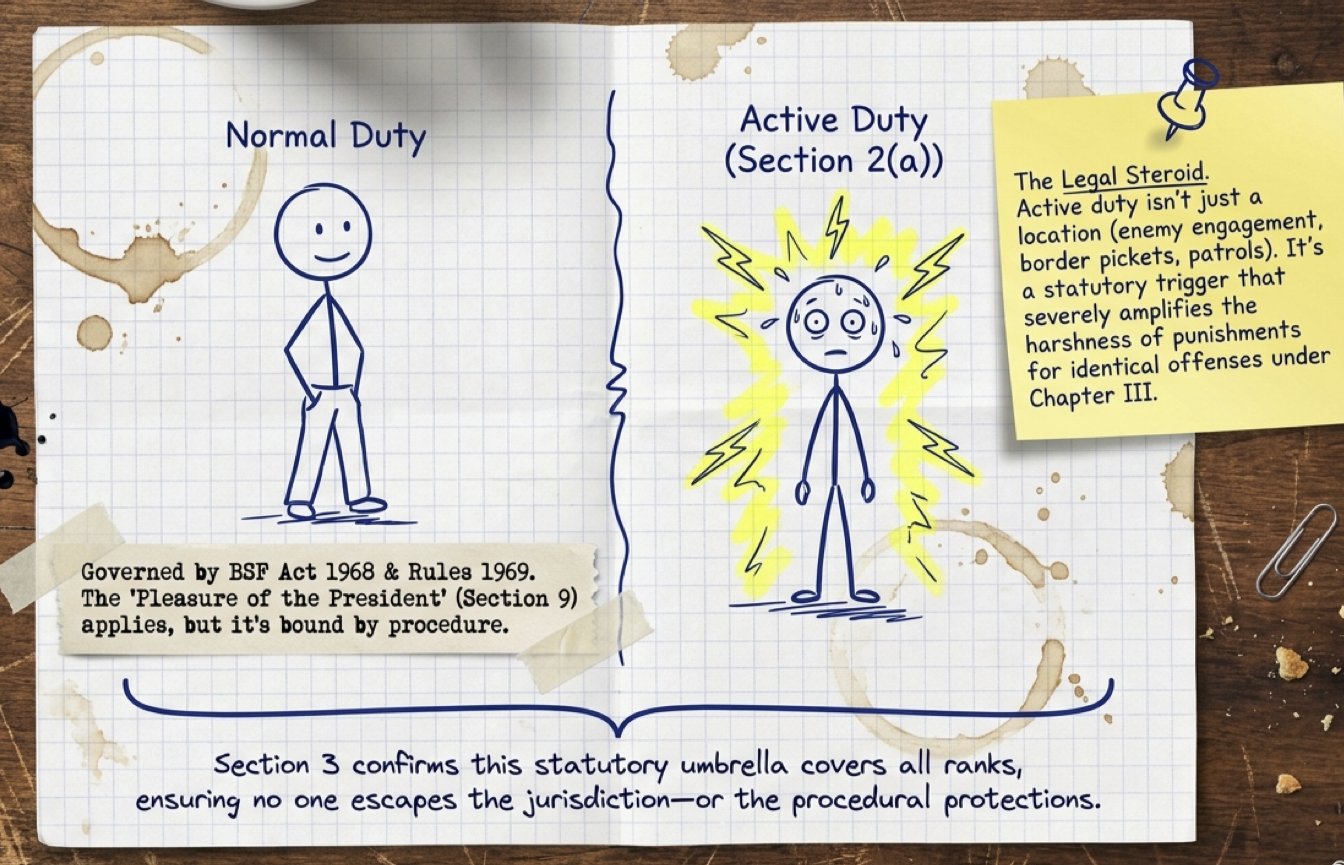
The Border Security Force Act, 1968 (hereinafter referred to as the Act), serves as the primary legislative instrument for the constitution and regulation of the force.2 Central to the application of this Act is the definition of “active duty.” Under Section 2(a), active duty is not merely a status but a operational condition that triggers specific legal consequences.3 It encompasses duty during periods of engagement against an enemy, or while operating at pickets, patrols, or guard duties along India’s borders.2 The significance of this designation lies in the penal provisions of the Act; numerous offenses, such as those related to neglect of duty or disobedience, attract significantly harsher punishments when committed on active duty compared to peacetime service.1
The jurisdictional reach of the Act is broad, covering all persons subject to it wherever they may be, ensuring that the disciplinary cord remains unbroken during international deployments or remote border postings.2 Section 3 explicitly lists officers, subordinate officers, under-officers, and other enrolled persons as being subject to the Act’s provisions.4 This statutory umbrella ensures that the “pleasure of the President” doctrine, articulated in Section 9, is administered through a structured legal process rather than arbitrary decree.3
| Operational Status | Statutory Definition and Contextual Application | Legal Implication for Offenses |
| Active Duty | Period of attachment to a unit engaged in operations or border patrol.3 | Enhanced penalties for certain offenses under Chapter III.1 |
| Force Custody | Arrest or confinement of a member according to the Rules.3 | Governs pre-trial detention and rights of the detainee. |
| Unit Attachment | Temporary or permanent posting to a specific battalion for duty.3 | Determines the identity of the competent Commandant for Rule 45 hearings.5 |
Taxonomy of Inquiries: Preliminary and Fact-Finding Mechanisms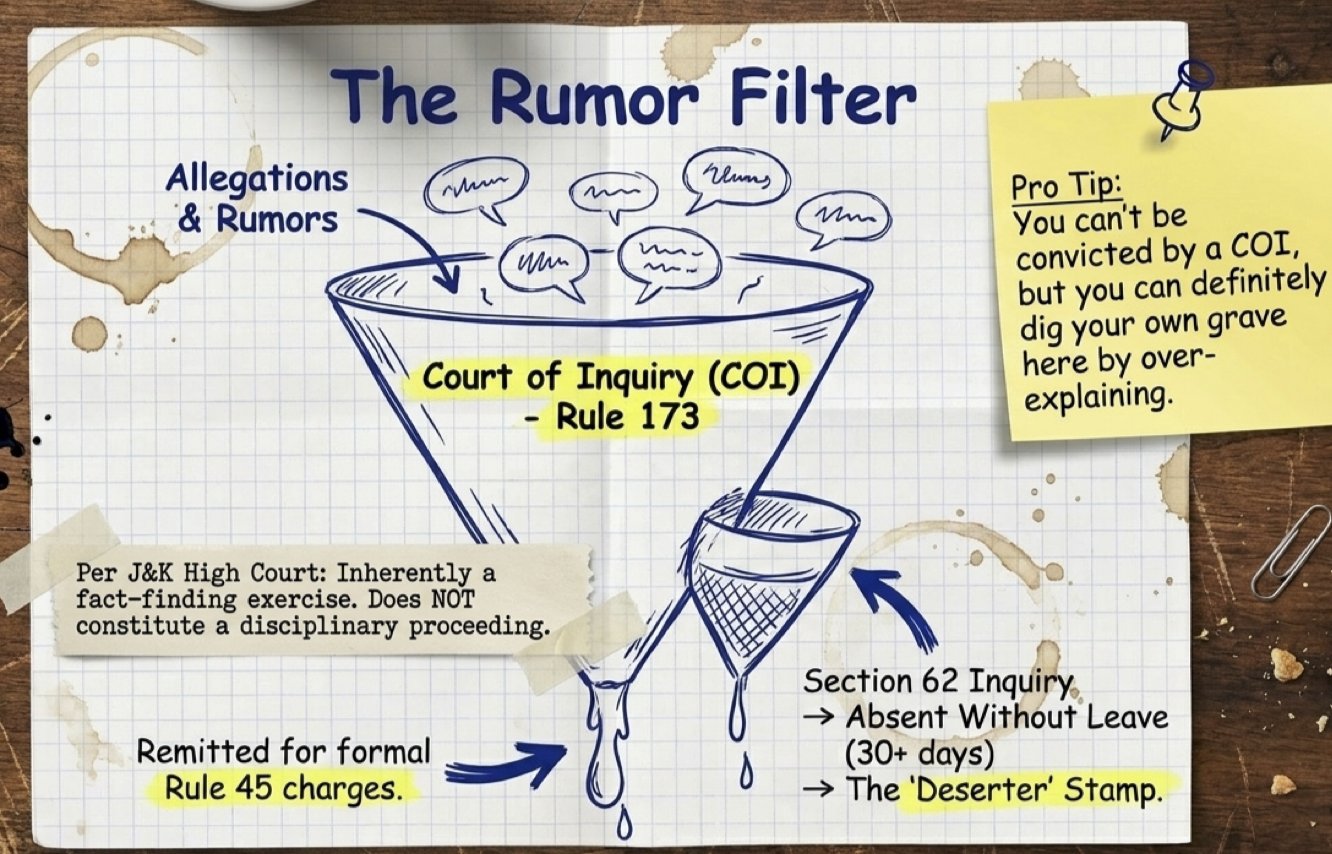
Before the formal machinery of a Security Force Court is activated, the BSF employs various types of inquiries to ascertain the veracity of allegations. The most common of these is the Court of Inquiry (COI), conducted under Rule 173.6 Judicial interpretation by the Jammu & Kashmir and Ladakh High Court has clarified that a COI is inherently a fact-finding exercise and does not, in itself, constitute a disciplinary proceeding.6 Its primary function is the collection of evidence to facilitate the decision-making process of the authorities regarding whether formal charges should be initiated.6
The findings of a COI are considered preliminary. They serve to inform the Commandant or higher authorities about the nature of the misconduct and the evidence available.6 Because a COI is not a trial, its results do not carry the finality of a conviction or acquittal, and personnel are often afforded an opportunity during the COI to provide an explanation that might persuade the authorities against pursuing formal disciplinary action.6 However, if the COI suggests the commission of a serious offense, the case is remitted for a formal hearing of charges under Rule 45.5
Beyond the standard COI, the BSF utilizes Staff Courts of Inquiry for specific internal matters and Preliminary Inquiries for minor infractions.7 In cases where a member of the force is absent without leave for more than thirty days, a specialized inquiry is mandated under Section 62 to declare the individual a deserter, which has significant implications for their service record and pensionary benefits.1
Procedural Mechanics of Rule 45 and the Role of the Commandant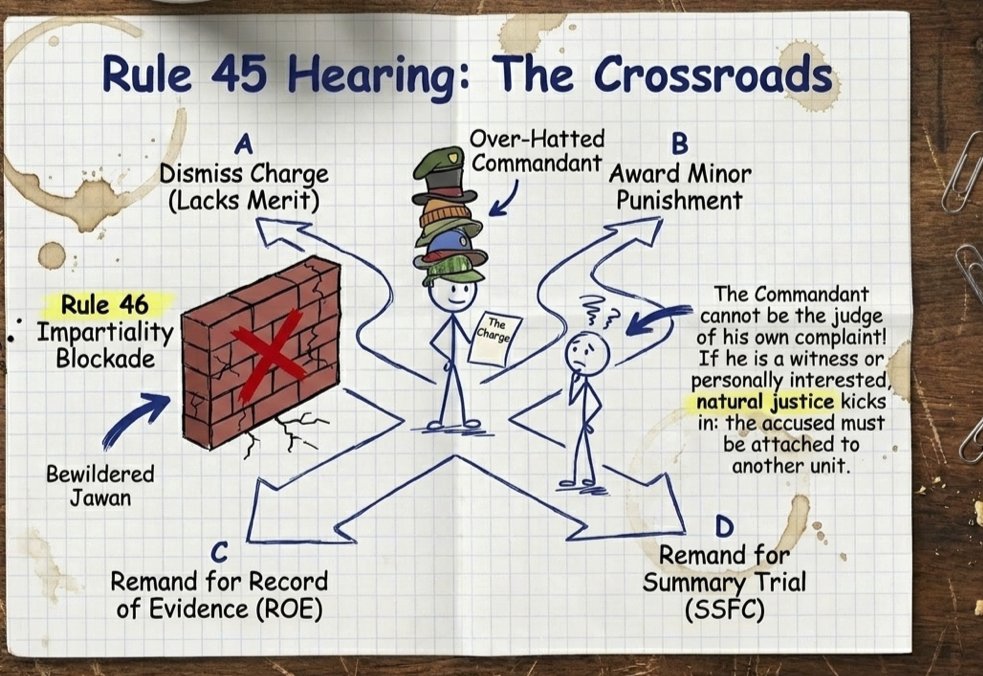
The formal disciplinary process initiates with Rule 45, which governs the “Hearing of the charge against an enrolled person”.5 This stage is the first instance where the accused is formally confronted with the allegations. The procedure requires the Commandant to read the charge and any recorded witness statements to the accused.5 If written statements are unavailable, the Commandant must hear such witnesses as are essential to determine the issue, providing the accused with a statutory right to cross-examine these individuals.5
The Commandant possesses broad discretionary powers at the conclusion of a Rule 45 hearing. As per Rule 45(2), the Commandant may award a minor punishment, dismiss the charge entirely if it lacks merit, remand the accused for a Record of Evidence (ROE), or remand the individual for trial by a Summary Security Force Court (SSFC).5 This decision is a critical juncture; a remand for an ROE indicates that a more serious trial, such as a General Security Force Court (GSFC), is being contemplated.9
A vital safeguard in this process is found in Rule 46, which addresses the impartiality of the Commandant. If the Commandant is the complainant, a witness, or otherwise personally interested in the case, they are disqualified from hearing the charge, and the accused must be attached to another unit to ensure a fair and unbiased proceeding.5 This rule reflects the core principle of natural justice that no person shall be a judge in their own cause, a principle that High Courts strictly enforce when reviewing BSF proceedings.10
The Record of Evidence (ROE): The Evidentiary Foundation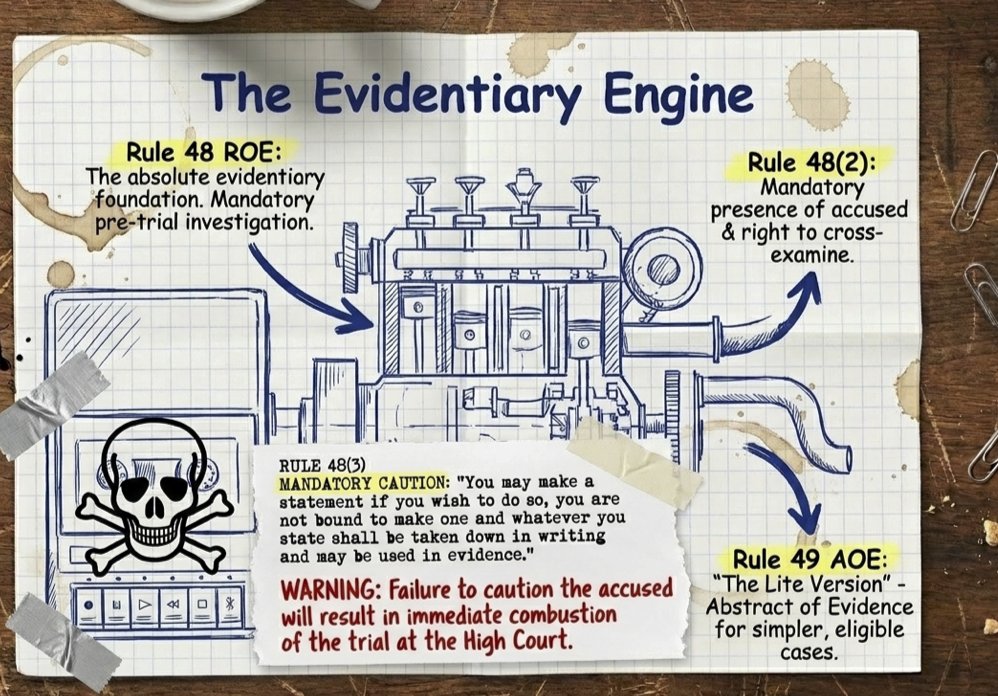
The Record of Evidence, governed by Rule 48, is arguably the most pivotal procedural stage in the BSF disciplinary architecture. It functions as a comprehensive pre-trial investigation where the prosecution’s case is documented in detail.11 The officer ordering the ROE—usually the Commandant—may prepare it personally or detail another officer to do so.11 The procedural requirements of Rule 48 are mandatory and non-compliance often leads to the quashing of subsequent trial findings by the judiciary.10
Under Rule 48(2), all witnesses must give their evidence in the presence of the accused, who maintains an absolute right to cross-examine them.11 This right is not merely a formality; it is an essential component of the right to a fair trial. Furthermore, Rule 48(3) mandates that after the prosecution witnesses have been examined, the accused must be cautioned in specific terms: “You may make a statement if you wish to do so, you are not bound to make one and whatever you state shall be taken down in writing and may be used in evidence”.11 This caution is a protection against self-incrimination, and the failure to record it accurately or provide the accused with the opportunity to make a statement is a frequent ground for legal challenge.12
In certain instances, an Abstract of Evidence (AOE) may be prepared under Rule 49 as an alternative to a full ROE.12 An AOE is typically used for less complex cases or when specified by the rules, consisting of a summary of the evidence that would be produced at trial.12 Regardless of whether an ROE or AOE is used, the objective remains the same: to ensure that the accused is fully aware of the evidence against them and to provide a basis for the Law Officer to give pre-trial advice under Rule 59.12
| Stage of Investigation | Statutory Provision | Core Requirement | Procedural Significance |
| Hearing of Charge | Rule 45 5 | Reading of charges and cross-examination of preliminary witnesses.9 | Determines whether to dismiss, punish minorly, or remand for ROE/Trial.5 |
| Record of Evidence | Rule 48 11 | Examination of witnesses on oath in presence of the accused.12 | Forms the formal evidentiary record; failure to caution accused vitiates trial.13 |
| Abstract of Evidence | Rule 49 14 | Summary of expected evidence from witnesses.12 | Used as an alternative to ROE for swifter processing in eligible cases.12 |
| Rule 45-A Hearing | Rule 45-A 9 | Hearing by a specified officer for summary disposal.5 | Limited to minor offenses and persons not under arrest.5 |
Classification of Offenses under the BSF Act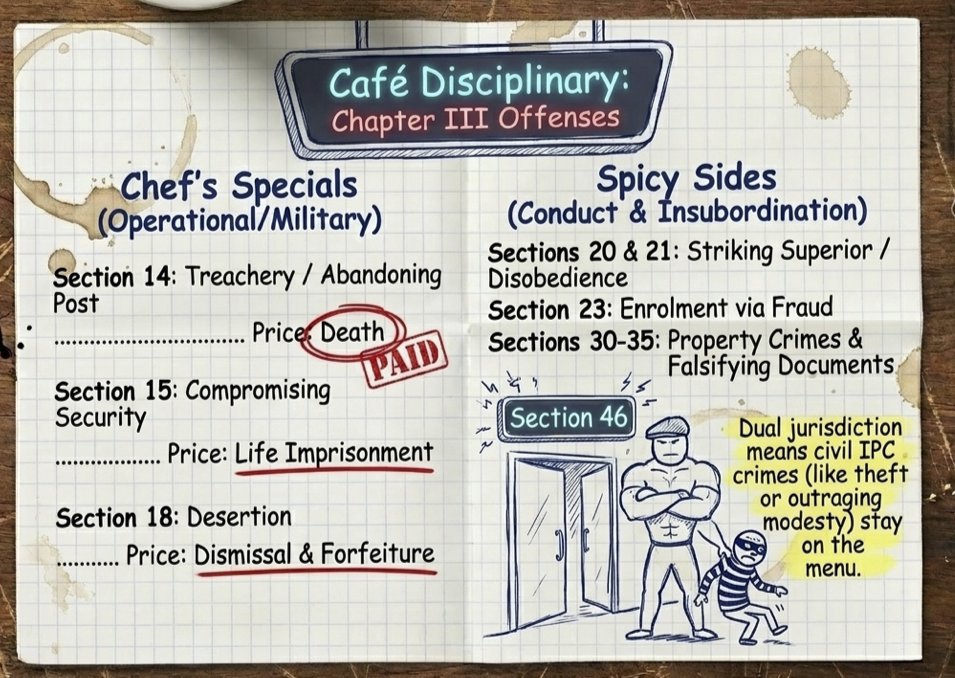
The Act categorizes offenses into several groups based on their nature and the context in which they are committed. Chapter III (Sections 14-46) provides an exhaustive list of behaviors that constitute misconduct.2 The gravity of these offenses dictates the type of Security Force Court that will be convened and the maximum punishment that can be awarded.1
Operational and Military Offenses
Offenses related to operational failures are treated with the highest severity. Section 14 outlines offenses punishable by death, such as abandoning a post, treacherously communicating with the enemy, or assisting the enemy with arms or supplies.1 Section 15 addresses similar offenses that, while not involving treachery, still compromise security, carrying a maximum penalty of life imprisonment.1 Mutiny (Section 17), desertion (Section 18), and absence without leave (Section 19) represent the core of military discipline, with desertion often leading to dismissal and forfeiture of service benefits.1
Conduct and Insubordination
The Act also focuses on the internal hierarchy and moral conduct of the force. Sections 20 and 21 penalize striking or threatening a superior officer and disobeying lawful commands, respectively.2 Section 23 deals with false answers given at the time of enrolment, a provision that allows the BSF to terminate personnel who secured their position through fraud or misrepresentation.2 Sections 24 to 26 address disgraceful conduct, ill-treating subordinates, and intoxication, highlighting the force’s commitment to maintaining a professional environment.2
Property and Integrity Offenses
Offenses against property, whether belonging to the force or to individuals, are covered under Sections 30 to 33. These include extortion, corruption, making away with equipment, and willful injury to property.2 Section 35 specifically targets the falsification of official documents and false declarations, which are critical for maintaining the administrative integrity of the force.1
Civil Offenses under Section 46
A notable feature of the Act is Section 46, which allows the BSF to try civil offenses—crimes punishable under the Indian Penal Code (IPC) or other laws—as if they were offenses under the BSF Act.17 This enables the force to maintain jurisdiction over its personnel even when they commit standard crimes like theft (Section 380 IPC) or outraging the modesty of a woman (Section 354 IPC).17 This dual jurisdiction is a key aspect of BSF law, though certain serious crimes like murder or rape of a civilian may be remitted to ordinary criminal courts under specific circumstances.2
Security Force Courts: Jurisdictional and Compositional Nuances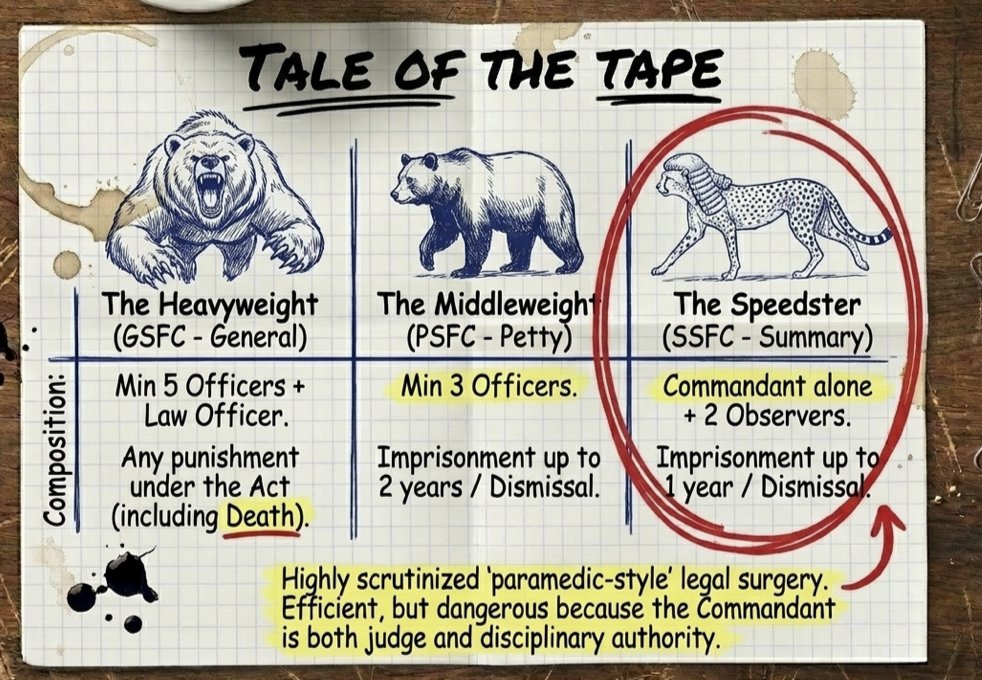
The Act establishes three tiers of Security Force Courts (SFCs), each designed for different levels of severity and rank.1
General Security Force Court (GSFC)
The GSFC is the highest judicial body within the BSF, empowered to try any person subject to the Act for any offense. It consists of at least five officers, and its proceedings must be attended by a Law Officer, who provides legal advice to the court. The GSFC has the authority to award the death penalty for capital offenses.
Petty Security Force Court (PSFC)
The PSFC is designed for the trial of enrolled persons and subordinate officers for offenses that do not warrant the death penalty.1 It is composed of at least three officers and can award imprisonment for a term of up to two years.1
Summary Security Force Court (SSFC)
The SSFC is unique to the paramilitary and military legal systems, allowing for the swift disposal of cases involving enrolled persons.19 It is conducted by the Commandant of the unit alone, although two other officers or subordinate officers must attend as observers. While efficient, the SSFC is subject to intense judicial scrutiny because the Commandant acts as both the judge and the primary disciplinary authority.13 The SSFC can award imprisonment for up to one year, but its findings and sentences must be transmitted to a superior officer for review under Section 115.
| Type of Court | Convening Authority | Composition | Punishment Capacity |
| General (GSFC) | Central Govt. or Director-General 15 | Min. 5 Officers + Law Officer | Any punishment under the Act, including death. |
| Petty (PSFC) | Officers empowered by warrant 1 | Min. 3 Officers | Imprisonment up to 2 years, dismissal.1 |
| Summary (SSFC) | The Commandant of the unit 15 | Commandant + 2 Observers | Imprisonment up to 1 year, dismissal.15 |
Rights and Opportunities of the Accused Person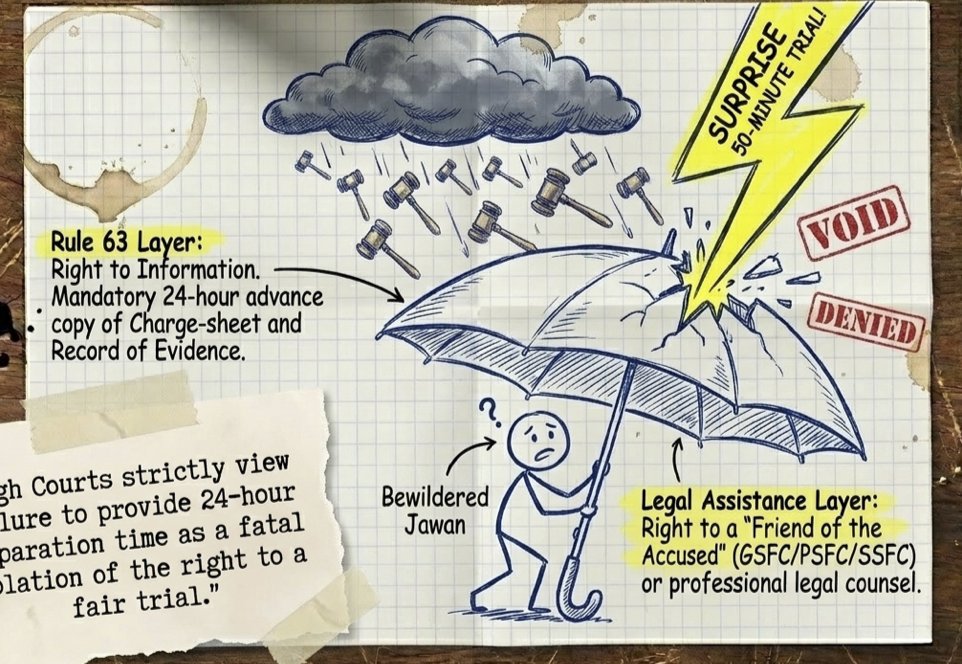
The BSF disciplinary process, while expedited, is bound by the fundamental rights of the accused. These rights are protected through both statutory provisions and judicial oversight.
Right to Information and Preparation
Under Rule 63, the accused must be provided with a copy of the charge-sheet and the Record of Evidence at least twenty-four hours before the trial begins.13 This is a mandatory requirement intended to give the accused sufficient time to prepare their defense and consult with a “Friend of the Accused” or legal counsel. Failure to comply with this timeline is often viewed by High Courts as a violation of the right to a fair trial.13
Right to Legal Assistance
In GSFC and PSFC proceedings, the accused has the right to be represented by a “Friend of the Accused,” who is typically an officer, or by professional counsel. In the case of an SSFC, while the rules are more restrictive, the accused is still entitled to have a “Friend of the Accused” to assist them during the trial. The Law Officer in a GSFC is tasked with ensuring that the court remains impartial and that the legal rights of the accused are not compromised.
The Mandatory Caution and Plea Recording (Rule 142)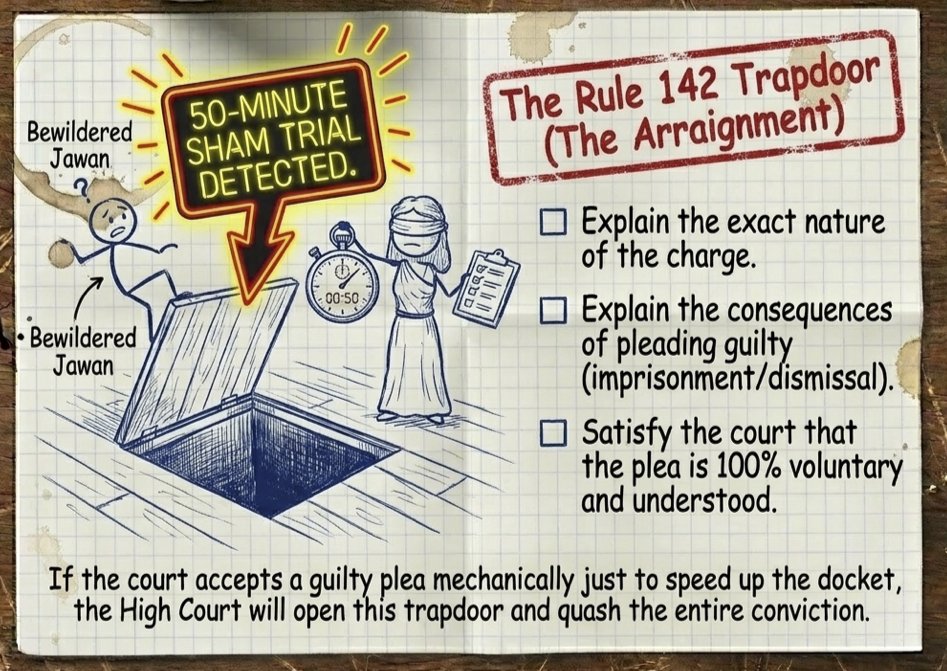
One of the most critical protections for the accused occurs during the arraignment. If an accused person pleads guilty, the court must follow the mandatory procedure under Rule 142.10 The court is required to explain the nature of the charge and the consequences of a guilty plea, specifically informing the accused that such a plea may result in a sentence of imprisonment or dismissal.10 The court must also satisfy itself that the accused understands the plea and that it is made voluntarily.10 In cases where trials are conducted hastily—sometimes in as little as 50 minutes—the judiciary has frequently intervened to quash convictions where it appeared the plea was coerced or misunderstood.13
Trial Procedures and the Law of Evidence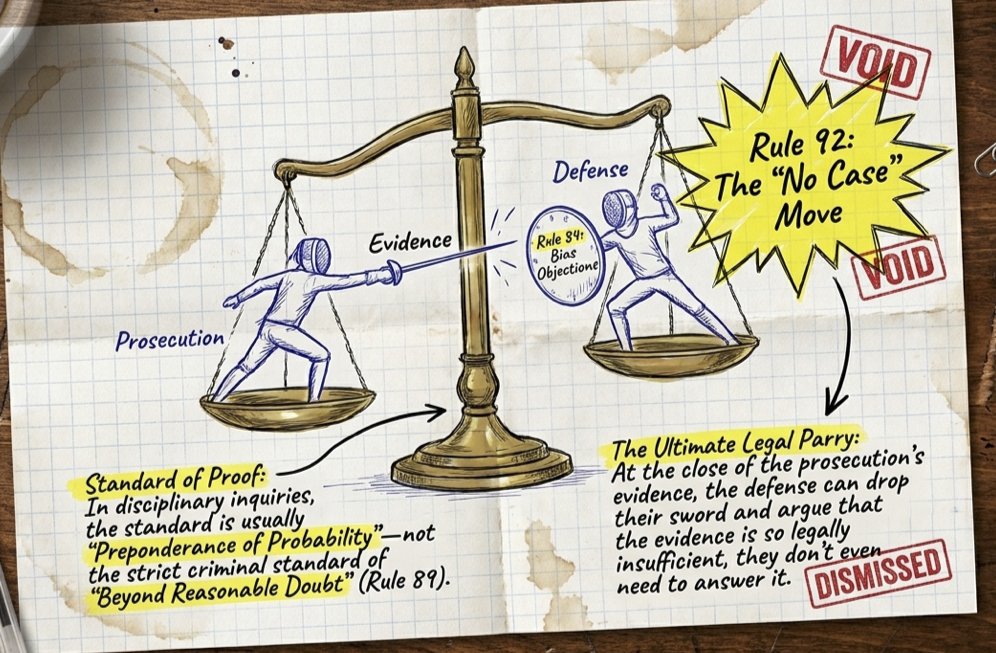
The trial before a Security Force Court follows a structured sequence designed to mirror criminal trials while adapting to the needs of the force.
Arraignment and Objections
The trial begins with the arraignment, where the charges are read to the accused and they are asked to plead guilty or not guilty. Before this, under Rule 84, the accused has the right to challenge any member of the court on the grounds of bias or interest. The members of the court, the Law Officer, and the witnesses are all required to take an oath or affirmation before the proceedings commence.
Examination of Witnesses and Submission of No Case
The prosecution presents its evidence first, followed by the defense. All witnesses are subject to examination-in-chief, cross-examination, and re-examination. A unique feature of SFC trials is the “submission of no case to answer” under Rule 92, where the defense can argue at the close of the prosecution’s case that the evidence produced is insufficient to support a conviction.
General Rules of Evidence
While the technical rules of the Indian Evidence Act do not strictly apply to BSF proceedings, the general principles of evidence are followed.8 Rule 89 stipulates that the court should generally follow the rules of evidence applied in ordinary criminal courts.8 However, in disciplinary inquiries, the standard of proof is often the “preponderance of probability” rather than “proof beyond reasonable doubt,” as highlighted in recent Delhi High Court judgments regarding misconduct.22
Summary Trial and Minor Punishments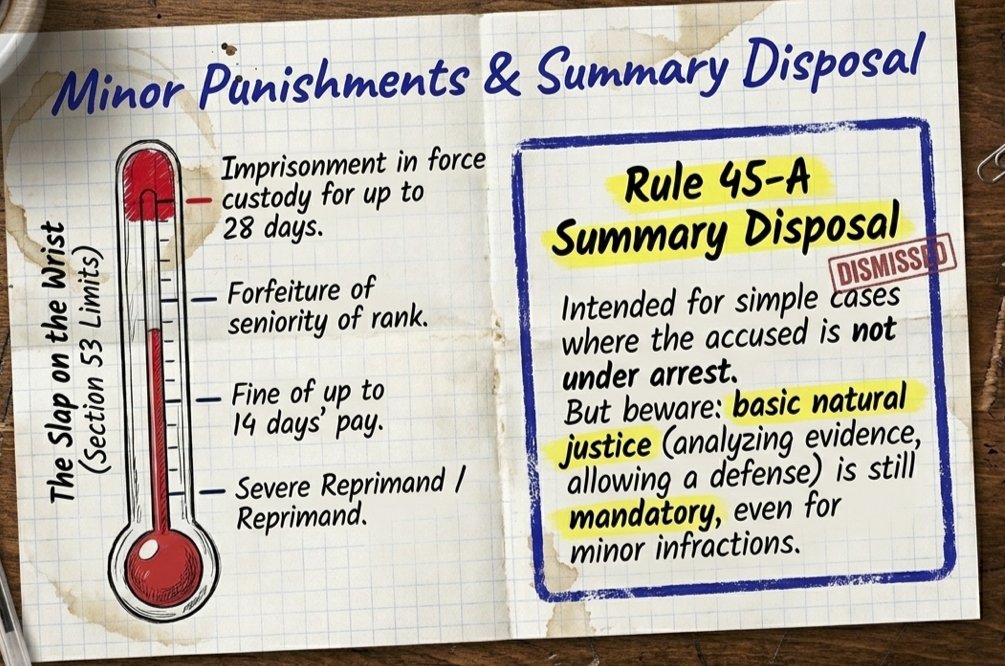
Not every offense requires a full trial by a Security Force Court. For minor infractions, the Act provides for summary disposal and the awarding of minor punishments.
Minor Punishments under Section 53
Section 53 empowers a Commandant to award minor punishments to persons below the rank of an officer.1 These punishments include:
- Imprisonment in force custody for up to twenty-eight days.
- Forfeiture of seniority of rank.
- Fine of up to fourteen days’ pay.
- Severe reprimand or reprimand.
Procedure for Summary Disposal
Rule 45-A allows for the hearing of charges by specified officers for the purpose of summary disposal.5 This procedure is intended for simple cases where the accused is not under arrest and the charge can be dealt with without a full trial.5 Even in these summary proceedings, the basic principles of natural justice must be observed, including the requirement to analyze the evidence and allow the accused to provide a defense.9
Post-Trial Remedies and Administrative Appeals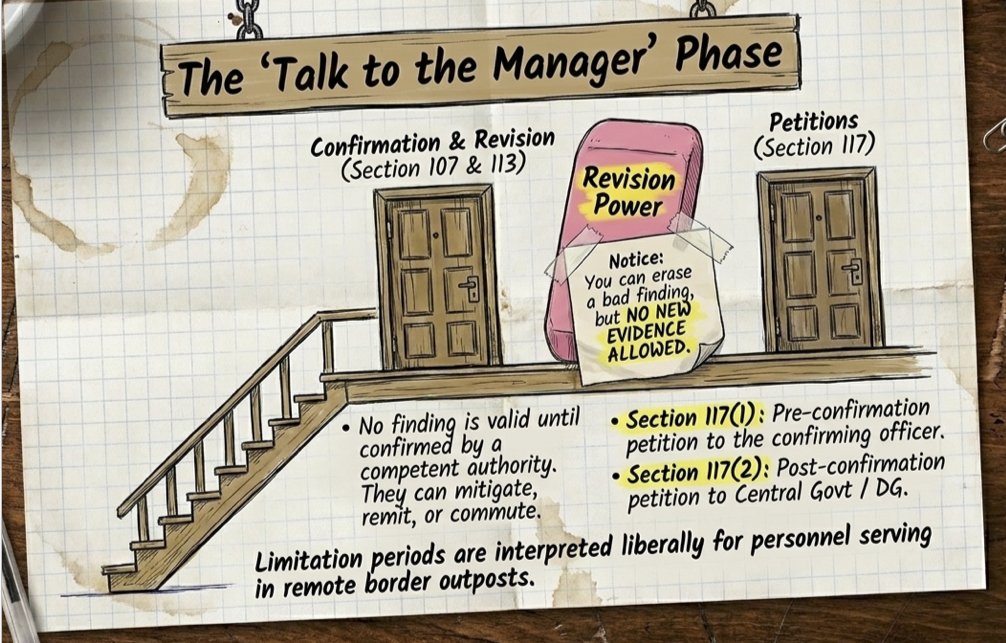
A conviction by a Security Force Court is not immediately final; it is subject to a dual system of administrative review and confirmation.
Confirmation and Revision
Under Section 107, no finding or sentence of a SFC is valid until it has been confirmed by the competent authority. For a GSFC, the confirming authority is typically the Central Government or the Director-General. The confirming authority has the power to mitigate, remit, or commute the sentence. If the authority finds the evidence insufficient or the procedure flawed, it can order a revision of the finding or sentence under Section 113, though no additional evidence can be taken unless specifically directed.
Petitions under Section 117
Any person aggrieved by an order of a SFC has a statutory right to present a petition under Section 117.24
- Section 117(1): A pre-confirmation petition may be presented to the officer empowered to confirm the finding or sentence.24
- Section 117(2): A post-confirmation petition may be presented to the Central Government or the Director-General.24
The judiciary has emphasized that these petitions must be considered on their merits. In cases where personnel are serving in remote border outposts, the limitation period for filing these petitions is to be interpreted liberally to ensure that operational realities do not deprive a member of their right to a remedy.19
Challenging Dismissal in the High Court: The Writ Jurisdiction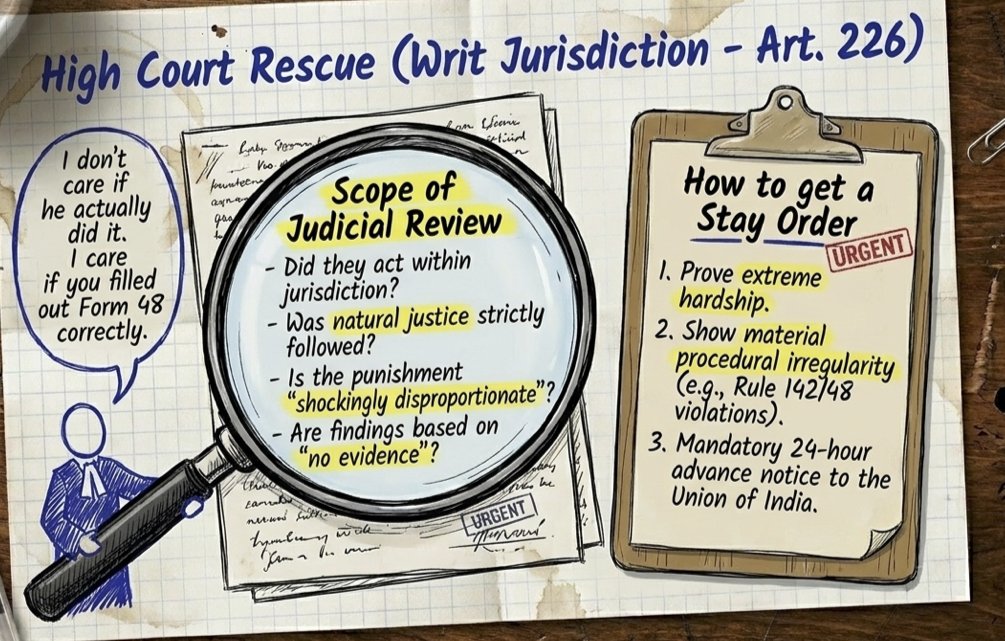
When administrative remedies are exhausted or prove futile, BSF personnel frequently invoke the extraordinary jurisdiction of the High Courts under Article 226 of the Constitution.18
Scope of Judicial Review
High Courts do not act as appellate courts to re-evaluate the factual evidence produced during a BSF trial. Instead, the scope of judicial review is circumscribed to ensuring that:
- The authority acted within its jurisdiction.22
- The principles of natural justice were strictly followed.22
- The procedure followed was in accordance with the Act and Rules.22
- The punishment is not “shockingly disproportionate” to the offense.22
- The findings are not based on “no evidence” or extraneous considerations.22
Strategies for Obtaining a Stay Order
To secure a stay order against a dismissal or an ongoing inquiry, a petitioner must present a compelling case of procedural irregularity or extreme hardship.30 The motion for a stay must be supported by declarations of fact showing that the stay is necessary to promote the ends of justice.32
| Element of Stay Request | Mandatory Detail in High Court | Procedural Basis |
| Notice Requirement | Minimum 24 hours notice to the Union of India counsel.31 | Principle of Fairness.29 |
| Document Cover | Prominently display the notice “STAY REQUESTED”.33 | High Court Rules.33 |
| Grounds for Stay | Material procedural irregularity or bias in the inquiry officer.34 | Rule 60 Compliance.10 |
| Evidence of Hardship | Detailed declaration of “extreme hardship” resulting from dismissal.31 | Equitable Relief.31 |
A stay is most likely to be granted when the petitioner can show that a mandatory rule, such as Rule 142 (explanation of guilty plea) or Rule 48 (presence of accused during ROE), was flagrantly violated.10
Landmark Judgments and Precedents Favoring the Petitioner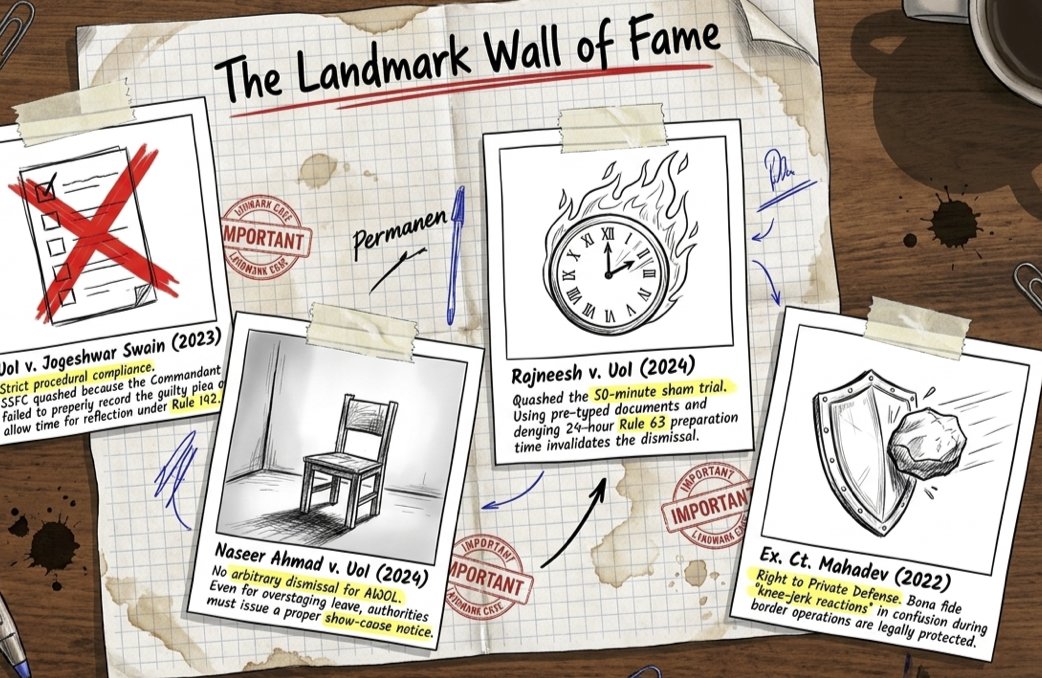
The evolution of BSF law is marked by several landmark judgments where the courts have intervened to protect the rights of force personnel against arbitrary disciplinary action.
The Doctrine of Strict Procedural Compliance
In Union of India v. Jogeshwar Swain (2023), the Supreme Court emphasized the necessity for strict adherence to procedural safeguards in Security Force Courts.10 The Court quashed the dismissal because the SSFC, presided over by a Commandant with a conflict of interest, failed to properly record the guilty plea and did not afford the accused adequate time for reflection.10 This case reinforces that the expedited nature of military justice cannot bypass the core requirements of Rule 142.10
Quashing Dismissals Based on Hasty Trials
The case of Rajneesh v. Union of India (2024) is a seminal ruling by the Delhi High Court regarding the “mechanical” conduct of trials.13 The court found that a trial lasting only 50 minutes, conducted using pre-typed documents and without providing the accused the ROE twenty-four hours in advance, was a sham.13 The court ordered the reinstatement of the constable with all consequential benefits, allowing for a fresh trial only if conducted in strict compliance with the rules.13
Protection Against Unprocedural Dismissal for Absence
In Naseer Ahmad v. Union of India (2024), the Jammu & Kashmir and Ladakh High Court held that dismissal for overstaying leave without a proper show-cause notice or adhering to the principles of natural justice is invalid. The court noted that while discipline is paramount, authorities lack the inherent power to terminate service without following the prescribed statutory procedures.28
The Right to Private Defense
The Supreme Court in Ex. Ct. Mahadev v. Director General, BSF (2022) clarified the application of the right to private defense in border contexts. It held that force personnel facing reasonable apprehension of death or grievous hurt are entitled to defend themselves, and “knee-jerk reactions” in confusion are allowable if done bona fide.19 This provides a vital legal shield for personnel accused of using criminal force in the line of duty.19
Holistic Guide to Navigating BSF Disciplinary Proceedings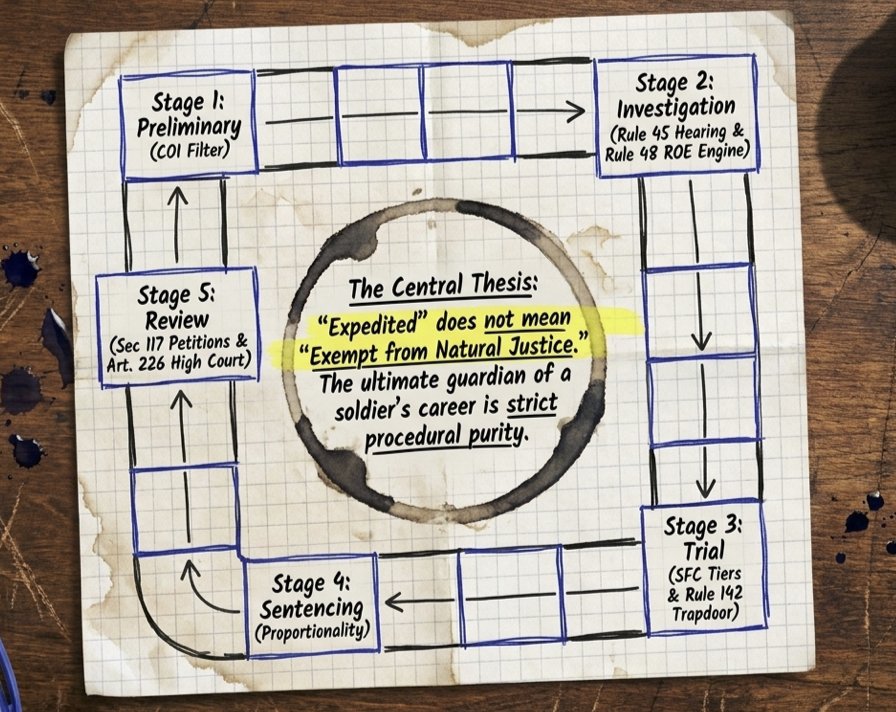
Navigating the BSF disciplinary system requires a thorough understanding of the procedural timeline and the specific rights available at each stage.
- Preliminary Stage: When a Court of Inquiry is ordered, personnel should view it as an opportunity to present their side of the story but should be aware that their statements can be used to initiate formal charges.6
- Investigation Stage: During the hearing of the charge under Rule 45 and the recording of evidence under Rule 48, the right to cross-examine prosecution witnesses is the most potent tool for the defense.11
- The Trial Stage: If the case proceeds to a Security Force Court, the accused must ensure they are provided with all necessary documents (Charge-sheet, ROE) at least 24 hours in advance.13 If a plea of guilty is entered, it must be fully informed and voluntary; any coercion should be reported immediately to the Law Officer or recorded in the proceedings.10
- The Sentencing Stage: Personnel should be aware that punishments must be proportionate. A long and unblemished service record is a significant mitigating factor that the court is bound to consider under Rule 101.9
- The Review Stage: Before approaching a High Court, it is generally necessary to exhaust the statutory remedies under Section 117.19 However, if the dismissal is palpably illegal or biased, a writ petition can be filed immediately alongside a prayer for an interim stay.30
Conclusion: Balancing Discipline with Due Process
The Border Security Force Act and Rules provide a comprehensive framework for maintaining discipline in one of India’s most critical armed forces. However, as demonstrated by a consistent line of judicial precedents, the “expedited” nature of these proceedings does not grant authorities a license to ignore the principles of natural justice.10 The Record of Evidence, the mandatory caution under Rule 48, and the rigorous requirements for recording a plea of guilty under Rule 142 are not mere technicalities; they are the bedrock of a fair trial.12
For the petitioner seeking relief in the High Court, the focus must always be on the “procedural purity” of the trial.13 Whether it is the failure to provide documents, the presence of a biased presiding officer, or the awarding of a “shockingly disproportionate” punishment, the judiciary remains the ultimate guardian of the constitutional rights of force personnel.22 By leveraging the landmark judgments that emphasize strict adherence to the BSF Rules, aggrieved personnel can effectively challenge arbitrary dismissals and ensure that the integrity of the force is maintained through the rule of law rather than the rule of power.10
Works cited
- Border Security Force Act, 1968 – India Code, accessed on April 27, 2026, https://www.indiacode.nic.in/handle/123456789/1561?locale=en
- THE BORDER SECURITY FORCE ACT, 1968 ______ ARRANGEMENT OF SECTIONS – India Code, accessed on April 27, 2026, https://www.indiacode.nic.in/bitstream/123456789/1561/1/a1968-47.pdf
- BSF ACT AND RULES – Ministry of Home Affairs, accessed on April 27, 2026, https://www.mha.gov.in/sites/default/files/bsfAct&Rules_2.pdf
- The Border Security Force Act, 1968 – Indian Kanoon, accessed on April 27, 2026, https://indiankanoon.org/doc/181955/
- The Border Security Force Rules, 1969 – Indian Kanoon, accessed on April 27, 2026, https://indiankanoon.org/doc/121410674/
- Under BSF Rules, Court of Inquiry is merely a fact-finding exercise: J&K HC – SCC Online, accessed on April 27, 2026, https://www.scconline.com/blog/post/2025/12/22/bsf-rules-court-of-inquiry-merely-a-fact-finding-exercise-jk-hc/
- AKHAND PRAKASH SHAHI v. UNION OF INDIA AND ANR. (BORDER SECURITY FORCE) | Jammu and Kashmir High Court | Judgment – CaseMine, accessed on April 27, 2026, https://www.casemine.com/judgement/in/691af5984095f1212ddd25e7
- Border Security Force Act, 1968 | Bare Acts | Law Library – AdvocateKhoj, accessed on April 27, 2026, https://www.advocatekhoj.com/library/bareacts/bordersecurityforce/index.php?Title=Border%20Security%20Force%20Act,%201968
- Before P.B. Bajanthri, J. OM PARKASH SINGH—Petitioner versus UNION OF INDIA AND OTHERS—Respondents CWP No.4814 of 2014 Septe – Punjab and Haryana High Court, accessed on April 27, 2026, https://highcourtchd.gov.in/landmark_judgments/HC/English/CWP_4814_2014.pdf
- Strict Adherence to Procedural Safeguards in Security Force Courts: Insights from Union Of India v. Jogeshwar Swain – CaseMine, accessed on April 27, 2026, https://www.casemine.com/commentary/in/strict-adherence-to-procedural-safeguards-in-security-force-courts:-insights-from-union-of-india-v.-jogeshwar-swain/view
- Section 48 in The Border Security Force Rules, 1969 – Indian Kanoon, accessed on April 27, 2026, https://indiankanoon.org/doc/63912368/
- Understanding ROE in BSF Procedures | PDF | Witness | Plea – Scribd, accessed on April 27, 2026, https://www.scribd.com/presentation/814658246/Record-of-Evidence-Abstract-of-Evidence
- The court found that the Summary Security Force Court (SSFC …, accessed on April 27, 2026, https://supremetoday.ai/the-court-found-that-the-summary-security-force-court-ssfc-proceedings-violated-procedural-rules-particularly-regarding-the-right-to-a-fair-trial-and-the-proper-recording-of-a-plea-of-guilty-leading-to-the-quashing-of-the-dismissal-order-IND_DEL_2024_DHC_6470_DB
- Border Security Force Rules, 1969, India-legitquest, accessed on April 27, 2026, https://www.legitquest.com/act/border-security-force-rules-1969/8DB0
- ˇSecurity Force Courts court martial in BSF – Fastrack Legal Solutions, accessed on April 27, 2026, https://fastracklegalsolutions.com/%CB%87security-force-courts-court-martial-in-bsf/
- Asraf Ali Mondal v. Commandant 135 Bn Bsf | Gauhati High Court | Judgment – CaseMine, accessed on April 27, 2026, https://www.casemine.com/judgement/in/56eaac85607dba3c8ce41bc7
- 08.08.2025 + W.P.(C) 1024/2010 – High Court of Delhi, accessed on April 27, 2026, https://delhihighcourt.nic.in/app/showFileJudgment/67908082025CW10242010_200942.pdf
- Shantanu Saha vs Union Of India And Ors on 4 December, 2025 – Indian Kanoon, accessed on April 27, 2026, https://indiankanoon.org/doc/112904974/
- Border Security Force Act 1968: Key Cases & Rules – Supreme Today AI, accessed on April 27, 2026, https://supremetoday.ai/search/border-security-force-act-1968-guide
- summary+security+force+court | Indian Case Law – CaseMine, accessed on April 27, 2026, https://www.casemine.com/search/in/summary%2Bsecurity%2Bforce%2Bcourt
- Baljinder Singh v. Union of India and others (Surya Kant, J.) 423 – Punjab and Haryana High Court, accessed on April 27, 2026, https://highcourtchd.gov.in/landmark_judgments/HC/English/CWP_1614_2002.pdf
- Janved Singh vs Union Of India And Ors on 4 February, 2026 – Indian Kanoon, accessed on April 27, 2026, https://indiankanoon.org/doc/160464823/
- Delhi High Court Upholds BSF Officer’s Dismissal for Illicit Relationship, Citing Conduct ‘Repugnant to Conscience’ – Supreme Today AI, accessed on April 27, 2026, https://supremetoday.ai/delhi-high-court-upholds-bsf-officer-s-dismissal-for-illicit-relationship-citing-conduct-repugnant-to-conscience-20251030205416c98a66
- Section 117 in The Border Security Force Act, 1968 | Draft Bot Pro, accessed on April 27, 2026, https://app.draftbotpro.com/doc/1974868
- Section 117 in The Border Security Force Act, 1968 – Indian Kanoon, accessed on April 27, 2026, https://indiankanoon.org/doc/1974868/
- Section 117(1) in The Border Security Force Act, 1968 | Draft Bot Pro, accessed on April 27, 2026, https://app.draftbotpro.com/doc/1561411
- 20.11.2025 Judgment pronounced on: 04.12.2025 + W.P – High Court of Delhi, accessed on April 27, 2026, https://delhihighcourt.nic.in/app/showFileJudgment/75204122025CW42612024_130252.pdf
- Termination from Service Following Bsf Force Court Court Order – Supreme Today AI, accessed on April 27, 2026, https://supremetoday.ai/search/termination-from-service-following-bsf-force-court-court-order
- Bias in Court Proceedings | Law Helpline, accessed on April 27, 2026, https://lawhelpline.in/wp-content/uploads/2025/08/Bias-in-Court-Proceedings.pdf
- Dismissal Due to Bsf Court Ruling – Supreme Today AI, accessed on April 27, 2026, https://supremetoday.ai/search/dismissal-due-to-bsf-court-ruling
- Guide To Request A Stay Of Execution, accessed on April 27, 2026, https://ebclc.org/wp-content/uploads/2024/12/Guide-Application-to-Stay-Judgment.pdf
- Rule 3.515. Motions and orders for a stay | Judicial Branch of California, accessed on April 27, 2026, https://courts.ca.gov/cms/rules/index/three/rule3_515
- Rule 8.116. Request for writ of supersedeas or temporary stay | Judicial Branch of California, accessed on April 27, 2026, https://courts.ca.gov/cms/rules/index/eight/rule8_116
- Joint Guidance on Federal Title IX Regulations: Analysis of Section 106.45(b)(8): Appeals June 4, 2020 Note – SUNY System Administration, accessed on April 27, 2026, https://system.suny.edu/media/suny/content-assets/documents/sci/tix2020/Appeals.pdf