The Jurisprudence of Regularization and Absorption in Indian Public Employment: A Comprehensive Legal Treatise on Constitutional Mandates and the Model Employer Doctrine
Creditor and contributor of this article:
Patra’s Law Chambers:
About Us:
Patra’s Law Chambers is a law firm with offices in Kolkata & Delhi, offering comprehensive legal services across various domains. Established in 2020 by Advocate Sudip Patra (Advocate, Supreme Court of India & Calcutta High Court) an alumnus of the Prestigious Rajiv Gandhi School of Intellectual Property Law, IIT Kharagpur ,with Post Graduate diploma in Business Law from IIM Calcutta, the firm specializes in Civil, Criminal, Writs,High Court Matters, Trademark, Copyright, Company, Tax, Banking, Property disputes, Service law, Family law, and Supreme Court matters.You can know more about us in here
Kolkata Office:
NICCO HOUSE, 6th Floor, 2, Hare Street, Kolkata-700001 (Near Calcutta High Court)
Delhi Office:
House no: 4455/5, First Floor, Ward No. XV, Gali Shahid
Bhagat Singh, Main Bazar Road, Paharganj, New Delhi-110055
Website: www.patraslawchambers.com
Email: [email protected]
Phone: +91 890 222 4444/ +91 7003 715 325
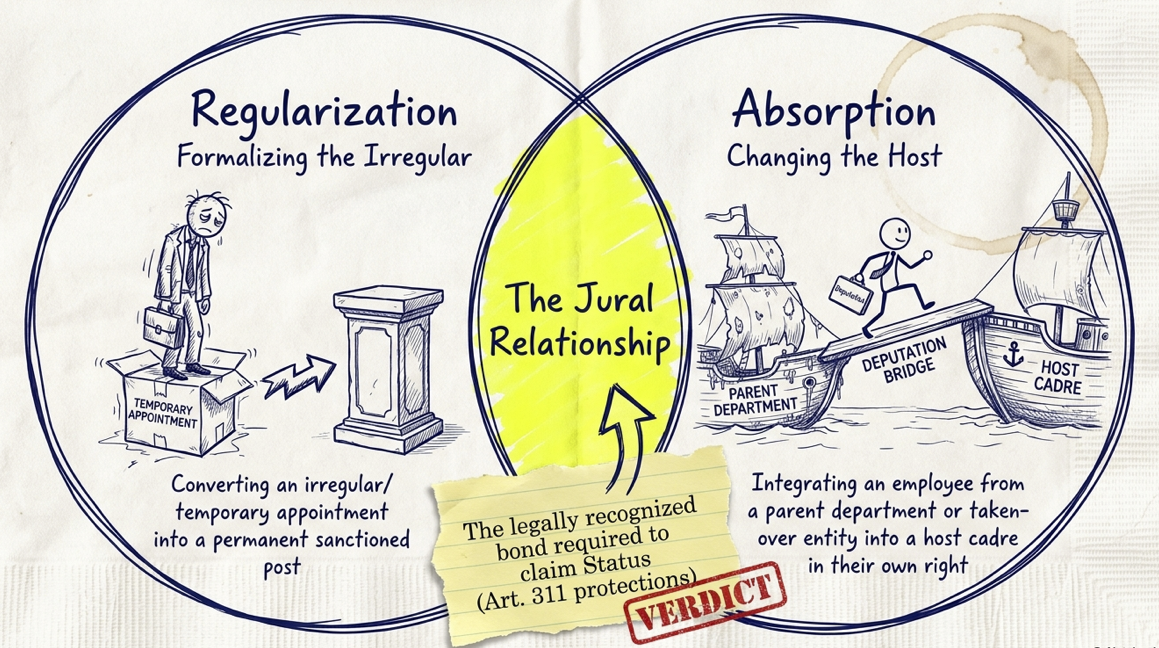
The legal landscape governing public employment in India is characterized by a profound tension between the rigid requirements of constitutional meritocracy and the equitable demands of a vast workforce engaged on a non-permanent basis. This dichotomy has given rise to the complex doctrines of regularization and absorption, which serve as the primary mechanisms for the formalization of service for millions of ad hoc, temporary, daily wage, and contractual employees. Regularization, in the context of service jurisprudence, refers to the process of converting a temporary or irregular appointment into a permanent, sanctioned post within the state’s administrative framework.1 While the term “absorption” is often used to describe the integration of deputationists or employees from taken-over entities into a host department, the fundamental principles governing both concepts are rooted in the same constitutional and equitable foundations.3 Consequently, in contemporary legal discourse, the term regularization is frequently employed to encompass the broader formalization of employment status across various categories of public service.3
I. Conceptual Foundations: Definitions and the Jural Relationship
The genesis of any claim for regularization or absorption lies in the establishment of a jural relationship between the employer and the employee.3 In public service, this relationship is not merely contractual but carries a “status” protected by the Constitution and statutory rules.5
Legal Etymology and Contextual Usage
Regularization implies the rectification of an “irregular” appointment to bring it into conformity with the regular cadre of the service.1 It is a mode of formal entry into regular service, generally invoked by casual or daily workers who have rendered long years of service.3 Absorption, on the other hand, implies that an employee who was not holding a particular post in their own right—perhaps because they were serving on deputation or as part of a project—is integrated into that post, thereby losing their lien on their parent department and becoming a permanent holder of the new post.3
| Term | Legal Definition | Service Outcome |
| Regularization | Formalization of an irregular or temporary appointment into a permanent sanctioned post. | Attainment of permanent status and regular pay scales. |
| Absorption | Integration of an employee (deputationist/transferee) into a host cadre in their own right. | Severance of lien from the parent department; fresh appointment in the host cadre. |
| Status | A legal condition of employment characterized by rights and protections beyond a contract. | Protection under Article 311 and statutory service rules. |
| Jural Relationship | The legally recognized bond between employer and employee. | Necessary threshold for any legal claim for regularization. |
The Moral Obligation of the Model Employer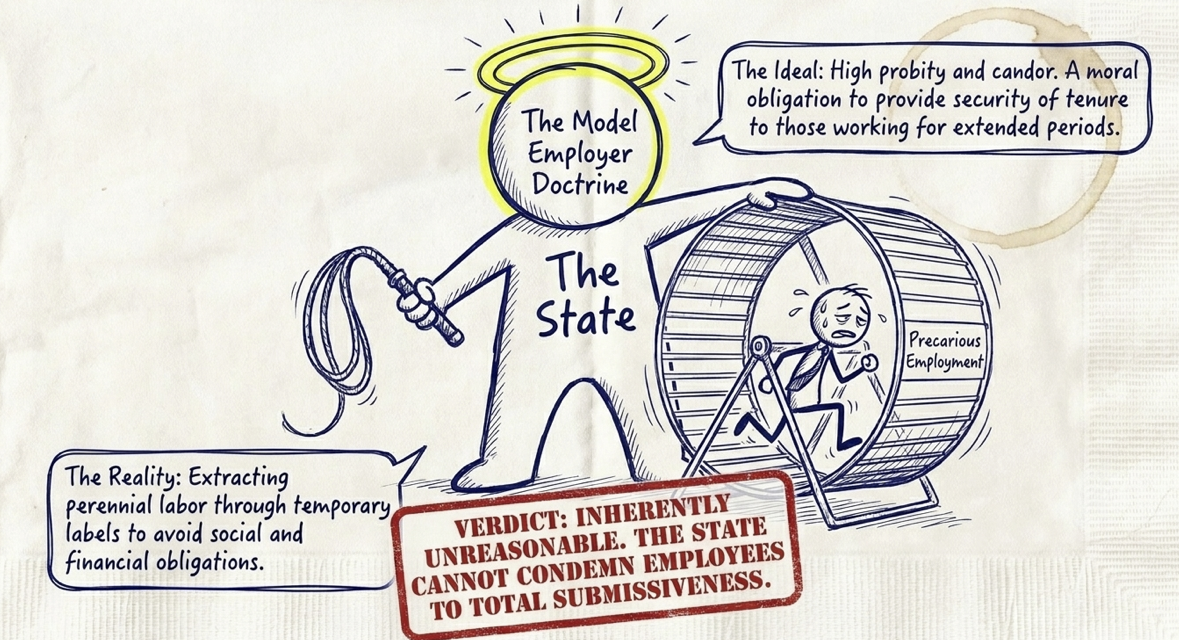
The doctrine of regularization is anchored in the moral and legal obligation of the State, acting as a “model employer,” to provide security of tenure to persons who have worked on a precarious basis for an extended period.3 The courts have observed that refusal to regularize long-serving employees in certain situations can be inherently unreasonable, particularly when the State extracts perennial labor through temporary labels to avoid its social and financial obligations.3 A model employer is expected to function with high probity and candor, avoiding exploitative practices that condemn employees to a state of total submissiveness.7
II. The Constitutional Prism: Articles 14, 16, and 309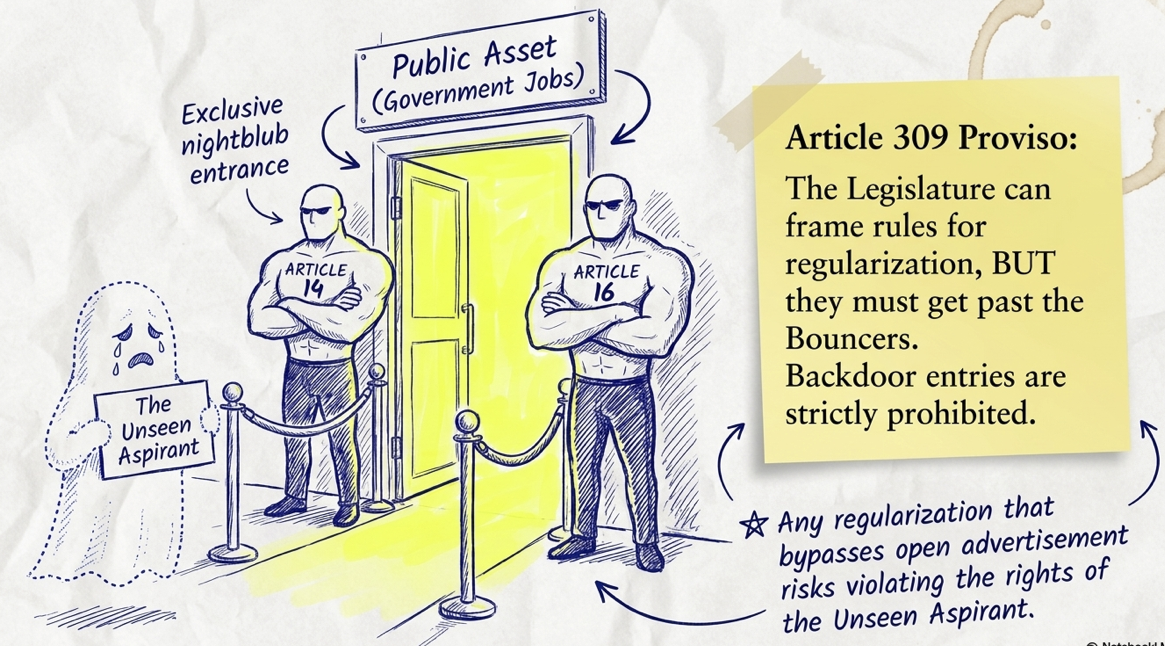
The authority of the State to regularize or absorb employees is not absolute; it must be exercised within the parameters of the constitutional scheme of public employment.
Equality of Opportunity and Meritocracy
Article 14 (Equality before the law) and Article 16 (Equality of opportunity in public employment) form the bedrock of service law.5 The Supreme Court has consistently held that public employment is a “public asset” and every eligible citizen has a right to compete for it.10 Therefore, any regularization process that bypasses the requirement of open advertisement and competitive selection risks violating the rights of the “unseen aspirants” who were never given a chance to apply.5
Legislative Power under Article 309
Article 309 empowers the appropriate legislature to regulate the recruitment and conditions of service of persons appointed to public services.6 While the State can frame rules for regularization under the proviso to Article 309, these rules must be consistent with the fundamental rights guaranteed under Part III of the Constitution.5 The judiciary plays a critical role in scrutinizing these rules to ensure they do not become a mechanism for “backdoor entry,” which undermines the merit-based system.5
III. The Historical Context: From Liberalism to the Umadevi Watershed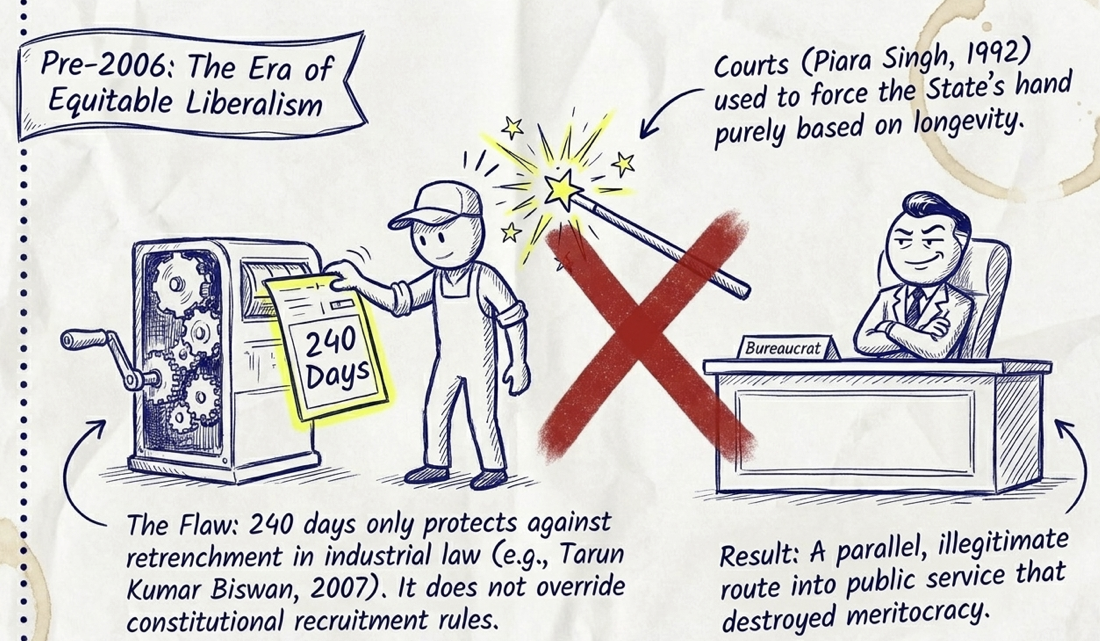
The evolution of regularization law can be divided into two distinct eras: the pre-2006 era of “equitable liberalism” and the post-2006 era of “constitutional discipline” initiated by the Umadevi judgment.
The Era of Equitable Liberalism
Prior to 2006, the judiciary frequently issued directions for regularization based on the length of service and the 240-day rule derived from industrial law.2 In cases like State of Haryana v. Piara Singh (1992), the court emphasized that the State should not keep employees on an ad hoc basis for decades and should instead frame schemes for their regularization.3 However, this liberal approach led to systemic distortions, where informal appointments bypassed recruitment rules and reservation policies, creating a parallel route into public service that eroded institutional legitimacy.5
The 240-Day Rule in Industrial Jurisprudence
The completion of 240 days of continuous service in a block of twelve months is a significant threshold under the Industrial Disputes Act, 1947.2 While this rule provides protection against retrenchment under Section 25F, it does not automatically confer a right to regularization in government service.2 The Supreme Court clarified in Bank of India v. Tarun Kumar Biswan (2007) that the completion of 240 days as a “Budlee” worker or casual laborer is merely a statutory requirement for retrenchment compensation and does not override the constitutional requirements for permanent appointment.3
| Case Phase | Primary Legal Stance | Impact on Workforce |
| Pre-Umadevi (Liberal) | Focused on longevity and equity; liberal directions for regularization. | Led to widespread backdoor entries and bypass of recruitment rules. |
| Umadevi (Disciplinary) | Strict adherence to Articles 14 and 16; barred regularization of illegal hires. | Reasserted meritocracy; created the 10-year one-time measure exception. |
| Post-Umadevi (Refined) | Balanced constitutional discipline with the “Model Employer” doctrine. | Targeted exploitation while maintaining the integrity of recruitment rules. |
IV. The Umadevi Revolution: Redefining Regularization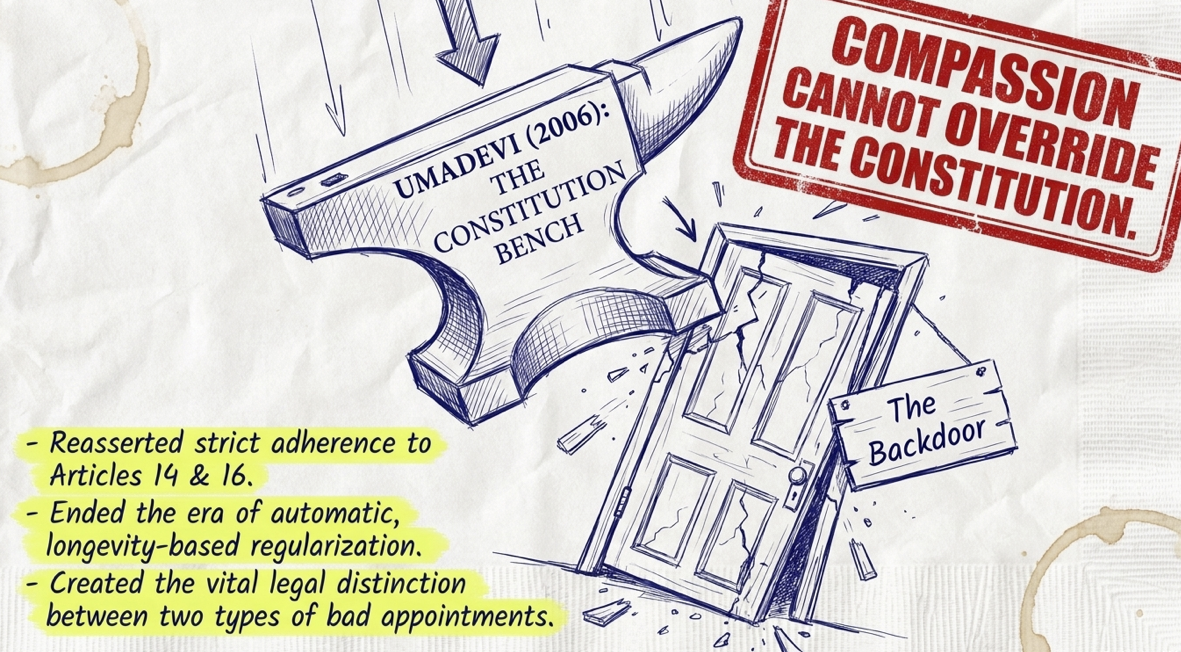
The Constitution Bench decision in Secretary, State of Karnataka v. Umadevi (3) (2006) redefined the limits of regularization and re-established equality of opportunity as a non-negotiable mandate.5
Illegal vs. Irregular Appointments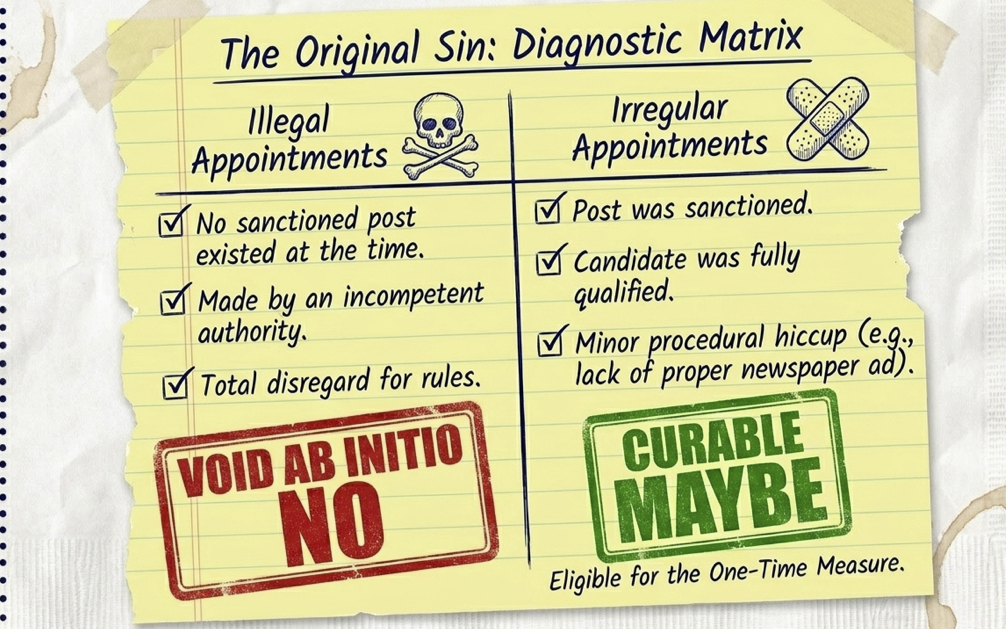
The Umadevi court introduced a critical distinction that remains the cornerstone of regularization law: the difference between “illegal” and “irregular” appointments.4
- Illegal Appointments: These are appointments made in total disregard of the constitutional scheme, often by an incompetent authority or without a sanctioned post. Such appointments are void ab initio and cannot be regularized, regardless of the length of service.4
- Irregular Appointments: These involve appointments made against sanctioned posts where the candidates were qualified, but the recruitment process had minor procedural deviations (e.g., lack of proper advertisement). Such appointments are eligible for regularization under a specific, one-time measure.4
The 10-Year “One-Time Measure” Threshold
To mitigate the hardship faced by long-serving employees, the Court permitted a “one-time measure” for the regularization of irregularly appointed persons who had worked for ten years or more as of April 10, 2006, without the protection of interim court orders.4 The Court clarified that this was an exceptional, one-time exercise and not a license for the State to continue irregular engagements in the future.4
The Rationale: Protecting the Unseen Aspirant
The Umadevi judgment poignant acknowledged the economic hardship of temporary employees but drew a decisive line: “Compassion cannot override the Constitution”.5 By preventing the regularization of those not duly appointed, the Court protected the rights of the millions of eligible citizens who seek public employment through legitimate, transparent channels.5
V. Post-Umadevi Refinements: M.L. Kesari and Narendra Kumar Tiwari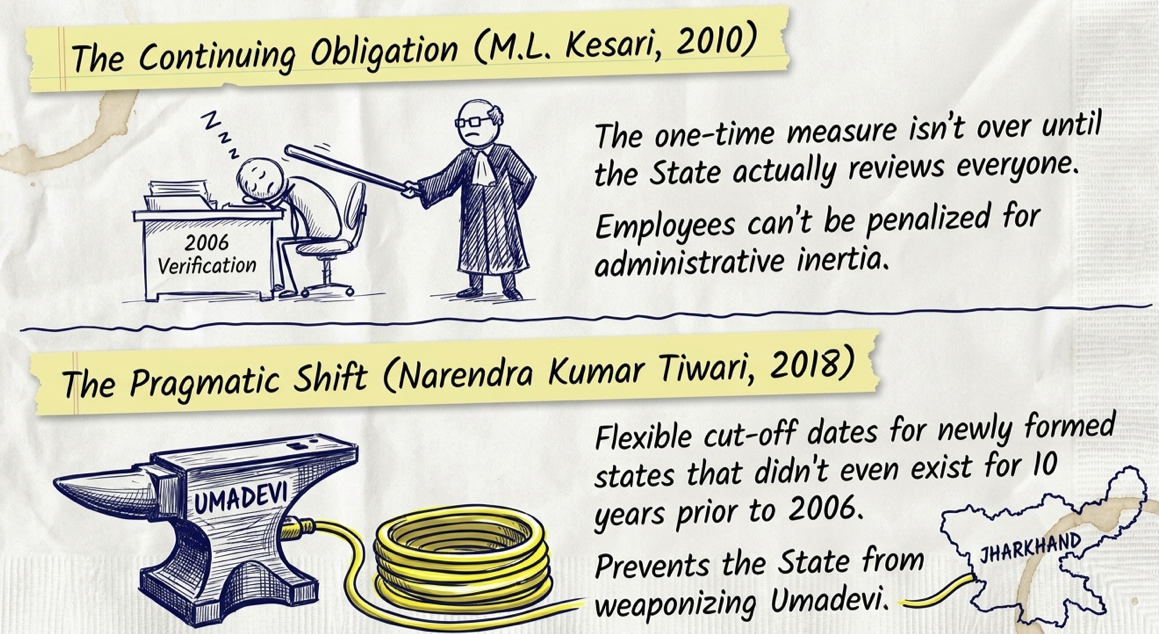
The strictness of Umadevi led to administrative inertia, where many eligible employees were denied regularization because the State failed to conduct the directed one-time exercise. Subsequent benches sought to rectify this through refined interpretations.
M.L. Kesari: The Comprehensive Nature of One-Time Measures
In State of Karnataka v. M.L. Kesari (2010), the Supreme Court clarified that the “one-time measure” mentioned in Umadevi must be considered concluded only when all employees who were entitled to regularization had their cases fairly examined.21 If the State had failed to undertake the exercise in 2006, it was under a continuing obligation to do so, and employees could not be penalized for administrative delays.21
Narendra Kumar Tiwari: Contextualizing the 10-Year Rule
The 10-year rule faced challenges in newly formed states like Jharkhand, where the state itself had not existed for ten years at the time of the Umadevi judgment.23 In Narendra Kumar Tiwari v. State of Jharkhand (2018), the Supreme Court adopted a “pragmatic and spirit-based” interpretation, ruling that the one-time measure should be flexible enough to regularize those who completed ten years of service even after the 2006 cut-off, provided the State had not yet completed its one-time regularization exercise.23
| Criterion | Umadevi (2006) Strict Rule | M.L. Kesari / Narendra Tiwari Interpretation |
| Cut-off Date | April 10, 2006. | Flexible if the State failed to act or is newly formed. |
| One-time Measure | Immediate exercise in 2006. | Continuing obligation until all eligible are covered. |
| Role of Judiciary | Strict prohibition on “backdoor” entry. | Guard against the State “weaponizing” Umadevi to exploit workers. |
| 10-Year Calculation | Continuous service against sanctioned posts. | Includes service post-2006 for newly formed states or delayed schemes. |
VI. The Modern Renaissance: Vinod Kumar, Jaggo, and Dharam Singh (2024-2026)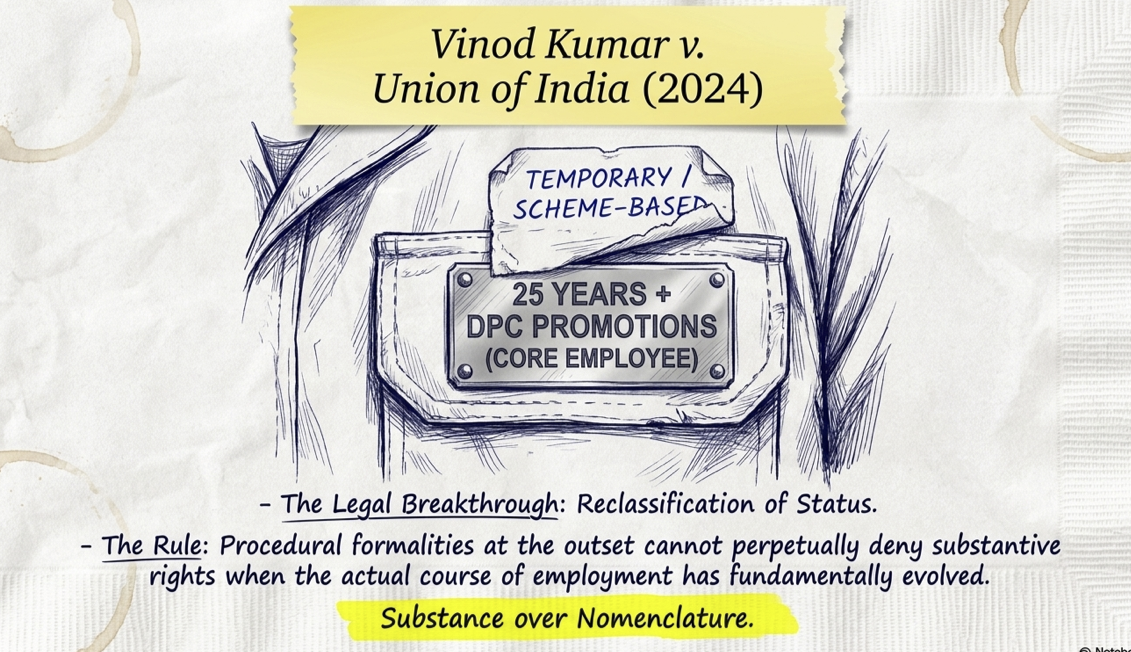
Recent jurisprudence (2024–2026) marks a significant shift toward “substantive justice,” where the court looks past initial labels to the “actual course of employment”.26
Vinod Kumar v. Union of India (2024): Reclassification of Status
The Vinod Kumar judgment is a watershed moment for long-term temporary employees.29 The appellants had served as Accounts Clerks in the Railways for over 25 years.29 Although their roles were labeled “temporary” or “scheme-based,” they had been selected through written tests and interviews, and had even been promoted by a Departmental Promotion Committee (DPC).26 The Supreme Court held that the “essence of employment and the rights thereof cannot be merely determined by the initial terms of appointment when the actual course of employment has evolved significantly over time”.28 The Court ordered their regularization, emphasizing that procedural formalities at the outset cannot be used to perpetually deny substantive rights accrued through continuous service.28
Jaggo v. Union of India (2024): Perennial Nature and Indispensable Duties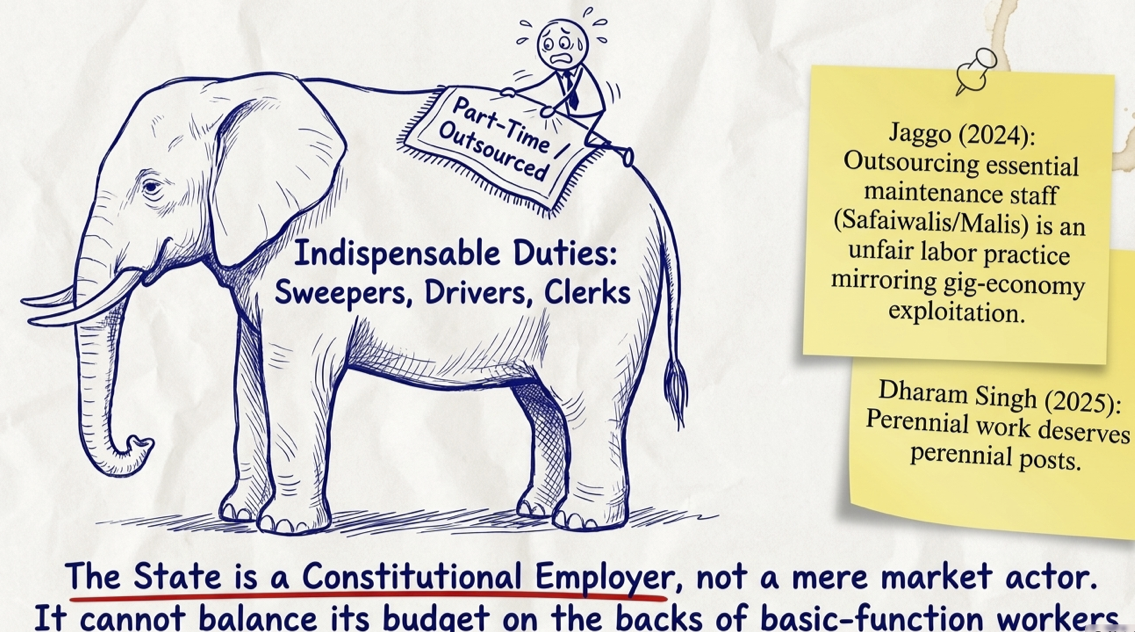
In Jaggo v. Union of India, the Court addressed the regularization of housekeeping and maintenance staff (Safaiwalis and Malis) who had served the Central Water Commission for 10–20 years.32 The Court rejected the “part-time” label as a mechanism to deny benefits, ruling that when duties are perennial, indispensable, and integral to the institution’s functioning, they must be treated as regular posts.32 The Court critiqued the practice of replacing such employees with outsourced labor as an “unfair labor practice” that mirrors the detrimental trends of the gig economy.33
Dharam Singh v. State of UP (2025): “Perennial Work Deserves Perennial Posts”
In a landmark shift, the Supreme Court in Dharam Singh (2025) declared that “perennial work deserves perennial posts”.8 This case involved daily wagers engaged in roles like attendants and drivers who had served for decades.8 The Court found that work which is recurrent and central to a commission’s functioning cannot be perpetuated under temporary labels indefinitely.8 Crucially, the Court distinguished the State as a “constitutional employer” rather than a mere “market actor,” emphasizing that it cannot balance its budgets on the backs of those who perform basic public functions.8
Bhola Nath v. State of Jharkhand (2026): nomenclature vs. Constitution
The Bhola Nath judgment reinforces the principle that contractual nomenclature cannot defeat the constitutional guarantees of equality and fairness.36 The Court ruled that once employees discharge public duties satisfactorily for extended periods (over a decade) on sanctioned posts after a due selection process, the State cannot arbitrarily discontinue their engagement solely based on the label of “contractual”.36 This decision effectively repositioned contractual employees within the protective ambit of Article 14, asserting that fundamental rights are “incapable of waiver” even through contractual acceptance.36
| 2024-2026 Case | Key Factual Insight | Legal Breakthrough |
| Vinod Kumar (2024) | Accounts Clerks with 25 years service and DPC promotions. | Evolution of employment status trumps initial “temporary” label. |
| Jaggo (2024) | Cleaning/gardening staff with 10-20 years service. | Perennial nature of work necessitates regularization; outsourcing is not a shield. |
| Dharam Singh (2025) | Attendants/drivers with decades of service. | Established “perennial work deserves perennial posts” principle. |
| Shripal (2025) | Gardeners with oral termination after 7 years. | Model employer obligation; adverse inference for missing records. |
| Bhola Nath (2026) | Junior Engineers on 10-year renewed contracts. | Constitutional rights cannot be waived by contractual nomenclature. |
VII. The Law of Absorption: Specialized Applications and Seniority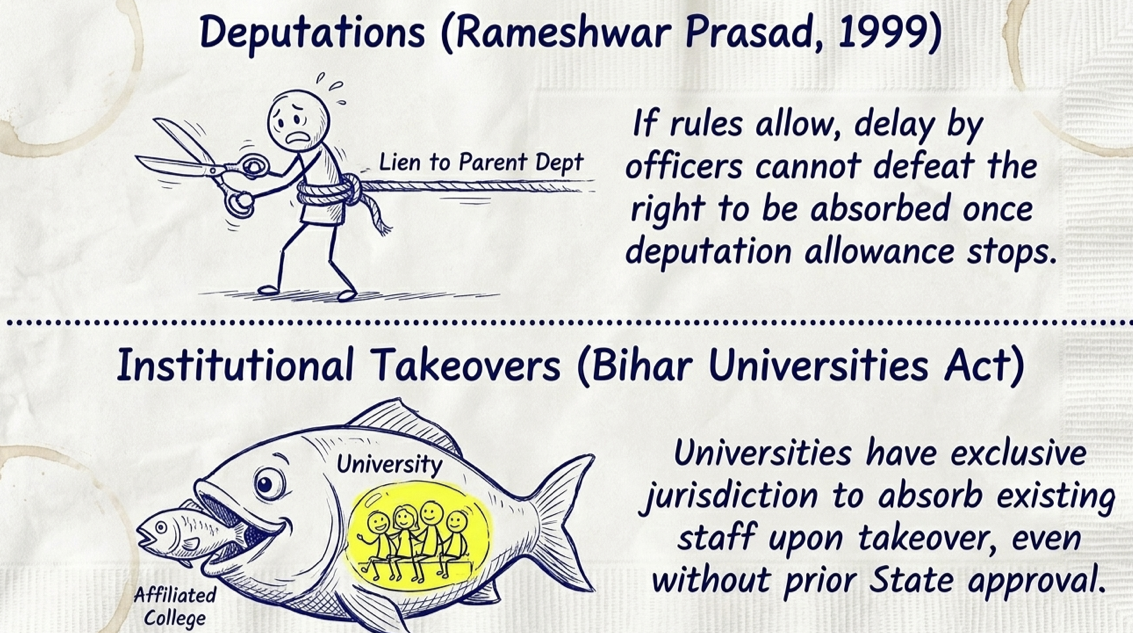
While regularization focuses on formalizing status, absorption deals with the integration of distinct groups into a host cadre, often following institutional restructuring or deputation.
Deputation and the Right to Be Considered for Absorption
Absorption of deputationists is governed by specific recruitment rules. If the rules provide for absorption, a deputationist has a right to be considered in accordance with those rules.3 In Rameshwar Prasad v. U.P. Rajkiya Nirman Nigam Ltd. (1999), the Court held that “delay or inadvertent inaction” by officers in passing an order of absorption would not affect an employee’s right to be absorbed if they had opted for it and the deputation allowance had been discontinued, signifying de facto absorption.3
Institutional Takeovers: The Bihar State Universities Act
Section 4(1)(14) of the Bihar State Universities Act, 1976, provides a specialized regime for the absorption of staff when affiliated colleges are converted into constituent colleges.3 The Supreme Court in Bihar M.S.E.S.K.K. Mahasangh (2005) ruled that the university’s power to absorb staff upon takeover is a distinct field of operation from regular recruitment.3 The university has the exclusive jurisdiction to recognize the validity of existing staff appointments and absorb them into its service, even if those appointments had not previously obtained the State’s prior approval under Section 35 of the Act.3
Seniority Fixation upon Regularization/Absorption
The recognition of pre-regularization service for the purpose of seniority is a contentious issue. The general rule is that seniority is counted from the date of regular appointment.26 However, in P. Rammohan Rao v. K. Srinivas (2025), the Court held that if an appointment was validly made against a sanctioned post (though on a temporary footing) and continued uninterruptedly until regularization, that pre-regularization period may be counted toward seniority.44 This applies where the initial hiring was not a “stop-gap” but was necessitated by institutional exigencies and followed a merit-based evaluation.44
VIII. Contract Labour and the “Sham/Camouflage” Test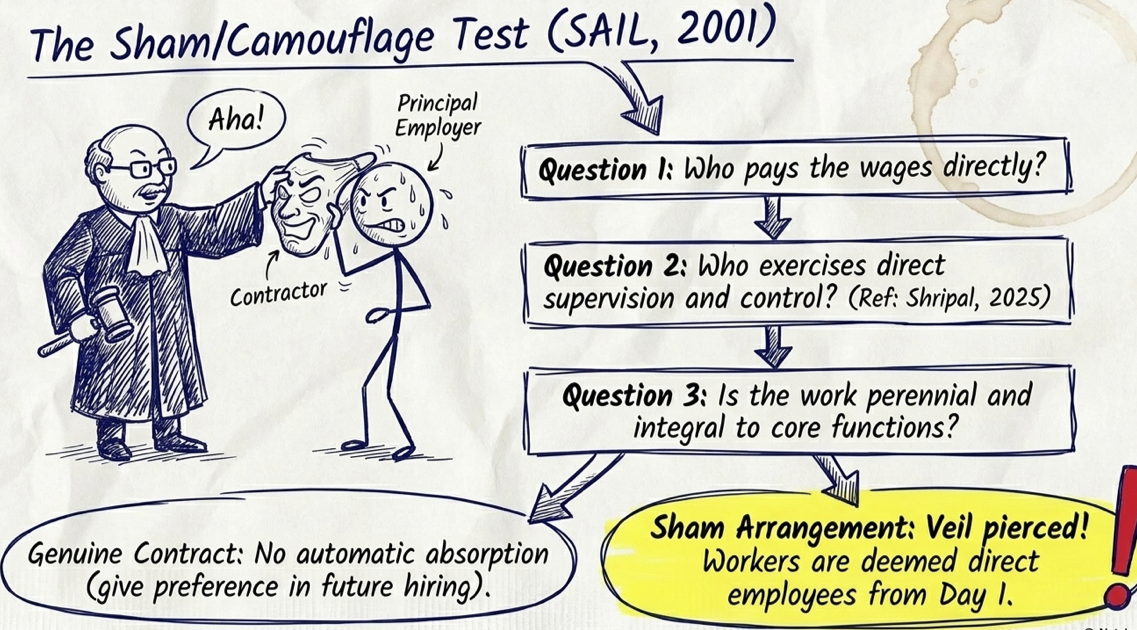
The regularization of workers engaged through contractors depends on the nature of the relationship between the principal employer, the contractor, and the worker.
The SAIL (2001) Landmark
The Constitution Bench in Steel Authority of India Ltd. v. National Union Waterfront Workers (2001) clarified that the abolition of contract labor under Section 10 of the CLRA Act does not lead to “automatic absorption”.45 Instead, it creates two scenarios:
- Genuine Contract: If the contract is genuine, the principal employer is not bound to absorb the workers, but must give them preference in future regular recruitment.46
- Sham/Camouflage: If the contract is found to be a “sham” intended to conceal a direct employer-employee relationship, the workers are deemed direct employees of the principal employer from the outset and are entitled to regularization.11
The “Real Employer” Test
To identify a sham arrangement, courts apply the “Real Employer” test, examining factors like:
- Who pays the wages directly? 14
- Who exercises direct control and supervision over the work? 45
- Is the work perennial and integral to the principal employer’s core functions? 11
In Shripal v. Nagar Nigam, Ghaziabad (2025), the Court rejected the employer’s “contractor defense” because the municipality failed to produce tender notices or licenses, while workers proved they were supervised directly by the Horticulture Department.48
IX. Constraints and Barriers: The “Financial Burden” Defense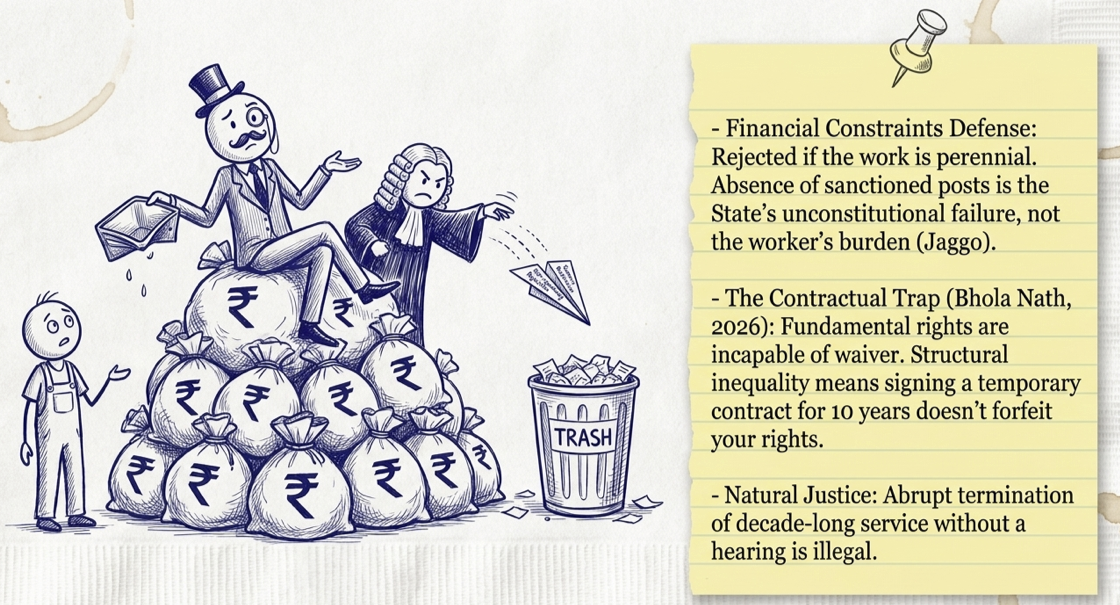
Government institutions frequently resist regularization by citing “financial constraints” or the absence of “sanctioned vacancies.”
Judicial Scrutiny of Administrative Excuses
While the creation of posts is an executive prerogative, the Supreme Court in Jaggo (2024) and Dharam Singh (2025) has held that a “non-speaking rejection on a generic plea of financial constraints” is not immune from judicial scrutiny for arbitrariness.35 If the State has extracted labor for decades to discharge regular duties, the absence of sanctioned posts is viewed as an “unconstitutional failure” of the State rather than a bar against the workers’ rights.35
Sick Industries and BIFR Protections
In the case of “sick” government companies, regularization and absorption are often mediated through BIFR schemes under the Sick Industrial Companies (Special Provisions) Act, 1985.3 These schemes are as good as statutes and cannot be defeated by subsequent state legislation.3 However, if the financial position of a sick company is so bleak that it cannot sustain even its existing workforce, courts may be cautious in directing further absorption.3
| Constraint | Legal Standing | Judicial Trend (2024-2026) |
| No Sanctioned Post | Prerequisite for regularization. | “Perennial work deserves perennial posts”; absence is State’s failure. |
| Financial Burden | Valid administrative consideration. | Rejected as a “generic talisman” if the need for work is perennial. |
| Recruitment Rules | Must be followed for Article 14/16 compliance. | Minor deviations (irregularities) can be cured as a one-time measure. |
| Outsourcing Policy | Legitimate administrative choice. | Cannot be used as a “shield” to replace long-serving temporary staff. |
X. Legitimate Expectation, Natural Justice, and Estoppel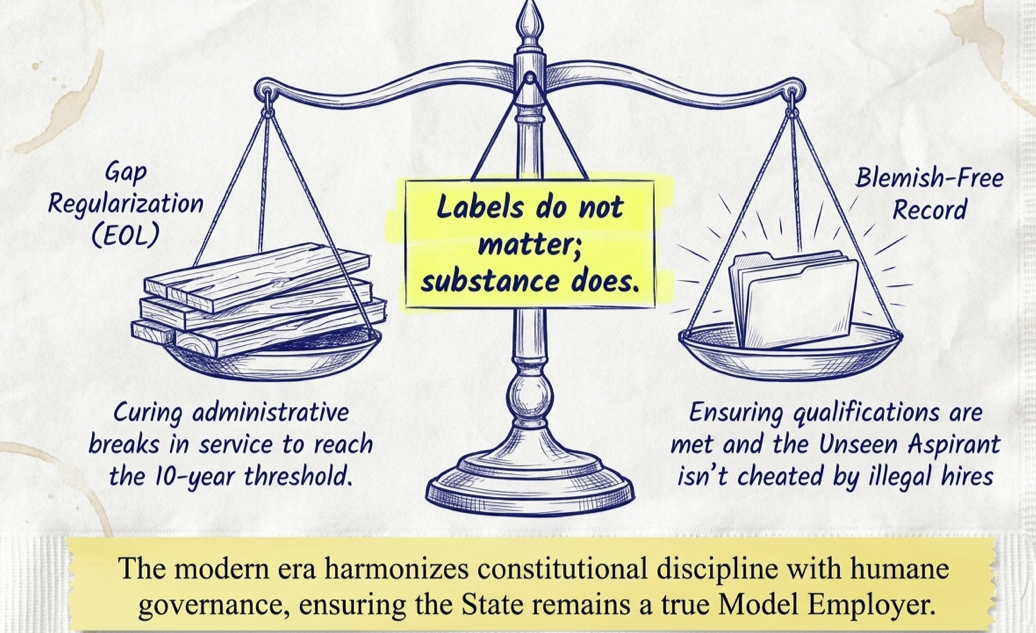
The procedural rights of temporary employees have been significantly enhanced by recent rulings on natural justice and the doctrine of legitimate expectation.
The Right to a Hearing before Termination
The abrupt termination of long-serving employees without notice or an opportunity to respond is now viewed as a violation of the principles of natural justice.9 Even in cases where regularization is denied, a “model employer” is expected to follow a fair procedure before discontinuing services that have spanned decades.32
Legitimate Expectation and Waiver of Rights
While employees are generally presumed to know the temporary nature of their job, the Court in Bhola Nath (2026) held that “structural inequality in bargaining power” means that workers do not forfeit their constitutional rights by signing exploitative contractual clauses.36 A decade-long uninterrupted service generates a legitimate expectation of fairness that prevents the State from arbitrarily discontinuing engagement solely through contractual nomenclature.36
XI. Practical Mechanics of Regularization Schemes
When the State decides to regularize employees, it often follows a structured verification process to ensure the integrity of the cadre.
Creation of Special Cadres and Verification
To sidestep the hurdles of sanctioned posts in existing cadres, governments sometimes create “special cadres” for regularized employees.1 The verification process typically involves:
- Duration Records: Confirming continuous service (e.g., the 10-year rule) without major gaps.1
- Original Appointment Letters: Establishing the initial terms of engagement to distinguish between illegal and irregular hires.1
- Performance Reviews: Ensuring that the service rendered was “blemish-free” and satisfactory.12
The Role of Gap Regularization
“Gap regularization” involves counting non-working periods (gaps) as continuous service, often treating them as “Extraordinary Leave” (EOL) to ensure employees meet the 10-year or seniority thresholds.43 This ensures fairness for workers who faced intermittent breaks due to administrative inaction rather than their own conduct.43
XII. Conclusion: The Evolving Balance of Equity and Equality
The law of regularization and absorption in India has entered a mature phase where constitutional discipline is harmonized with humane governance.5 The Umadevi judgment remains the “constitutional baseline,” ensuring that merit-based recruitment is not indefinitely adjourned.5 However, the contemporary rulings of 2024–2026 provide a “refined balancing framework,” ensuring that Articles 14 and 16 are not used as tools for State exploitation.5
The current jurisprudence establishes that “labels do not matter; substance does”.28 The State, as a model employer, is now legally bound to recognize that perennial work deserves permanent posts, and that the “actual course of employment” can transform an initially temporary role into one demanding the full protections of regular status.8 This evolution preserves the integrity of public service while affirming the labor dignity and security of those who keep the nation’s public institutions running.5
Works cited
- A Guide to Regularization of Contractual Employees – Draft Bot Pro, accessed on April 29, 2026, https://www.draftbotpro.com/post/a-guide-to-regularization-of-contractual-employees
- Job Regularisation in India: Legal Rules & Process – Supreme Today AI, accessed on April 29, 2026, https://supremetoday.ai/issue/job-regularisation-india-rules
- SERVICE LAW DIGEST Vol. 1 FINAL pages 43 – 51.pdf
- Uma Devi Regularisation: Rules & Exceptions Explained – Supreme Today AI, accessed on April 29, 2026, https://supremetoday.ai/issue/uma-devi-regularisation-guide
- Regularisation in Service Jurisprudence: Before and After Umadevi – SCC Online, accessed on April 29, 2026, https://www.scconline.com/blog/post/2026/04/13/regularisation-service-jurisprudence-before-after-umadevi/
- Umadevi and others – Amazon S3, accessed on April 29, 2026, https://s3.ap-south-1.amazonaws.com/apfinance.gov.in/uploads/umadevi_vs_karnataka.pdf
- model+employer | Indian Case Law – CaseMine, accessed on April 29, 2026, https://www.casemine.com/search/in/model%2Bemployer
- From Precarious Work to Perennial Rights? Some Lessons from …, accessed on April 29, 2026, https://justjobsnetwork.org/insights/perspectives/from-precarious-work-to-perennial-rights-some-lessons-from-dharam-singh/
- High courts must exemplify standards of model employer: SC – Economic Times Legal, accessed on April 29, 2026, https://legal.economictimes.indiatimes.com/news/litigation/high-courts-must-exemplify-standards-of-model-employer-sc/126082360
- Supreme Court: Giving Contractual Employees Same Status As Regular Employees Amounts To Giving Premium To Arbitrarily Selected Process – Verdictum, accessed on April 29, 2026, https://www.verdictum.in/court-updates/supreme-court/giving-contractual-employees-same-status-regular-employees-amounts-giving-premium-arbitrarily-selected-process-1604080
- Contractual staff can’t claim regular status as a right, says SC; long-serving workers may get relief but not set a precedent – The Economic Times, accessed on April 29, 2026, https://m.economictimes.com/wealth/legal/will/contractual-staff-cant-claim-regular-status-as-a-right-says-sc-long-serving-workers-may-get-relief-but-not-set-a-precedent/articleshow/128608759.cms
- Nishi And Anr vs Panjab University And Ors on 6 November, 2025 – Indian Kanoon, accessed on April 29, 2026, https://indiankanoon.org/doc/11410946/
- Supreme Court on Regularisation of Workers in India – TIJER, accessed on April 29, 2026, https://tijer.org/tijer/papers/TIJER2509011.pdf
- Supreme Court Ruling on Contract Labour: Workers Hired Through Contractors Cannot Claim Equal Status as Regular Employees – Bhatt & Joshi Associates, accessed on April 29, 2026, https://bhattandjoshiassociates.com/supreme-court-ruling-on-contract-labour-workers-hired-through-contractors-cannot-claim-equal-status-as-regular-employees/
- Supreme Court Dismisses Appeal in Regularization Case Due to Failure to Meet Umadevi Criteria. Daily Wage Employee Not Entitled to Regularization as Initial Appointment Was Not by Competent Authority and No Sanctioned Post Existed, Following Binding Precedent from Constitution Bench Decision. – Lawtext, accessed on April 29, 2026, https://lawtext.in/judgement.php?bid=2448&ref=LT000007
- http://JUDIS.NIC.IN SUPREME COURT OF INDIA Page 1 of 14 CASE NO.: Appeal (civil) 4996 of 2006 PETITIONER: Indian Drugs & Ph – Caseon, accessed on April 29, 2026, https://www.caseon.in/uploads/cases/pdf/indian-drugs-and-pharmaceuticals-ltd-vs-workman-indian-drugs-and-pharmaceuticals-ltd.pdf
- Regularization of Temporary Employees: Insights from Sheo Narain Nagar & Ors. v. State Of Uttar Pradesh & Ors. – CaseMine, accessed on April 29, 2026, https://www.casemine.com/commentary/in/regularization-of-temporary-employees:-insights-from-sheo-narain-nagar-&-ors.-v.-state-of-uttar-pradesh-&-ors./view
- Distinction Between Illegal and Irregular Appointments and Their Impact on Regularisation: Insights from Ram Sevak Yadav v. State of Bihar – CaseMine, accessed on April 29, 2026, https://www.casemine.com/commentary/in/distinction-between-illegal-and-irregular-appointments-and-their-impact-on-regularisation:-insights-from-ram-sevak-yadav-v.-state-of-bihar/view
- IN THE HIGH COURT OF MADHYA PRADESH AT GWALIOR – Mphc.gov.in, accessed on April 29, 2026, https://mphc.gov.in/upload/gwalior/MPHCGWL/2025/WP/197/WP_197_2025_FinalOrder_09-01-2025.pdf
- irregular+appointments | Indian Case Law – CaseMine, accessed on April 29, 2026, https://www.casemine.com/search/in/irregular%2Bappointments
- uma+devi,+employees | Indian Case Law – CaseMine, accessed on April 29, 2026, https://www.casemine.com/search/in/uma%2Bdevi%2C%2Bemployees
- regularisation+uma+devi | Indian Case Law – CaseMine, accessed on April 29, 2026, https://www.casemine.com/search/in/regularisation%2Buma%2Bdevi
- Supreme Court Upholds One-Time Regularisation Measure in Narendra Kumar Tiwari v. State of Jharkhand – CaseMine, accessed on April 29, 2026, https://www.casemine.com/commentary/in/supreme-court-upholds-one-time-regularisation-measure-in-narendra-kumar-tiwari-v.-state-of-jharkhand/view
- Narendra Kumar Tiwari And Ors Vs. State Of Jharkhand And Ors On 22 December, 2022 – Legitquest, accessed on April 29, 2026, https://www.legitquest.com/case/narendra-kumar-tiwari-and-ors-v-state-of-jharkhand-and-ors/76FEE4
- Casual Workers in Jharkhand: Regularization After 10 Years? – Supreme Today AI, accessed on April 29, 2026, https://supremetoday.ai/issue/casual-worker-regularization-jharkhand-10-years
- Vinod Kumar vs. Union of India [January 30, 2024] – Law Gratis, accessed on April 29, 2026, https://www.lawgratis.com/blog-detail/vinod-kumar-vs-union-of-india-january-30-2024
- Contract Labourer’s are Entitled to be Considered for Regularization and Permanent Employment: Supreme Court – AMLEGALS, accessed on April 29, 2026, https://amlegals.com/contract-labourers-are-entitled-to-be-considered-for-regularization-and-permanent-employment-supreme-court/
- Pawan Sharma And Ors vs Government Of Nct Of Delhi And Ors on 10 November, 2025 – Indian Kanoon, accessed on April 29, 2026, https://indiankanoon.org/doc/188992953/
- VINOD KUMAR & ORS. ETC. VERSUS UNION OF INDIA & ORS., accessed on April 29, 2026, https://www.vintagelegalvl.com/post/vinod-kumar-ors-etc-versus-union-of-india-ors
- VINOD KUMAR AND ORS. v. UNION OF INDIA . | Supreme Court Of India | Judgment | Law, accessed on April 29, 2026, https://www.casemine.com/judgement/in/662ff55af08f3770a113f457
- Vinod Kumar vs Union of India: Regularization Ruling | PDF | Appeal | Judgment (Law), accessed on April 29, 2026, https://www.scribd.com/document/736033837/Vinod-Kumar-vs-Uoi
- Regularization of Long-Term Temporary Employees Performing …, accessed on April 29, 2026, https://www.casemine.com/commentary/in/regularization-of-long-term-temporary-employees-performing-essential-functions:-supreme-court’s-landmark-decision-in-jaggo-v.-union-of-india-(2024-insc-1034)/view
- Jaggo vs. Union of India: Supreme Court judgment on ensuring the rights of “temporary workers” | AICCTU, accessed on April 29, 2026, https://aicctu.org/workers-resistance/workers-resistance-january-2025/jaggo-vs-union-india%C2%A0-supreme-court-judgment-ensuring-rights-%E2%80%9Ctemporary-workers%E2%80%9D
- HC orders Haryana to regularise long-serving temporary staff; read why it says the State can’t run on ‘permanent temporariness’ – The Tribune, accessed on April 29, 2026, https://www.tribuneindia.com/news/explainers/hc-orders-haryana-to-regularise-long-serving-temporary-staff-read-why-it-says-the-state-cant-run-on-permanent-temporariness/
- Dharam Singh vs State Of Up on 19 August, 2025 – Indian Kanoon, accessed on April 29, 2026, https://indiankanoon.org/doc/163061119/
- SUPREME COURT HOLDS STATE CANNOT DENY REGULARISATION OF LONG-SERVING CONTRACT STAFF APPOINTED ON SANCTIONED POST BY DUE PROCESS – The Indian Lawyer, accessed on April 29, 2026, https://theindianlawyer.in/supreme-court-holds-state-cannot-deny-regularisation-of-long-serving-contract-staff-appointed-on-sanctioned-post-by-due-process/
- Supreme Court Mandates Regularization of Long-Serving Contractual Employees, accessed on April 29, 2026, https://supremetoday.ai/sc-regularization-long-serving-contractual-employees-20260131008
- 2026:CGHC:7471 AFR HIGH COURT OF CHHATTISGARH AT BILASPUR WPS No. 5378 of 2023 1, accessed on April 29, 2026, https://highcourt.cg.gov.in/hcbspjudgement/judgements_web/WP(S)5378_23(10.02.26)_8.pdf
- The contractual trap – Bar and Bench, accessed on April 29, 2026, https://www.barandbench.com/view-point/the-contractual-trap
- Bihar Universities Act: Employee Absorption Case | PDF | Judgment (Law) | High Court Of Australia – Scribd, accessed on April 29, 2026, https://www.scribd.com/document/940417484/State-of-Bihar-and-Ors-vs-Bihar-Rajya-MSESKK-Mahass040881COM78419
- Jai Prakash Vishwavidyalya … vs The Ghancellor Of Universities Of Bihar … on 6 April, 2023, accessed on April 29, 2026, https://indiankanoon.org/docfragment/34015550/?formInput=affiliation%20of%20college%20%20%20doctypes%3A%20patna
- Shanti Singh vs The T. M. Bhagalpur University on 24 October, 2024 – Indian Kanoon, accessed on April 29, 2026, https://indiankanoon.org/doc/29352020/
- Regularize Gap Period: Legal Meaning in Service Law – Supreme Today AI, accessed on April 29, 2026, https://supremetoday.ai/search/regularize-gap-period:-legal-meaning-in-service-law
- The Recognition of Pre-Regularization Service in Determining Seniority – CaseMine, accessed on April 29, 2026, https://www.casemine.com/commentary/in/the-recognition-of-pre-regularization-service-in-determining-seniority/view
- Steel Authority Of India Limited v. Workmen Of Steel Authority Of India Limited & Ors. | Calcutta High Court | Judgment | Law | CaseMine, accessed on April 29, 2026, https://www.casemine.com/judgement/in/58be630b4a9326199e6a9d6a
- Steel Authority of India Ltd. and Ors. vs. National Union Water Front Workers and Ors. – Manupatra Academy, accessed on April 29, 2026, http://www.manupatracademy.com/LegalPost/MANU_SC_0515_2001
- Principal Employer Must Give Preference to Erstwhile Contract Workers for Regular Jobs, accessed on April 29, 2026, https://supremetoday.ai/principal-employer-must-give-preference-to-erstwhile-contract-workers-for-regular-jobs-supreme-court-20260129016
- REPORTABLE IN THE SUPREME COURT OF INDIA CIVIL …, accessed on April 29, 2026, https://api.sci.gov.in/supremecourt/2019/22593/22593_2019_5_1502_58996_Judgement_31-Jan-2025.pdf
- Sick Industrial Companies (Special Provisions) Act, 1985 and BIFR, accessed on April 29, 2026, https://www.bcasonline.org/Referencer2015-16/Other%20Laws/Company%20Law/sick_industrial_companies.htm
- Supreme Court Upholds BIFR Scheme Over State Legislation in Government Of A.P v. V.S.R Murthy And Others – CaseMine, accessed on April 29, 2026, https://www.casemine.com/commentary/in/supreme-court-upholds-bifr-scheme-over-state-legislation-in-government-of-a.p-v.-v.s.r-murthy-and-others/view
- Punjab & Haryana High Court Directs Regularisation of Long-Serving Daily Wage and Contractual Employees; Holds State Cannot Perpetuate Perennial Work Through Temporary Labels – LaWGiCo, accessed on April 29, 2026, https://lawgico.in/law-updates/punjab-haryana-high-court-regularisation-daily-wage-contractual-employees-holds-state-cannot-perpetuate-perennial-work-through-temporary-labels/