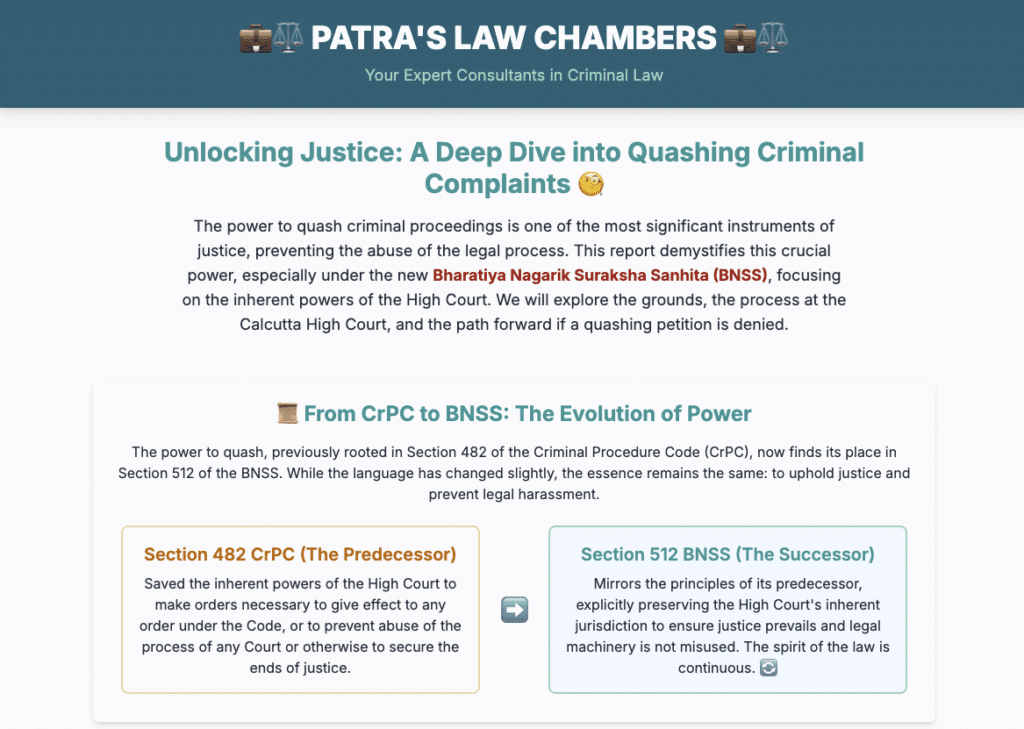
- High Court's power to quash criminal proceedings is now codified in Section 528 BNSS, preserving earlier jurisprudence from Section 482 CrPC.
- The transition reflects legislative continuity, ensuring established precedents and principles remain applicable under the new framework.
- Inherent powers of the High Court safeguard against misuse of the legal process, crucial for maintaining justice.
- Quashing of proceedings is guided by State of Haryana v. Bhajan Lal, which outlines illustrative categories to prevent abuse.
- Judicial review can quash charges when disputes are fundamentally civil, lacking criminal intent, or marked by malicious prosecution.
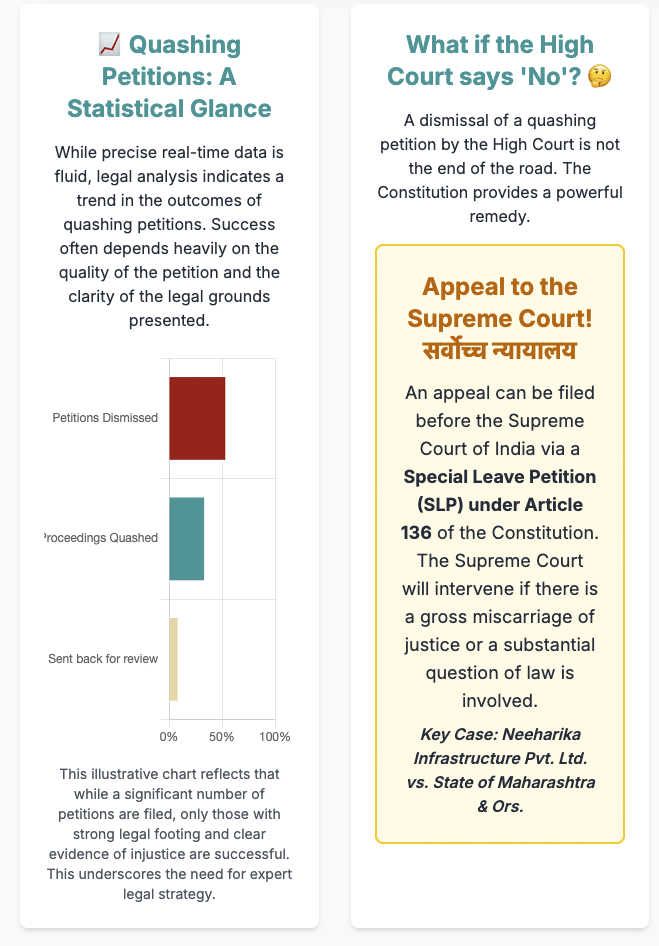
- Special Leave Petitions (SLPs) provide a remedy against dismissals of quashing applications, emphasizing judicial oversight.
- This power serves as a critical filter, ensuring the criminal justice system remains free from frivolous cases and harassment.
An Expert Report on the Quashing of Criminal Proceedings by the High Court under Indian Law
-
Creditor and contributor of this article:
Patra’s Law Chambers:
About Us:
Patra’s Law Chambers is a law firm with offices in Kolkata & Delhi, offering comprehensive legal services across various domains. Established in 2020 by Advocate Sudip Patra (Advocate, Supreme Court of India & Calcutta High Court) an alumnus of the Prestigious Rajiv Gandhi School of Intellectual Property Law, IIT Kharagpur ,with Post Graduate diploma in Business Law from IIM Calcutta, the firm specializes in Civil, Criminal, Writs,High Court Matters, Trademark, Copyright, Company, Tax, Banking, Property disputes, Service law, Family law, and Supreme Court matters.You can know more about us in here
Kolkata Office:
NICCO HOUSE, 6th Floor, 2, Hare Street, Kolkata-700001 (Near Calcutta High Court)
Delhi Office:
House no: 4455/5, First Floor, Ward No. XV, Gali Shahid
Bhagat Singh, Main Bazar Road, Paharganj, New Delhi-110055
Website: www.patraslawchambers.com
Email: [email protected]
Phone: +91 890 222 4444/ +91 7003 715 325
Part I: The Legal Framework and Inherent Powers of the High Court
YouTube video Overview:
Section 1: Introduction and Clarification of Governing Law
1.1 Addressing the Query: Section 512 BNSS vs. Section 528 BNSS
1.2 Legislative Continuity: From Section 482 CrPC to Section 528 BNSS
|
Provision
|
Verbatim Text
|
Key Phrases
|
Judicial Interpretation/Implication
|
|
Section 482 CrPC, 1973
|
“Saving of inherent powers of High Court. – Nothing in this Code shall be deemed to limit or affect the inherent powers of the High Court to make such orders as may be necessary to give effect to any order under this Code, or to prevent abuse of the process of any Court or otherwise to secure the ends of justice.” 9
|
– Nothing in this Code shall be deemed to limit or affect – inherent powers – prevent abuse of the process – secure the ends of justice
|
This is a saving clause, not a source of new power. It acknowledges the pre-existing, plenary power of the High Court. The power is to be used sparingly, in exceptional cases, to correct grave injustice.
|
|
Section 528 BNSS, 2023
|
“Saving of inherent powers of High Court. Nothing in this Sanhita shall be deemed to limit or affect the inherent powers of the High Court to make such orders as may be necessary to give effect to any order under this Sanhita, or to prevent abuse of the process of any Court or otherwise to secure the ends of justice.” 7
|
– Nothing in this Sanhita shall be deemed to limit or affect – inherent powers – prevent abuse of the process – secure the ends of justice
|
The language is identical, ensuring that the entire body of jurisprudence developed over five decades under Section 482 CrPC remains directly applicable and authoritative for the interpretation and application of Section 528 BNSS.
|
1.3 The Nature of “Inherent Powers”: Preserved, Not Conferred
Part II: Grounds for Quashing Criminal Proceedings: A Doctrinal and Case Law Analysis
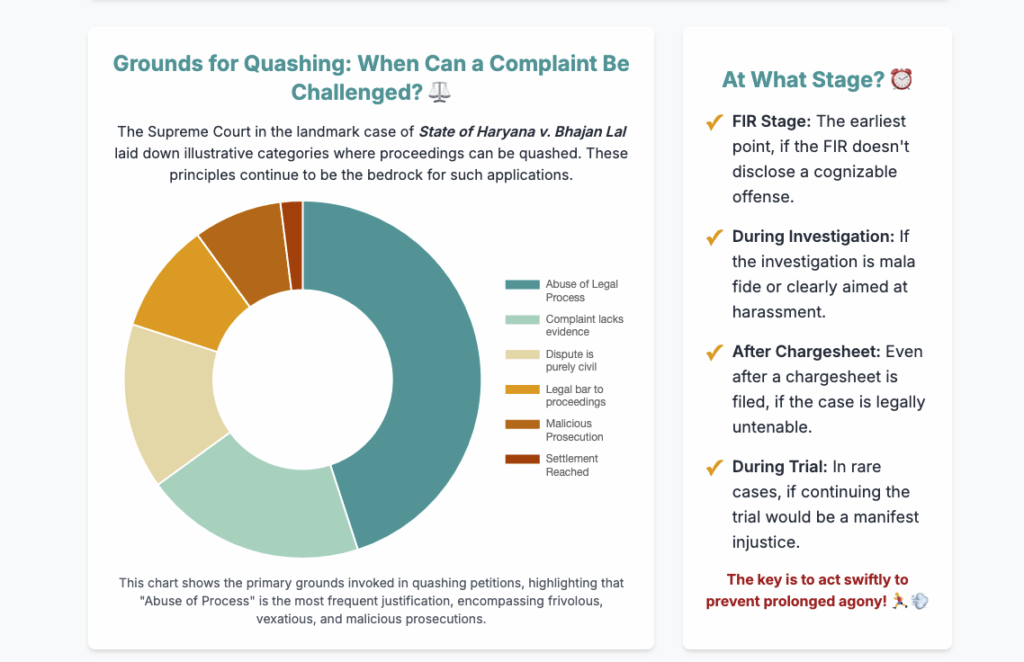

Section 2: The Foundational Principles of State of Haryana v. Bhajan Lal
2.1 Introduction to the Landmark Judgment
2.2 Detailed Examination of the Seven Illustrative Categories
|
Category from State of Haryana v. Bhajan Lal
|
Principle Explained
|
Illustrative Judgments
|
|
1. No Prima Facie Offence
|
The allegations in the FIR or complaint, even if accepted in their entirety at face value, do not prima facie constitute any offence or make out a case against the accused. 13
|
– Usha Chakraborty & Anr v. State of West Bengal & Anr. 18
|
|
2. No Cognizable Offence Disclosed
|
The allegations in the FIR and any accompanying materials do not disclose a cognizable offence, justifying a police investigation under Section 156(1) CrPC without a Magistrate’s order. 13
|
– P. Viswanathan vs Dr. A.K. Burman And Anr. 20
|
|
3. Insufficient Evidence
|
The uncontroverted allegations in the FIR/complaint and the evidence collected in support of the same do not disclose the commission of any offence and make out a case against the accused. 13
|
– Kalyan Panda v. State of W.B. 21
|
|
4. Offence is Non-Cognizable
|
The allegations in the FIR make out only a non-cognizable offence, and no order has been passed by a Magistrate under Section 155(2) CrPC permitting an investigation.
|
– State of Haryana v. Bhajan Lal 22
|
|
5. Absurd and Inherently Improbable Allegations
|
The allegations made in the FIR or complaint are so absurd and inherently improbable that no prudent person could ever reach a just conclusion that there is sufficient ground for proceeding against the accused. 13
|
– X v. State of Maharashtra 23
|
|
6. Express Legal Bar
|
There is an express legal bar engrafted in any of the provisions of the Code or the concerned Act (under which a criminal proceeding is instituted) to the institution and continuance of the proceedings.
|
– Punit Beriwala v. The State Of NCT Of Delhi (discusses limitation bar) 25
|
|
7. Malicious and Vengeful Prosecution
|
A criminal proceeding is manifestly attended with mala fide and/or where the proceeding is maliciously instituted with an ulterior motive for wreaking vengeance on the accused and with a view to spite him due to private and personal grudge. 13
|
– Suman Mishra vs The State Of Uttar Pradesh 27
|
Section 3: Quashing Based on the Merits and Nature of the Dispute
3.1 Absence of Mens Rea (Guilty Mind)
3.2 Disputes of a Predominantly Civil Nature
-
Commercial Disputes: In the realm of commercial transactions, this distinction is paramount. The Supreme Court, in Lalit Chaturvedi v. State of Uttar Pradesh, quashed an FIR for cheating and criminal breach of trust arising from a commercial sale, holding that a mere failure to pay dues under a contract does not automatically amount to a criminal offence.32 The Court underscored that the police machinery cannot be used as a recovery agent for civil dues and that criminal proceedings should not be initiated unless there is clear evidence of fraudulent or dishonest intention at the inception of the transaction.
-
Property Disputes: Similarly, disputes over property, inheritance, or the management of societies are often civil in nature. The Calcutta High Court has quashed criminal proceedings arising from disputes within a residents’ forum, noting that the underlying conflict was about control and management, which should be adjudicated in a civil court.33 The Supreme Court, in
Usha Chakraborty & Anr v. State of West Bengal & Anr., set aside a Calcutta High Court order and quashed an FIR where a property dispute was given a criminal colour, finding the allegations to be vague and lacking the essential ingredients of the alleged offences.18
Section 4: Quashing Based on Procedural Impropriety and Abuse of Process
4.1 Malicious Prosecution and Personal Vengeance
4.2 Inordinate and Unexplained Delay
Section 5: Quashing Based on Settlement and Compromise
5.1 The Doctrine of Gian Singh v. State of Punjab
5.2 Application to Non-Compoundable Offences
5.3 Limitations in Heinous and Socio-Economic Offences
-
Heinous Offences: Crimes that are against society, such as murder, rape, dacoity, and other offences involving mental depravity, cannot be quashed on the ground of a compromise between the victim and the offender. The overriding public interest in punishing such crimes outweighs the private settlement.22
-
Economic Offences: The Supreme Court has consistently held that economic offences form a class apart. In cases of financial fraud, bank fraud, and misappropriation of public funds, which have a serious impact on the nation’s economy and public exchequer, quashing based on settlement is impermissible.42 In
Anil Bhavarlal Jain, the Court refused to quash proceedings against company directors despite a one-time settlement with the bank, holding that such offences harm the public interest.42 -
Corruption Cases: Proceedings under the Prevention of Corruption Act are almost never quashed on the basis of a compromise, as corruption is an offence against the state and society.40
-
Environmental Offences: Offences under environmental laws are also considered crimes against the community, and the scope for quashing based on private settlements is virtually non-existent, especially given the citizen suit provisions that empower the public to enforce these laws.46
Part III: Procedural Aspects and Remedies
Section 6: The Appropriate Stage for Invoking Quashing Jurisdiction
6.1 From FIR to Chargesheet
6.2 Post-Filing of Chargesheet
6.3 At the Stage of Framing of Charges
6.4 Post-Conviction (Exceptional Circumstances)
Section 7: Detailed Process of Criminal Quashing in the Calcutta High Court
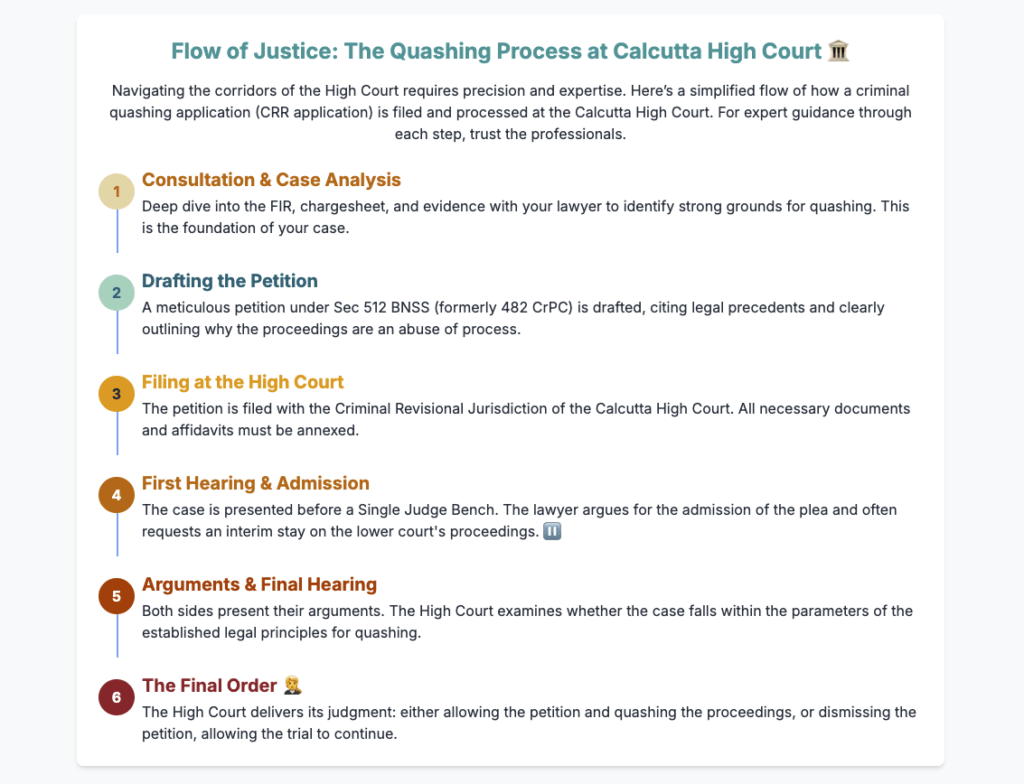
7.1 Nature of the Application
7.2 Drafting the Petition
-
Cause Title: Clearly stating the jurisdiction (“In the High Court at Calcutta, Criminal Revisional Jurisdiction, Appellate Side”).
-
Memo of Parties: The petitioner(s) (the accused) must be arrayed against the opposite parties, which must include: (1) The State of West Bengal, represented by the learned Public Prosecutor, High Court, Calcutta, and (2) The de-facto complainant/informant.
-
Pleadings: The body of the petition should systematically lay out the facts of the case, the details of the impugned FIR/complaint and criminal proceeding, the specific legal grounds for quashing (explicitly linking them to the principles from Bhajan Lal or other relevant doctrines), and a clear prayer to quash and set aside the proceedings.
-
Affidavit: The petition must be supported by an affidavit sworn by the petitioner, verifying the contents of the petition.
-
Annexures: It is mandatory to annex clear, legible copies of all relevant documents, including the FIR, the formal written complaint (if any), the chargesheet (if filed), any settlement deed, and any other documentary evidence relied upon by the petitioner.60
7.3 Filing and Procedure
|
Step
|
Action Required
|
Key Documents
|
Relevant Rule
|
|
1. Drafting & Verification
|
Draft the CRR petition with all necessary pleadings, grounds, and prayers. The petition must be affirmed by the petitioner before an Oath Commissioner.
|
– CRR Petition – Vakalatnama – Affidavit of Petitioner
|
Calcutta High Court Appellate Side Rules 62
|
|
2. Filing
|
File the petition, along with all annexures, at the registry of the Appellate Side of the Calcutta High Court. This can be done physically or via the e-filing portal. 63
|
– Stamped Petition Set – Annexures
|
E-filing Manual and High Court Rules 63
|
|
3. Curing Defects
|
The registry will scrutinize the petition. If any defects are found, they must be cured by the advocate-on-record.
|
– Defect Sheet from Registry
|
Registry Practice
|
|
4. Mentioning for Listing
|
Once the petition is free from defects and numbered, the advocate must “mention” the matter before the appropriate bench (the Single Bench with the determination to hear criminal revisional matters) to get a date for the first hearing.
|
– CRR Number
|
Daily Cause List and Court Practice
|
|
5. Service of Notice
|
A copy of the petition must be served on the office of the Public Prosecutor, High Court, Calcutta (representing the State) and on the de-facto complainant (Opposite Party No. 2).
|
– Petition Copy – Affidavit of Service
|
CrPC and High Court Rules
|
|
6. Hearing on Admission & Interim Relief
|
On the first date of hearing, the petitioner’s counsel will argue for the admission of the petition and for any interim orders, such as a stay of investigation or further proceedings. The State and the complainant will have the right to oppose.
|
– Petition – Oral Submissions
|
–
|
7.4 Interim Orders
Section 8: Remedy Against Dismissal: The Special Leave Petition (SLP)
8.1 Constitutional Basis and Scope
8.2 Grounds for Filing an SLP
-
The High Court has ignored or misapplied the settled principles of law laid down in Bhajan Lal or other binding precedents.
-
The High Court’s decision is perverse, i.e., it is a decision that no reasonable judicial mind could have reached.
-
The High Court has failed to quash a proceeding that is manifestly attended with mala fides or is an abuse of the process of law.
-
The case involves a substantial question of law of general public importance that requires an authoritative pronouncement from the Supreme Court.
8.3 Procedure and Limitation
-
Limitation Period: The SLP must be filed within 90 days from the date of the High Court’s impugned order.66
-
Advocate-on-Record (AOR): An SLP can only be filed through an Advocate-on-Record who is registered with the Supreme Court.67
-
Documentation: The petition must be accompanied by a certified copy of the High Court’s judgment, the quashing petition filed in the High Court, and all relevant annexures. It must also contain a list of dates, a statement of facts, and the precise questions of law that the petitioner wants the Supreme Court to consider.66
8.4 Locus Standi and Public Interest
Part IV: Thematic Analysis of Over 30 Landmark Judgments
Section 9: Foundational and Procedural Principles
-
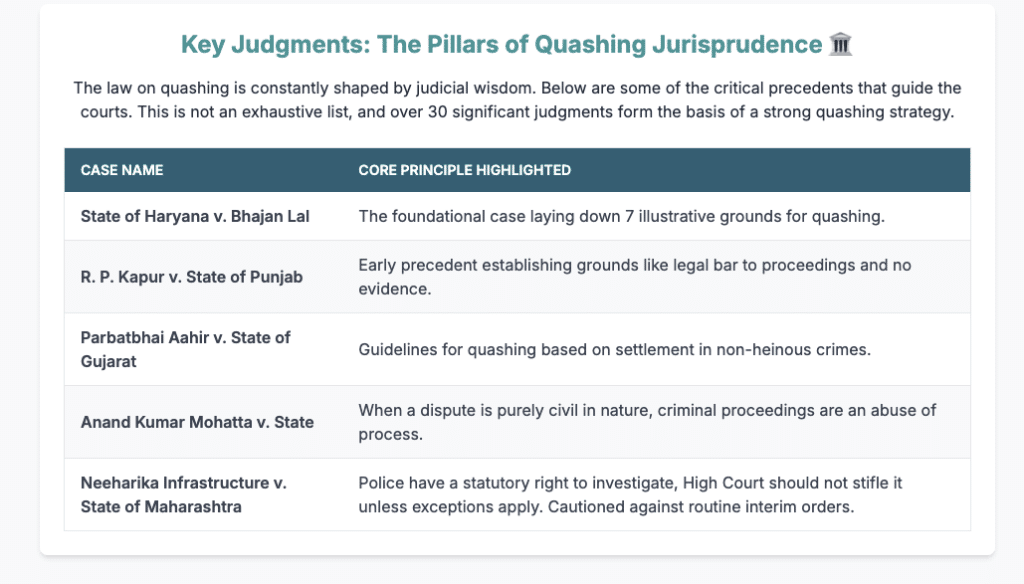
State of Haryana v. Bhajan Lal (1992): This is the foundational judgment that laid down seven illustrative categories for quashing an FIR. It established a structured framework to prevent the misuse of criminal law for personal vendettas, emphasizing that the power should be exercised to prevent abuse of process or to secure the ends of justice.13
-
R.P. Kapur v. State of Punjab (1960): An early and influential precedent that identified three major grounds for quashing: (i) a legal bar to the proceedings, (ii) absence of allegations constituting an offence, and (iii) no legal evidence to support the charge.39
-
Gian Singh v. State of Punjab (2012): This landmark ruling clarified the distinction between “compounding” of offences under Section 320 CrPC and “quashing” under Section 482 CrPC. It held that the High Court’s inherent power is wider and can be used to quash non-compoundable offences if the dispute is primarily private and the settlement serves the ends of justice.9
-
Narinder Singh v. State of Punjab (2014): Building on Gian Singh, this judgment provided detailed guidelines for quashing non-compoundable offences based on settlement, emphasizing factors like the nature and gravity of the offence and the timing of the settlement.31
-
State of M.P. v. Laxmi Narayan (2019): The Court held that even serious offences like attempt to murder (Section 307 IPC) could be quashed based on a settlement, but only after considering the specific facts, such as the nature of the injury and whether the dispute was purely private.9
-
M/s Neeharika Infrastructure Pvt. Ltd. v. State of Maharashtra (2021): A crucial judgment that curtailed the practice of High Courts granting blanket interim orders of “no coercive steps.” It strongly reiterated that the police have a statutory right to investigate and courts should not interfere prematurely unless no cognizable offence is disclosed at all.9
-
Abhishek v. State of Madhya Pradesh (2023): This judgment settled a vital procedural issue, holding that a quashing petition under Section 482 CrPC remains maintainable even if a chargesheet is filed by the police during its pendency. This prevents the police from rendering the petition infructuous.52
-
Pratibha v. Rameshwari Devi (2007): The Supreme Court held that in a petition for quashing an FIR, the High Court cannot call for and rely upon the investigation report, as its inquiry is limited to the allegations in the FIR itself.22
-
Joseph Salvaraj A. v. State of Gujarat (2011): A key precedent cited in Abhishek, which affirmed the High Court’s power to quash proceedings even after the filing of a chargesheet.52
-
Madhu Limaye v. State of Maharashtra (1977): This case clarified the relationship between the High Court’s revisional jurisdiction (Section 397 CrPC) and its inherent powers (Section 482 CrPC). It held that the bar on revision against interlocutory orders does not limit the High Court’s inherent power to intervene in cases of abuse of process.74
Section 10: Matrimonial and Family Disputes (Sec 498A IPC & Dowry Prohibition Act)
-
Suman Mishra v. State of U.P. (2025): The Supreme Court quashed a 498A IPC case, finding it to be a malicious “counter blast” filed by the wife two months after the husband had initiated divorce proceedings, highlighting the “ulterior motive” ground from Bhajan Lal.27
-
X v. State of Maharashtra (2025): The Bombay High Court quashed a dowry harassment FIR against the husband’s relatives, observing a “tendency” to make “general and omnibus” allegations against the entire family to settle personal scores.23
-
Calcutta HC Judgment (Feb 2025): The Calcutta High Court, while quashing an FIR against sisters-in-law, cautioned lower courts to be “extremely careful” with matrimonial complaints containing vague allegations against relatives who do not reside in the matrimonial home.24
-
Calcutta HC Judgment (May 2023): In a case of clear abuse of process, the Calcutta High Court quashed a second FIR filed on the same allegations four months after the accused were acquitted in the first case, noting that no new cause of action had been disclosed.75
-
Kalyan Panda v. State of W.B. (2023): The Calcutta High Court exercised its power under Section 482 CrPC to quash a 498A case due to the lack of specific allegations and the presence of material suggesting a multifaceted dispute, including the complainant’s psychiatric issues and ongoing domestic violence proceedings.21
-
Shaurabh Kumar Tripathi v. Vidhi Rawal (2025): The Supreme Court clarified that proceedings under the Domestic Violence Act, 2005, though civil in nature, are handled by Criminal Courts, and therefore, the High Court has jurisdiction under Section 482 CrPC / 528 BNSS to quash them in appropriate cases.76
-
J&K HC Judgment (Apr 2025): The Jammu & Kashmir High Court quashed an FIR in a matrimonial dispute based on a compromise, holding that the High Court’s inherent power under Section 528 BNSS to secure the ends of justice overrides the statutory limitations on compounding offences under Section 359 BNSS.77
Section 11: Commercial, Financial, and Property Disputes
-
Lalit Chaturvedi v. State of Uttar Pradesh (2024): The Supreme Court quashed criminal proceedings for cheating in a commercial dispute, emphasizing that a mere breach of contract or inability to pay dues does not constitute a criminal offence without an element of fraudulent intent from the outset.32
-
Anil Bhavarlal Jain v. State of Maharashtra (2024): The Court refused to quash an FIR in a case of bank fraud despite a settlement, holding that economic offences that affect the “public exchequer” and the financial system are crimes against society and cannot be quashed on the basis of a private compromise.42
-
Dinesh Sharma v. Emgee Cables (2025): The Supreme Court ruled that High Courts cannot quash FIRs when larger economic offences, such as the creation of shell companies to siphon funds, are manifest, even if there is a history of civil transactions between the parties.43
-
Usha Chakraborty v. State of West Bengal (2023): The Supreme Court, allowing an appeal against a Calcutta High Court order, quashed an FIR in a property dispute that was essentially civil in nature but had been given a “cloak of criminal offence,” finding the allegations vague and insufficient.18
-
Rekha Sharad Ushir v. Saptashrungi Mahila Nagari Sahkari Patsanstha Ltd. (2024): A cheque bounce complaint under Section 138 of the Negotiable Instruments Act was quashed because the complainant had deliberately suppressed material facts (the accused’s replies to the demand notice), which amounted to an abuse of the process of law.78
-
H.N. Jagadeesh v. R. Rajeshwari (2025): The Supreme Court restored an acquittal in a cheque bounce case, setting aside the High Court’s remand order. The Court held that the complainant’s failure to prove essential procedural requirements, like the service of the statutory notice, was fatal to the case, and allowing another opportunity to present evidence was improper.79
Section 12: Other Specific Contexts
-
Naushey Ali v. State of U.P. (2025): The Supreme Court held that the mere inclusion of a serious, non-compoundable offence like Section 307 IPC in an FIR does not act as a bar to quashing if the allegations, injuries, and circumstances do not prima facie support such a grave charge.31
-
Calcutta HC Judgment on Medical Negligence (2023): A Division Bench of the Calcutta High Court set aside charges of medical negligence, holding that complex issues of a doctor’s competence and adherence to medical protocols should be adjudicated by specialized bodies like the National Medical Commission, not consumer forums, and found “palpable wrongs” in the adjudication process.80
-
Orissa HC Judgment (July 2025): The High Court quashed criminal proceedings in a nine-year-old case where the trial had not even commenced due to the prosecution’s failure to produce witnesses, holding that the prolonged delay violated the accused’s fundamental right to a speedy trial under Article 21.36
-
Delhi HC Judgment on Tablighi Jamaat (2025): The Delhi High Court quashed 16 chargesheets against Indian citizens accused of sheltering foreign attendees of the Tablighi Jamaat congregation during the COVID-19 lockdown, bringing an end to proceedings that were widely debated.82
-
MR Ajayan v. The State of Kerala (2024): In a landmark decision, the Supreme Court allowed a third party to file an SLP against a High Court order quashing criminal proceedings. The Court expanded the traditional rules of locus standi, reasoning that the case involved allegations of tampering with judicial records, which is a matter of grave public interest affecting the integrity of the justice system.72
-
State of T.N v. R. Vasanthi Stanley (2016): This case serves as a key precedent where the Supreme Court declined to quash proceedings in a case involving the abuse of the financial system, reinforcing the principle that such offences have a broad societal impact.42
-
Parbatbhai Aahir v. State of Gujarat (2017): The Supreme Court summarized the principles for exercising power under Section 482 CrPC to quash an FIR based on a settlement, emphasizing that the High Court must consider the nature and gravity of the offence and its societal impact, especially in cases of serious and public wrongs like economic frauds.40
-
Krishnan v. Krishnaveni (1997): The Supreme Court clarified that while a second revision is barred, the High Court can still exercise its inherent powers under Section 482 CrPC, but must do so sparingly and be conscious of the fact that a lower revisional court has already applied its mind.54
Part V: Conclusion

Section 13: Concluding Remarks and Hashtags
13.1 Synthesis and Future Outlook
Works cited
-
Comparison of Bharatiya Nyaya Suraksha Sanhita, (BNSS) 2023 and Code of Criminal Procedure, (CRPC)1973 – B&B Associates LLP, accessed on July 21, 2025, https://bnblegal.com/article/comparison-of-bharatiya-nyaya-suraksha-sanhita-bnss-2023-and-code-of-criminal-procedure-crpc1973/
-
Section-512 BNSS – Bhartiya Nagarik Suraksha Sanhita, 2023 & equivalent Cr.P.C. Section, accessed on July 21, 2025, https://www.prashantkanha.com/section-512-bnss-bhartiya-nagarik-suraksha-sanhita-2023-equivalent-cr-p-c-section/
-
Section 512 in Bharatiya Nagarik Suraksha Sanhita, 2023 – Indian Kanoon, accessed on July 21, 2025, https://indiankanoon.org/doc/101334521/
-
BNSS Section 512 – Defect or error not to make attachment unlawful – Latest Laws, accessed on July 21, 2025, https://www.latestlaws.com/bare-acts/central-acts-rules/bnss-section-512-defect-or-error-not-to-make-attachment-unlawful/
-
CrPC or BNSS: Applicability of S. 528 BNSS or S. 482 CrPC …, accessed on July 21, 2025, https://www.scconline.com/blog/post/2025/07/10/sik-hc-crpc-or-bnss-section-528-section-482/
-
Quashing of FIR: 482 CRPC & S. 528 Bharatiya Nagarik Suraksha Sanhita, 2023, accessed on July 21, 2025, https://www.thelawadvice.com/articles/quashing-of-fir-482-crpc-s-528-bharatiya-nagarik-suraksha-sanhita-2023
-
Section 528 in Bharatiya Nagarik Suraksha Sanhita, 2023 – Indian Kanoon, accessed on July 21, 2025, https://indiankanoon.org/doc/99044874/
-
Quashing the FIR under Section 528 BNSS: Inherent Powers of the High Court to Prevent Misuse of Law – Advocate Himanshu Jain, accessed on July 21, 2025, https://advocatehimanshujain.com/fir-under-section-528-bnss-powers/
-
section 482 crpc – Indian Kanoon, accessed on July 21, 2025, https://indiankanoon.org/search/?formInput=section%20482%20crpc
-
Section 482 – India Code, accessed on July 21, 2025, https://www.indiacode.nic.in/show-data?actid=AC_CEN_5_23_000010_197402_1517807320555§ionId=22899§ionno=482&orderno=532
-
Section 482 CrPC – Gyan Sanchay, accessed on July 21, 2025, https://gyansanchay.csjmu.ac.in/wp-content/uploads/2024/02/Section-482-CrPC.pdf
-
DECODING THE INHERENT POWERS UNDER SECTION-482 CRPC, accessed on July 21, 2025, https://officeofpartapsingh.com/our-presence/f/decoding-the-inherent-powers-under-section-482-crpc
-
State of Haryana vs Bhajan Lal (1990 ) Case Analysis – Testbook, accessed on July 21, 2025, https://testbook.com/landmark-judgements/state-of-haryana-vs-bhajan-lal
-
Bhajan Lal v. State of Haryana & Others – Jyoti Judiciary Coaching, accessed on July 21, 2025, https://www.jyotijudiciary.com/bhajan-lal-v-state-of-haryana-others/
-
State of Haryana v. Bhajan Lal (1990) : case analysis – iPleaders, accessed on July 21, 2025, https://blog.ipleaders.in/state-of-haryana-v-bhajan-lal-1990-case-analysis/
-
The Importance of Bhajan Lal in the Powers of the High Court and Supreme Court Regarding the Quashing of Criminal Proceedings – Etching the Path, accessed on July 21, 2025, https://etchingthepath.com/2024/09/21/the-importance-of-bhajan-lal-in-the-powers-of-the-high-court-and-supreme-court-regarding-the-quashing-of-criminal-proceedings/
-
State Of Haryana V. Ch. Bhajan Lal [1990] – Delhi Law Academy, accessed on July 21, 2025, https://www.delhilawacademy.com/state-of-haryana-v-ch-bhajan-lal-1990/
-
In Criminal Appeal No.256 of 2022-SC-Jurisdiction u/s 482 CrPC is …, accessed on July 21, 2025, https://legiteye.com/in-criminal-appeal-no256-of-2022-sc-jurisdiction-us-482-crpc-is-to-be-exercised-sparingly-with-caution-for-securing-ends-of-justice-and-only-in-cases-where-refusal-to-exercise-that-power-may-result-in-abuse-of-process-of-law-sc-justices-ajay-rastogi-ct-ravikumar-30-01-2023/
-
section 482 crpc doctypes: judgments – Indian Kanoon, accessed on July 21, 2025, https://indiankanoon.org/search/?formInput=section%20482%20crpc+doctypes:judgments
-
quash the fir doctypes: kolkata – Indian Kanoon, accessed on July 21, 2025, https://indiankanoon.org/search/?formInput=quash%20the%20fir%20%20doctypes%3A%20kolkata&pagenum=1
-
Calcutta High Court quashes Section 498A IPC complaint – SCC Online, accessed on July 21, 2025, https://www.scconline.com/blog/post/2023/09/08/calcutta-hc-quashes-complaint-under-section-498a-of-the-ipc-on-lack-of-specific-allegations-scc-blog-legal-research/
-
Supreme Court Ruling on Section 482 CRPC Inherent Jurisdiction, accessed on July 21, 2025, https://ksandk.com/corporate/section-482-crpc-jurisdiction-supreme-court/
-
“It’s wife’s tendency to implicate husband and his … – SCC Online, accessed on July 21, 2025, https://www.scconline.com/blog/post/2025/06/20/bom-hc-section-498a-ipc-wifes-tendency-to-implicate-husband-to-settle-personal-scores/
-
Be careful in criminal cases tied to matrimonial disputes: Calcutta HC – The Times of India, accessed on July 21, 2025, https://timesofindia.indiatimes.com/india/be-careful-in-criminal-cases-tied-to-matrimonial-disputes-calcutta-hc/articleshow/118225873.cms
-
DELAY IN LODGING FIR CANNOT BE REASON TO QUASH FIRS FOR OFFENCES PUNISHABLE WITH MORE THAN 3 YEARS IMPRISONMENT: A CASE ANALYSIS – Edu Law, accessed on July 21, 2025, https://www.theedulaw.in/content/judgements/56/DELAY-IN-LODGING-FIR-CANNOT-BE-REASON-TO-QUASH-FIRS-FOR-OFFENCES-PUNISHABLE-WITH-MORE-THAN-3-YEARS-IMPRISONMENT:-A-CASE-ANALYSIS
-
wreaking vengeance – Indian Kanoon, accessed on July 21, 2025, https://indiankanoon.org/search/?formInput=wreaking%20vengeance
-
Suman Mishra vs The State Of Uttar Pradesh on 12 February, 2025, accessed on July 21, 2025, https://indiankanoon.org/doc/97340294/
-
Supreme Court quashes abetment to suicide case against husband’s in-laws over lack of mens rea – SCC Online, accessed on July 21, 2025, https://www.scconline.com/blog/post/2025/05/05/sc-quashes-abetment-case-husbands-inlaws-mens-rea-absence/
-
IN THE HIGH COURT OF MADHYA PRADESH AT JABALPUR BEFORE HON’BLE SHRI JUSTICE PRAMOD KUMAR AGRAWAL ON 07th of Augus – Mphc.gov.in, accessed on July 21, 2025, https://mphc.gov.in/upload/jabalpur/MPHCJB/2024/MCRC/2625/MCRC_2625_2024_FinalOrder_07-08-2024.pdf
-
Quashing of FIR in India: Legal Grounds and Process Explained – Finlaw Associates, accessed on July 21, 2025, https://finlawassociates.com/blog/quashing-of-fir-in-india-legal-grounds-and-process-explained/
-
Quashing of FIR – Supreme Court Observer, accessed on July 21, 2025, https://www.scobserver.in/supreme-court-observer-law-reports-scolr/quashing-of-fir-naushey-ali-v-state-of-up/
-
Quashing Criminal Proceedings in Commercial Disputes: Lalit …, accessed on July 21, 2025, https://www.casemine.com/commentary/in/quashing-criminal-proceedings-in-commercial-disputes:-lalit-chaturvedi-v.-state-of-uttar-pradesh/view
-
Sukhdeb Saha vs The State Of West Bengal & Ors on 10 January, 2024 – Indian Kanoon, accessed on July 21, 2025, https://indiankanoon.org/doc/76694053/
-
Section 482 CrPC – iPleaders, accessed on July 21, 2025, https://blog.ipleaders.in/section-482-crpc/
-
A. Criminal Procedure Code, 1973, Section 482 – Inherent powers of High Court – Law Finder, accessed on July 21, 2025, https://www.lawfinderlive.com/archivesc/198581.htm
-
Trial delay forces HC to quash criminal proceedings against 2, accessed on July 21, 2025, https://timesofindia.indiatimes.com/city/bhubaneswar/trial-delay-forces-hc-to-quash-criminal-proceedings-against-2/articleshow/122668031.cms
-
quashing of fir doctypes: kolkata – Indian Kanoon, accessed on July 21, 2025, https://indiankanoon.org/search/?formInput=quashing%20of%20fir%20%20%20%20%20doctypes%3A%20kolkata&pagenum=23
-
Daljit Singh Alias Tota And Another vs State Of Punjab And Another on 6 February, 2023 – Indian Kanoon, accessed on July 21, 2025, https://indiankanoon.org/doc/138725592/
-
Quashing of FIR: Supreme Court Guidelines and Case Studies – Rajendra Law Office LLP, accessed on July 21, 2025, https://rajendralawoffice.com/quashing-of-fir-supreme-court-guidelines-and-case-studies/
-
$~ * IN THE HIGH COURT OF DELHI AT NEW DELHI % Reserved on: 11.08.2023 Pronounced on: 16.08.2023 + CRL.M.C. 5720/2023 ABHISHEK @, accessed on July 21, 2025, https://dhccaseinfo.nic.in/jsearch/judgement.php?path=dhc/SKS/judgement/19-08-2023/&name=SKS16082023CRLMM57202023_163749.pdf
-
SECTION 482 CrPC-PROJECT | PDF | High Court Of Australia | Crimes – Scribd, accessed on July 21, 2025, https://www.scribd.com/document/725244588/SECTION-482-CrPC-PROJECT-1
-
Supreme Court: Economic Offences Cannot Be Quashed Even if a …, accessed on July 21, 2025, https://www.metalegal.in/post/supreme-court-economic-offences-cannot-be-quashed-even-if-a-settlement-exists-between-the-parties
-
High Courts can’t quash FIR when larger economic offences are manifest: Supreme Court, accessed on July 21, 2025, https://www.newindianexpress.com/nation/2025/Apr/27/high-courts-cant-quash-fir-when-larger-economic-offences-are-manifest-supreme-court
-
Supreme Court Observer Law Reports (SCO.LR), accessed on July 21, 2025, https://www.scobserver.in/supreme-court-observer-law-reports-scolr/
-
Preliminary inquiry not mandatory in every case under Prevention of Corruption Act: SC, accessed on July 21, 2025, https://legal.economictimes.indiatimes.com/news/litigation/preliminary-inquiry-not-mandatory-in-every-case-under-prevention-of-corruption-act-sc/118507543
-
Supreme Court Declines to Limit Environmental Citizen Suits – JD Supra, accessed on July 21, 2025, https://www.jdsupra.com/legalnews/supreme-court-declines-to-limit-5558109/
-
Supreme Court requires environmental clearance before projects start | India – Law.asia, accessed on July 21, 2025, https://law.asia/vanashakti-supreme-court-ruling/
-
M/S Neeharika, Infrastructure Pvt. Ltd. vs The State Of Maharashtra …, accessed on July 21, 2025, http://vestralex.com/2021/04/15/m-s-neeharika-infrastructure-pvt-ltd-vs-the-state-of-maharashtra/
-
Neeharika Infrastructure Private Limited vs State of Maharashtra – 2021 3 Supreme 531, accessed on July 21, 2025, https://supremetoday.ai/doc/judgement/00100073833
-
Investigating Agencies deserve reasonable time to conduct investigation, Supreme Court sets aside Madras HC order quashing a criminal proceeding in haste – SCC Online, accessed on July 21, 2025, https://www.scconline.com/blog/post/2023/01/19/investigating-agency-has-the-right-to-conduct-investigation-and-reasonable-time-should-be-given-to-them-to-conduct-the-investigation-supreme-court-set/
-
Supreme Court on Section 482 CrPC – Have the inherent powers of High Courts been diluted? | India Corporate Law, accessed on July 21, 2025, https://corporate.cyrilamarchandblogs.com/2021/05/supreme-court-on-section-482-crpc-have-the-inherent-powers-of-high-courts-been-diluted/
-
High Court can entertain Section 482 Petition to quash FIR even if …, accessed on July 21, 2025, https://bonumlex.com/high-court-can-entertain-section-482-petition-to-quash-fir-even-if-chargesheet-has-been-filed-during-its-pendency-supreme-court/
-
SC explains scope of proceedings in plea for discharge & quashing of criminal cases, accessed on July 21, 2025, https://lawbeat.in/supreme-court-judgments/sc-explains-scope-proceedings-plea-discharge-quashing-criminal-cases
-
REPORTABLE IN THE SUPREME COURT OF INDIA CRIMINAL APPELLATE JURISDICTION CRIMINAL APPEAL NO. 1405/2019 STATE REP. BY THE DEPUTY, accessed on July 21, 2025, https://api.sci.gov.in/supremecourt/2018/1920/1920_2018_11_1501_60277_Judgement_26-Mar-2025.pdf
-
Quashing of FIR or Discharge Application – YouTube, accessed on July 21, 2025, https://www.youtube.com/shorts/zzQkkCSLntc
-
Criminal Proceedings Can Be Quashed At Post-Conviction Stage Invoking Power U/S 482 CrPC Upon Settlement Between Victim & Convict: Kerala High Court – Asia Law Offices, accessed on July 21, 2025, https://www.asialawoffices.com/7253-/criminal-proceedings-can-be-quashed-at-post-conviction-stage-invoking-power-u-s-482-crpc-upon-settlement-between-victim-convict-kerala-high-court/
-
Calcutta High Court – Appellate side – Case Status : Search by Case Number, accessed on July 21, 2025, https://hcservices.ecourts.gov.in/ecourtindiaHC/cases/case_no.php?state_cd=16&dist_cd=1&court_code=3&stateNm=Calcutta
-
Case Status – eCourt India High Courts Services, accessed on July 21, 2025, https://hcservices.ecourts.gov.in/ecourtindiaHC/index_highcourt.php?state_cd=16&dist_cd=1&court_code=3&stateNm=Calcutta
-
Rules of High Court at Calcutta relating to Applications under Article 226 of The Constitution of India – Indian Kanoon, accessed on July 21, 2025, https://indiankanoon.org/doc/23892089/
-
Proforma for Compromise Quashing First of all for filing compromise quashing below-mentioned documentation is required: 1. Comp, accessed on July 21, 2025, https://bnblegal.com/wp-content/uploads/2018/10/Proforma-for-Compromise-Quashing.pdf
-
Quashing FIR Petition Under Sec 528 BNSS Format | PDF | Crimes – Scribd, accessed on July 21, 2025, https://www.scribd.com/document/811173769/Quashing-FIR-Petition-Under-Sec-528-BNSS-Format
-
Calcutta High Court Appellate Side Rules, – CourtKutchehry, accessed on July 21, 2025, https://www.courtkutchehry.com/Judgement/Search/AdvancedV2?s_acts=Calcutta%20High%20Court%20Appellate%20Side%20Rules,
-
eFiling Services 3.0 – Orissa High Court, accessed on July 21, 2025, https://www.orissahighcourt.nic.in/e-filing/eFiling_manual.pdf
-
e-Filing services for online filing of cases, plaints, written statements, replies and various applications related to cases before any High Court or District Court of the country, accessed on July 21, 2025, https://filing.ecourts.gov.in/
-
Untitled – S3waas, accessed on July 21, 2025, https://cdnbbsr.s3waas.gov.in/s3ec057d2a383e54274888b4b73b97e1aa/uploads/2024/01/2024011197.pdf
-
Special Leave Petition in Indian Judicial System – Law Senate, accessed on July 21, 2025, https://www.lawsenate.com/publications/articles/special-leave-petition-slp.pdf
-
SLP Filing Supreme Court – SSRANA, accessed on July 21, 2025, https://ssrana.in/litigation/special-leave-petition-india/slp-special-leave-petition-filing-supreme-court/
-
Special Leave Petition – Drishti Judiciary, accessed on July 21, 2025, https://www.drishtijudiciary.com/ttp-constitution-of-india/special-leave-petition
-
Special Leave Petition (SLP) – VENSO LAW OFFICES LLP, accessed on July 21, 2025, https://vensolawoffices.com/special-leave-petition-slp/
-
Special Leave Petition – How to File SLP | Procedure – Corpbiz, accessed on July 21, 2025, https://corpbiz.io/special-leave-petition
-
SLP Filing in Supreme Court | Article 136 Guide and Procedure, accessed on July 21, 2025, https://www.duasnduas.com/resources/slp-filing-process-supreme-court-india/
-
Third-Party Can File SLP Under Article 136 Against Quashing of …, accessed on July 21, 2025, https://blog.firuzkhanlegalservicesllp.com/third-party-can-challenge-quashing-of-criminal-cases-with-slp-under-article-136-supreme-court/
-
Neeharika Infrastructure – Digital Supreme Court Reports, accessed on July 21, 2025, https://digiscr.sci.gov.in/view_judgment?id=Mjk3ODQ=
-
Alternate Remedy and Inherent Powers of High Courts under the …, accessed on July 21, 2025, https://www.scconline.com/blog/post/2025/03/26/alternate-remedy-and-inherent-powers-of-high-courts-under-the-nagarik-suraksha-sanhita-2023/
-
Calcutta High Court quashes FIR lodged under section 498A IPC – India Legal, accessed on July 21, 2025, https://indialegallive.com/constitutional-law-news/courts-news/calcutta-high-court-quashes-498a-ipc/
-
High Court can Quash DV U/S 482 & 528 BNSS : SC as on 19 May 2025 | Men Welfare Trust, accessed on July 21, 2025, https://www.menwelfare.in/judgements/high-court-can-quash-dv-u-s-482-528-bnss-sc-as-on-19-may-2025/
-
Section 528 Bnss – Your Ultimate Guide to Indian Legal News, Judgments, and Bare Acts – Court Book, accessed on July 21, 2025, https://courtbook.in/posts/tag/Section%20528%20BNSS
-
Supreme Court: Cheque Bounce Complaint Quashed for … – Metalegal, accessed on July 21, 2025, https://www.metalegal.in/post/supreme-court-cheque-bounce-complaint-quashed-for-suppression-of-material-facts
-
Supreme Court Restores Acquittal in Cheque Bounce Case – Legal Light Consulting, accessed on July 21, 2025, https://legallightconsulting.com/supreme-court-restores-acquittal-in-cheque-bounce-case/
-
Calcutta High Court set asides medical negligence charges on finding palpable wrongs in the adjudication process – SCC Online, accessed on July 21, 2025, https://www.scconline.com/blog/post/2023/12/18/calcutta-hc-set-asides-medical-negligence-charges-on-finding-palpable-wrongs-in-the-adjudication-process-scc-blog/
-
medical negligence doctypes: kolkata_app – Indian Kanoon, accessed on July 21, 2025, https://indiankanoon.org/search/?formInput=medical%20negligence%20%20doctypes%3A%20kolkata_app&pagenum=1
-
Covid-19 Tablighi Jamaat congregation case: HC quashes charges against nationals for sheltering foreigners; 16 cases junked, accessed on July 21, 2025, https://timesofindia.indiatimes.com/india/covid-19-tablighi-jamaat-congregation-case-hc-quashes-charges-against-nationals-for-sheltering-foreigners-16-cases-junked/articleshow/122630804.cms