Customs Appeal Lawyer in Kolkata: Commissioner (Appeals) and CESTAT
A customs order has fixed time limits, a fixed pre-deposit and a forum that depends on who passed it. This page explains Section 128, Section 129A, Section 129E and the High Court route in plain English, so you can see where your appeal belongs.
Which forum hears your customs appeal?
The forum depends on who passed the order. An order of an officer below the rank of Commissioner goes first to the Commissioner (Appeals) under Section 128 of the Customs Act, 1962. An order passed by a Commissioner or Principal Commissioner as adjudicating authority goes straight to the Customs, Excise and Service Tax Appellate Tribunal (CESTAT) under Section 129A(1)(a). An order of the Commissioner (Appeals) goes to CESTAT under Section 129A(1)(b). The tribunal’s own details and procedure are published at cestat.gov.in. Always note the date on which the order was communicated to you, because every limitation period runs from that date.
This page deals with appeals only. For show cause notices, seizure, adjudication and DRI arrest, please read our customs and import-export lawyer page. Where an order is challenged by writ, our guide to filing a writ petition in the Calcutta High Court explains the process. Passengers and NRIs returning to India will find related points on our NRI and OCI legal matters page. Sudip Patra drafts and argues customs appeals himself. Supreme Court matters are filed through his Supreme Court connection. Please verify every date and figure against your own order.
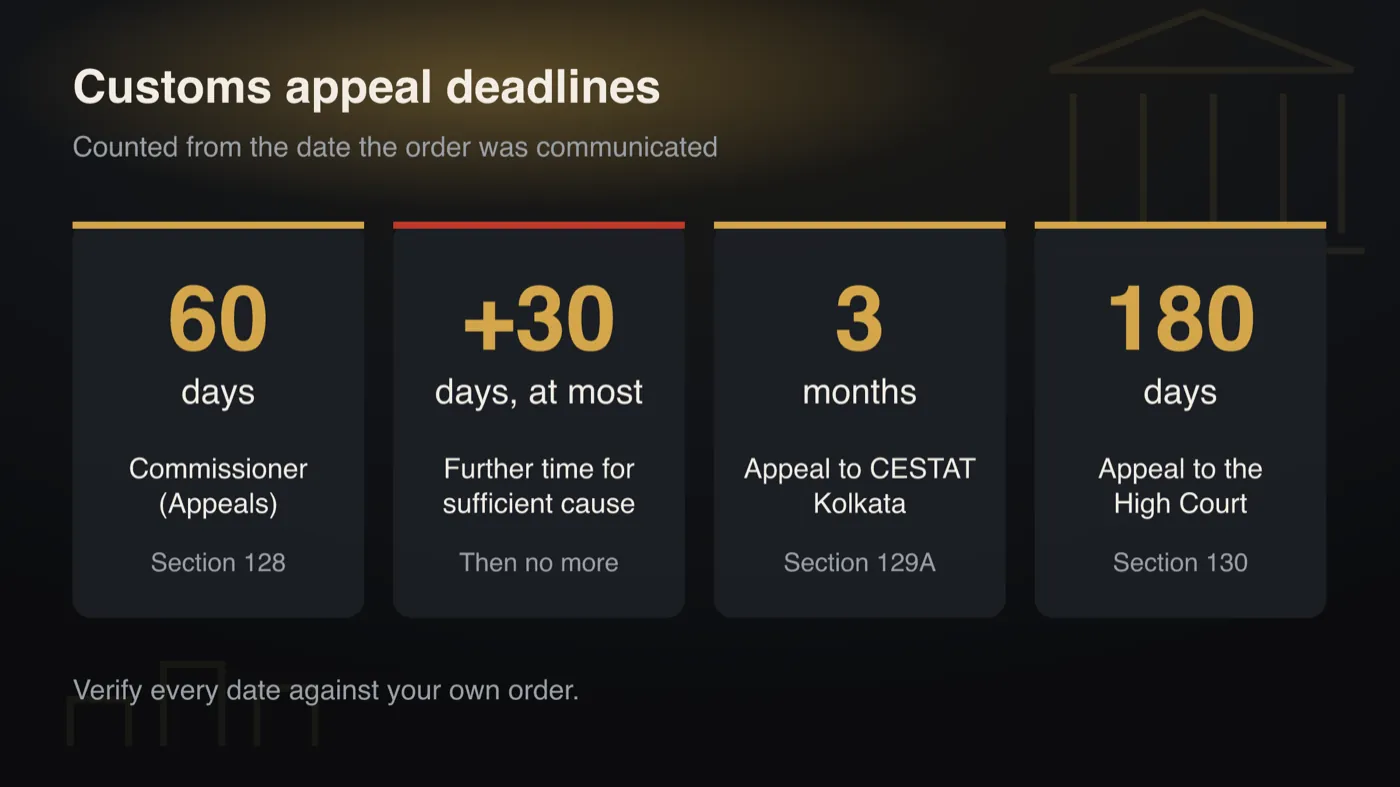
Customs appeal deadlines you cannot miss
Each forum has its own period, and the first one is the strictest.
Videos from Adv. Sudip Patra
More short explainers on our YouTube channel: Patra’s Law Chambers on YouTube ↗
Which customs paper do you hold in your hand?
The forum for a customs appeal depends on who passed the order and what the goods were. This is general information, not advice on your file.
Choose one of the options above.
How a customs dispute moves from notice to the higher courts
Most disputes follow this path. Dates and forums depend on your papers, so please verify them against your own order.
The notice is issued under Section 124 or Section 28, and you can ask for the relied-upon documents, file a written reply and seek a personal hearing. Seizure, notices and adjudication are covered on the customs lawyer Kolkata page.
The order may confiscate goods, demand duty or impose penalty. Limitation runs from the date it was communicated to you, and the rank of the officer who passed it decides your forum.
An officer below Commissioner rank is appealed to the Commissioner (Appeals) under Section 128, with a 7.5% pre-deposit. Where a Commissioner passed the order, the appeal goes to CESTAT instead.
A second appeal lies under Section 129A, with a 10% pre-deposit against a Commissioner (Appeals) order. Baggage, short-landing and drawback cases are excluded and go for revision under Section 129DD.
The Calcutta High Court hears appeals on a substantial question of law, while rate and valuation disputes go to the Supreme Court under Section 130E. Supreme Court matters are filed through the firm’s Supreme Court connection.
Article 226 is available mainly for lack of jurisdiction, breach of natural justice or a challenge to a law. The guide to filing a writ petition explains the process.
Three points people often miss, tap a card
Before the Commissioner (Appeals), the delay that can be condoned is capped at 30 days beyond the 60-day period. The Supreme Court held in Singh Enterprises, (2008) 3 SCC 70, that Section 5 of the Limitation Act cannot extend it further.
Under the first proviso to Section 129A(1), CESTAT has no jurisdiction over goods imported as baggage. The remedy after the Commissioner (Appeals) is a revision application under Section 129DD.
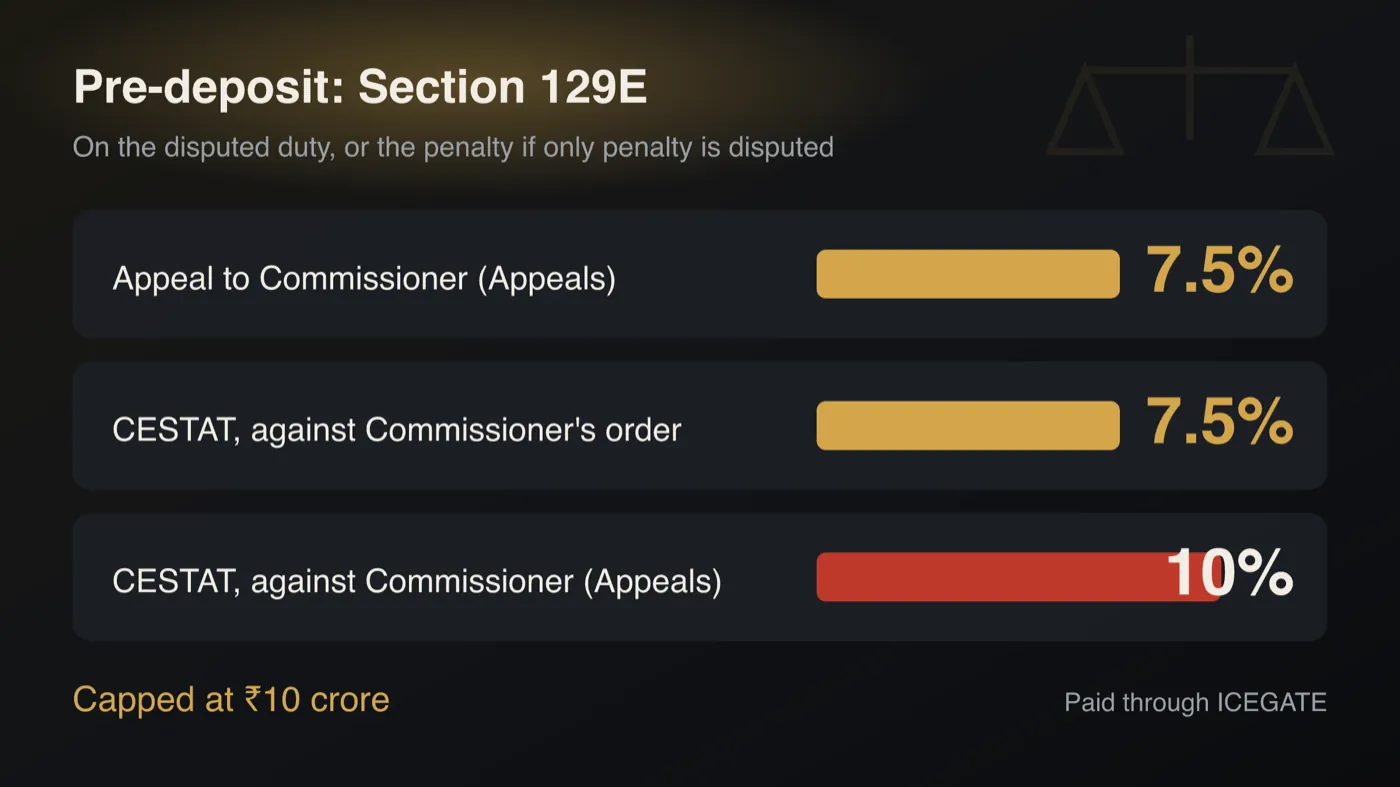
Section 129E requires 7.5% or 10% of the duty or penalty in dispute, capped at Rs 10 crore. It is refundable with interest under Section 129EE if the appeal succeeds.
Customs appeals we handle
First appeal to the Commissioner (Appeals)
Orders passed by officers below Commissioner rank are first challenged here, in Form C.A.-1, within 60 days. The authority can condone a further 30 days at most. Pre-deposit of 7.5% of the disputed duty or penalty is required under Section 129E before the appeal is heard.
Appeals before CESTAT, Kolkata
The Tribunal hears appeals against Commissioner orders and Commissioner (Appeals) orders within 3 months, in Form C.A.-3. The pre-deposit is 7.5% against a Commissioner’s order and 10% against a Commissioner (Appeals) order, capped at ₹10 crore.
Baggage cases and revision
CESTAT has no jurisdiction over goods imported as baggage, such as gold or electronics carried by passengers. After the Commissioner (Appeals), the remedy is a revision application to the Central Government under Section 129DD, within 3 months.
High Court, Supreme Court and writs
After CESTAT, an appeal lies to the Calcutta High Court under Section 130 on a substantial question of law. Rate of duty and valuation disputes go to the Supreme Court under Section 130E. A writ under Article 226 is available only in exceptional cases.
Papers to bring for a customs appeal
- Order-in-Original or appellate order, and proof of the date it was communicated
- Show cause notice with relied-upon documents, your reply and the hearing record
- Bill of Entry or Shipping Bill, invoices, packing list and contracts
- Section 108 statements and any retraction, seizure memo or panchnama
- Pre-deposit challan paid through ICEGATE
- Passport, ticket and KYC details for passenger and NRI cases
Supreme Court rulings that shape a customs appeal
These decisions fix the time limits, the scope of confiscation and fines, and when the Calcutta High Court will hear a writ petition instead of the statutory appeal. Each citation below was checked against published reports. Read the full text before you rely on any of them.
2007
No condonation beyond the extra 30 days
The Supreme Court held that the appellate authority can excuse a delay of only 30 days after the normal 60-day period. Section 5 of the Limitation Act cannot be used to extend it further. The case arose under Section 35 of the Central Excise Act. The tribunals apply the same rule to appeals before the Commissioner (Appeals) under Section 128 of the Customs Act, 1962.
2024
DRI officers are proper officers
A three-judge Bench allowed the Revenue’s review and reversed the 2021 Canon India ruling. It held that officers of the Directorate of Revenue Intelligence are proper officers who can issue demand notices under Section 28 of the Customs Act. It also upheld the validation in Section 97 of the Finance Act, 2022. The old argument that a DRI notice is without jurisdiction generally no longer succeeds.
2021
Redemption discretion must be exercised judicially
For prohibited goods, release on payment of a fine in lieu of confiscation under Section 125 is a matter of discretion. The Supreme Court held that this discretion must be exercised rationally, according to law and with reasons, never arbitrarily. Appellants rely on this ruling when an order of absolute confiscation gives no proper reasons.
2003
Breach of conditions can make goods prohibited
The Supreme Court held that goods may be treated as prohibited goods if the conditions for importing or exporting them are not met, even where the goods are not banned outright. This is why gold brought in by passengers in breach of the conditions is often treated as prohibited. Once goods are prohibited, release on a fine is discretionary, not a right.
1971
No extension of the seizure period without a hearing
Under Section 110(2), extending the six-month period for issuing a show cause notice after seizure is a quasi-judicial act. The owner must get notice and a hearing before the extension is granted. An extension granted without a hearing is invalid. If no valid notice or extension follows, the owner can ask for the seized goods to be returned.
2021
When a writ lies despite an appeal
The Supreme Court restated that an alternative remedy restricts, but does not bar, a writ under Article 226. A High Court may hear a writ where a fundamental right is at stake, natural justice was breached, the order is wholly without jurisdiction, or a law is challenged as invalid. In other customs cases, the appeal route under the Act must be followed.
How a customs appeal moves from the order to CESTAT Kolkata
Note the date the order reached you
Limitation runs from the date the Order-in-Original was communicated to you, not the date printed on it. Keep the envelope, email or acknowledgement. Also check the rank of the officer who passed the order, because that decides which forum hears your appeal.
Choose the correct forum
An order by an officer below the rank of Commissioner goes to the Commissioner (Appeals) under Section 128. An order by a Commissioner or Principal Commissioner goes straight to CESTAT under Section 129A(1)(a). Baggage, short-landing and drawback cases cannot go to CESTAT. After the Commissioner (Appeals), they go to the Central Government in revision under Section 129DD.
Pay the pre-deposit
Pay the pre-deposit under Section 129E through the ICEGATE e-payment challan before you file. It is 7.5% for a first appeal, whether to the Commissioner (Appeals) or to CESTAT, and 10% before CESTAT against a Commissioner (Appeals) order. It is worked out on the duty or penalty in dispute, with a maximum of Rs. 10 crore. Attach the proof of payment to the appeal.
File within the time limit
File Form C.A.-1 before the Commissioner (Appeals) within 60 days. Only 30 more days can be allowed, and only for sufficient cause. File Form C.A.-3 before the CESTAT Eastern Zonal Bench, Kolkata within three months, with the fee under Section 129A(6). Verify the current fee slabs and the e-filing requirements on cestat.gov.in before you file.
Argue the grounds at the hearing
The grounds usually cover limitation under Section 28, the valuation or classification, any breach of natural justice, retracted statements under Section 108 and the right to cross-examine witnesses, and the reasons given for confiscation and the redemption fine under Section 125. File the documents relied on and a written note of submissions.
Take the next step after CESTAT
Against a CESTAT order, an appeal lies to the Calcutta High Court under Section 130 within 180 days, but only on a substantial question of law. Where the dispute is about the rate of duty or valuation, the appeal lies to the Supreme Court under Section 130E. Sudip files Supreme Court matters through his Supreme Court connection.
Ordinary customs appeal versus baggage case
A baggage case follows a different path after the first appeal.
Pre-deposit for a customs appeal under Section 129E of the Customs Act, 1962 (maximum Rs. 10 crore)
Mistakes that cost customs appellants their case
Filing on day 91 before the Commissioner (Appeals) No authority can excuse a delay beyond 60 plus 30 days (Singh Enterprises). Count the days from the date the order reached you, and file well before the last day.
Taking a baggage case to CESTAT The first proviso to Section 129A(1) bars CESTAT from hearing appeals about passenger baggage, such as gold seized at Kolkata airport. The correct remedy is a revision application under Section 129DD, and time spent before the wrong forum is lost.
Expecting the pre-deposit to be waived Courts treat the 7.5% or 10% pre-deposit under Section 129E as mandatory and rarely waive it for financial hardship. Arrange the funds before the time limit runs out. If you win, the deposit is refunded with interest under Section 129EE.
Filing a writ when an appeal is available The Calcutta High Court usually sends parties back to the appeal under the Customs Act. A writ is heard only in exceptional cases, such as lack of jurisdiction, denial of a hearing or a challenge to a law (Radha Krishan Industries). For seizure and show cause notice issues, see our customs lawyer page.
Discuss your customs order with the chambers
If you have received a customs order, bring it with the date of receipt and the papers listed above. Sudip Patra will read the order, identify the correct forum and the last date for appeal, and explain what pre-deposit applies. Matters of valuation or rate of duty that reach the Supreme Court are filed through his Supreme Court connection. No result can be promised, and every date and percentage should be verified against the order and the current Act. NRIs can be represented through an authorised representative and vakalatnama; see our Calcutta High Court advocate page for appeals that reach the High Court.
Book a ConsultationEstablished by a distinguished alumnus of IIT Kharagpur, Patra’s Law Chambers stands as a beacon of legal expertise in Kolkata & Delhi. Know more →

Kolkata Office
NICCO House, 6th Floor, 2 Hare Street
Kolkata-700001 (Near Calcutta High Court)
Delhi Office
4455/5, First Floor, Gali Shahid Bhagat Singh
Main Bazar Road, Paharganj, New Delhi-110055
Contact
[email protected]
+91 890 222 4444 / +91 7003 715 325
How much must be deposited under Section 129E
The percentage depends on the forum, and the total is capped at Rs 10 crore.
Frequently asked questions about customs appeals in Kolkata
An appeal to the Commissioner (Appeals) under Section 128 is due within 60 days of communication of the order, and at most 30 more days can be allowed for sufficient cause. An appeal to CESTAT under Section 129A is due within 3 months. Please verify the date of communication.
7.5% of the duty in dispute (or of the penalty where only penalty is disputed) for an appeal to the Commissioner (Appeals), and for a first appeal to CESTAT against a Commissioner’s order. It is 10% for a CESTAT appeal against a Commissioner (Appeals) order, capped at Rs 10 crore.
Yes, where the order was passed by a Commissioner or Principal Commissioner as the adjudicating authority, the appeal lies to CESTAT under Section 129A(1)(a). For orders of lower officers, the first appeal goes to the Commissioner (Appeals).
No. Under the first proviso to Section 129A(1), CESTAT has no jurisdiction over goods imported as baggage. After the Commissioner (Appeals), the remedy is a revision application to the Central Government under Section 129DD. Please verify the forum for your case.
Provisional release can be sought under Section 110A on bond and security, as explained in CBIC Circular 35/2017-Cus. Separately, if no show cause notice is issued within 6 months of seizure, or within a valid extension, the goods must be returned under Section 110(2).
Usually after CESTAT, by an appeal under Section 130 within 180 days on a substantial question of law. A writ under Article 226 is possible only in exceptional cases, such as lack of jurisdiction or denial of a hearing, since an appeal remedy exists.
Section 130 does not apply to questions of rate of duty or valuation. Those appeals lie to the Supreme Court under Section 130E. Supreme Court matters are filed through the firm’s Supreme Court connection, and the current text of the section should be verified.
Generally an authorised representative can appear on the person’s behalf under a vakalatnama, with documents attested where required. Passport, ticket and baggage details are important in passenger cases. Please verify the attestation requirements for your country.