Contempt Petition in CAT: Enforcing an Order the Department Has Not Complied With
You won before the Central Administrative Tribunal, but months later nothing has happened. This guide explains when non-compliance becomes contempt under Section 17 of the Administrative Tribunals Act, 1985, the one-year limitation, and when an execution application or a fresh OA is the better route.
What a contempt petition in CAT is, and when it applies
Section 17 of the Administrative Tribunals Act, 1985 gives the Tribunal the same jurisdiction, powers and authority over contempt of itself as a High Court has. The Contempt of Courts Act, 1971 applies, with the word “High Court” read as “Tribunal”. The Act was not replaced by the BNS or BNSS, so it continues to govern. Civil contempt means wilful disobedience of an order (s.2(b)). Because contempt is quasi-criminal, wilfulness has to be proved, and a bona fide reading of the order or real inability to comply is not contempt (Ram Kishan v. Tarun Bajaj, (2014) 16 SCC 204).
For central government employees in Kolkata, the petition is filed before the CAT Calcutta Bench in the same OA or MA proceeding. Whether contempt is the right tool depends on the wording of the order, the compliance period, and what the department has done since. Our service matters practice before CAT and SAT begins with a close reading of the operative part of the order. You can also read our general guide to service matter cases in CAT for the wider picture.
The clocks that matter after a CAT order
Different steps run on different clocks, so check each one against your dates.
Short explainers from Adv. Sudip Patra
More short explainers on our YouTube channel: Patra’s Law Chambers on YouTube ↗
What has the department done since the CAT order?
Pick the option closest to your situation. This is general information, not advice, and your own order and dates decide the real route.
Choose one of the options above.
From a CAT order to a contempt petition
A typical route for a central government employee in Kolkata. Each case differs, so read your own order first.
Check whether the order directs a specific benefit or only asks the department to consider. Note the compliance period, often three months from receipt of a certified copy. For related service disputes, see our service matters page.
Serve the certified copy on the authority that must comply and keep proof of service. This fixes the date from which the compliance period is counted.
No statute requires a notice, but it helps show wilfulness and often brings compliance. Attach the order and give a short, clear deadline.
Confirm that no stay is in force from the Calcutta High Court. Count one year from the end of the compliance period under s.20 of the 1971 Act and file well inside it.
File it in the same OA proceeding under the Contempt of Courts (CAT) Rules, 1992, with an affidavit and annexures. Name the officer currently holding the post. Verify the court fee at the registry.
If a prima facie case is found, notice issues under Rule 8. The department usually answers with a compliance affidavit, and the bench may call the officer in person if defaults continue. The petition is closed on compliance, and only rarely are charges framed.
Contempt myths and facts, tap a card
Not usually. If the order only said ‘consider’, a fresh reasoned decision is normally a fresh cause of action and calls for a new OA. The position differs where the order granted a specific benefit and the fresh order simply defies it.
Only if the original order granted them. The contempt bench must stay within the four corners of the order and cannot add reliefs.
Contempt must be wilful and is proved beyond reasonable doubt. A bona fide reading of the order or genuine inability to comply is not contempt, though plain administrative delay is treated weakly.

Contempt, execution application or fresh OA
Contempt Petition (Civil)
Used where a clear direction to pay, grant or release has been wilfully ignored after the compliance period. It must be filed within one year. The Tribunal can only enforce what the original order actually granted, and cannot add interest or new reliefs (Sudhir Vasudeva, (2014) 3 SCC 373).
Execution or miscellaneous application
Often the better tool for a clear, ministerial direction where wilfulness is doubtful, or where the order is open to two readings. It seeks implementation and does not need proof of wilful disobedience. Contempt should not become execution in disguise.
Fresh Original Application
Where the order only said “consider” and the department rejected the claim again with reasons, that fresh decision generally gives a new cause of action (J.S. Parihar v. Ganpat Duggar, (1996) 6 SCC 291). The remedy is usually a new OA within s.21 limitation.
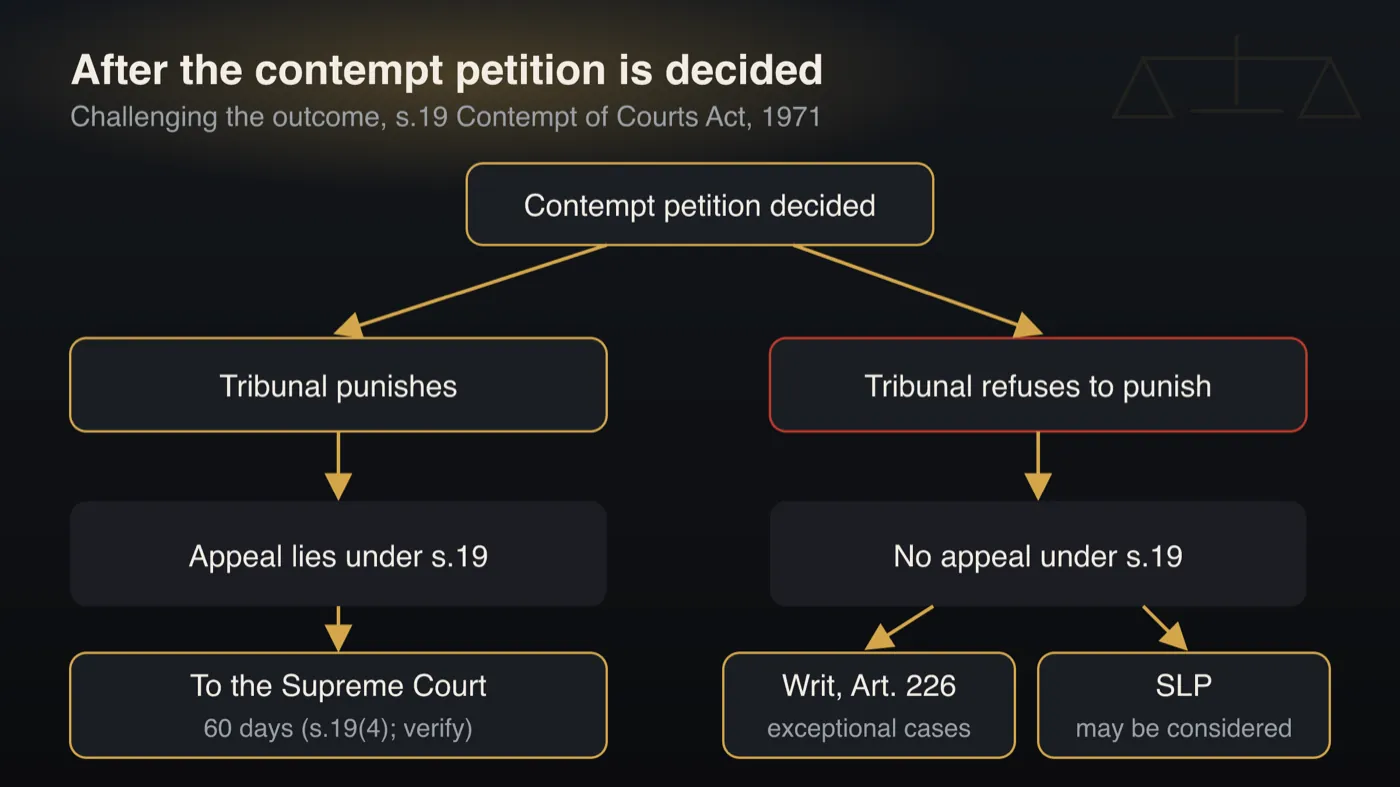
Challenging the outcome
An order punishing contempt can be appealed under s.19, to the Supreme Court. An order refusing to punish cannot be appealed under s.19; a writ under Article 226 may lie in exceptional cases (Brajendra Singh Chauhan, SC, December 2024), or an SLP may be considered.
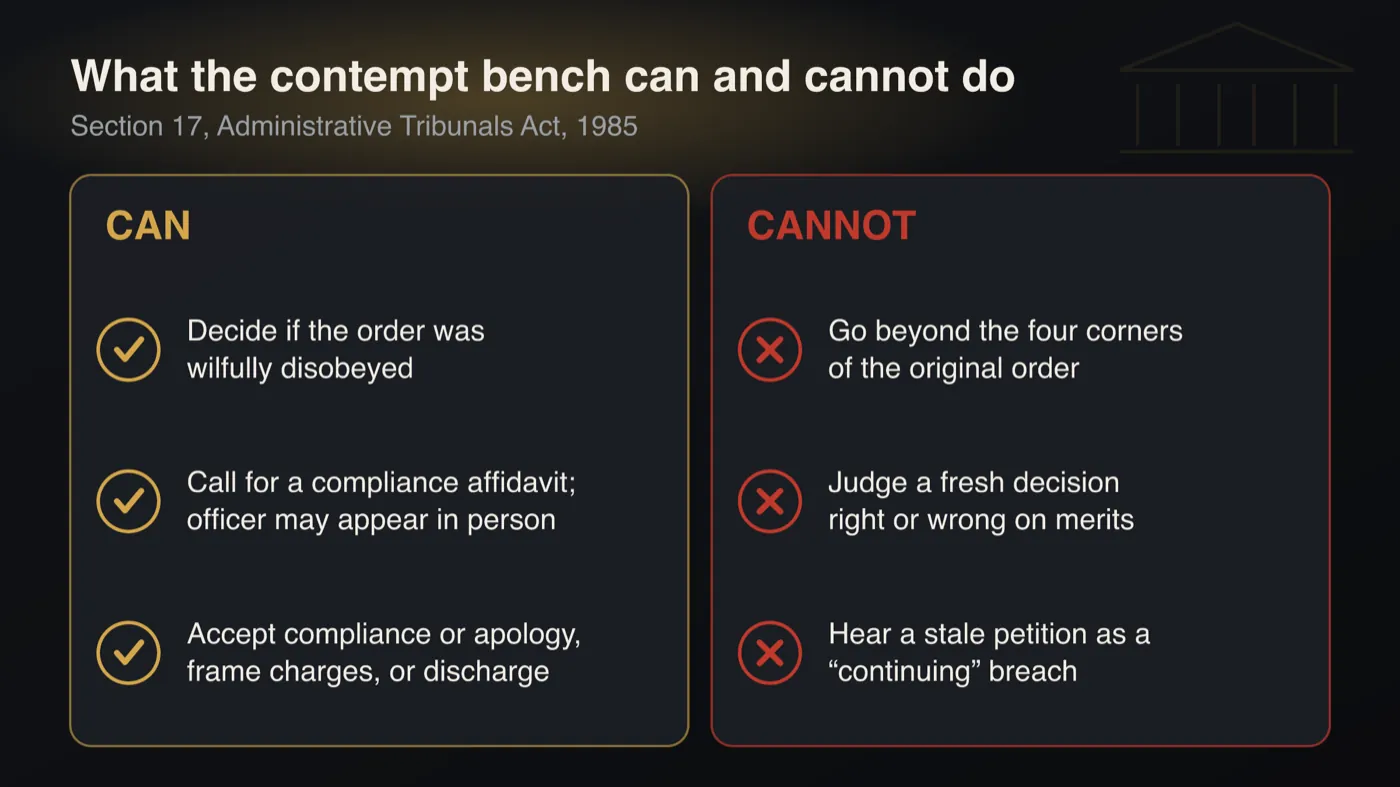
What the contempt bench can and cannot do
- Can: decide whether the order was wilfully disobeyed and direct compliance
- Can: call for a compliance affidavit and require the officer to appear personally
- Can: accept compliance or an apology, frame charges, or discharge the respondent (Rule 13, 1992 Rules)
- Cannot: go beyond the four corners of the original order
- Cannot: judge whether a fresh decision is right or wrong on merits (J.S. Parihar)
- Cannot: entertain a stale petition because the breach is called “continuing” (S. Tirupathi Rao, 2024 INSC 544)
Contempt petition in CAT: the Supreme Court rulings that decide your case
The rules in Section 17 of the Administrative Tribunals Act, 1985 and the Contempt of Courts Act, 1971 have been shaped by a small number of Supreme Court decisions. Read these before you file a contempt petition to enforce a CAT order.
2000
Tribunals can punish contempt of their own orders
The Supreme Court held that Section 17 of the Administrative Tribunals Act, 1985 survived L. Chandra Kumar. CAT has the same contempt powers over its own orders as a High Court. This is why a contempt petition for an unimplemented CAT order is filed before the same Tribunal, and not in the High Court.
2014
Only wilful disobedience, proved beyond doubt, is contempt
Contempt is quasi-criminal, so disobedience must be proved beyond reasonable doubt. Wilful means knowing, deliberate and intentional. It does not cover bona fide or accidental acts or real inability to comply. Where the order can reasonably be read in two ways, the Court held that there is no contempt.
1996
A fresh decision is a fresh cause of action
Once the government passes an order following the court’s direction, that order gives a new cause of action. Whether it is right or wrong is not a question for the contempt court, which cannot decide the merits. If CAT only directed the department to consider your claim and it was rejected again with reasons, the usual remedy is a fresh OA.
2014
Contempt bench stays within the original order
The contempt court must stay within the four corners of the order said to be disobeyed. It looks only at directions that are explicit or plainly self-evident. It cannot add new reliefs, such as creating posts, granting interest or ordering promotion, that the original order did not give. The Supreme Court set aside the High Court’s supplementary directions.
2024
Stale petitions cannot be revived as continuing breach
A contempt petition filed in 2014 over a 2009 order was held barred by the one-year limit in Section 20 of the Contempt of Courts Act, 1971. The Supreme Court warned that calling a stale complaint a continuing breach would let petitioners pick their own time to sue. Count one year from the end of the compliance period and file well within it.
2024
Writ lies against CAT contempt orders only exceptionally
CAT disposed of a contempt application, finding that the department had substantially complied. The Allahabad High Court refused to hear the writ, holding that only the Supreme Court could be approached. Relying on Midnapore Peoples’ Coop. Bank, the Supreme Court held that a writ under Article 226 can lie in exceptional cases, and sent the matter back to the High Court. Verify the full order before relying on it.
How to file a contempt petition in CAT, step by step
Read the operative part of the order
Check whether CAT directed the department to pay, grant or release something specific, or only to consider and decide your claim. Note the compliance period, which often runs from the date the department receives a certified copy. A consider-and-decide direction may end once a reasoned order is passed.
Serve the order and send a reminder
Serve a certified copy on the officer who has to comply, and keep proof of service. Then send a reminder or legal notice with the order attached. No law requires this notice, but it often produces compliance. It also helps show the Tribunal that the non-compliance was wilful.
Work out the one-year limitation
Section 20 of the Contempt of Courts Act, 1971 bars contempt proceedings started more than one year after the contempt. In practice, count from the day the compliance period expires. Do not rely on a continuing breach argument after S. Tirupathi Rao (2024). Plead every date precisely.
Check for a stay from the High Court
Find out whether the department has challenged the CAT order in the Calcutta High Court and obtained a stay. While a stay is in force, non-compliance is not contempt. If a writ is pending but there is no stay, verify the current position with your advocate before filing.
Draft and file the Contempt Petition (Civil)
Under the Contempt of Courts (CAT) Rules, 1992, set out the OA number and order, the dates of service and reminders, the specific acts of non-compliance, and the officer named by name and designation. Add a supporting affidavit and annexures. File it before the CAT bench that passed the order, such as the Calcutta Bench. See service matters in CAT.
Preliminary hearing, notice and compliance
If the Tribunal finds a prima facie case, it issues notice under Rule 8. The department usually files a reply or a compliance affidavit and is often given time to comply. If it keeps defaulting, the bench may call the officer to appear in person. The Tribunal may then close the petition on compliance or an apology, or frame charges under Rule 13.
Contempt petition or execution application?
Both aim at compliance, but they work differently.
Mistakes that sink a contempt petition in CAT
Filing after the one-year limit Section 20 of the 1971 Act is applied strictly. Since S. Tirupathi Rao (2024), calling the default a continuing breach will not save a late petition.
Treating a fresh rejection as contempt If the department has passed a reasoned order rejecting your claim again, J.S. Parihar treats it as a fresh cause of action. The usual remedy is a fresh OA under Section 21 of the Administrative Tribunals Act, 1985, not contempt.
Asking for more than the order granted The contempt bench cannot add interest, promotion or any other benefit the original order did not grant (Sudhir Vasudeva). Limit the petition to what the order actually directed.
Choosing contempt when the order is unclear If the order can reasonably be read in two ways, Ram Kishan holds that there is no wilful disobedience. Consider applying for clarification, or for directions under Rule 24 of the CAT (Procedure) Rules, 1987, instead.
Discuss an order that has not been implemented
Every CAT order is different, and the right route depends on its exact wording, the compliance period, any stay, and the department’s response. If you hold a Tribunal order that has not been acted on, bring the certified copy and any reminders sent. Patra’s Law Chambers will read the order with you and explain the options available under the law. No result can be promised, and the advice depends on the documents.
Book a ConsultationEstablished by a distinguished alumnus of IIT Kharagpur, Patra’s Law Chambers stands as a beacon of legal expertise in Kolkata & Delhi. Know more →

Kolkata Office
NICCO House, 6th Floor, 2 Hare Street
Kolkata-700001 (Near Calcutta High Court)
Delhi Office
4455/5, First Floor, Gali Shahid Bhagat Singh
Main Bazar Road, Paharganj, New Delhi-110055
Contact
[email protected]
+91 890 222 4444 / +91 7003 715 325
Four checks before choosing your remedy
Work through these in order. Your own order and dates decide the real route, so verify them first.
Is a stay in force?
If the Calcutta High Court has stayed the CAT order, non-compliance is generally not contempt while the stay lasts.
What does the order say?
A clear direction to pay, grant or release points to contempt. A direction only to consider the claim, followed by a reasoned rejection, usually means a fresh OA (J.S. Parihar).
Can it be read two ways?
If the order is open to two reasonable readings, wilful disobedience is hard to prove (Ram Kishan). An execution or clarification application is often safer.
Is it within one year?
Count one year from the end of the compliance period (s.20, Contempt of Courts Act, 1971) and file well inside it. A continuing breach argument will not revive a stale petition (S. Tirupathi Rao, 2024).
Frequently asked questions about contempt petitions in CAT
Yes. Section 17 of the Administrative Tribunals Act, 1985 gives CAT the same jurisdiction, powers and authority in respect of contempt of itself as a High Court has, and the Contempt of Courts Act, 1971 applies with the Tribunal read in place of the High Court.
Section 20 of the Contempt of Courts Act, 1971 bars proceedings after one year from the date of the alleged contempt. In practice this is usually counted from the end of the compliance period in the order. File early and verify your dates.
No statute requires it. A reminder or legal notice with the order attached is still advisable because it helps show wilfulness, and it often produces compliance without a hearing.
Under s.12 of the 1971 Act, simple imprisonment up to six months, a fine up to Rs 2,000, or both, and a bona fide apology may be accepted. In practice the bench’s aim is to get its order complied with.
If the order only told the department to consider the claim, a fresh reasoned rejection is usually challenged in a new OA, not in contempt (J.S. Parihar v. Ganpat Duggar, (1996) 6 SCC 291). Your order’s exact wording decides this.
Only if the original order granted interest. The contempt bench cannot go beyond the order or add reliefs, as the Supreme Court held in Sudhir Vasudeva v. M. George Ravishekaran, (2014) 3 SCC 373.
A stay suspends the duty to comply, so there is no contempt while it lasts. Without a stay, the duty to comply generally continues. Please verify the High Court order itself before deciding.
A contempt petition punishes wilful defiance and needs proof of wilfulness. A miscellaneous or execution application, relying on s.27 of the Act and Rule 24 of the CAT (Procedure) Rules, 1987, seeks implementation of the order and is often suited to clear, ministerial directions.