Section 9 IBC: The Operational Creditor’s Two-Tiered Gateway to CIRP
Suppliers, employees, and statutory authorities do not walk through the same door as banks and financial institutions. Before the National Company Law Tribunal will even look at your claim, you must clear a strict statutory gateway — the demand notice, the ten-day wait, and the pre-existing dispute test. Get any one of them wrong, and a genuine claim is dismissed at the threshold.
A recovery mechanism this is not — and courts guard that line closely
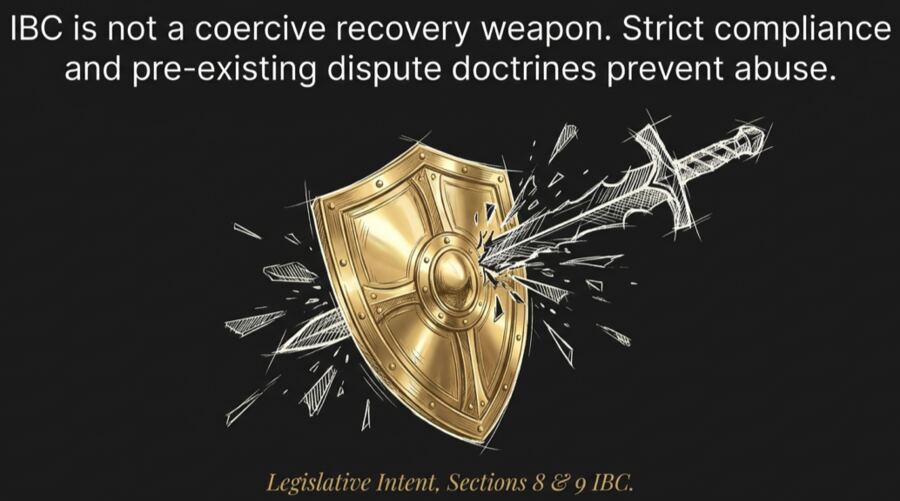
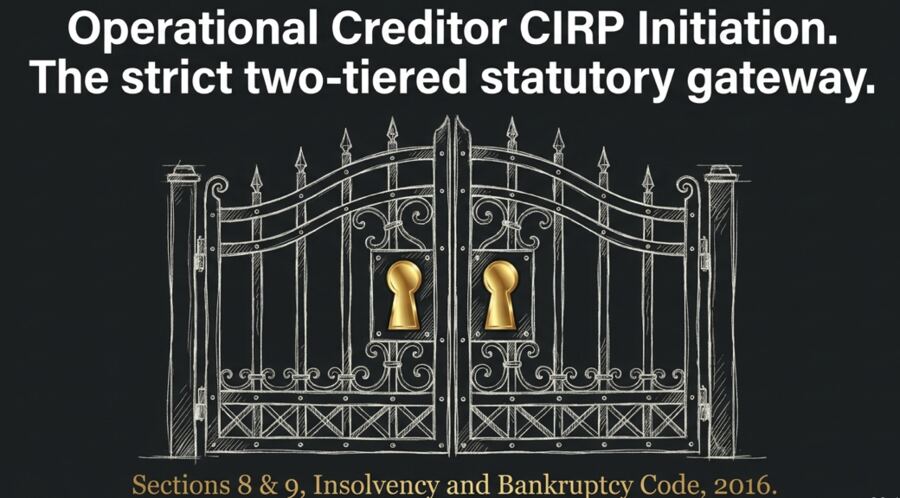
The Corporate Insolvency Resolution Process (CIRP) under the Insolvency and Bankruptcy Code, 2016 gives distressed companies a structured, time-bound path to reorganisation. Financial creditors — banks, NBFCs — walk in directly under Section 7. Operational creditors, comprising suppliers of goods and services, employees, and statutory authorities, face a deliberately different route: a two-tiered statutory gateway under Sections 8 and 9. Parliament built this bottleneck on purpose, to stop the insolvency framework from being weaponised as a coercive recovery tool for claims that are genuinely disputed. Every step that follows — the notice format, the ten-day wait, the affidavit’s timing, the evidentiary bar — exists to enforce that one idea.
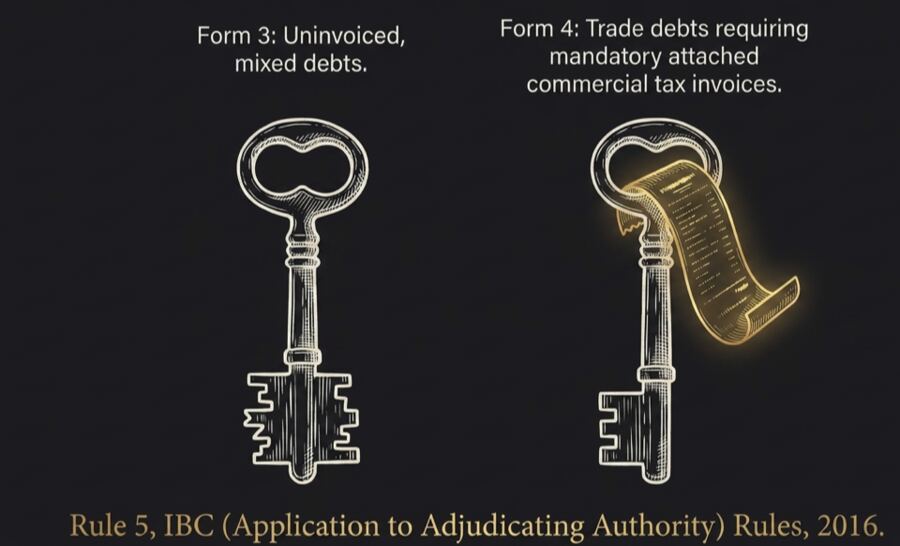
The demand notice: Form 3 or Form 4, and nothing improvised
Section 8(1) is the mandatory threshold every operational creditor must clear before touching the NCLT. Once a default occurs on an operational debt above the statutory minimum, the creditor must deliver a demand notice — and Rule 5 of the IBC (Application to Adjudicating Authority) Rules, 2016 prescribes exactly two formats. Using the wrong one, or omitting a mandatory attachment, is a self-inflicted wound at the first step.
Uninvoiced debts, employment dues, statutory liabilities, mixed debt accounts
Trade debts evidenced directly by commercial tax invoices
Documents proving the debt and default — contracts, ledgers, bank statements
Copies of all underlying invoices and statement of accounts
Transaction history, itemised break-up of debt, date of default
Summary of defaulted invoice amounts, dates, and default period
Prescribed format under Rule 5(1)(a)
Prescribed format under Rule 5(1)(b)
Service that actually reaches the debtor — or the notice is a nullity
Service of the Section 8 notice must strictly comply with Rule 5(2). Valid service means delivery to the corporate debtor’s registered office address exactly as recorded in the Master Data maintained by the Ministry of Corporate Affairs — by registered post with acknowledgment due, speed post, hand delivery, or email to the MCA-registered address. Dispatching to an outdated address, an unauthorised branch office, or an unverified email renders the entire Section 9 application inadmissible on procedural grounds alone.
What the debtor can do — and what happens if it does nothing
Delivery of the demand notice triggers a mandatory 10-day statutory window under Section 8(2). Within that window the corporate debtor must respond with either proof of repayment made before the notice was received, or a notice of a pre-existing dispute — including records of a suit or arbitration already pending on that dispute before the notice arrived. Silence, or a manufactured dispute invented only after the notice lands, does not count.
The pre-existing dispute rule: Mobilox‘s three-part test
Section 9(5)(ii)(d) compels the NCLT to reject a petition if a notice of dispute has been received, or a record of dispute exists in an Information Utility. The Supreme Court in Mobilox Innovations Pvt. Ltd. v. Kirusa Software Pvt. Ltd. fixed the standard: the NCLT’s role is strictly summary. It is not asked whether the defence will ultimately succeed before a civil court or arbitral forum — only whether a plausible dispute existed before the demand notice arrived. Tap each card below for the test the tribunal actually applies.
Not spurious, hypothetical, or illusory. A dispute invented only to dodge insolvency after the notice arrives fails this limb entirely — the NCLT will see through an afterthought.
The defence must present a plausible contention requiring further investigation. The tribunal does not weigh whether it will win — only whether it is genuinely arguable, not a bare denial.
Contemporaneous communications — emails on defects, delays, or breaches, sent before the Section 8 notice — satisfy this limb. A dispute raised for the first time in reply to the notice does not.
Four rulings that decide almost every Section 9 admission fight
From the scope of the summary inquiry to the outer limits of tribunal overreach, these four Supreme Court decisions anchor virtually every argument raised at the admission stage.
2018
The foundational pre-existing dispute standard
The NCLT’s inquiry under Section 9 is strictly summary — confined to whether the operational debt exceeds the statutory threshold, whether it is due and defaulted, and whether a real, bona fide dispute predates the demand notice. The tribunal never adjudicates whether the defence will actually succeed.
2018
The financial certificate is directory, not mandatory
Section 9(3)(c) does not bar a petition merely because the creditor has no account with an Indian financial institution to certify from. Default can be established through contracts, invoices, delivery receipts, Information Utility records, or audited books. The Court also confirmed that an advocate duly authorised under Section 30 of the Advocates Act, 1961 can validly issue the Section 8 notice.
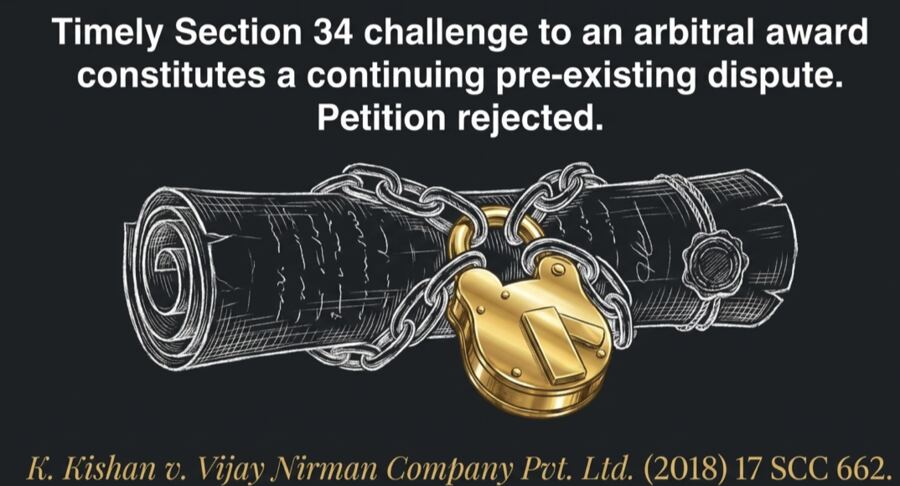
2018
A pending Section 34 challenge is a continuing dispute
Even where an arbitral award exists in the creditor’s favour, a timely challenge under Section 34 of the Arbitration and Conciliation Act, 1996 keeps the underlying debt disputed. CIRP cannot be used to bypass the statutory challenge procedure — the Section 9 petition must be rejected while that challenge remains pending.

2021
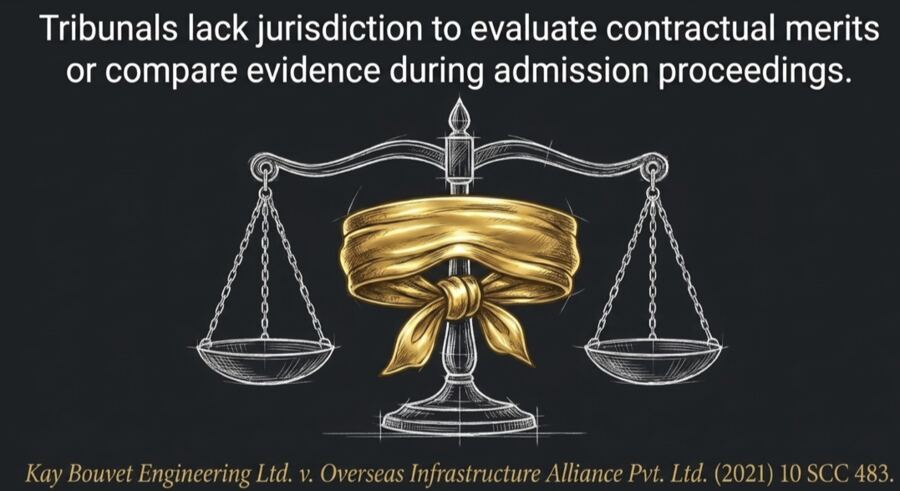
Neither the NCLT nor the NCLAT may weigh contractual merits
Reversing an NCLAT order that had examined credit adjustments and termination clauses in detail, the Supreme Court held that admission proceedings are not the forum for evaluating counterclaims or comparing evidence. If contemporaneous correspondence predates the Section 8 notice, the jurisdictional threshold is breached and the petition must be dismissed — full stop.
Three years from default — the notice does not reset the clock
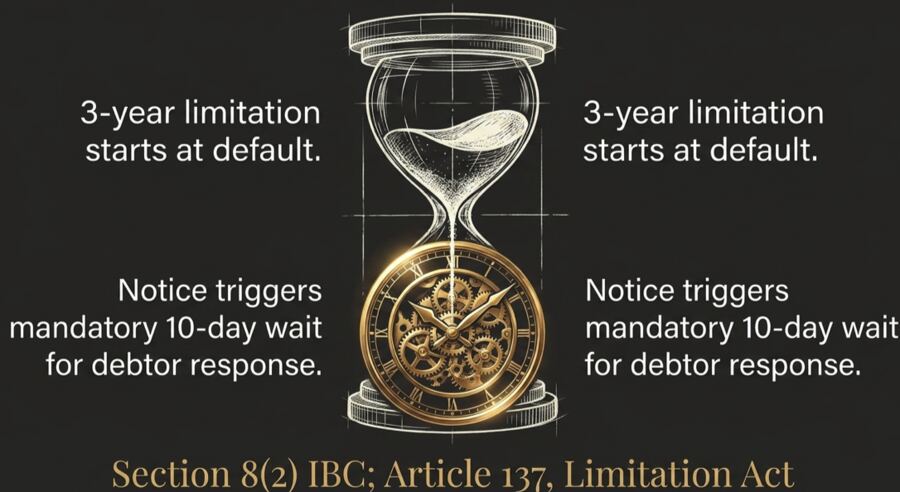
Section 9 applications are governed by Article 137 of the Limitation Act, 1963 — a three-year period running from the date of default, not from the date the demand notice is issued. Issuing a Section 8 notice is a procedural prerequisite, never a fresh cause of action (B.K. Educational Services Pvt. Ltd. v. Parag Gupta & Associates). If a claim is already time-barred when the notice is served, the notice cannot revive it. A debt older than three years survives only through a written acknowledgment of liability under Section 18 of the Limitation Act, signed before the original period expired, or an unequivocal entry in the debtor’s own audited balance sheet made before expiry (Asset Reconstruction Company (India) Ltd. v. Bishal Jaiswal).

The three-year Article 137 limitation clock starts here — on the date the operational debt became due and remained unpaid, not on any later date.
Form 3 or Form 4, delivered strictly to the MCA-registered office address. This is a procedural prerequisite — it neither extends nor resets the limitation clock.
The debtor may reply with proof of repayment or a notice of pre-existing dispute. Filing or swearing the Section 9 affidavit before this window closes is premature and fatal.
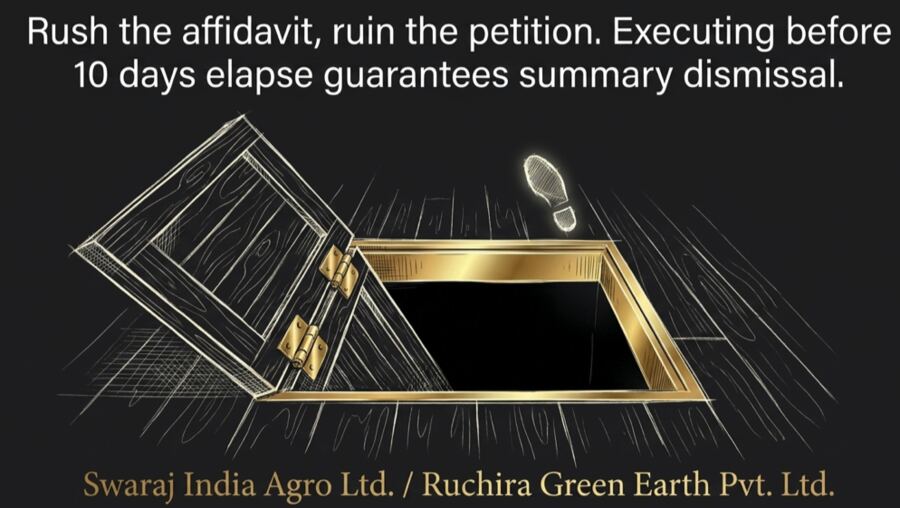
Accompanied by the Section 9(3)(b) affidavit confirming no notice of dispute was received, executed strictly after the 10-day window has elapsed.
The tribunal checks the threshold, the evidence of debt and default, and whether any real, pre-notice dispute exists — never a merits trial on the underlying contract.
Clearing every gate results in admission and the start of CIRP. Failing even one — threshold, service, timing, or a genuine dispute — results in rejection at the threshold stage.
Two mistakes that sink an otherwise valid claim
Executing the Section 9(3)(b) affidavit before the 10-day window elapses. The right to apply under Section 9 has not yet accrued — Swaraj India Agro Ltd. v. Walchandnagar Industries Ltd. treats this as a fatal, non-curable procedural defect, however strong the underlying claim.
Deposing “no dispute received” while sitting on pre-notice objection emails. If the creditor received quality-rejection emails, a Section 8 response, or any pre-notice complaint and conceals it in the affidavit, Ruchira Green Earth Pvt. Ltd. v. KLB Komaki Pvt. Ltd. makes the petition liable to summary dismissal for concealment — with exposure to sanctions under Section 60(1) for false statements.
Five checks before you dispatch anything
Pull live MCA Master Data on dispatch day
Confirm the corporate debtor’s current registered office and email exactly as recorded, on the actual day of dispatch — not from an old filing.
Audit every communication channel for pre-notice objections
Email archives, meeting minutes, letterhead correspondence, and delivery receipts — scrutinised for any quality, pricing, or timeline objection that predates the notice.
Calculate the default threshold without unbacked interest
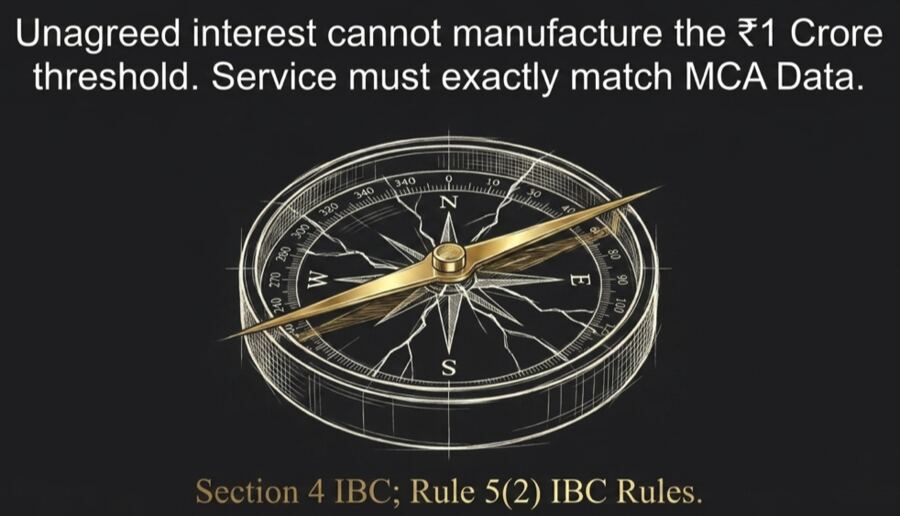
Confirm the principal default alone exceeds ₹1 Crore, or that any interest relied upon rests on an explicit contractual or statutory entitlement.
Verify the limitation position
Confirm the default date falls within three years of filing, or that a valid Section 18 acknowledgment or balance-sheet entry extends it.
Time the Section 9(3)(b) affidavit precisely
Execute it strictly after the 10-day statutory window has elapsed — never before, and never while a pre-notice objection sits unacknowledged in the file.
End-to-end operational creditor representation before the NCLT
Patra’s Law Chambers drafts and serves Section 8 demand notices in the correct form, audits the evidentiary file for concealed pre-notice disputes before an affidavit is ever sworn, and represents operational creditors — and corporate debtors defending against premature or abusive petitions — at the Section 9 admission stage before the National Company Law Tribunal. Our practice draws on the summary standard fixed in Mobilox Innovations Pvt. Ltd. v. Kirusa Software Pvt. Ltd. and the line of Supreme Court authority that followed it.
Book a ConsultationEstablished by a distinguished alumnus of IIT Kharagpur, Patra’s Law Chambers stands as a beacon of legal expertise in Kolkata & Delhi. Know more →

Kolkata Office
NICCO House, 6th Floor, 2 Hare Street
Kolkata-700001
Delhi Office
4455/5, First Floor, Gali Shahid Bhagat Singh
Main Bazar Road, Paharganj, New Delhi-110055
Contact
[email protected]
+91 890 222 4444 / +91 7003 715 325
Common questions
₹1 Crore, since the Central Government’s Notification dated 24 March 2020. This attaches to the unpaid principal default, not the aggregate commercial relationship, and unbacked unilateral interest cannot be added to cross the threshold.
Form 4 is used when the claim rests directly on commercial tax invoices, and must attach copies of every invoice. Form 3 covers everything else — uninvoiced, mixed, or statutory debts such as employment dues — supported by contracts, ledgers, or bank statements instead.
Only if the dispute is real, bona fide, and predates the demand notice, per Mobilox Innovations Pvt. Ltd. v. Kirusa Software Pvt. Ltd. A dispute invented after the notice arrives, with no contemporaneous paper trail, will not succeed.
No. Macquarie Bank Ltd. v. Shilpi Cable Technologies Ltd. held Section 9(3)(c) directory, not mandatory — default can be proved through contracts, invoices, delivery receipts, or Information Utility records instead.
Yes. K. Kishan v. Vijay Nirman Company Pvt. Ltd. holds that a timely Section 34 challenge to the award keeps the underlying debt disputed, regardless of the award’s own findings.
The application becomes premature — the right to apply has not yet accrued. Swaraj India Agro Ltd. v. Walchandnagar Industries Ltd. treats this as grounds for summary dismissal, independent of the claim’s underlying merit.
No. The three-year period under Article 137 of the Limitation Act runs from the date of default, not the date of notice. A claim already time-barred when the notice is served cannot be revived by it.
No. Its jurisdiction is strictly summary. Kay Bouvet Engineering Ltd. v. Overseas Infrastructure Alliance Pvt. Ltd. confirms that neither the NCLT nor the NCLAT may weigh contractual merits or compare evidence at the admission stage.