Your gradation list decides your career. One wrong entry date can cost a promotion.
Quota-rota mechanics, the fall of N.R. Parmar, the rule in K. Meghachandra Singh, DoPT OM dated 13.08.2021, and exactly how a wrongly drawn seniority list is challenged before the Central Administrative Tribunal or a High Court under Article 226.
Constitutional foundations
Seniority is a legal entitlement, not an office courtesy
Public employment in India rests on equality of opportunity and non-arbitrariness under Articles 14 and 16 of the Constitution. Rules framed under the proviso to Article 309 of the Constitution, or corresponding statutory enactments, regulate recruitment, conditions of service and relative seniority. A seniority list — usually called a gradation list — is the foundational record that fixes an employee’s relative standing within a cadre, and that placement dictates career progression, eligibility for promotional consideration, pay-scale progression and postings.
A gradation list must follow the governing statutory recruitment rules strictly. Where the appointing authority departs from them — by misapplying quotas, granting unauthorised retrospective seniority, or ignoring the legal consequences of an inter-departmental transfer — the list becomes constitutionally vulnerable and can be assailed by an Original Application before an Administrative Tribunal under the Administrative Tribunals Act, 1985, or by a Writ Petition under Articles 226 and 227 before the High Court.

Four recurring defaults
Tap each card to see how the error shows up on the list
Quota-rota misapplied
The roster between direct recruits and promotees is worked wrongly.
Tap to revealAlternating slots are filled out of turn, so an entire block of officers is displaced for the rest of their service.
Illegal antedating
Direct recruit seniority is pushed back before actual induction.
Tap to revealOfficers who joined later appear above promotees who were already serving — squarely barred after 19 November 2019.
Fortuitous service counted
Ad-hoc, stop-gap or emergency service outside the quota is added in.
Tap to revealTemporary officiation is treated as regular service, inflating a promotee’s position against the rule in C.K. Antony.
Transfers misclassified
A policy absorption is recorded as a personal request transfer.
Tap to revealAccrued service is forfeited and the officer is dropped to the bottom of the receiving cadre, though public interest moved him.
Quota & rota
Two rules that are constantly confused
The quota-rota system harmonises officers entering one cadre from different streams — chiefly direct recruitment and internal promotion. The quota rule prescribes the share of substantive vacancies for each stream. The rota rule governs inter se seniority by rotating positions among those recruits according to a prescribed roster cycle. A statutory quota does not automatically imply a rota: in Paramjit Singh Sandhu v. Ram Rakha the Supreme Court held that rota cannot be read into service rules unless the rules specifically mandate a rotational mechanism.
NoteThe figures illustrate a common 60:25:15 division. Your own share is whatever your recruitment rules prescribe — the first document to read in any seniority dispute is the rule, not the list.
The breakdown doctrine
When does the roster actually collapse?
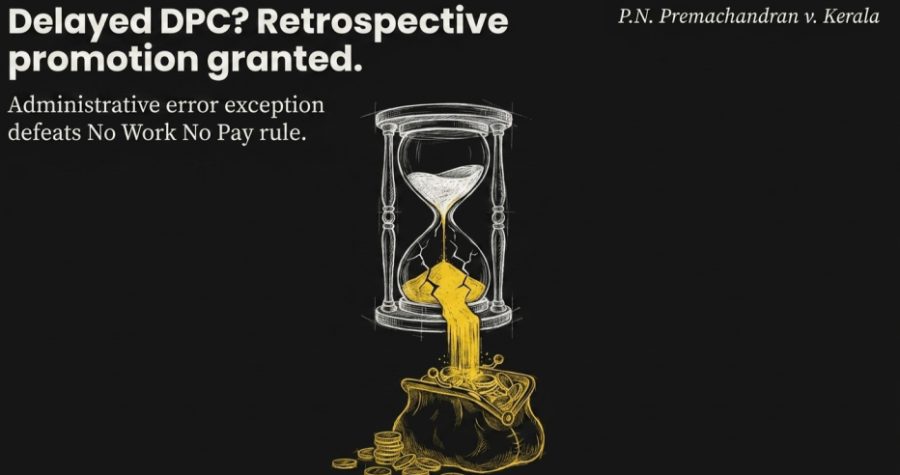
Where the administration fails to recruit or to hold Departmental Promotion Committees for years, promotees serving on ad-hoc basis argue that the quota-rota rule has broken down and that their continuous officiation must count. Courts test that claim strictly.
Rota operativeSeniority is fixed strictly by the rotational roster: direct recruit and promotee slots alternate in the prescribed cycle.
M.S.L. Patil v. State of Maharashtra and C. Jayachandran v. State of Kerala: mere delay, omission or failure to prepare annual select lists does not amount to a breakdown of the quota rule.
Union of India v. Harish Chander Bhatia: sporadic appointments made to meet immediate administrative exigencies do not show a collapse of the statutory quota system.
B.S. Mathur and G.S. Lamba v. Union of India: breakdown arises only where enforcing rota becomes impossible after massive, continuous, long-standing departures from the quota.
Once breakdown is judicially found, the rota collapses and inter se seniority is recalculated on the length of continuous, regularised officiation.
Fortuitous service
Rule A and Rule B — the Constitution Bench test
Where promotees are appointed in excess of quota or under emergency provisions — such as Rule 9(a)(i) of the Kerala State and Subordinate Service Rules — the initial service is “fortuitous” or “stop-gap”. In C.K. Antony v. B. Muraleedharan the Supreme Court held that such service cannot be counted; seniority runs only from regular appointment against a substantive vacancy within the appointee’s own quota, because no one can claim seniority from a date on which he was not validly borne in the cadre. This mirrors the Constitution Bench in Direct Recruit Class II Engineering Officers Association v. State of Maharashtra (1990).
Where the initial appointment followed the procedure prescribed by the recruitment rules, continuous officiation in the post counts towards seniority.
Direct Recruit Class II (1990)Where the initial appointment was purely ad-hoc, stop-gap or fortuitous and the officer was regularised later, the earlier service is excluded and seniority runs from regular induction.
Direct Recruit Class II (1990)The paradigm shift
From paper seniority to date of induction
The rule deciding inter se seniority between direct recruits and promotees changed fundamentally between 2012 and 2021, and every central and state gradation list drawn in that window is worth re-reading.
Under N.R. ParmarDirect recruits carry seniority back to the year the vacancy arose, so officers who joined in 2018 sit above promotees regularised in 2015.
A government servant cannot claim seniority from a date earlier than actual entry into the cadre.
Seniority cannot be given to a direct recruit from the vacancy year or the date of advertisement when he was not yet appointed.
Inter se seniority is reckoned from the date of actual regular appointment or induction into service.
Lists finalised under N.R. Parmar before 19 November 2019 were protected, so settled cadres were not reopened.
Following K. Meghachandra Singh v. Ningam Siro, the Department of Personnel and Training issued Office Memorandum No. 20011/2/2019-Estt.(D) dated 13 August 2021, withdrawing its 2014 Parmar-based instructions. The 2021 OM fixes relative seniority by actual dates of appointment or promotion and keeps the rotational quota only among candidates appointed in the same recruitment year. Paragraph 7(iii), which dealt with transitional cases, has itself been litigated: in Ashwani Kumar Anand v. Union of India (O.A. 991/2022, affirmed by the High Court of Bombay) seniority lists antedating direct recruit seniority under transitional clauses were quashed. After 19 November 2019, backdating a direct recruit above a promotee who joined earlier offends both binding Supreme Court authority and Article 14.
Transfers and absorption
Who asked for the move decides who keeps the seniority
Disputes also arise when officers move across cadres, districts or departments. Service jurisprudence separates the transfer an employee asks for from the transfer the State orders in public interest.
Accrued seniority in the parent cadre is forfeited and the officer is placed at the bottom of the target cadre’s list on the date of joining, so the promotional prospects of officers already in the receiving cadre are protected.
K.P. Sudhakaran v. State of Kerala (2006)The officer carries forward continuous length of service and retains original seniority in the new cadre, because the move served the administration and not personal convenience.
K.P. Sudhakaran — public interest exceptionExercising an option for absorption under a State reorganisation plan is not an individual request transfer; forfeiture does not apply, and inter se seniority is protected on original appointment and advice dates.
Geetha V.M. v. Rethnasenan K. (2025)In Geetha V.M. health department personnel had opted for absorption into the newly created Department of Medical Education under a State policy decision. A Division Bench had treated those options as voluntary request transfers under the proviso to Rule 27(a) of the KS&SS Rules and pushed the staff to bottom seniority. The Supreme Court set that aside and restored their original seniority — the distinction between a policy absorption and a personal request is now the first question in any transfer-seniority dispute.
Principles at a glance
Nine settled propositions
Rota depends on quota adherence; the rotational roster fixes alternating slots between direct recruits and promotees only where the rules mandate it.
Paramjit Singh Sandhu · DoPT OMs 1959/1986Breakdown requires systemic unworkability, not routine DPC delay or temporary stop-gap promotion. If proved, seniority follows continuous regular service.
B.S. Mathur · G.S. Lamba · Suraj Parkash GuptaEmergency service outside the statutory quota is fortuitous and confers no seniority; the clock starts at regular substantive appointment.
C.K. Antony · Direct Recruit Class II (Rule B)Seniority is reckoned from the actual date of appointment; a direct recruit joining later cannot override a promotee already validly serving in a regular post.
K. Meghachandra Singh · DoPT OM 13.08.2021A transfer sought by the employee forfeits parent cadre seniority; the transferee goes to the bottom of the target cadre on the date of joining.
K.P. Sudhakaran · proviso to Rule 27(a) KS&SSOptions exercised under a State reorganisation policy preserve past continuous service and inter se seniority in the absorbed cadre.
Geetha V.M. (2025) · Kartar SinghPost-based rosters replace vacancy-based rosters, holding percentage quotas against total cadre strength and preventing over-reservation.
R.K. Sabharwal v. State of PunjabOfficers whose ranking would fall if the petition succeeds must be impleaded; otherwise the challenge is defective for non-joinder.
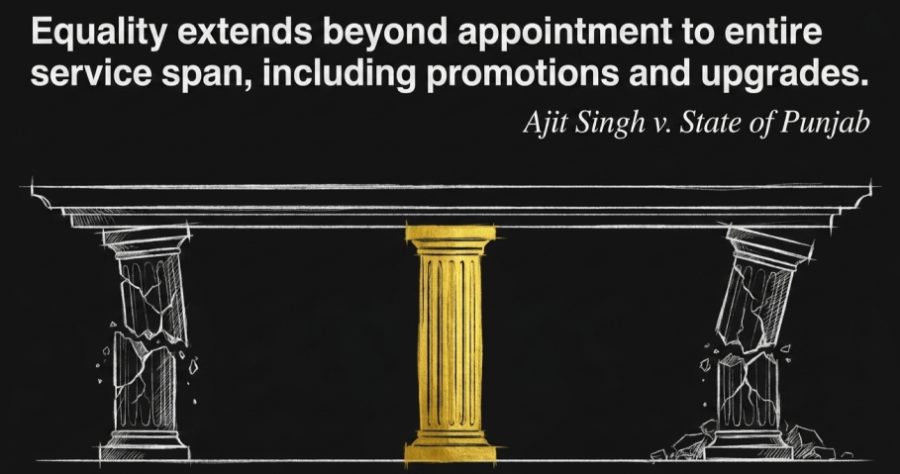
Prabodh Verma · J.S. YadavThere is no vested right to promotion itself, but there is an enforceable right to fair consideration — which is exactly what a wrong gradation list destroys.
Ajit Singh v. State of Punjab
Challenging the list
The procedural spine of a seniority challenge
A judicial challenge follows a sequence, and each step creates or destroys the case. Litigation against a draft list without first filing formal objections is usually treated as premature.
Read the draft gradation list line by line
Examine the dates, quota categories and entry mode assigned to every officer in the cadre, not merely your own row.
File written objections within the circular’s time limit
Set out the exact statutory rule violated, the continuous service left uncounted and every instance of improper backdating.
Obtain the final list and the speaking order
If objections are rejected, the authority must pass a reasoned order. The final list plus that order is your cause of action.
Check necessary parties and limitation
Implead every officer who would be pushed down — individually or by representation under Order 1 Rule 8 CPC — and move promptly.
File before the correct forum
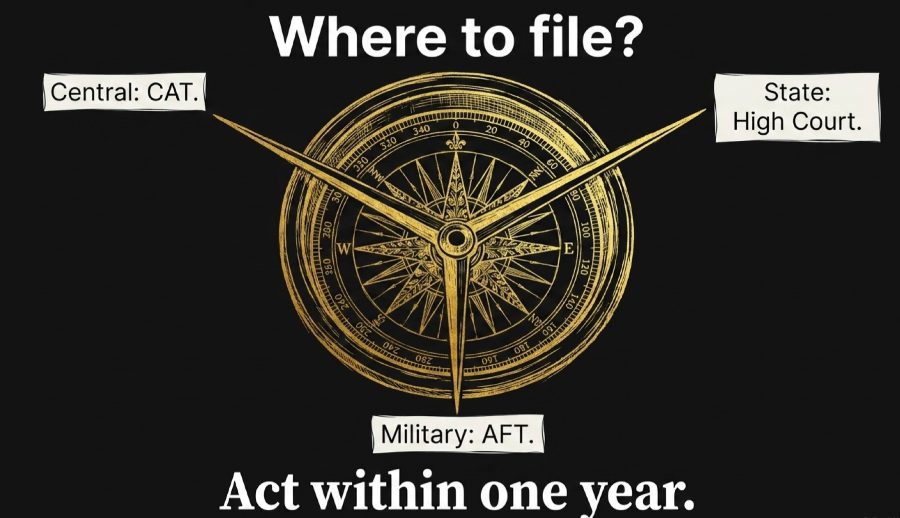
An Original Application before CAT under Section 19 of the Administrative Tribunals Act, 1985, or a Writ Petition under Article 226.
Choose your service above and the forum, the enabling provision and the first thing to file will appear here.
4 months · strongWell within a defensible period. Move now, while the record and the officers affected are all traceable.
Indicative only. There is no fixed statutory bar for every forum, but the cause of action arises when the final list adversely affecting your rank is published, or when you are passed over because of that ranking — and an unexplained lapse of years invites dismissal at the threshold.
Where cases die
Five avoidable mistakes
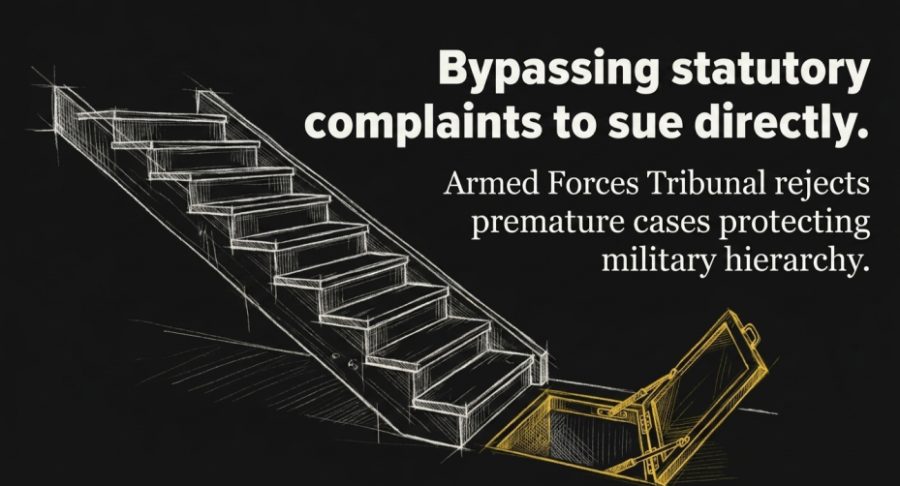
Challenging a provisional or draft list without first filing objections — dismissed as premature.
Suing only the department and omitting the officers whose rank would fall — defective for non-joinder under Prabodh Verma.
Waiting until a promotion is actually denied, years after the final list — laches.
Pleading “breakdown of quota” on the strength of ordinary DPC delay, without showing years of massive deviation.
Relying on N.R. Parmar for a list finalised after 19 November 2019 — the authority no longer holds.
Controlling precedent
The judgments a seniority petition is argued on
Union of India v. N.R. Parmar
(2012) · Supreme Court of IndiaDirect recruits could carry seniority back to the recruitment year in which the vacancy arose. The resulting “paper seniority” placed later-joining recruits above promotees who had served throughout. No longer good law.
K. Meghachandra Singh v. Ningam Siro
(2020) · Three-Judge Bench · 19 November 2019Overruled Parmar. Seniority runs from actual regular appointment or induction into the cadre; retrospective seniority is prohibited; the overruling operates prospectively, protecting lists finalised earlier.
Direct Recruit Class II Engineering Officers Association v. State of Maharashtra
(1990) · Constitution BenchRule A and Rule B: officiation after a rule-compliant appointment counts for seniority; ad-hoc, stop-gap or fortuitous service before regularisation does not.
C.K. Antony v. B. Muraleedharan
Supreme Court of India · Kerala Forest ServiceEmergency appointments beyond quota are fortuitous. Seniority accrues only from regular appointment against a substantive vacancy within the officer’s own quota.
K.P. Sudhakaran v. State of Kerala
(2006) · Supreme Court of IndiaA request transfer for personal convenience forfeits parent cadre seniority and places the officer at the bottom of the receiving cadre — subject to the public interest exception.
Geetha V.M. v. Rethnasenan K.
2025 INSC 33 · [2025] 1 S.C.R. 515Absorption under a State reorganisation policy is not a voluntary request transfer; continuity of service and inter se seniority are preserved.
R.K. Sabharwal v. State of Punjab
Supreme Court of IndiaReservation is worked on post-based, not vacancy-based, rosters — percentages run against total cadre strength, preventing over-reservation.
Prabodh Verma v. State of U.P. · J.S. Yadav v. State of U.P.
Supreme Court of IndiaOfficers whose seniority would be lowered are necessary parties. Their absence renders the petition defective and offends natural justice.
Representation
Bring us the list, the rules and the dates
A seniority dispute is won on documents: the recruitment rules, the advice and appointment dates, the DPC minutes, the earlier gradation lists and the objections filed. Patra’s Law Chambers appears in service matters before the Central Administrative Tribunal, the Armed Forces Tribunal, the Calcutta High Court and the Supreme Court of India, and drafts the statutory objections that keep the case alive before litigation begins.
Established by a distinguished alumnus of IIT Kharagpur, Patra’s Law Chambers stands as a beacon of legal expertise in Kolkata & Delhi. Know more →
Patra’s Law Chambers, Kolkata, West Bengal — High Court, City Civil & Sessions Court, CAT, AFT and DRT matters.
Patra’s Law Chambers, New Delhi — Supreme Court of India, Central Administrative Tribunal (Principal Bench) and Delhi High Court matters.
Questions
Frequently asked
No. After K. Meghachandra Singh v. Ningam Siro, seniority is reckoned from the date of actual regular appointment or induction into the cadre. Retrospective or “paper” seniority from the vacancy year or the date of advertisement is impermissible. Lists finalised under N.R. Parmar before 19 November 2019 were, however, protected from being reopened.
Only if the initial appointment was made following the procedure prescribed by the recruitment rules — Rule A of Direct Recruit Class II. Purely ad-hoc, stop-gap or fortuitous service outside the quota is excluded, and seniority runs from the date of regular substantive appointment.
Not automatically. Mere delay, omission or failure to prepare select lists does not amount to breakdown. Breakdown is recognised only where enforcing the rota has become impossible because of massive, continuous and long-standing departures from the quota over many years, and it must be pleaded with figures for each recruitment year.
Ordinarily yes. Under K.P. Sudhakaran, a transfer sought for personal convenience forfeits accrued seniority in the parent cadre and you join at the bottom of the target cadre. If, however, the move was ordered in public interest or was an absorption under a State reorganisation policy, Geetha V.M. protects your continuous service and original seniority.
Every officer whose ranking would be lowered if you succeed, besides the department and the appointing authority. Prabodh Verma and J.S. Yadav require it; affected officers may be impleaded individually or through representative respondents under Order 1 Rule 8 CPC. Omitting them makes the petition defective for non-joinder.
File written objections against the draft list within the time given in the circular, and litigate against the final list read with the speaking order rejecting your objections. A petition against a provisional list, without exhausting the objection stage, is usually dismissed as premature.
There is no single answer, but the cause of action arises on publication of the final list or on being passed over because of the wrong ranking. Courts decline to unsettle long-established seniority; an unexplained delay of several years commonly leads to dismissal on laches, so the safe course is to move within months, not years.
Central Civil Services employees file an Original Application before the Central Administrative Tribunal under Section 19 of the Administrative Tribunals Act, 1985. State employees approach the State Administrative Tribunal where one functions, or file a Writ Petition under Article 226 before the High Court. Armed forces personnel go to the Armed Forces Tribunal.