Partition and Succession under Muslim Law in India
A plain-English guide to who inherits, in what shares, and how an undivided Muslim estate is divided in India. It covers the Shariat Act 1937, the Hanafi scheme of heirs, Aul and Radd, and the partition suit.
How Muslim law treats inheritance and partition
Succession among Muslims in India is governed by the Muslim Personal Law (Shariat) Application Act, 1937 (see the Act on India Code), together with uncodified Islamic law and court decisions. Section 2 of the Act says that, despite any custom to the contrary, Muslim Personal Law is the rule of decision in intestate succession, the special property of females, marriage, gifts, trusts and wakfs. Agricultural land was left out of the Central Act, so for farm land you must check the law of your State.
There is no joint family, no coparcenary and no right by birth in Muslim law. An heir becomes owner of a fixed, undivided share only when the ancestor dies. Until then the heirs hold the estate as tenants-in-common, and each can ask for partition. If you are dealing with a family property dispute, our family and matrimonial law practice handles such questions, and appeals can go up to the Calcutta High Court and the Supreme Court.
Fixed shares of some main heirs under Hanafi law
These are shares of the net estate before Aul, Radd or the presence of other heirs changes them.
Videos from Adv. Sudip Patra
More short explainers on our YouTube channel: Patra’s Law Chambers on YouTube ↗
What is happening with the property of the person who has died?
Pick the line that is closest to your situation. This is general information about Muslim personal law, not advice on your own papers.
Choose one of the options above.
How a Muslim family estate moves from death to separate possession
Where all heirs agree, the later stages are skipped. Where they do not, this is the usual order.
Ownership passes to the heirs at the moment of death, as undivided shares. Note down the schools of law followed (most Indian Muslims follow Hanafi law) and every Sharer, Residuary and other heir.
Funeral expenses, proven debts (including unpaid Mahr) and legacies up to one-third come out first. Only the net estate is divided among the heirs.
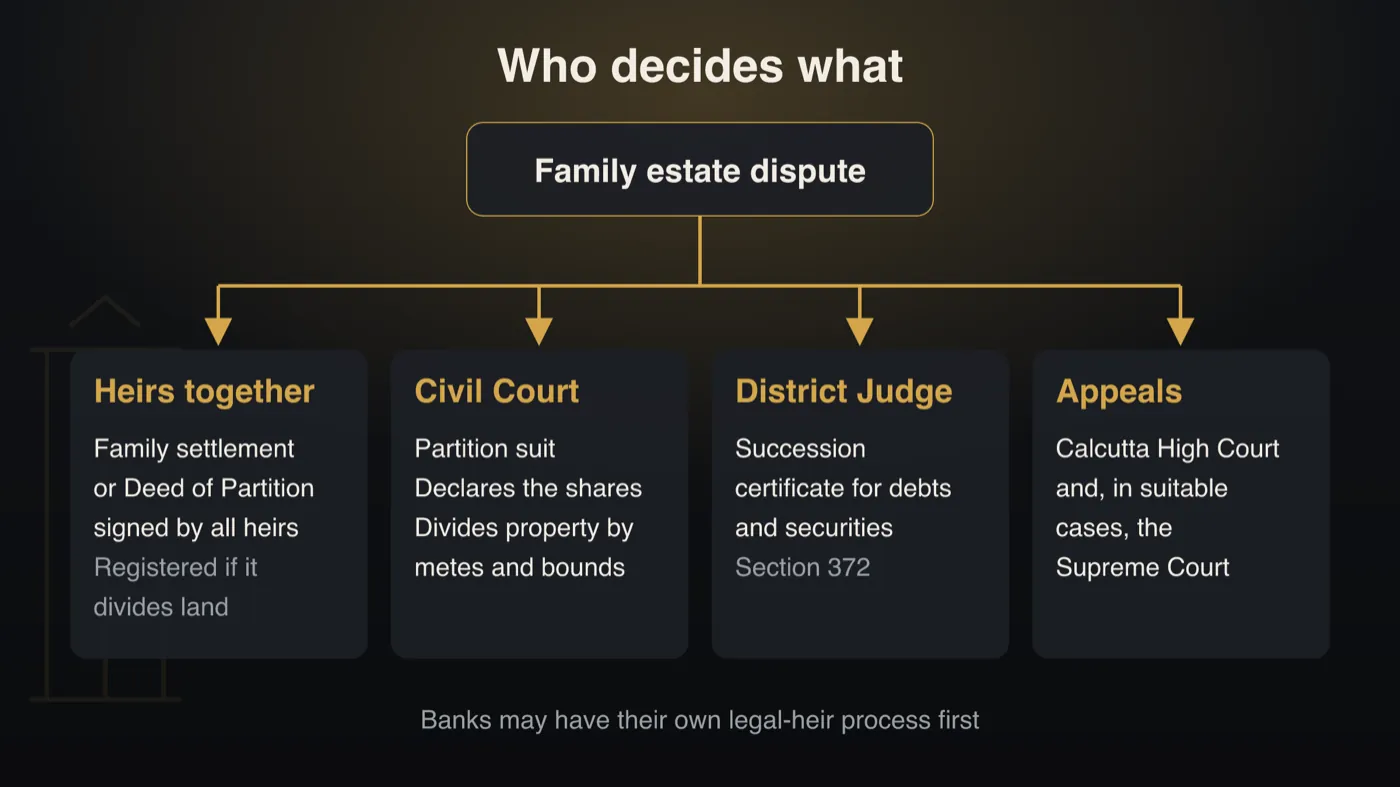
A written and, where it deals with immovable property, registered deed records each heir’s share and portion. For family disputes more generally, see our Matrimonial & Family Law Services page.
A notice records the demand for partition and the shares claimed. It also shows the Court that settlement was tried first.
The Civil Court decides who the heirs are, their shares and what forms part of the estate. Under Order XX Rule 18 of the Code of Civil Procedure, 1908, this is followed by a preliminary decree.
A Commissioner may divide the property by metes and bounds, after which the Court passes the final decree. Appeals can go up to the Calcutta High Court and, in suitable cases, the Supreme Court.
Three ideas that surprise most families: tap a card
Muslim heirs hold fixed shares as tenants-in-common, not as a joint family. There is no Karta and no survivorship, so a dead heir’s share passes to that heir’s own heirs.
Until partition, every heir owns a fraction of the whole property and not a particular room. Such a share can still be sold, mortgaged or gifted, and the buyer can sue for partition.
A living person has no heirs, so a son cannot demand partition from his father. Anything a parent hands over in life is a gift (Hiba) and must meet its own rules of delivery of possession.
What this guide covers
Statutory foundation
Section 2 of the Shariat Application Act makes Muslim Personal Law the rule of decision on intestate succession despite custom. This restored shares that customary law had denied to women. Agricultural land depends on State amendments, so verify the position in your State.
Ownership before partition
Heirs hold undivided shares (Mushaa) with no right of survivorship. A daughter owns her share from the day of death. If she dies before partition, her share passes to her own heirs, not to her brothers. An heir may transfer their undivided share.
Sharers, residuaries, distant kindred
After funeral expenses, debts including unpaid dower (Mahr), and legacies up to one-third, the net estate goes first to the sharers, then to the residuaries, then to distant kindred. The doctrines of Aul and Radd handle cases where the shares do not add up to one.
Family settlement or partition suit
Heirs can divide the estate by a written deed of partition, or one heir can sue for partition and the court fixes each share. A gift made by a father in his lifetime is not inheritance, and it must satisfy the rules of gift (Hiba), including delivery of possession.
Points heirs often ask about
- A living person has no heir: a son cannot demand partition from his father.
- A Will can cover only one-third of the surplus estate, and a bequest to an heir needs the other heirs’ consent after death.
- Unpaid dower is a debt of the estate and ranks before the heirs’ shares.
- A husband takes 1/4 if there are children, otherwise 1/2; a wife takes 1/8 if there are children, otherwise 1/4.
- A daughter with a son stops being a sharer and takes as a residuary alongside her brother.
- Rights over agricultural land depend on State law, so check before dividing.
Court rulings on Muslim inheritance and partition in India
Indian courts settle Muslim property disputes by applying the Muslim Personal Law (Shariat) Application Act, 1937 and a long line of decided cases. These five decisions explain how heirs hold property, when a lifetime family division is valid, and what an expectant heir may or may not give up.
2024
No partition during the owner's lifetime
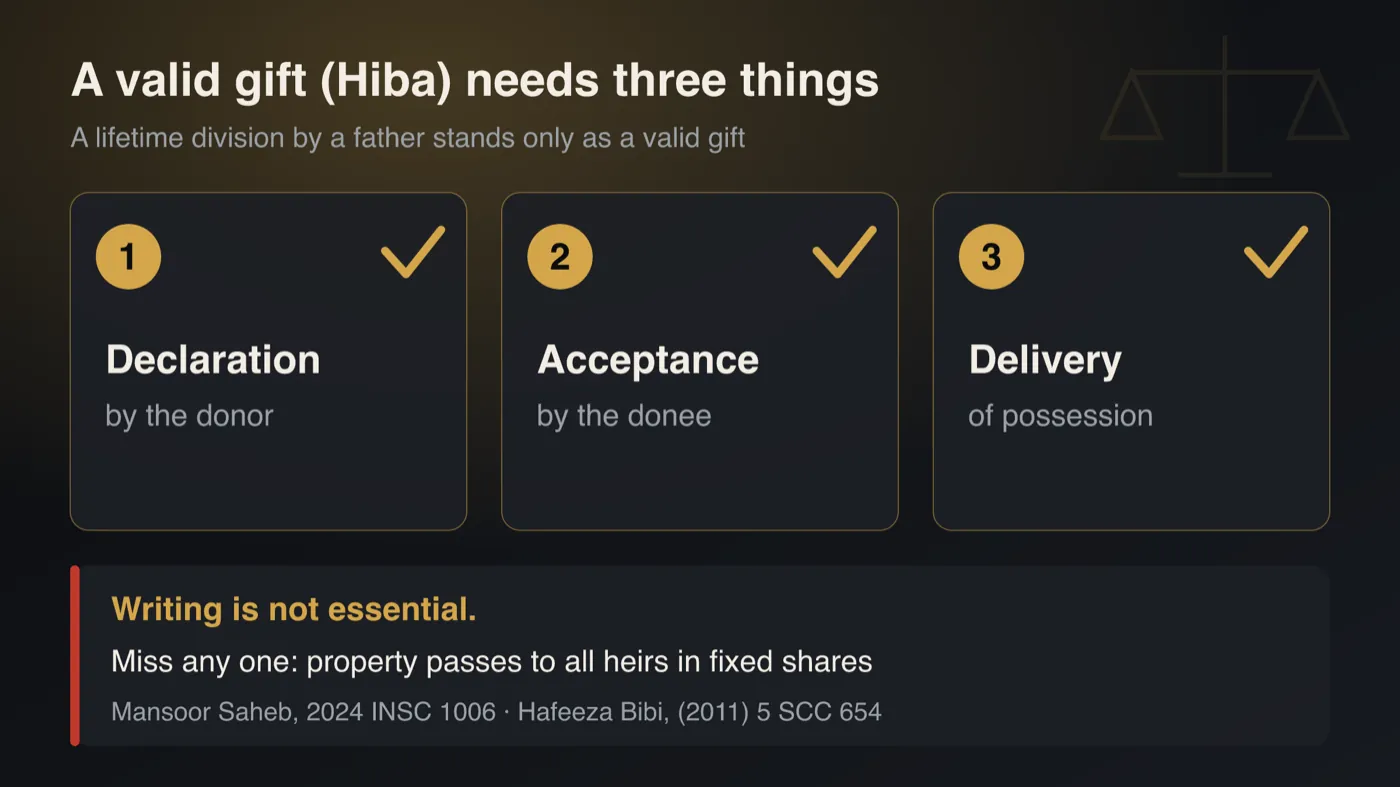
The Supreme Court held that Mohammedan law has no partition of property during the owner’s lifetime. A division made by a living father can stand only if it meets the rules of a valid gift (hiba): a declaration, acceptance and delivery of possession. If those are not proved, the property passes on his death to all heirs in their fixed shares.
2024
Hindu joint-family rules do not apply
In a land dispute between Muslim parties under the U.P. Consolidation of Holdings Act, 1953, the Supreme Court upheld the High Court’s view that the authorities were wrong to apply Hindu joint-family ideas. Muslim law has no joint family property, so each heir’s share has to be worked out under Muslim personal law.
1973
Paid-for release of future share binds
A mere hope of inheritance (spes successionis) cannot be transferred. That is the rule in Section 6(a) of the Transfer of Property Act, 1882 and in Muslim law. But the Supreme Court held that an expectant heir who takes payment to give up a future share, and lets the owner act on that promise, may be stopped (estopped) from claiming the share after the owner dies.
2011
Heirs who took consideration are estopped
The Supreme Court accepted that a Muslim heir-apparent’s chance of succeeding cannot by itself be validly transferred or released. On the facts, though, siblings who had signed release deeds and accepted payment for their future shares during their father’s lifetime were estopped. They could not claim shares in his estate after his death.
2011
Oral gift valid without a deed
The Supreme Court held that a valid gift under Muslim law needs three things: a declaration by the donor, acceptance by the donee and delivery of possession. Writing is not essential. If a written paper only records an oral gift already made, it does not become a gift deed just because it is in writing. Whether registration is needed depends on the facts.
How a Muslim family estate is divided, step by step
Identify the heirs and the school of law
Find out whether the deceased was Sunni (usually Hanafi) or Shia, because the share rules differ. List every surviving relative: spouse, children, parents and others. Under Muslim law shares fix on the date of death. An heir who dies before the property is divided passes that share to his or her own heirs.
Clear funeral costs, debts and unpaid mahr
Before anyone takes a share, pay reasonable funeral costs and all proven debts, including unpaid dower (mahr) owed to the widow. A Muslim can leave by will only up to one-third of what remains, and cannot leave anything extra to an heir unless the other heirs agree after the death.
Work out the fixed and residuary shares
Give the Quranic sharers their fixed fractions first, such as the wife’s 1/8 or the husband’s 1/4 where there are children. The residue goes to the residuaries; a son and daughter divide it 2:1. Apply Aul (proportionate reduction) or Radd (return of surplus) where the fractions do not add up to one.
Get documents of heirship
Gather death certificates, a family or legal heir certificate from the local authority, and the title deeds and tax records. A succession certificate under Part X of the Indian Succession Act, 1925 is needed to collect debts and securities owed to the deceased. Verify what your bank or registrar asks for.
Divide by family settlement and register it
If all heirs agree, write the division into a partition deed or family settlement signed by every co-owner, with a schedule of who gets which property. A deed that divides immovable property must be stamped and registered (Registration Act, 1908, section 17). After that, apply for mutation in the land and municipal records.
File a partition suit if heirs disagree
Any co-owner, or someone who bought a co-owner’s share, can file a civil suit for partition and separate possession. The court first passes a preliminary decree declaring the shares (Order XX Rule 18, CPC). A commissioner then divides the property by metes and bounds (Order XXVI Rule 13), and a final decree follows. Under the Partition Act, 1893, the court may order a sale where the property cannot fairly be divided.
What comes out of the estate before heirs take their shares
Partition is only possible after the estate has been administered in this order.
Funeral expenses
Reasonable cost of burial and last rites, without extravagance.
Proven debts and Mahr
Unpaid dower to the widow ranks as a debt ahead of the heirs.
Legacies up to one-third
A Will operates only on up to one-third of the net estate.
Sharers take fixed shares
Husband, wife, daughter, mother and others receive their fractions.
Residuaries take the balance
The son and other male agnates take what is left.
Will limit under Muslim law: at most one-third of the estate left after funeral costs and debts can go by will (more needs the heirs' consent after death)
Common mistakes in Muslim property partition
Treating the estate as Hindu joint family property Muslim law has no coparcenary, karta or birthright, and the Supreme Court has rejected Hindu joint-family reasoning in Muslim share disputes. Every heir is a tenant-in-common with a fixed share, and one heir cannot sell or deal with the others’ shares without their consent.
Relying on a father's 'partition' made while he was alive A division made during the owner’s lifetime is not a partition under Muslim law. It holds only if it was a valid gift with declaration, acceptance and actual delivery of possession, so keep proof of possession and verify the paperwork.
Leaving out a daughter, widow or a deceased heir's children Women’s shares are fixed by law. Excluding any heir, or the heirs of a co-owner who died before the division, leaves the partition open to challenge. Draw up a complete family tree before you sign anything.
Ignoring unpaid mahr, debts and the one-third will limit Unpaid dower is a debt that comes before the heirs’ shares, and a will that gives more than one-third, or gives extra to an heir, needs the other heirs’ consent after the death. Settle these items first, or the share calculation will be wrong.
Facing a dispute over a Muslim family estate?
Inheritance and partition disputes turn on the exact list of heirs, the property involved, and the documents available, such as title papers, gift deeds and Wills. Patra’s Law Chambers advises on partition suits and family settlements before the civil courts and the Calcutta High Court. Each matter is assessed on its own facts, and no outcome can be promised. Bring the death certificate, the property papers and any Will or gift deed to the consultation.
Book a ConsultationEstablished by a distinguished alumnus of IIT Kharagpur, Patra’s Law Chambers stands as a beacon of legal expertise in Kolkata & Delhi. Know more →

Kolkata Office
NICCO House, 6th Floor, 2 Hare Street
Kolkata-700001 (Near Calcutta High Court)
Delhi Office
4455/5, First Floor, Gali Shahid Bhagat Singh
Main Bazar Road, Paharganj, New Delhi-110055
Contact
[email protected]
+91 890 222 4444 / +91 7003 715 325
Muslim law and Hindu joint family law compared
Concepts from one system should not be carried into the other.
Frequently asked questions on partition and succession under Muslim law
The Muslim Personal Law (Shariat) Application Act, 1937 applies. Section 2 directs that, despite custom, questions of intestate succession among Muslims are decided by Muslim personal law. Agricultural land may follow State law, so verify the position in your State.
A lone daughter takes one-half and two or more daughters share two-thirds, if there is no son. Where there is a son, the daughter becomes a Residuary and shares the residue with her brother in the ratio 1:2. Other heirs can change these figures.
No. A Muslim can bequeath only up to one-third of the net estate after debts. A bequest above that, or in favour of an heir, is valid only if the other heirs consent after the testator’s death.
No. A living person has no heirs, so the son has no right in the father’s property during his lifetime. Anything the father gives in life is a gift (Hiba) and must meet the rules of declaration, acceptance and delivery of possession.
Yes, but only his own undivided share. The buyer steps into his place and may sue for partition. The other heirs’ shares stay untouched. For a dwelling house, Section 4 of the Partition Act, 1893 may give family members a chance to buy a share sold to an outsider.
There is no fixed period for asking co-owners for partition while the shared ownership continues. If one heir has openly excluded the others and held the property against them, the 12-year period for possession under Article 65 of the Limitation Act, 1963 may come in. Get your dates checked early.
Aul applies when the fixed shares add up to more than one, so each share is reduced proportionately. Radd applies when they add up to less than one and there is no Residuary, so the balance returns to the Sharers in proportion to their shares.
Yes. Unpaid dower owed to a widow is treated as a debt of the deceased and is cleared from the estate before any share is calculated. Funeral expenses and other proven debts also come first, and legacies are limited to one-third of the net estate.