Caste Certificate in West Bengal: Procedure and Remedies
How to apply for an SC, ST or OBC certificate in West Bengal, what the Constitution and the Supreme Court say about reservation, and what you can do if the certificate is refused, cancelled or revoked.
Getting a caste certificate and defending it
A caste certificate is the document that lets a person claim reservation in public employment, admission to educational institutions and welfare schemes. In West Bengal, applications are made online through the state’s official caste certificate portal. The applicant then submits documents, the local authority makes an inquiry, a hearing is held where needed, and the digitally signed certificate is issued. A delay, a missing document or a faulty inquiry report can stall an otherwise valid claim.
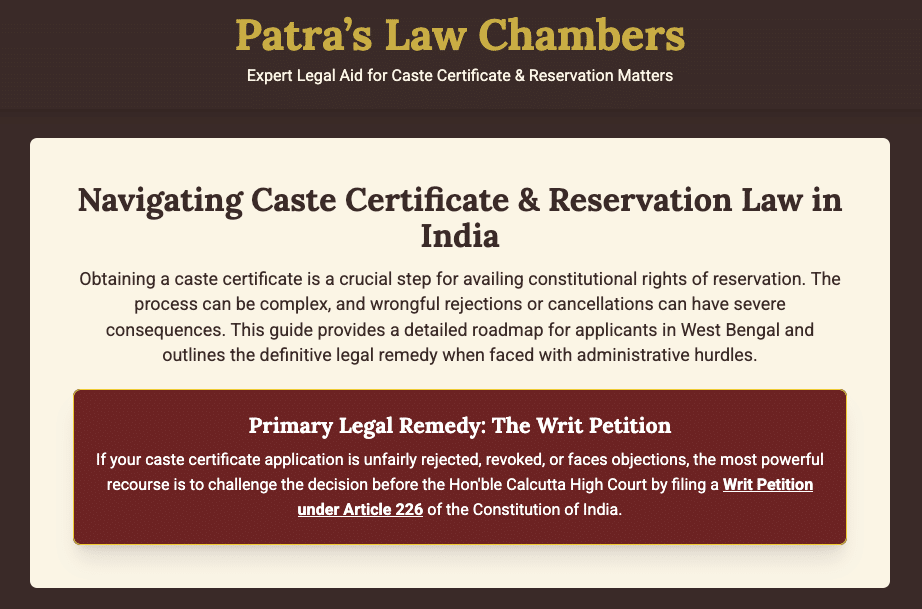
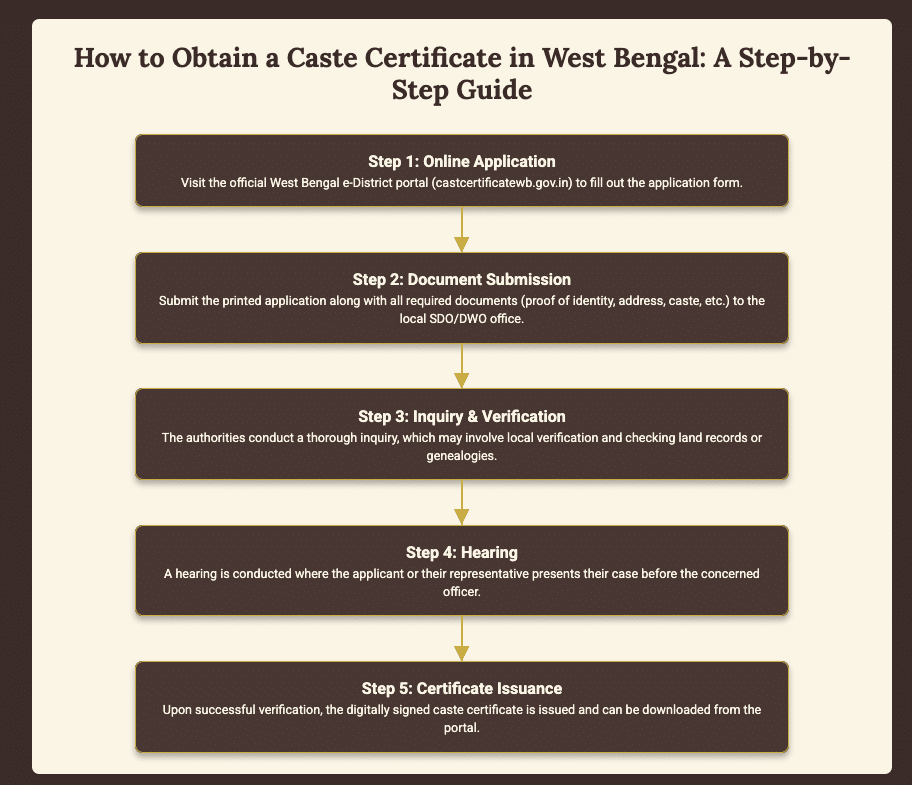
The legal basis for reservation lies in Articles 15(4), 16(4), 341 and 342 of the Constitution and in the West Bengal laws on Scheduled Castes, Scheduled Tribes and Other Backward Classes. This guide explains that framework, the landmark Supreme Court rulings, and the remedies when a certificate is rejected or cancelled. The main remedy is a writ petition, which is explained in our guides to filing a writ petition in the Calcutta High Court and to writs under the Calcutta High Court. Rules and notifications change, so please verify the current position before relying on any of it.
SC/ST list and OBC list: what differs
The three categories are identified in different ways, and that affects where a dispute is taken.
Short explainers from Adv. Sudip Patra
More short explainers on our YouTube channel: Patra’s Law Chambers on YouTube ↗
What does the latest paper about your caste certificate say?
Pick the paper or situation closest to yours. This is general information, not advice, and the forum or time limit for your case must be verified from the order itself.
Choose one of the options above.
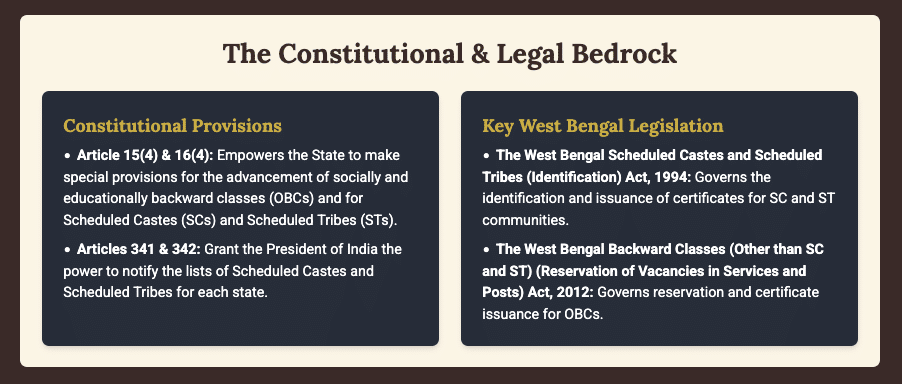
From application to remedy: how a caste certificate matter usually moves
The sequence below is the usual path. Offices, forms and time limits can differ, so check them against the current State notification and your own order.
Collect old records linking you to the community in the State, such as a parent’s or grandparent’s certificate, school records, land or voter records. For SC and ST, the community must be in the Presidential Order list for West Bengal.
File the application with the officer notified for your area and keep the acknowledgment. Enquiry reports and hearing notices may follow.
Where genuineness is questioned, the matter goes to a verification authority or Scrutiny Committee. You are entitled to a notice, to the material against you and to a fair hearing.
A reasoned order is the key document. Note its date and any appeal route it states, because the time limit runs from the order.
Use any statutory appeal first and file it with the order, the certificate and your supporting records. The forum and period must be checked in the order and the governing rules.
A writ petition under Article 226 may be considered for denial of hearing, no reasons, or wrong law applied. See our guides on writs in the Calcutta High Court and the Calcutta High Court advocate consultation.
Three things people often mix up: tap a card
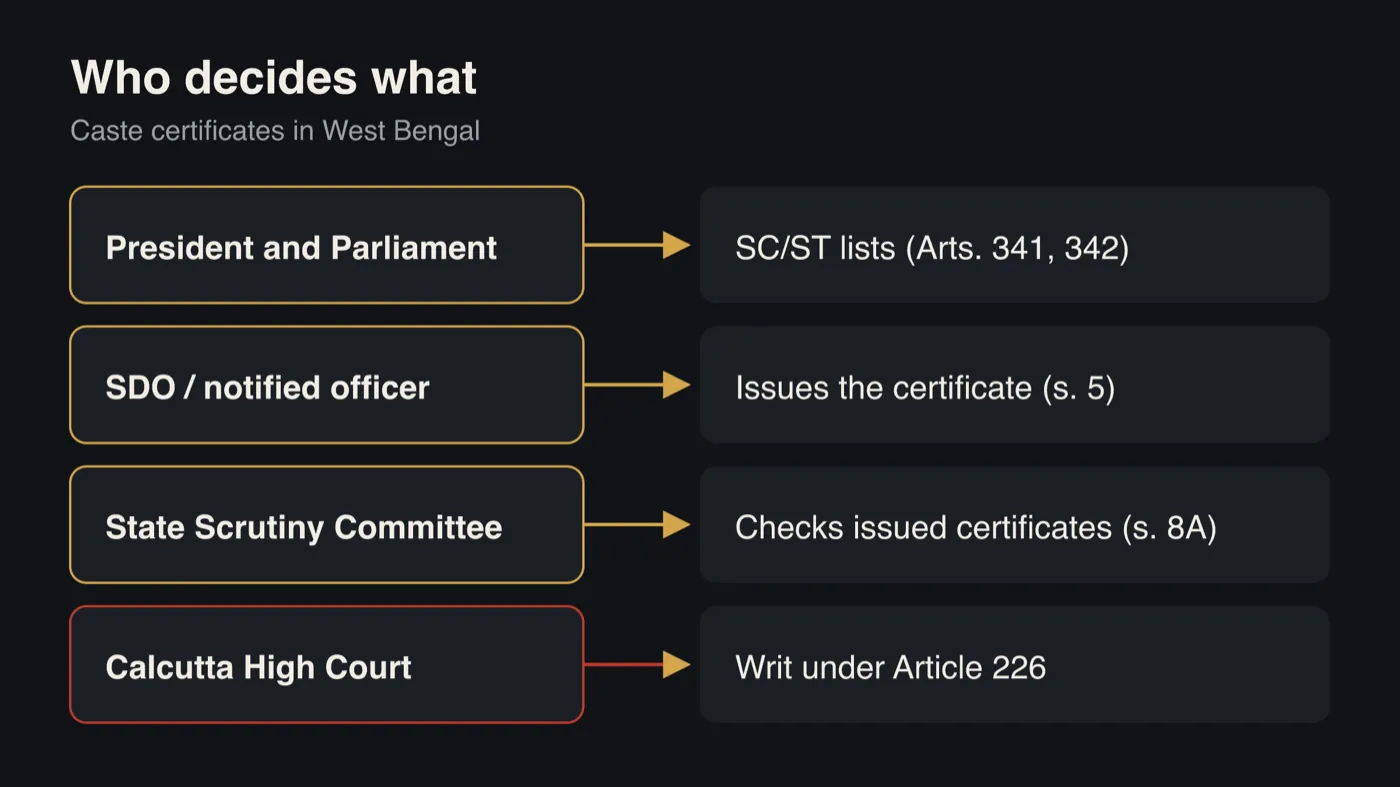
SC and ST lists are notified by the President under Articles 341 and 342 and changed only by Parliament. OBC identification works differently and is State- and Centre-specific.
A community may be a Scheduled Caste in one State and not in another. A West Bengal certificate speaks for West Bengal, so migration needs careful checking.
A certificate that has been issued should not be cancelled without notice and a chance to answer. Courts treat the lack of a fair hearing as a strong ground to challenge the order.
Where caste certificate disputes are heard
Writ petition under Article 226
When a certificate is refused, cancelled or revoked without a fair hearing or reasons, the order can be challenged by a writ petition. The court examines whether the authority followed the law and the principles of natural justice.
Articles 341 and 342
The President notifies the Scheduled Caste and Scheduled Tribe lists for each State, and only Parliament can add a community to a list or remove it. A community may be listed in one State and not in another.
Identification and issue
The West Bengal Scheduled Castes and Scheduled Tribes (Identification) Act, 1994 and the West Bengal Backward Classes Act, 2012 govern who is entitled to a certificate and which authority issues it.
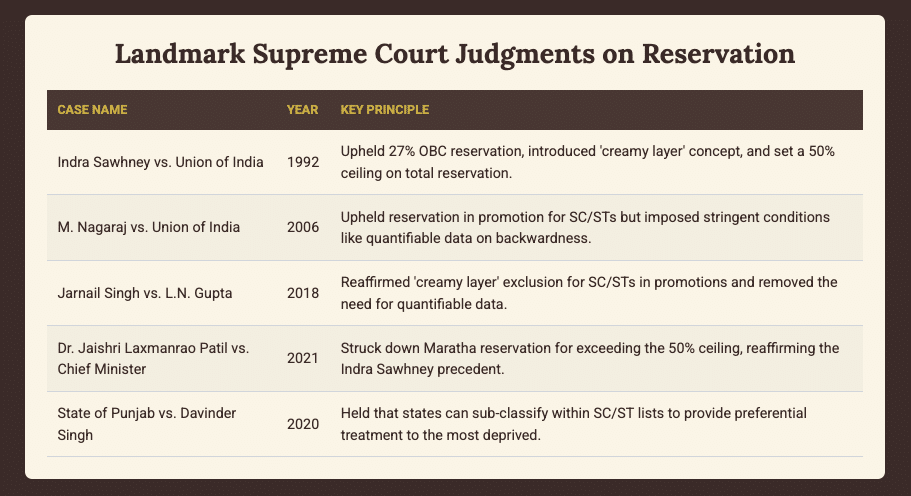
Reservation case law
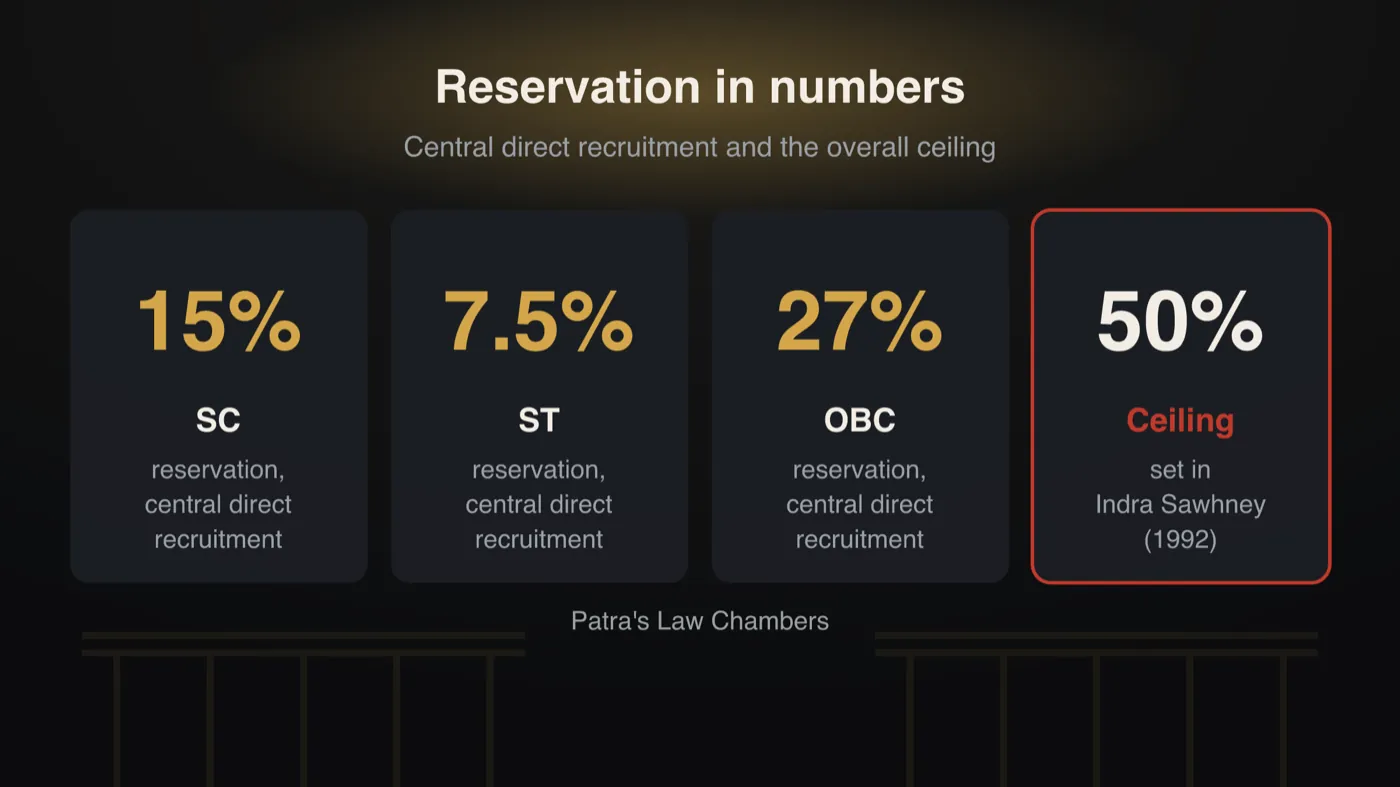
Indra Sawhney, M. Nagaraj, Jarnail Singh and other rulings shape the 50% ceiling, the creamy layer and reservation in promotion. They guide how courts read a reservation dispute.
Problems that reach the courts
- Application rejected for missing or doubtful documents
- Certificate cancelled after a verification inquiry
- Cancellation without notice or a hearing
- OBC creamy layer and non-creamy layer questions
- Claims based on a parent’s or ancestor’s certificate
- Service or admission benefit denied for want of a valid certificate
Court rulings on getting, checking and cancelling a caste certificate
These judgments decide how a caste claim is checked, whose caste a person takes, and what happens if a certificate is cancelled. Courts in West Bengal apply them alongside the West Bengal Scheduled Castes and Scheduled Tribes (Identification) Act, 1994.
1994
Caste claims must pass a scrutiny committee
The Supreme Court found that false caste claims were taking reserved seats and posts. It told every State to set up a scrutiny committee with a vigilance cell to check social status certificates. The claimant must see the vigilance report and be heard before any adverse finding. West Bengal’s State Scrutiny Committee under section 8A of the 1994 Act comes from these directions.
2017
Invalid certificate means reserved benefits go
A three-judge bench held that once the scrutiny process finds a caste claim invalid, the holder cannot keep a job or admission taken against a reserved vacancy. Length of service does not save the post. The Court also held that it does not matter whether the false claim was made dishonestly or by honest mistake. A reserved seat belongs only to a genuine member of the class.
1996
Marriage does not change caste for reservation
A woman born into a forward community married a man from a backward class and claimed a reserved post. The Supreme Court refused. Reservation under Articles 15(4) and 16(4) is for people who have carried the disadvantage since birth. Joining a community by marriage, or being accepted by it, does not give a person that status for reservation.
2012
Child of mixed parentage: a question of fact
The Court considered a child with one Scheduled Tribe parent and one parent from a forward caste. It held there is no automatic rule that the child takes the father’s caste. Whether the child can claim the reserved status depends on the evidence: how the child was brought up, and whether the child suffered the disadvantages of that community.
2023
Section 8A of the West Bengal Act is not retrospective
The case was about a caste certificate cancelled by the issuing authority under section 9(1) of the West Bengal 1994 Act. The Supreme Court held that section 8A, which set up the State Scrutiny Committee in 2007, does not apply retrospectively. If your certificate is challenged, check which version of the Act applied on the relevant date before choosing a forum.
How a caste certificate is issued, cancelled and challenged in West Bengal
Apply to the competent authority
In West Bengal, SC, ST and OBC certificates are issued under section 5 of the 1994 Act, mainly by the Sub-Divisional Officer of your area. Apply on the State’s online caste certificate portal or at the SDO or BDO office. When a form asks whether you ‘obtained the caste certificate from the competent authority of West Bengal’, it means a certificate from this authority.
File proof of caste and residence
Attach proof of residence, identity papers and documents showing your family’s caste, such as a father’s or relative’s certificate, old land records or school records. For SC and ST claims, the authority may ask for proof that your family lived in West Bengal on the date of the Presidential Order. This is often called the ‘1950 proof’.
Enquiry and verification
The authority makes an enquiry, which may include a local field report, before it issues the certificate. A certificate already issued can later be checked by the State Scrutiny Committee under section 8A. Keep copies of every paper you file and reply to any notice in writing.
Show-cause notice before cancellation
Under section 9 of the 1994 Act, read with Rule 3 of the 1995 Rules, the issuing authority can start cancellation proceedings if it believes the certificate was obtained by misrepresentation, by hiding facts or with forged papers. You must get a notice and a hearing. The final order must give reasons.
Appeal or writ petition
A 2022 amendment added section 9A, which gives an appeal against cancellation. Calcutta High Court records indicate the appeal lies to the District Magistrate. Check the notified text and time limit before you file. If no appeal is available, or the procedure was unfair, a writ petition may lie. See our guide to filing a writ petition in the Calcutta High Court and writs under the Calcutta High Court.
Protect your job or admission
If a certificate you used for a job or college seat is under challenge, tell your lawyer straight away. After FCI v. Jagdish Balaram Bahira, an adverse finding can cost you the post or the seat. For help with the case, see our Calcutta High Court advocate consultation page.
What to keep ready if your certificate is challenged
A well-organised file helps in any reply, appeal or writ petition.
Keep the original certificate, the application form and the acknowledgment.
Note its date, the officer who issued it and any appeal route in it.
Old certificates of parents or grandparents from West Bengal support your claim.
Documents showing the community entry from earlier years can be useful.
Ask in writing for a copy of any report used against you.
Keep the postal or portal proof that shows when you received each paper.
Mistakes that weaken a caste certificate claim
Claiming caste through marriage After Valsamma Paul, a spouse who marries into a reserved community does not get its reservation status. An application on that basis is likely to be refused or later cancelled.
Ignoring the show-cause notice If you do not reply to a section 9 notice with documents, the SDO can decide against you on the record as it stands. Reply in writing, ask for copies of any adverse report and attend the hearing.
Relying on a certificate from another State SC and ST lists are notified separately for each State. A certificate from another State may not count for West Bengal benefits, so check that your community is on the West Bengal list.
Going straight to the High Court If section 9A gives you an appeal, the High Court may send you back to that forum first. Check the remedy and the time limit before choosing where to file.
Caste certificate refused or cancelled?
If your application has been rejected or your certificate cancelled, the first step is to read the order, note its date and gather your documents. Patra’s Law Chambers appears before the Calcutta High Court and can advise whether a writ petition is suitable on your facts. See our Calcutta High Court advocate consultation page for how a consultation works. Every matter depends on its own papers, and no result can be promised. Please bring the order, the application and your supporting documents.
Book a ConsultationEstablished by a distinguished alumnus of IIT Kharagpur, Patra’s Law Chambers stands as a beacon of legal expertise in Kolkata & Delhi. Know more →

Kolkata Office
NICCO House, 6th Floor, 2 Hare Street
Kolkata-700001 (Near Calcutta High Court)
Delhi Office
4455/5, First Floor, Gali Shahid Bhagat Singh
Main Bazar Road, Paharganj, New Delhi-110055
Contact
[email protected]
+91 890 222 4444 / +91 7003 715 325
Frequently asked questions about caste certificates in West Bengal
This line appears on forms to ask whether you hold a caste certificate issued by the officer authorised under West Bengal rules, such as the Sub-Divisional Officer. Answer yes only if you hold such a certificate, and attach it. Check the form’s instructions for your category.
Certificates are issued by the officers notified by the State government, commonly the Sub-Divisional Officer in districts and the corresponding officer in Kolkata. The notified officer can change, so verify the current authority on the official State portal before applying.
Old records that link you or your family to the community in West Bengal help most, such as a parent’s or grandparent’s caste certificate, school leaving records, and land or voter records. The cut-off year and accepted papers depend on the category, so verify current rules.
Yes, if the issuing or verification authority finds it was obtained on wrong or false information. Cancellation should follow a notice and a hearing. Without these, the order may be open to challenge. The details depend on the governing Act and rules.
Read the order for reasons and any appeal route, and note the date. File the appeal within the stated time if one exists. Where none is available or a fair hearing was denied, a writ petition under Article 226 in the Calcutta High Court may be considered.
In writ jurisdiction under Article 226, the High Court can examine whether the authority acted fairly and lawfully. It usually does not decide caste status as a fresh trial, but can quash orders passed without hearing, reasons or authority.
The creamy layer exclusion was laid down for OBCs in Indra Sawhney v. Union of India. In Jarnail Singh v. Lachhmi Narain Gupta (2018), the Supreme Court extended the idea to SC and ST members in the context of promotions. It does not decide whether a person belongs to the community.
SC and ST lists are State-specific. A West Bengal certificate is generally relied on for West Bengal, and a migrant’s status in another State depends on that State’s list and rules. Check the position before applying for jobs or admissions elsewhere.