
OF
PROBATE
Probate Lawyer in Kolkata: Probate Law Changes 2026 & the Calcutta High Court Procedure
Section 213 of the Indian Succession Act was omitted with effect from 20 December 2025. Probate is no longer a statutory must in Kolkata — but it is still the only order that binds the whole world. Here is what changed, when you still need probate, how a probate petition runs in the Calcutta High Court, and how contested wills are won or lost.
Updated September 2026 · reflects the Repealing and Amending Act, 2025Probate, will and contested-will lawyers for Kolkata and all of West Bengal
Patra’s Law Chambers handles testamentary work end to end — from drafting a Will that will survive scrutiny, to obtaining probate on the Original Side of the Calcutta High Court or before a District Judge, to fighting (or defending) a contested Will through a full testamentary suit. We act for executors, beneficiaries, and heirs who believe a Will is not genuine.
Probate & Letters of Administration
Drafting and filing the PLA petition, valuation and court-fee compliance, special and general citations, and obtaining the grant — in the Calcutta High Court or the District Judge’s court where the deceased lived or held property.
Contested Wills & Testamentary Suits
Filing or opposing caveats, affidavits in support, framing issues and leading evidence of attesting witnesses — for the propounder proving the Will, or for heirs exposing forgery, undue influence or lack of testamentary capacity.
Will Drafting, Execution & Registration
Wills built to withstand a probate trial: capacity documentation, independent attesting witnesses, clear dispositions, and registration strategy. We also advise on joint Wills of husband and wife.
Revocation of Probate & Appeals
Applications to revoke a grant obtained without citing necessary heirs, by concealment or by fraud, and appeals to the Division Bench against grants or refusals.
Probate for Non-Resident Indians
Executors living abroad can run a Kolkata probate through a properly executed power of attorney, with affidavits sworn before an Indian mission — without repeated travel.
Banks, Societies & Mutation
Using the grant (or, after the 2025 change, the Will itself where acceptable) to transmit bank balances, securities, society flats and to secure mutation before the KMC and land records authorities.
Section 213 is gone — what actually changed in Kolkata
For a century, Section 213 of the Indian Succession Act, 1925 barred anyone from establishing a right as executor or legatee in any court unless probate (or letters of administration with the Will annexed) had first been granted. Read with Section 57, this bit hardest on Wills of Hindus, Buddhists, Sikhs and Jains made within the old Presidency limits of Calcutta, Bombay and Madras, or dealing with immovable property there — which is why probate was treated as compulsory in Kolkata. The Repealing and Amending Act, 2025 omitted Section 213, and made consequential changes to Sections 3 and 370, on receiving Presidential assent on 20 December 2025.
Yes, for Wills covered by Section 57 — no right as executor or legatee could be established in court without it.
No statutory bar. The Will can be proved in the proceeding in which it is relied upon, but probate remains available.
A grant of probate operated as a judgment in rem, conclusive against the world.
Unchanged. Only probate gives that in-rem finality; proving the Will collaterally binds only the parties to that case.
Filed because the law required them.
The Amending Act’s saving clause protects proceedings already initiated — pending matters continue and should not simply be abandoned.
Banks, housing societies and registrars insisted on probate as a matter of law.
Many continue to ask for it as a risk-control measure, especially for high-value assets or where heirs disagree.
Omission of Section 213 removed a procedural gate — it did not make a Will self-proving. Without probate, the Will may have to be proved afresh every time it is relied on: in a partition suit, an eviction, a mutation dispute, a bank’s internal review. With probate, one judgment settles genuineness against everyone. For contested families, high-value estates and property that will be sold, probate is usually still the safer course. The text of the omission is in the Repealing and Amending Bill, 2025 (PRS Legislative Research).
Your answers will show whether probate is essential, advisable, or genuinely optional in your situation.
General information only, not legal advice for your specific estate. Call or WhatsApp us for an assessment of your documents.
What a valid Will needs under the Indian Succession Act
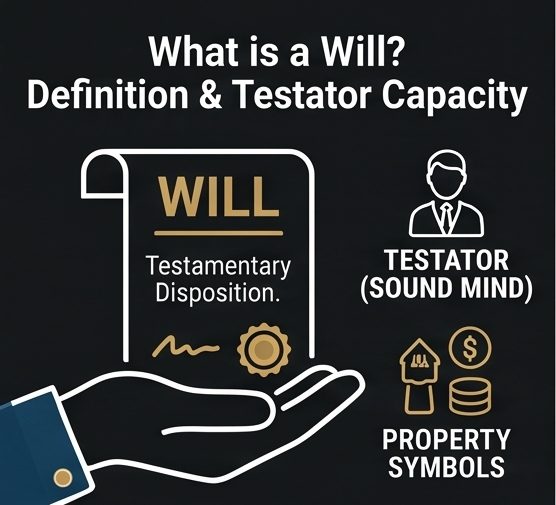
Under Section 2(h) of the Indian Succession Act, 1925, a Will is the legal declaration of a testator’s intention about his property, which he desires to be carried into effect after his death. It speaks only from death, so it can be changed or revoked any number of times while the testator remains competent — the last validly executed Will prevails. The Act governs Wills of Hindus, Buddhists, Sikhs, Jains, Christians and Parsis; Wills of Muslims follow personal law, explained in our guide to Muslim Wills (Wasiyat) in India.
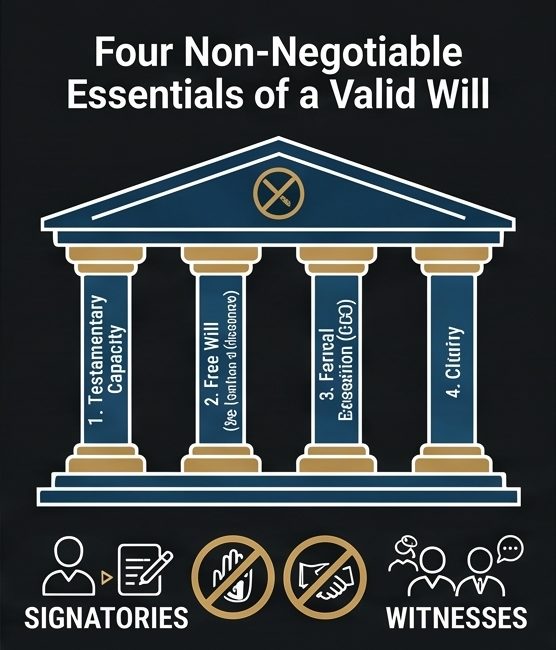
Testamentary capacity
The testator must be a major of sound mind when signing. The test is a sound disposing mind: understanding the act of making a Will, the extent of the property, and the claims of those being included or left out. A person usually of unsound mind may make a valid Will in a lucid interval.
Free will and consent
A Will, or any part of it, caused by fraud, coercion, or importunity that takes away the testator’s free agency is void. Courts look closely at who arranged the lawyer, the stamp paper, the witnesses and the registration.
Formal execution
The Will must be in writing and signed (or marked) by the testator, or by someone in his presence and by his direction. It must be attested by two or more witnesses, each of whom saw the testator sign or received his acknowledgment, and each of whom signed in the testator’s presence. The witnesses need not sign in each other’s presence.
Clarity and certainty
Beneficiaries and property must be described clearly enough to be acted upon. Vague bequests fail, and ambiguity invites the very litigation the Will was meant to prevent.
Types of Wills recognised in India
- Unprivileged Wills — the ordinary Will, which must strictly satisfy Section 63.
- Privileged Wills (Sections 65–66) — soldiers on expedition, airmen so employed and mariners at sea may make Wills orally or in writing without full attestation.
- Conditional, joint and mutual Wills — a joint Will usually takes effect only after the death of all executants; mutual Wills rest on an agreement between testators. See our detailed joint Will guide and format.
- Holograph Wills — written in the testator’s own hand; still require attestation under Section 63.
Probate, letters of administration and succession certificates
Section 2(f) defines probate as the copy of a Will certified under the seal of a competent court with a grant of administration to the estate of the testator. It declares that the document is the last genuine Will and that the named executor may administer the estate. It does not decide title: whether the testator actually owned a property is a question for a regular civil suit, not the probate court.
Only the executor named in the Will (Section 222).
An administrator appointed by the court — on intestacy, or with the Will annexed where no executor is named or the executor cannot or will not act.
Genuineness and due execution of the Will, conclusively and against everyone.
The administrator’s authority to collect and distribute the estate according to the Will or the law of intestate succession.
Limited to debts and securities (bank balances, shares, deposits) — not immovable property.
Section 370 was amended alongside the omission of Section 213; the right forum now depends on the asset, the Will and whether heirs agree — take advice before choosing.
Calcutta High Court or District Judge — choosing the forum
The Calcutta High Court’s testamentary and intestate jurisdiction flows from Clause 34 of its Letters Patent and is exercised by the Original Side under Chapter XXXV of the Original Side Rules. Section 300 of the Act gives the High Court concurrent jurisdiction with the District Judge, so an executor usually has a genuine choice.
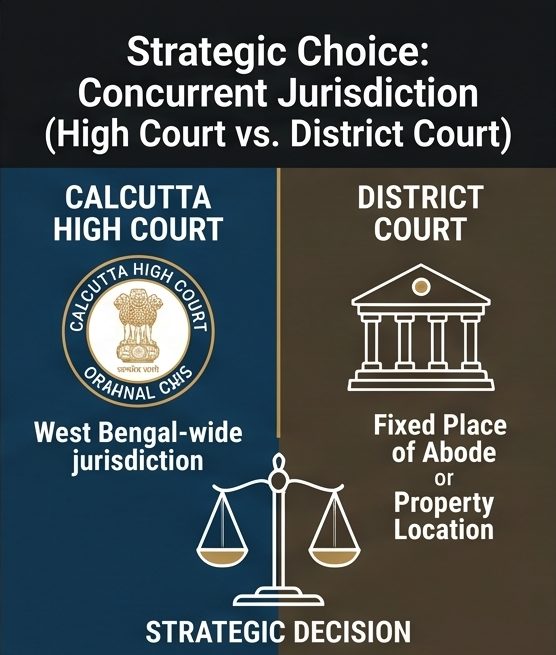
Testamentary jurisdiction throughout West Bengal.
Where the deceased had a fixed place of abode or any property, movable or immovable (Section 270).
High-value or multi-district estates, Wills likely to be contested, complex questions of capacity or forgery.
Smaller, uncontested estates located wholly in one district, where local filing saves cost and travel.
City Civil Court amendments carved out jurisdiction for certain matters arising exclusively within its limits.
The High Court’s wider Letters Patent jurisdiction is triggered — check this before filing to avoid a preliminary objection.
How a probate petition runs in the Calcutta High Court
The procedure is one of escalating scrutiny: a summary route for undisputed Wills, and a full civil trial the moment someone lodges a caveat and supports it by affidavit. Tap each stage to expand it.
The executor files a petition verified as required by Section 276, stating the date and place of death, that the annexed document is the last Will, that it was duly executed, the value of assets likely to come into the petitioner’s hands, and the names and addresses of all heirs and next of kin. The matter is registered with a PLA number.
The estate is valued in the form set out in Schedule III of the West Bengal Court-Fees Act, 1970, with assets and liabilities shown separately. The ad valorem fee under item No. 10 of Schedule I is calculated on graded slabs of the net estate and must be paid before the court makes the order for the grant. The Collector can scrutinise an undervaluation.
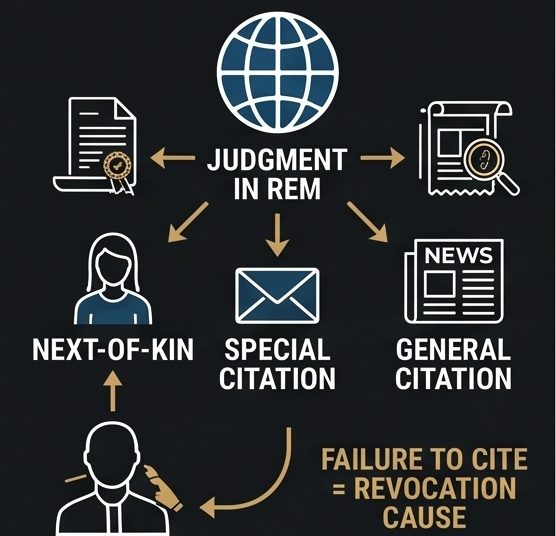
Because a grant is a judgment in rem, everyone with an interest must be told. Special citations go personally to heirs who would take on intestacy; a general citation is published in a newspaper circulating where the deceased lived. Failing to cite a necessary party is a classic ground for revocation under Section 263.
Any person with a caveatable interest may lodge a caveat in the prescribed form and must follow it with an affidavit in support within the short time fixed by Chapter XXXV, stating the interest and the grounds of challenge. A caveat left unsupported may be discharged. If nobody objects, the court examines the papers and grants probate in common form.
Once the affidavit in support is filed, the PLA becomes a contentious Testamentary Suit (TS): the executor is plaintiff, the caveator is defendant, issues are framed and evidence is led. The Will must now be proved in solemn form, with at least one attesting witness examined.
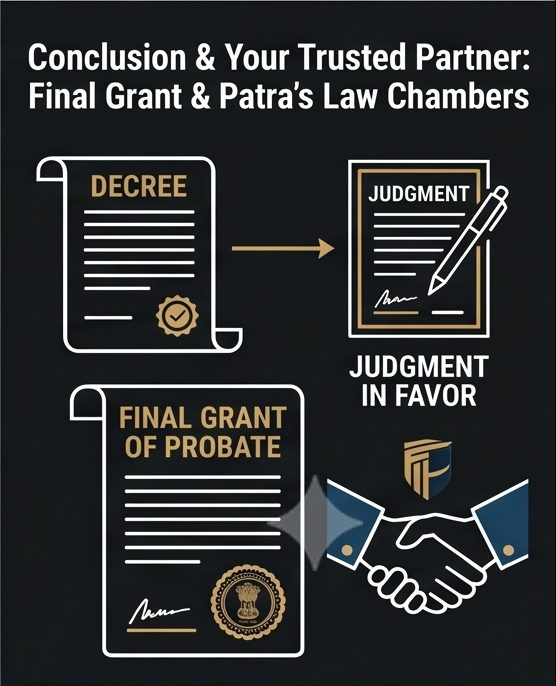
If the propounder satisfies the court’s conscience, a decree follows; on payment of the assessed court fee, the Registry issues the Grant of Probate — a certified copy of the Will under the court’s seal. The executor then administers the estate and may be called upon to file an inventory and account.
Uncontested PLA or contested testamentary suit
Whether your case stays a quick summary proceeding or becomes a full trial depends on one event: a caveat backed by an affidavit. Switch between the two outcomes to see the route.
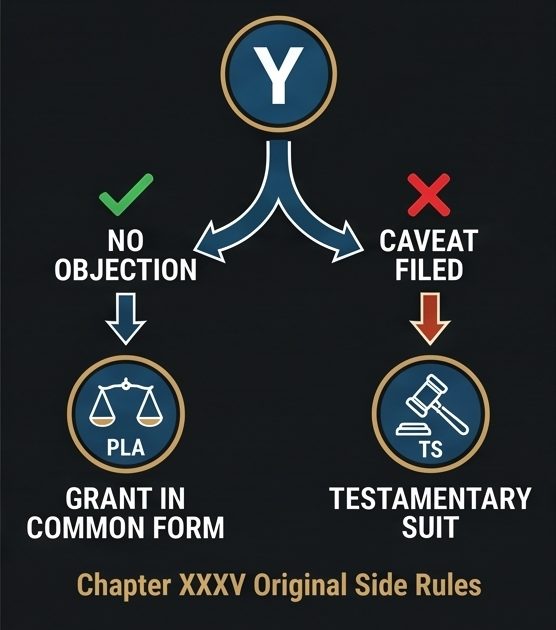
With no objection, the court examines the petition and the attesting witness’s affidavit and grants probate in common form — typically the fastest and least expensive route.
The trial: burden, attesting witnesses and evidence
In a testamentary suit the propounder carries the whole burden of satisfying the conscience of the court that the document is the last Will of a free and capable testator. A Will is a document required by law to be attested, so at least one attesting witness who is alive and capable must be called to prove execution — Section 68 of the Indian Evidence Act, now carried into Section 67 of the Bharatiya Sakshya Adhiniyam, 2023 for proceedings governed by it.
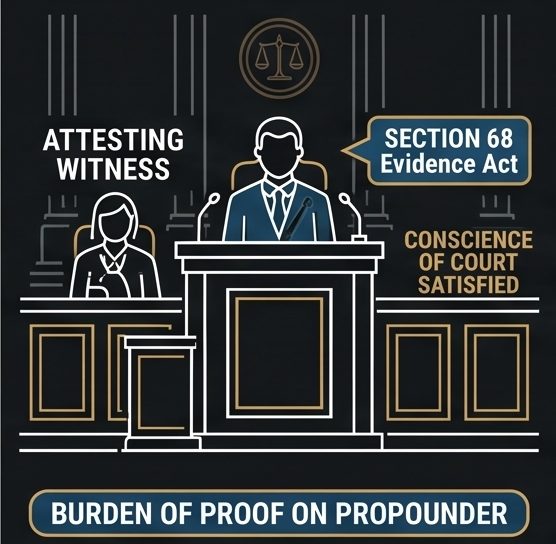
- What the witness must prove: that the testator signed or acknowledged his signature, that the witness signed in the testator’s presence, and that the testator appeared to understand what he was doing.
- When attesting witnesses are unavailable: the Calcutta High Court (Division Bench) in Rama Datta Gupta v. Gopal Das (decided 24 June 2026) accepted the evidence of an attending witness to prove execution, and held that an unusual disposition is not by itself a suspicious circumstance once execution and capacity are established.
- Registration helps, but does not settle it: the Supreme Court in Leela v. Muruganantham (2025) held that registration does not by itself validate a Will clouded by suspicion, while Metpalli Lasum Bai v. Metapalli Muthaih (2025) held that a registered Will whose signature is admitted carries a presumption the challenger must displace.
Suspicious circumstances that win or lose a contested Will
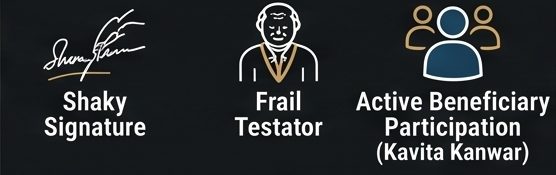
Since H. Venkatachala Iyengar, courts have asked whether the propounder has removed every legitimate suspicion. These are the circumstances that most often decide contested Will cases. Tap a card to see the rule.
Landmark and recent probate judgments
The statute sets the frame; these decisions tell courts how to apply it. Recent Calcutta High Court and Supreme Court rulings from 2025–2026 are listed first.
2026
Rama Datta Gupta v. Gopal Das
Calcutta High Court (DB), decided 24.06.2026Where attesting witnesses were unavailable, the Division Bench held that execution could be proved through the attending witness under the Evidence Act’s provisions for such cases, set aside the refusal of probate, and held that an unusual disposition does not by itself raise suspicion.
2026
Dev Sahitya Kutir Pvt. Ltd. v. Archana Debnath
Calcutta High Court (DB), 21.01.2026The Division Bench upheld an injunction obtained by the executrix and a legatee of cartoonist Narayan Debnath before any probate was sought, recognising the executor’s standing to protect the estate — a sign of how Kolkata courts are approaching pre-probate enforcement after the 2025 amendment.
2025
Metpalli Lasum Bai v. Metapalli Muthaih
2025 INSC 879A registered Will whose signature is admitted by the contesting heir carries a presumption of genuineness; the burden shifts to the challenger to prove real suspicious circumstances rather than bare allegations.
2025
Leela v. Muruganantham
2025 INSC 10Mere registration does not validate a Will. Execution at a distant place, witnesses unconnected to the testator and the beneficiary’s role in procuring stamp paper left suspicions unremoved. Read the judgment ↗
1959
H. Venkatachala Iyengar v. B.N. Thimmajamma
AIR 1959 SC 443The foundational test: the propounder must prove due execution and capacity, and must remove every legitimate suspicion to satisfy the court’s conscience. Read the judgment ↗
2021
Kavita Kanwar v. Pamela Mehta
(2021) 11 SCC 209Active participation of a major beneficiary in the making of the Will is a grave suspicious circumstance calling for a clear explanation.
2008
Krishna Kumar Birla v. Rajendra Singh Lodha
(2008) 4 SCC 300Only a person with a caveatable interest — some interest in the estate of the deceased — may oppose a grant; a stranger to the estate cannot file a caveat.
1993
Chiranjilal Shrilal Goenka v. Jasjit Singh
(1993) 2 SCC 507The probate court alone decides the genuineness of a Will; the question cannot be referred to arbitration.
1954
Ishwardeo Narain Singh v. Kamta Devi
AIR 1954 SC 280A probate court decides only whether the Will is genuine and duly executed — not whether the testator had title to the property.
1955
Anil Behari Ghosh v. Latika Bala Dassi
AIR 1955 SC 566Revocation for “just cause” under Section 263: non-citation matters where it is a substantive defect or part of a scheme, not a mere technicality.
2010
Gopal Swaroop v. Krishna Murari Mangal
(2010) 14 SCC 266The evidence of a single attesting witness can prove a Will if it establishes every element of execution required by Section 63.
What probate costs in West Bengal, and how long it takes
The largest cost is usually the ad valorem court fee, calculated on graded slabs of the net value of the estate under item No. 10 of Schedule I to the West Bengal Court-Fees Act, 1970, and paid before the grant issues. Add newspaper publication of the general citation, certified copies, and professional fees, which depend on whether the matter stays uncontested. An uncontested PLA with cooperative heirs can often conclude within months; a testamentary suit that goes to trial commonly runs for years. Accurate valuation matters in both directions — undervaluation invites the Collector’s scrutiny, while overvaluation simply wastes money.
Five mistakes that derail probate cases
Leaving out an heir. Every person who would inherit on intestacy must be cited. An omitted heir can seek revocation of the grant years later under Section 263.
Assuming “no probate needed” means “no proof needed”. After the 2025 amendment, a Will not probated may have to be proved in every dispute where it is relied upon — often with fewer surviving witnesses each time.
Beneficiary-managed execution. The beneficiary choosing the lawyer, buying the stamp paper and bringing the witnesses is the single most common suspicious circumstance in contested Will cases.
Letting a caveat go unsupported, or supported late. For caveators, missing the affidavit window can end the challenge; for executors, a supported caveat means preparing immediately for trial.
Choosing the wrong forum. Filing in a court that lacks jurisdiction — especially around the City Civil Court limits — invites preliminary objections and months of delay.
Talk to a probate and contested-will lawyer in Kolkata
Whether you are an executor seeking a grant, a beneficiary protecting an inheritance, or an heir who believes a Will is not genuine, we can review the Will, the family tree and the asset position and tell you the right route — probate, letters of administration, a caveat, or no court proceeding at all. We represent clients before the Original Side of the Calcutta High Court, District Judges across West Bengal, and in appeals.
Advocate Sudip Patra — 9+ Years of Professional Legal Experience, IIT Kharagpur and IIM Calcutta Alumnus, practising before the Supreme Court of India and the Calcutta High Court. Established by a distinguished alumnus of IIT Kharagpur, Patra’s Law Chambers stands as a beacon of legal expertise in Kolkata & Delhi. Know more →
Kolkata Office
NICCO House, 6th Floor, 2 Hare Street
Kolkata-700001 (Near Calcutta High Court)
Delhi Office
4455/5, First Floor, Gali Shahid Bhagat Singh
Main Bazar Road, Paharganj, New Delhi-110055
Contact
[email protected]
+91 890 222 4444 (Call / WhatsApp)
+91 7003 715 325
Probate and Will questions we are asked most
No longer as a statutory requirement. Section 213 of the Indian Succession Act, which barred executors and legatees from establishing their rights in court without probate, was omitted by the Repealing and Amending Act, 2025, with Presidential assent on 20 December 2025. Probate remains available and is often still the safest route where heirs may dispute the Will or institutions insist on it.
The Amending Act contains a saving provision for proceedings already initiated, so pending PLAs and testamentary suits continue. Withdrawing a pending case without advice can create more problems than it solves.
The original Will, the death certificate, an affidavit of assets and valuation in the Schedule III form, an attesting witness’s affidavit, a full list of heirs with addresses, title documents, and the executor’s identity proof. Consent affidavits of heirs, where available, help.
An uncontested PLA, with citations served and no caveat, can often be completed within months. Once a caveat is supported by affidavit and the case becomes a testamentary suit, a trial with witness evidence commonly takes years.
If a probate petition has been filed, enter a caveat and file the affidavit in support within the time allowed, stating your interest and grounds such as forgery, undue influence or lack of capacity. If probate has already been granted without notice to you, an application for revocation under Section 263 may lie. If no probate is sought, the Will can be challenged in the proceeding where it is relied upon.
Only a person with a caveatable interest in the estate — typically an heir who would inherit on intestacy, or a beneficiary under another Will. A stranger to the estate cannot oppose the grant (Krishna Kumar Birla v. Rajendra Singh Lodha).
Yes. Under Section 300 the High Court’s jurisdiction is concurrent with the District Judge’s. A District Judge can grant probate where the deceased had a fixed place of abode or any property within the district.
Registration and probate are different things. Registration records the document; probate is a court’s declaration that it is the genuine last Will. A registered Will is not automatically valid, and can still be challenged.
Yes. An executor abroad can act through a duly executed and attested power of attorney, with affidavits sworn before an Indian mission, and need not attend every hearing personally.
No. The probate court decides only whether the Will is genuine and duly executed. Disputes about whether the testator actually owned a property must be decided in a separate civil suit.
Statutes and references
- Indian Succession Act, 1925 — Sections 2(f), 2(h), 57, 61, 63, 222, 263, 270, 276, 300 and 370.
- The Repealing and Amending Bill, 2025 — PRS Legislative Research ↗
- The West Bengal Court-Fees Act, 1970 — West Bengal Judicial Academy ↗
- Calcutta High Court (Original Side) Rules, 1914 — Chapter XXXV (testamentary and intestate matters).
- Indian Evidence Act, 1872, Section 68 / Bharatiya Sakshya Adhiniyam, 2023, Section 67.