- Supreme Court centralizes challenges to the Online Gaming Act, moving all petitions to itself to ensure a consistent ruling.
- The Promotion and Regulation of Online Gaming Act, 2025 faces criticism for being enacted with minimal parliamentary debate.
- Major gaming companies argue the Act violates fundamental rights by broadly banning skill-based games.
- The Supreme Court's decision reinforces its role as a central arbiter of significant legislative challenges.
- This case could impact the future of India's digital economy and the regulation of online activities.
- A ruling against the Act may strengthen fundamental rights and compel a shift towards regulatory frameworks.
- The case emphasizes federalism concerns, as online gaming laws involve both state and national jurisdiction issues.
Weekly Legal News: Supreme Court of India, High Courts & the world (September 8-14, 2025)
Centralises Online Gaming Challenge Amidst Major Tax Reforms
Judgment of the Week: Supreme Court to Adjudicate on the Constitutionality of the Online Gaming Act, 2025
Background: The Genesis of a Contentious Legislation
The Constitutional Challenge: A Barrage of Petitions Across High Courts
-
Lack of Legislative Competence: The most fundamental challenge pertains to the division of powers under the Indian Constitution. The petitioners argue that the subject of “Betting and gambling” falls squarely under Entry 34 of the State List (List II) in the Seventh Schedule, granting exclusive legislative authority to the State legislatures. By enacting a nationwide ban, the Union Parliament has allegedly encroached upon the legislative domain of the States, rendering the Act an unconstitutional exercise of power. The Union has attempted to justify its legislative competence by citing its authority over telecommunications and inter-state trade, a contention that the petitioners argue is a misapplication of constitutional provisions.5
-
Violation of the Fundamental Right to Trade (Article 19(1)(g)): A cornerstone of the petitioners’ case is the infringement of the fundamental right to practise any profession, or to carry on any occupation, trade or business. Decades of Supreme Court jurisprudence have consistently held that games of skill are legitimate business activities protected under Article 19(1)(g). By imposing a blanket prohibition that fails to differentiate between skill-based gaming and chance-based gambling, the Act is argued to be a disproportionate and unreasonable restriction on this fundamental right.2
-
Violation of the Right to Equality (Article 14): The petitions contend that the Act is manifestly arbitrary and violates the right to equality. By treating two unequal categories of activities—games of skill and games of chance—as one and the same, the law fails the test of reasonable classification. This legislative clubbing of distinct activities is argued to be irrational and unconstitutional.4
-
Legislative Overruling of Judicial Precedent: The challengers also argue that the Act represents an impermissible attempt by the legislature to overrule established judicial precedent. The distinction between skill and chance is not a mere legal nuance but a judicially recognized doctrine that forms the basis of the legality of the entire skill-gaming industry. The Act, by ignoring this distinction, effectively seeks to nullify a long line of judgments from the Supreme Court and various High Courts without altering the foundational legal principles upon which those judgments were based.4
The Supreme Court’s Intervention: Rationale for Centralisation
Analysis and Broader Implications: A High-Stakes Legal Battle
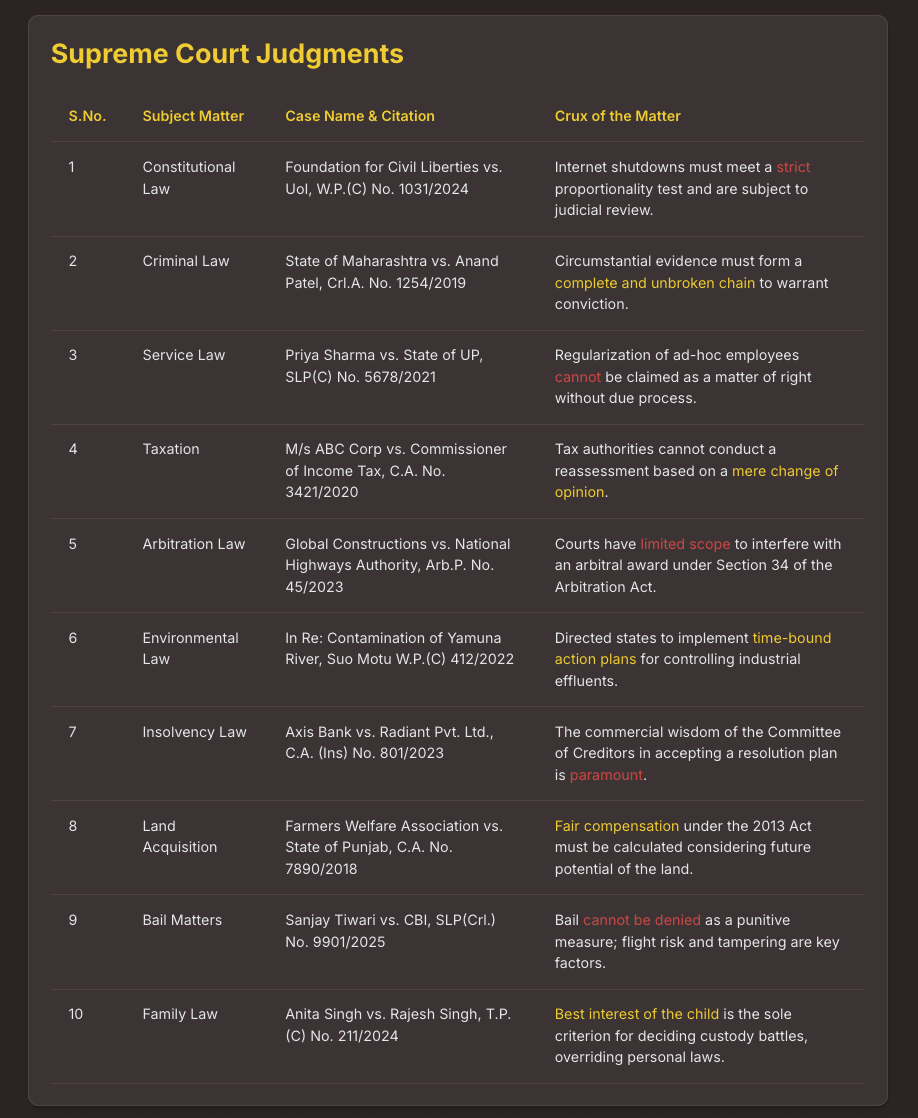
Supreme Court of India: Weekly Judgment Synopsis
|
Sr. No.
|
Case Subject Matter
|
Case Name and Citation
|
Main Gist of the Judgment
|
|
1.
|
Constitutional Law / Online Gaming
|
Union of India v. Head Digital Works Pvt. Ltd. & Ors.
|
Allowed the Centre’s petition to transfer all writ petitions pending in various High Courts challenging the Promotion and Regulation of Online Gaming Act, 2025, to the Supreme Court to avoid conflicting judgments and for an authoritative pronouncement.7
|
|
2.
|
Constitutional Law / Fundamental Rights (Article 21)
|
Sohan Singh @ Bablu v. State of Madhya Pradesh
|
Directed the State of Madhya Pradesh to pay ₹25 lakh in compensation for the illegal incarceration of a convict for over 4.7 years beyond his sentence. The Court held this to be a grave violation of the fundamental right to life and personal liberty under Article 21.11
|
|
3.
|
Criminal Law / POCSO / Death Penalty
|
Akhtar Ali @ Ali Akhtar v. The State of Uttarakhand, Crl.A. No. 3955-3956/2025
|
Set aside the death sentence awarded to a convict under the POCSO Act, commuting it to life imprisonment. The Court reiterated that capital punishment is irreversible and must be reserved for the “rarest of rare” cases, and even the slightest doubt must favor the accused.14
|
|
4.
|
Service Law / Reservation Policy
|
[Case Name Inferred: Union of India v. X]
|
Held that SC/ST candidates who avail relaxations in age, physical standards, or qualifying marks under reservation rules cannot be migrated to the general (unreserved) category, even if their scores are higher than the general cut-off. The ruling overturned a High Court order and affirmed the principle that relaxation is an integral part of the reservation benefit.14
|
|
5.
|
Electoral Law / Citizenship
|
Association for Democratic Reforms & Ors v. Election Commission of India & Anr.
|
Directed the Election Commission of India to accept Aadhaar cards as a valid document for identity verification in the electoral roll revision process in Bihar, but emphatically clarified that an Aadhaar card is not proof of citizenship.11
|
|
6.
|
Insolvency Law (IBC) / Real Estate
|
Confederation of Real Estate Developers Association of India (CREDAI) v. Union of India, C.A. No. 10043/2024
|
Held that insolvency proceedings against real estate companies under the IBC should, as a general rule, be project-specific rather than against the entire corporate entity. This landmark ruling aims to protect homebuyers of solvent projects from the insolvency of the parent company.18
|
|
7.
|
Labour Law / POSH Act
|
**
|
Ruled that complaints under the Sexual Harassment of Women at Workplace (Prevention, Prohibition and Redressal) Act, 2013, must be filed within the statutory limitation period of six months. Belated complaints were held to be time-barred and liable for rejection.14
|
|
8.
|
Environmental Law / Public Health
|
In re: M.C. Mehta
|
During a hearing on air pollution, the Court orally observed that the ban on firecrackers should be implemented nationwide and not be limited to the Delhi-NCR region, questioning why only certain cities receive clean-air protections. It sought a report from the Commission for Air Quality Management.14
|
|
9.
|
Motor Accident Law / Compensation
|
Manjula v. The Branch Manager Oriental Insurance Company Ltd. Bijapur, C.A. No. 11425/2025
|
Ruled that children injured in motor accidents cannot be treated as ‘non-earning individuals’ for compensation purposes. The Court held that their future earning potential must be factored in to ensure just and fair compensation, criticizing a High Court for ignoring settled principles.20
|
|
10.
|
Criminal Law / Defamation
|
BJP Telangana v. Revanth Reddy
|
Dismissed a petition filed by the BJP challenging a Telangana High Court order that had quashed a defamation case against Chief Minister Revanth Reddy, thereby upholding the High Court’s decision.11
|
|
11.
|
NDPS Act / Drug Quantity
|
[Case Name Inferred: X v. Union of India]
|
Agreed to reconsider its 2020 Hira Singh ruling, which held that the entire weight of a narcotic mixture, including neutral substances, should be considered for determining ‘small’ or ‘commercial’ quantity. The Court issued notice to the Centre on a plea arguing that only the pure drug content should be weighed.20
|
|
12.
|
Education Law / Teacher Eligibility
|
**
|
Ruled that the Teacher’s Eligibility Test (TET) is a mandatory qualification for all teachers for continued service and promotion. However, the question of whether this mandate applies to minority-run institutions was referred to a larger bench for consideration.20
|
|
13.
|
Constitutional Law / Political Funding
|
In re: Ashwini Kumar Upadhyay
|
Issued notice on a PIL seeking stricter regulation of political parties to curb the use of black money and enhance transparency in funding. The Court suggested impleading major national parties as respondents.14
|
|
14.
|
Law of Torts / Custodial Violence
|
In re: Suo Motu PIL on Custodial Deaths
|
Took suo motu cognizance of a media report highlighting 11 custodial deaths and non-functional CCTV cameras in police stations. The Court initiated a PIL to ensure strict compliance with its earlier directions on CCTV installation to curb custodial violence.20
|
|
15.
|
Environmental Law / Himalayan Ecology
|
[Case Name Inferred: X v. Union of India]
|
Sought the Centre’s response on a plea for urgent measures to protect Himalayan states from environmental disasters, flagging reports of illegal tree felling and unplanned development as contributing factors to ecological fragility.20
|
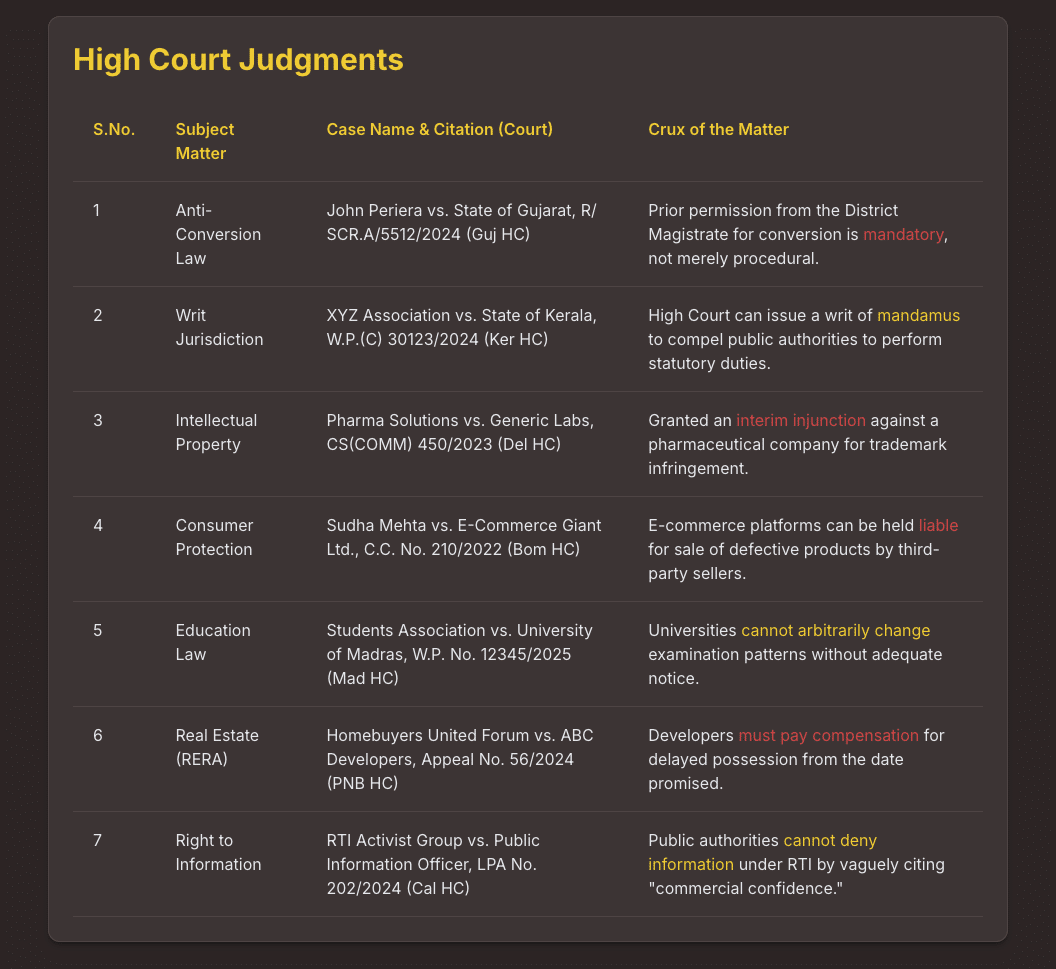
High Courts of India: Weekly Judgment Synopsis
|
Sr. No.
|
Case Subject Matter
|
Case Name and Citation (Court)
|
Main Gist of the Judgment
|
|
1.
|
Personality Rights / Intellectual Property
|
Aishwarya Rai Bachchan v. X & Ors. (Delhi HC)
|
Granted an ex-parte injunction protecting the actor’s personality and publicity rights, restraining the misuse of her name, image, and likeness. The Court held that such unauthorized use violates the right to privacy and dignity, especially in the context of AI and deepfakes.14
|
|
2.
|
Criminal Law / Misuse of Section 498A IPC
|
** (Gujarat HC)
|
Quashed criminal proceedings under Section 498A IPC (dowry harassment) against in-laws, holding that vague and general allegations without specific evidence amount to an abuse of the legal process.14
|
|
3.
|
Constitutional Law / Right to Privacy (Article 21)
|
** (Karnataka HC)
|
Quashed a lower court’s order compelling a DNA test in a partition suit, ruling that ordering such a test without an imminent and compelling need violates an individual’s fundamental right to privacy and dignity under Article 21.23
|
|
4.
|
Freedom of Speech / Film Censorship
|
[Case Name: Masoom Kaatil] (Delhi HC)
|
Upheld the Central Board of Film Certification’s (CBFC) decision to deny certification to a film, stating that content with derogatory remarks about religions and portrayal of gruesome vigilantism is incompatible with public exhibition standards in a secular society.14
|
|
5.
|
Family Law / Maintenance
|
** (Delhi HC)
|
Held that a highly qualified wife earning over ₹1 lakh per month is still entitled to maintenance if her income is insufficient to maintain the standard of living enjoyed during the marriage, especially when there is a stark disparity with the husband’s income.14
|
|
6.
|
Constitutional Law / Right to Dignity (Article 21)
|
Kanchan Patil (Mirasi) Samaj v. State (Rajasthan HC)
|
Held that the right to dignity under Article 21 extends beyond life and includes the right to a dignified burial or cremation. The Court directed the State to formulate a common policy for post-death rituals for all communities.23
|
|
7.
|
Service Law / War Injury Pension
|
Union of India v. X (Punjab & Haryana HC)
|
Dismissed the Centre’s petition challenging an Armed Forces Tribunal order granting war injury pension to a 1971 Indo-Pak war veteran. The Court criticized the government for raising objections over delay instead of proactively granting the benefit to a soldier who fought for the country.23
|
|
8.
|
Public Health / Student Suicides
|
** (Delhi HC)
|
Expressed deep concern over the rising number of student suicides and emphasized the urgent need for a functional and effective anti-ragging and mental health helpline in educational institutions.15
|
|
9.
|
Administrative Law / BSF Act
|
** (Delhi HC)
|
Upheld the jurisdiction of the Border Security Force (BSF) court to try cases under the Protection of Children from Sexual Offences (POCSO) Act, reinforcing the authority of internal military justice systems.18
|
|
10.
|
Trademark Law
|
Wow Momo Foods Pvt. Ltd. v. Wow Burger (Delhi HC)
|
Refused to grant an interim injunction in a trademark infringement suit, holding that the common and laudatory word “WOW” cannot be monopolized by a single entity in the food industry.19
|
|
11.
|
Professional Ethics / Attorney-Client Privilege
|
Puneet Batra v. Union of India, W.P.(C) – 11021/2025 (Delhi HC)
|
Ruled that GST officials cannot search or access an advocate’s computer without their presence and consent, as it could lead to a serious breach of confidentiality and attorney-client privilege.22
|
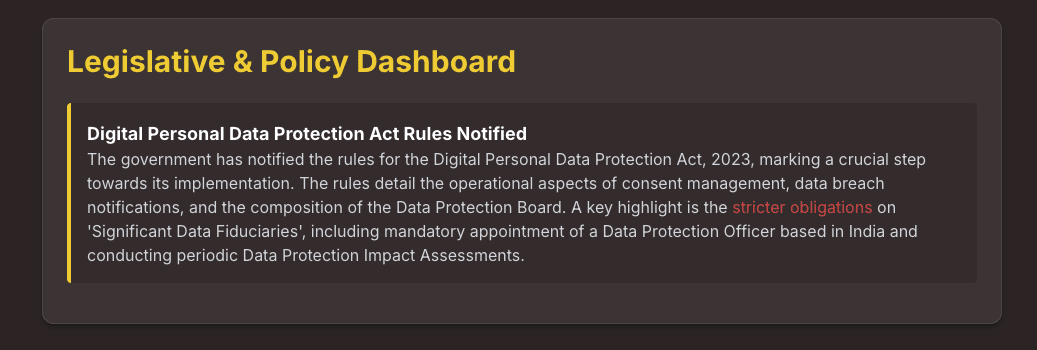
Legislative and Policy Developments
A New Direct Tax Regime: The Income Tax Act, 2025
-
Introduction of ‘Tax Year’: In a significant move to enhance clarity, the Act replaces the often-confusing dual concepts of ‘Previous Year’ and ‘Assessment Year’ with a single, unified ‘Tax Year’. This simplification is expected to reduce ambiguity and make compliance more intuitive for the average taxpayer.26
-
Structural Simplification and Consolidation: The new law is structurally leaner, with fewer sections and a more logical arrangement of chapters. It incorporates helpful tables and formulae directly into the text to improve readability. Furthermore, provisions that were previously scattered, such as those related to Tax Deducted at Source (TDS), have been consolidated under a single, streamlined section to facilitate easier reference and compliance.26
-
Digital-First Framework: The Act is designed for a digital-first era, formally enabling faceless assessments and other digital compliance mechanisms. This is intended to reduce the human interface between taxpayers and tax officials, thereby increasing transparency and minimizing opportunities for corruption.26
‘GST 2.0’: India’s Indirect Tax System Restructured
-
5%: For essential goods and services.
-
18%: A standard rate for most other goods and services.
-
40%: A new, higher rate for designated sin and luxury items.
State Legislative Action: The Rajasthan Anti-Conversion Bill
International Legal Developments
This week, significant legal and policy shifts occurred across major global jurisdictions, from landmark court rulings on data privacy in the European Union to new immigration legislation in Australia and high-stakes trade disputes involving the United States. These developments reflect evolving approaches to fundamental rights, economic regulation, and national security in an interconnected world.
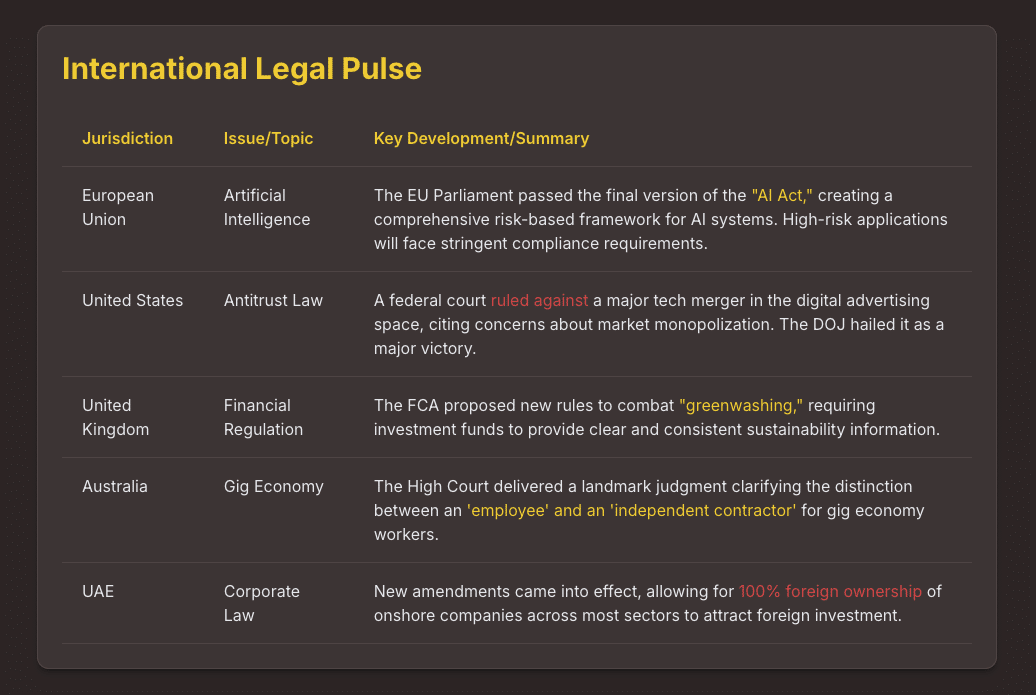
Table 2: Key International Legal Issues (September 8-14, 2025)
| Sr. No. | Jurisdiction | Legal Issue | Summary of Development |
| 1. | United States | Immigration Enforcement / Constitutional Law | The U.S. Supreme Court granted a stay on a lower court’s order that had restricted federal immigration agents in Los Angeles from stopping individuals based solely on factors like race, language, or occupation. The 6-3 decision allows agents to resume “roving patrols” using these factors, sparking intense debate over racial profiling and Fourth Amendment rights.22 |
| 2. | European Union | Data Privacy / International Data Transfers | The EU’s General Court dismissed a legal challenge against the EU-U.S. Data Privacy Framework (DPF). The judgment confirmed that the U.S. ensures an adequate level of protection for personal data transferred from the EU, temporarily securing a key mechanism for transatlantic data flows for over 3,400 U.S. companies.27 |
| 3. | United Kingdom | Tax Law / Corporate Law | The UK Supreme Court delivered its judgment in The Prudential Assurance Company Ltd v HMRC. The case addressed whether VAT is chargeable on an intra-group supply of services when the supplier has left the VAT group by the time the invoice is issued and payment is made, clarifying a key aspect of VAT law for corporate groups.30 |
| 4. | Australia | Immigration and Deportation Law | The Australian Parliament passed the Home Affairs Legislation Amendment (2025 Measures No. 1) Bill 2025. The controversial “Anti-Fairness Bill” removes procedural fairness requirements to expedite the deportation of noncitizens, including those who may face harm, raising significant human rights concerns.32 |
| 5. | New Zealand | Financial Regulation / AML | The government introduced the Anti-Money Laundering and Countering Financing of Terrorism (AML/CFT) Amendment Bill. The bill aims to streamline regulation by proposing a single supervisor for AML/CFT compliance and updating rules on customer due diligence and suspicious activity reporting.34 |
| 6. | International | International Law / State Property | The International Court of Justice (ICJ) rejected Equatorial Guinea’s request for provisional measures against France. The case concerned France’s confiscation of property in criminal proceedings, and the ruling addressed the limits of interim protection in disputes between sovereign states.35 |
#WeeklyLegalNews #WeeklyLegalSummary #LegalUpdate #LawRoundupIndia #SupremeCourtOfIndia #HighCourtJudgments #IndianJudiciary #LegalNewsIndia #InternetShutdown #ConstitutionalLaw #FundamentalRights #FreedomOfSpeech #JudicialReview #DPDPAct #DataPrivacy #IndianLaw #InternationalLaw #GlobalLegalNews #PatrasLawChambers #LegalInsights
Works cited
-
SC transfers all petitions challenging online gaming law to itself, accessed on September 15, 2025, https://m.economictimes.com/tech/technology/sc-transfers-all-petitions-challenging-online-gaming-law-to-itself/articleshow/123762964.cms
-
Supreme Court transfers online gaming law challenges from high courts to itself, accessed on September 15, 2025, https://www.tribuneindia.com/news/india/supreme-court-transfers-online-gaming-law-challenges-from-high-courts-to-itself/
-
Cutting off online gaming with the scissors of prohibition – The Hindu, accessed on September 15, 2025, https://www.thehindu.com/opinion/op-ed/cutting-off-online-gaming-with-the-scissors-of-prohibition/article70049718.ece
-
A23 Challenges India’s Online Gaming Ban: Legal Battle Underway …, accessed on September 15, 2025, https://legal.economictimes.indiatimes.com/news/law-policy/exclusive-legal-brief-inside-a23s-petition-challenging-indias-online-gaming-ban/123561529
-
Online Gaming Act 2025: No longer a skill issue – Bar and Bench, accessed on September 15, 2025, https://www.barandbench.com/view-point/online-gaming-act-2025-no-longer-a-skill-issue
-
Online Gaming Act, 2025: Game over for RMG? | India | Law.asia, accessed on September 15, 2025, https://law.asia/online-gaming-ban-india/
-
Supreme Court transfers to itself pleas challenging Online Gaming Act – The Hindu, accessed on September 15, 2025, https://www.thehindu.com/news/national/supreme-court-transfers-to-itself-pleas-challenging-online-gaming-act/article70027141.ece
-
SC agrees to hear Centre’s plea to transfer online gaming law challenges from HC, accessed on September 15, 2025, https://www.hindustantimes.com/india-news/sc-agrees-to-hear-centre-s-plea-to-transfer-online-gaming-law-challenges-from-hc-101756970428444.html
-
Supreme Court to hear challenges to India’s online gaming ban, accessed on September 15, 2025, https://focusgn.com/asia-pacific/supreme-court-to-hear-challenges-to-indias-online-gaming-ban
-
Supreme Court to adjudicate constitutionality of Online Gaming Act, transfers all High Court cases to itself – India Legal, accessed on September 15, 2025, https://indialegallive.com/constitutional-law-news/courts-news/supreme-court-to-adjudicate-constitutionality-of-online-gaming-act-transfers-all-high-court-cases-to-itself/
-
Supreme Court Weekly Round Up [September 8-14, 2025] – LawBeat, accessed on September 15, 2025, https://lawbeat.in/top-stories/supreme-court-weekly-round-up-september-8-14-2025-1518477
-
SC to hear plea on transfer of all online gaming cases | Latest News India – Hindustan Times, accessed on September 15, 2025, https://www.hindustantimes.com/india-news/sc-to-hear-plea-on-transfer-of-all-online-gaming-cases-101757013760025.html
-
Supreme Court Centralizes Legal Challenges to Online Gaming Ban – ScanX, accessed on September 15, 2025, https://scanx.trade/stock-market-news/stocks/supreme-court-centralizes-legal-challenges-to-online-gaming-ban/18870854
-
Law & Justice This Week: Big Wins, Court Orders & Legal Milestones [September 8- 14, 2025] – LawBeat, accessed on September 15, 2025, https://lawbeat.in/amp/legal-spotlight/law-justice-this-week-big-wins-court-orders-legal-milestones-september-8-14-2025-1518476
-
Law & Justice This Week: Big Wins, Court Orders & Legal Milestones [September 8- 14, 2025] – LawBeat, accessed on September 15, 2025, https://lawbeat.in/legal-spotlight/law-justice-this-week-big-wins-court-orders-legal-milestones-september-8-14-2025-1518476
-
SCC Online® | The Surest Way To Legal Research, accessed on September 15, 2025, https://www.scconline.com/
-
Top news of the day: At least 14 killed in Nepal protests triggered by social media ban; Aadhaar should be treated as valid proof for SIR exercise, says Supreme Court, and more – The Hindu, accessed on September 15, 2025, https://www.thehindu.com/news/top-news-from-the-hindu-8-september-2025/article70025899.ece
-
India Legal: Legal News, Supreme Court Updates, HCs Updates, accessed on September 15, 2025, https://indialegallive.com/
-
Legal News India | Supreme Court of India, High Court, Law Firm …, accessed on September 15, 2025, https://www.barandbench.com/
-
Top Ten Legal Headlines of the Week-08 Sep 2025 – Law Colloquy, accessed on September 15, 2025, https://lawcolloquy.com/publications/blog/top-ten-legal-headlines-of-the-week-08-sep-2025
-
Supreme Court of India | India, accessed on September 15, 2025, https://www.sci.gov.in/
-
Delhi High Court Weekly Round Up [September 8- 14, 2025] – LawBeat, accessed on September 15, 2025, https://lawbeat.in/legal-spotlight/delhi-high-court-weekly-round-up-september-8-14-2025-1518478
-
High Court Weekly Roundup – September 2025 [Week 1]| Umar Khalid’s Bail Denial; Rahul Gandhi’s Citizenship; Maratha Reservation Protest – SCC Online, accessed on September 15, 2025, https://www.scconline.com/blog/post/2025/09/07/high-court-cases-from-september-2025-weekly-roundup-on-umar-khalid-rahul-gandhi-maratha-reservation/
-
REPORTABLE IN THE SUPREME COURT OF INDIA CRIMINAL APPELLATE JURISDICTION CRIMINAL APPEAL NO(S). OF 2025 (Arising out of SLP, accessed on September 15, 2025, https://api.sci.gov.in/supremecourt/2024/18489/18489_2024_3_1502_62660_Judgement_25-Jul-2025.pdf
-
Latest Judgments | Welcome To Delhi High Court, accessed on September 15, 2025, https://delhihighcourt.nic.in/web/judgement/fetch-data
-
Press Note Details: Press Information Bureau, accessed on September 15, 2025, https://www.pib.gov.in/PressNoteDetails.aspx?NoteId=155137&ModuleId=3
-
India Adopting Organised Tax Structure- September 2025 – Legallands, accessed on September 15, 2025, https://legallands.com/india-adopting-organised-tax-structure-september-2025-paves-the-way-for-tax-reforms-2/
-
New GST Rates 2025: GST 2.0 Reform Bill Explained – Ujjivan Small Finance Bank, accessed on September 15, 2025, https://www.ujjivansfb.in/banking-blogs/personal-finance/new-gst-rates-gst-2-0-reform-billest-compliance
-
Anti-conversion bill passed, Raj recorded no love jihad case ever, accessed on September 15, 2025, https://timesofindia.indiatimes.com/city/jaipur/anti-conversion-bill-passed-raj-recorded-no-love-jihad-case-ever/articleshow/123873392.cms