- The Supreme Court directed creation of Special Appellate Tribunals to hear appeals against decisions in the SIR process.
- Tribunal benches to comprise former Chief Justices and former High Court judges; Chief Justice of the Calcutta High Court nominates members.
- Serving District and Civil Judges adjudicate initial SIR claims; tribunal judges will be separate retired senior judges for appeals.
- The Election Commission of India must notify tribunals, bear expenses, create login IDs, and resolve online portal technical issues immediately.
- Invoking Article 142, supplementary lists are deemed published on February 28, 2026; cleared individuals remain eligible to vote.
- Judges must issue speaking orders stating reasons for exclusion; affected persons must receive immediate communication to pursue tribunal appeals.
- Massive scale: nearly 60 to 80 lakh claims pending; over 10.16 lakh objections decided by March 9, 2026.
All you need to know about the Supreme Court order, an update regarding SIR hearing in tribunals, and the updated SIR process
Creditor and contributor of this article:
Patra’s Law Chambers:
About Us:
Patra’s Law Chambers is a law firm with offices in Kolkata & Delhi, offering comprehensive legal services across various domains. Established in 2020 by Advocate Sudip Patra (Advocate, Supreme Court of India & Calcutta High Court) an alumnus of the Prestigious Rajiv Gandhi School of Intellectual Property Law, IIT Kharagpur ,with Post Graduate diploma in Business Law from IIM Calcutta, the firm specializes in Civil, Criminal, Writs,High Court Matters, Trademark, Copyright, Company, Tax, Banking, Property disputes, Service law, Family law, and Supreme Court matters.You can know more about us in here
Kolkata Office:
NICCO HOUSE, 6th Floor, 2, Hare Street, Kolkata-700001 (Near Calcutta High Court)
Delhi Office:
House no: 4455/5, First Floor, Ward No. XV, Gali Shahid
Bhagat Singh, Main Bazar Road, Paharganj, New Delhi-110055
Website: www.patraslawchambers.com
Email: [email protected]
Phone: +91 890 222 4444/ +91 7003 715 325
The integrity of the democratic process in India is fundamentally predicated upon the accuracy and transparency of the electoral roll. In the state of West Bengal, the 2025-2026 Special Intensive Revision (SIR) has emerged as a landmark case study in the intersection of constitutional law, administrative governance, and judicial intervention. Following a series of hearings that culminated in significant directives on March 10, 2026, the Supreme Court of India has fundamentally restructured the mechanisms of voter scrutiny and appellate review. This transition from a purely administrative exercise to a judicially monitored operation underscores a deep-seated institutional friction between the Election Commission of India (ECI) and the Government of West Bengal, necessitating the invocation of the Court’s extraordinary powers under Article 142 of the Constitution.1
The Genesis of Judicial Scrutiny and the Scrutiny Mechanism
The shift toward judicial scrutiny in West Bengal was the result of a protracted “trust deficit” between two constitutional functionaries: the State Government and the ECI.3 The core of the dispute originated in the Election Commission’s requirement for Group ‘A’ officers, such as Sub-Divisional Officers (SDO) or Sub-Divisional Magistrates (SDM), to perform the quasi-judicial duties of Electoral Registration Officers (EROs).1 The ECI contended that the State of West Bengal had failed to provide officers of this rank, instead deploying personnel from Group ‘B’ and ‘C’ cadres. Given that the revision process involves the sensitive scrutiny of citizenship and identity documents, the ECI argued that entrusting this task to lower-level staff was untenable.1
In response, the Supreme Court took the exceptional step of deploying the judiciary to oversee the revision process. This intervention was designed to impart a “degree of seriousness” and impartiality to an exercise that had become mired in controversy.1 The Court’s rationale was that EROs perform quasi-judicial functions and are obligated under law to pass “speaking orders” that clearly articulate the reasons for accepting or rejecting a voter’s claim.3 Such a task requires a “partially judicially trained mind” to navigate the complexities of documentary evidence.3
The Scale of Deployment and Current Scrutiny Standards
The current scrutiny is being carried out by a massive force of serving judicial officers. The scale of the task is reflected in the nearly 60 lakh to 80 lakh claims and objections that were pending adjudication.5
| Category of Judicial Officer | Source Jurisdiction | Total Estimated Deployment |
| Primary Judicial Officers | West Bengal | 500+ (District and Civil Judges) 4 |
| Requisitioned Officers | Odisha and Jharkhand | 200+ Judicial Officers 2 |
| Specialized Civil Judges | West Bengal | Senior/Junior Div with 3+ years experience 7 |
| Support Staff | Technical Mobilization | 700+ Login IDs created for officers 2 |
As of March 9, 2026, it was reported that over 10.16 lakh objections had already been decided through this judicial mechanism.4
The Supreme Court Directive: Formation of the Special Appellate Tribunal
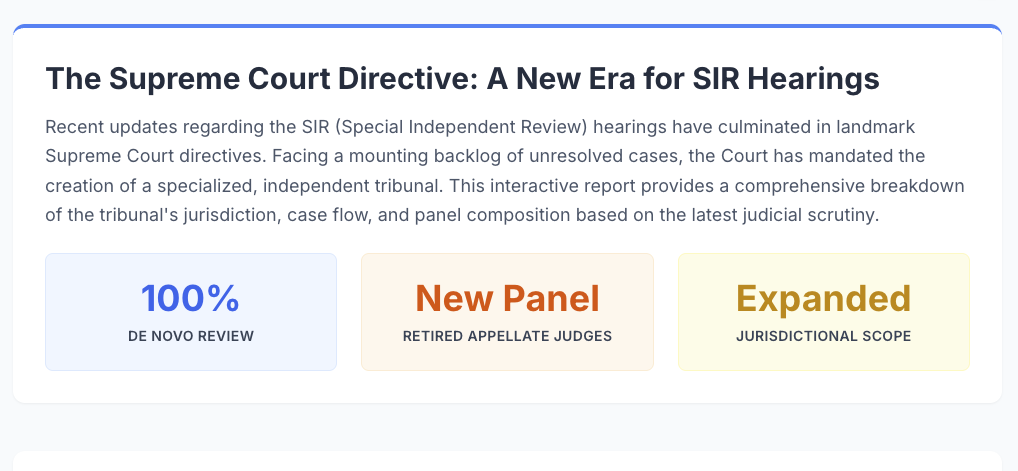
A pivotal development in the March 10, 2026, hearing was the Supreme Court’s directive to establish specialized appellate tribunals. This order was a response to concerns that there was no independent mechanism for citizens to appeal the decisions made by the judicial officers acting as EROs.7 The Court reasoned that since the primary adjudication was being handled by the judiciary, any appeal against those decisions should not fall back into the hands of executive or administrative officers of the Election Commission.7
Structure and Composition of the Tribunal
The architecture of these tribunals is designed to ensure a high level of judicial expertise and independence:
- Presiding Officers: The tribunals will comprise former Chief Justices and former High Court judges, primarily from the Calcutta High Court or neighboring states.7
- Appointment Process: The Chief Justice of the Calcutta High Court has the authority to nominate the members and determine the number of benches required.7
- Funding: The ECI is mandated to notify the formation of these tribunals and bear all related expenses, including the honorarium for the retired judges.11
Jurisdiction: Kinds of Cases to be Heard
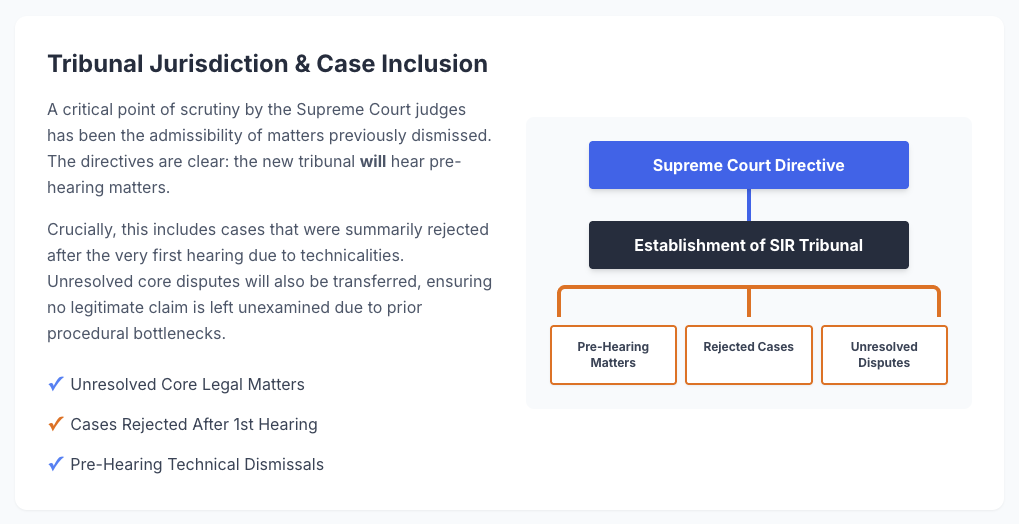
The tribunal serves as the designated forum for hearing appeals against the rejections made during the SIR process. This includes several distinct categories of matters:
- Rejected Claims for Inclusion: Appeals by individuals whose applications for inclusion in the voter list (Form 6) were rejected by judicial officers during the primary scrutiny phase.7
- Exclusion Appeals: Cases where an existing voter was deleted from the roll following an objection (Form 7) or a suo motu inquiry.7
- Pre-hearing and Procedural Matters: The tribunal will handle matters where cases were rejected on technical grounds—what is often referred to as matters “after the first hearing when cases have been rejected.”7 The Court directed that all “ancillary issues” related to these rejections would be determined by the judicial framework rather than administrative staff.3
Clarification of Judicial Roles: Serving Officers vs. Tribunal Judges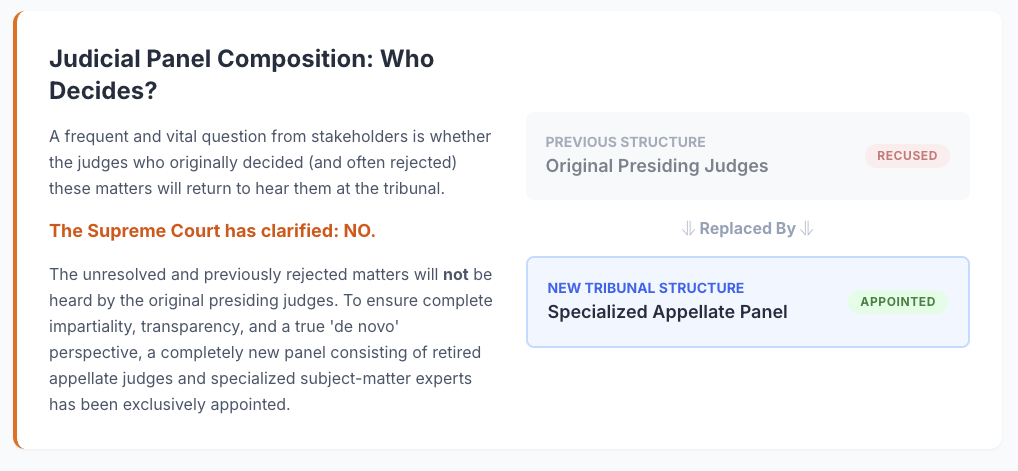
A critical point of clarification from the Supreme Court involves the distinction between the judges currently deciding “unresolved matters” and those who will staff the tribunal.
- Serving Judicial Officers (The Ground Force): These are the 700+ serving District and Civil Judges from West Bengal, Odisha, and Jharkhand.2 They are the ones currently on the ground adjudicating the initial 60 lakh+ pending claims and unresolved matters. They function as the primary EROs/AEROs and make the first-instance decisions.3
- Tribunal Judges (The Appellate Force): The judges presiding over the Appellate Tribunals are a separate group of retired and senior judicial figures—specifically former Chief Justices and former High Court Judges.7
The judges currently deciding the unresolved matters in the districts will NOT be the same judges hearing the appeals in the tribunal. This hierarchical separation is essential to ensure that an independent senior body reviews the quasi-judicial orders passed by the serving lower and district judiciary.7
Technical Challenges and Operational Mandates
The March 10 hearing also addressed logistical hurdles. The Court issued several specific directions to the ECI to ensure the smooth continuation of the SIR:
- Login Access: The ECI was directed to create new login IDs promptly for judicial officers as required, particularly in sensitive districts where mobilization is ongoing.2
- Portal Stability: The ECI must resolve technical issues affecting the online verification portal, which had been causing disruptions in the adjudication process.2
- No New Hurdles: The ECI is prohibited from introducing any new “mandatory requirements” that could disrupt the process without the prior approval of the Chief Justice of the Calcutta High Court.7
The Publication of Supplementary Lists
The Supreme Court emphasized that the formal publication of the voter list on February 28, 2026, does not signal the end of the process for those under scrutiny.
- Deeming Provision: Invoking Article 142, the Court directed that all supplementary lists generated from the judicial adjudication would be “deemed” to have been published on February 28, 2026.11
- Voting Rights: This ensures that voters cleared by either the judicial officers or the subsequent appellate tribunal are legally recognized and eligible to vote in upcoming elections.11
- Immediate Communication: The Court added that the reasons for exclusion (the “speaking order”) must be immediately communicated to affected individuals to facilitate their right to appeal to the new tribunal without delay.11
Conclusion: A Multi-Tiered Judicial Shield
The West Bengal SIR of 2026 represents a shift from administrative discretion to a multi-tiered judicial shield for voter rights. By involving serving judges for initial scrutiny and retired High Court judges for the Appellate Tribunals, the Supreme Court has created an independent pathway for “unresolved matters” and “rejected cases” to be heard fairly. This separation of personnel ensures that those who decide the initial facts are not the ones who hear the appeals, thereby restoring institutional trust in the electoral roll revision process.7
Works cited
- West Bengal SIR test: reading the Supreme Court’s order – The Hindu, accessed on March 12, 2026, https://www.thehindu.com/news/national/west-bengal/west-bengal-sir-test-reading-the-supreme-courts-order/article70722401.ece
- West Bengal SIR : Live Updates From Supreme Court Hearing, accessed on March 12, 2026, https://www.livelaw.in/top-stories/west-bengal-sir-live-updates-from-supreme-court-hearing-525795
- West Bengal SIR | SC turns to Calcutta HC for adjudication of LD …, accessed on March 12, 2026, https://www.scobserver.in/reports/west-bengal-sir-sc-turns-to-calcutta-hc-for-adjudication-of-ld-claims/
- West Bengal SIR hearing Updates: Chief Justice of Calcutta HC writes to SC, says over 10 lakh objections decided, accessed on March 12, 2026, https://www.thehindu.com/news/national/west-bengal/west-bengal-sir-hearing-supreme-court-live-updates-march-10-2026/article70725581.ece
- SIR in W.B.: Supreme Court to consider plea against deletion of electors from electoral rolls, accessed on March 12, 2026, https://www.thehindu.com/news/national/sir-in-wb-supreme-court-to-consider-plea-against-deletion-of-electors-from-electoral-rolls/article70721548.ece
- SC tightens oversight on West Bengal SIR | Daily Pioneer, accessed on March 12, 2026, https://dailypioneer.com/news/sc-tightens-oversight-on-west-bengal-sir
- West Bengal SIR: Supreme Court Directs To Form Appellate Tribunals Of Ex-HC Judges For Appeals Against Exclusions – Live Law, accessed on March 12, 2026, https://www.livelaw.in/top-stories/west-bengal-sir-supreme-court-directs-to-form-appellate-tribunals-of-ex-hc-judges-for-appeals-against-exclusions-525804
- SC directs ECI to form a body to deal with appeals against judicial officers’ decisions in SIR process in West Bengal – Newsonair, accessed on March 12, 2026, https://www.newsonair.gov.in/sc-directs-eci-west-bengal-govt-to-support-judicial-officers-in-sir/
- SC directs tribunals to hear appeals in West Bengal SIR exclusions, accessed on March 12, 2026, https://m.economictimes.com/news/elections/assembly-elections/west-bengal/sc-directs-tribunals-to-hear-appeals-in-west-bengal-sir-exclusions/articleshow/129412645.cms
- SC sets up judicial tribunals to hear Bengal SIR appeals, accessed on March 12, 2026, https://timesofindia.indiatimes.com/india/sc-sets-up-judicial-tribunals-to-hear-bengal-sir-appeals/articleshow/129426679.cms
- Form special tribunals to hear appeals of people left out of Bengal SIR, says Supreme Court, accessed on March 12, 2026, https://www.thehindu.com/news/national/west-bengal/supreme-court-asks-for-special-tribunals-to-hear-appeals-of-voters-excluded-in-west-bengal-sir/article70727502.ece
- West Bengal SIR | SC directs creation of appellate body as verification exercise continues, accessed on March 12, 2026, https://www.scobserver.in/reports/west-bengal-sir-sc-directs-creation-of-appellate-body-as-verification-exercise-continues/
- WB SIR | SC permits deployment of Judges from Jharkhand & Odisha and WB Civil Judges for SIR claims adjudication, accessed on March 12, 2026, https://www.scconline.com/blog/post/2026/02/24/directions-on-west-bengal-sir-claims-adjudication-sc/