- Muslim personal law in India governs testamentary disposition, differing from secular inheritance laws.
- Wasiyat is a testamentary document allowing Muslims to dispose of property, bound by Islamic jurisprudence.
- A will must be made by a Muslim of sound mind and majority age to be valid under Islamic law.
- One-third limitation restricts beneficiaries to receive only one-third of the estate via will, requiring heir consent for more.
- The Supreme Court is reviewing the possibility for Muslims to opt for the Indian Succession Act over Shariat law.
- Sunni and Shia laws differ: Shia allows bequests to heirs up to one-third without consent, unlike Sunni restrictions.
- Legal challenges underline the tension between religious law and constitutional principles, impacting Muslim testamentary law.
The Law Regarding Muslim Wills (Wasiyat) in India: A Comprehensive Analysis
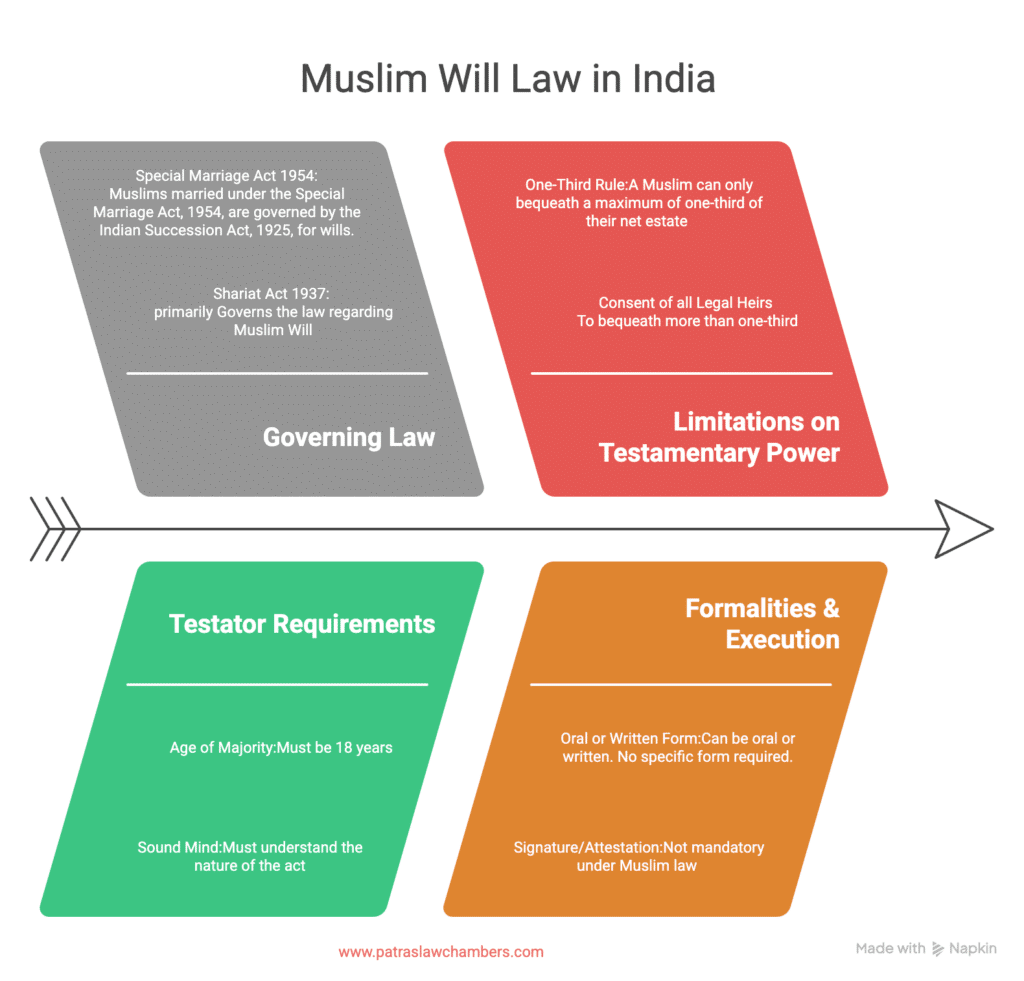 Muslim personal law governs testamentary disposition among Muslims in India, incorporating unique principles and limitations distinct from secular succession laws. This report examines the concept of Wasiyat (Muslim will), its legal framework, essential requirements, limitations, and recent judicial developments in India.
Legal Framework Governing Muslim Wills in India
The Muslim Personal Law (Shariat) Application Act, 1937 governs matters related to succession, inheritance, and testamentary disposition among Muslims in India[1][2]. This legal framework derives from traditional Islamic jurisprudence based on four primary sources: the Quran, Sunna (practices of Prophet Muhammad), Ijma (consensus of Islamic scholars), and Qiya (analogical deduction based on divine principles)[3].
Wasiyat (Muslim will) holds religious significance in Islamic tradition. As Ameer Ali defined it, a will from the Mussalman perspective is considered a divine institution since its exercise is regulated by the Quran[4]. This religious foundation explains why testamentary disposition under Islamic law follows specific rules that differ substantially from secular inheritance laws.
An important exception exists for Muslims who marry under the Special Marriage Act, 1954. In such cases, testamentary disposition is governed by the Indian Succession Act, 1925, rather than Muslim personal law[4]. This creates a pathway for Muslims to opt out of religious inheritance rules without formally renouncing their faith.
Nature and Concept of Wasiyat
A wasiyat is essentially a testamentary document through which a Muslim can dispose of property after death[5]. Like any will, it represents a legal declaration of intention regarding property disposition that takes effect posthumously[4]. However, unlike wills under secular law, Wasiyat operates within specific constraints imposed by Islamic jurisprudence.
The importance of creating a will is emphasized in Islamic tradition. A Hadith narrated by Abdullah bin Umar and recorded by Al-Bukhari states: “A Muslim who has something has no right even to pass two nights without making a will unless he has already written one”[4]. This highlights the religious duty aspect of will-making in Islam.
⚖️ Discuss Your Case/ Will Free of cost with Experienced Advocates of Kolkata High Court & Supreme Court 🇮🇳
📌 Trusted Legal Guidance. Strong Courtroom Representation. Call Now (No hidden cost, free consultation)!
📍 Kolkata Office:🏢 NICCO HOUSE, 6th Floor, 📫 2, Hare Street, Kolkata – 700001📍 (Near Calcutta High Court)
📍 Delhi Office: 🏠 House No: 4455/5, First Floor, 🗺️ Ward No. XV, Gali Shahid Bhagat Singh, 🛣️ Main Bazar Road, Paharganj,📮 New Delhi – 110055
📞 Call Us Today:📲 +91 890 222 4444 / 📲 +91 9044 04 9044
📧 Email:📨 [email protected] 🌐 Visit Our Website:🔗 www.patraslawchambers.com
🧑⚖️ Criminal Law ⚔️ | 🧾 Tax Matters 💰 | 🏛️ Civil & Company Law 📑 | 👨👩👧👦 Matrimonial & Family Matters 💔 | 🕵️♂️ Cyber & IP Law 💻 | 🚨 Bail, Anticipatory Bail & Writs 📜 | 📌 Supreme Court & High Court Practice ⚖️
Competence to Make a Valid Wasiyat
For a Wasiyat to be valid, the testator must fulfill several conditions:
Religious Identity
The testator must be a Muslim for the will to be governed by Muslim personal law[4]. Interestingly, if a Muslim makes a will and later converts to another religion before death, the will remains valid as the testator was Muslim at the time of creating the will[4]. While the testator must be Muslim, the beneficiary (legatee) can be of any religion[4].
Age and Mental Capacity
The testator must have attained the age of majority. While traditional Muslim law considers 15 years as the age of majority, in India, the Indian Majority Act, 1875 applies, setting the age at 18 years (except for matters relating to marriage, divorce, dower, and adoption)[4]. In cases where a court-appointed guardian manages a minor’s property, the age of majority increases to 21 years[4].
There are differences between Sunni and Shia schools on this matter. According to Shia law, a person as young as 10 years old can create a will, though the Patna High Court in Abdul Manan Khan vs. Mirtuza Khan And Ors. (1991) rejected this view, holding that a will declared by a minor is void[6][4].
The testator must be of sound mind. Under the Shafi School of Sunni Law, a person under inhibition due to insanity cannot make a valid will[6]. Similarly, a person not in their senses or unable to understand what they are doing (whether due to intoxication, illness, or other causes) cannot execute a valid will[6][7].
Special Considerations
Physical disabilities do not affect testamentary capacity. Persons who are deaf, dumb, or blind can make valid wills if they are of sound mind[7].
Under Shia law specifically, a will made by a person after attempting suicide is deemed invalid due to presumed mental instability[6][4]. However, the landmark case of Mazhar Hussain v. Bodha Bibi (1898) established that a will made before a suicide attempt remains valid[4][8]. This exception does not exist in Sunni law[4].
Limitations on Testamentary Powers
Muslim law imposes significant restrictions on testamentary freedom, distinguishing it from secular succession laws:
One-Third Limitation
The most fundamental restriction is that a Muslim can bequeath only up to one-third of their estate through a will after deducting debts and funeral expenses[9][4][10]. The remaining two-thirds must be distributed according to fixed Islamic inheritance principles among legal heirs[9][10].
If a testator wishes to bequeath more than one-third of their property, they must obtain consent from all legal heirs. This principle was upheld by the Madras High Court in Asma Beevi vs. M.Ameer Ali (2008)[4]. In Jeeva vs. H.H. Yakoob Ally (1928), the court held that without consent from heirs, a bequest exceeding one-third would be valid only up to the one-third limit[4].
Restrictions Regarding Heirs
Under Sunni law, a Muslim cannot bequeath any portion of their property to legal heirs without the consent of other heirs, even within the one-third limit[4]. This restriction aims to maintain the balance of inheritance shares prescribed by Islamic law and prevent favoritism among heirs.
The Kerala High Court in Mohammed Haneefa vs. Salim (2011) clarified that in cases involving multiple heirs, consent by one heir cannot be deemed consent by all others[4]. For consent to be valid, all consenting persons must be sane, major, and Muslim[4].
Consent need not be explicitly stated but can be inferred from unambiguous conduct. In Daulatram vs. Abdul Kayam (1902), when the testator’s sons witnessed a will bequeathing property to a stranger and did not object to the legatee taking possession afterward, the court deemed they had implicitly consented[4].
Differences Between Sunni and Shia Laws
Shia law takes a more permissive approach to testamentary disposition. Under Shia (Ithna-Ashari) law, a will can be made in favor of any person—including legal heirs—up to one-third of the estate without requiring consent from other heirs[4]. However, for bequests exceeding one-third, heir consent remains necessary.
Another distinction is that under Shia law, heir consent is valid only if given during the testator’s lifetime, whereas under both schools, once given, consent cannot be rescinded[4].
Additionally, Shia law employs a “preferential distribution” method when bequests exceed one-third and heirs refuse consent. In this system, legatees receive shares based on their order of mention in the will until the one-third limit is exhausted[4].
Formalities and Construction of a Wasiyat
Form and Execution
Muslim law is remarkably flexible regarding the formalities of will creation. A Muslim can make a will orally or in writing[6]. No specific formalities are required—the will need not be signed by the testator nor attested by witnesses[6]. This contrasts sharply with the formal requirements of the Indian Succession Act.
However, practical considerations should not be overlooked. The burden of proving an oral will falls on the person asserting its existence if contested by other heirs[4]. Therefore, a written will specifying clear instructions is highly advisable for evidentiary purposes[4].
Interpretation and Construction
The primary principle governing will interpretation is the testator’s intention[4]. The will should be constructed according to customary rules of Muslim law and use non-technical, unambiguous language[4]. When a will is ambiguous or vague, Tyabji suggests that interpretation may be left to the discretion of legal heirs[4].
Clarity is essential, especially when designating specific bequests. For instance, if a testator bequeaths multiple properties to multiple beneficiaries without specifying which property goes to whom, the content becomes ambiguous, leaving the heirs to mutually agree upon division[4].
Recent Legal Developments
The intersection of religious personal law and secular constitutional principles has led to significant legal challenges regarding Muslim testamentary laws in India:
Supreme Court Challenges to Testamentary Restrictions
The Supreme Court is currently examining whether Muslims can choose to be governed by the Indian Succession Act instead of Shariat law without renouncing their faith[10][11][12]. This question has arisen through multiple petitions:
- Naushad K.K. from Kerala’s Thrissur district has petitioned to be governed by secular succession law while remaining Muslim[10][11][12].
- Safiya P.M., representing “Ex-Muslims of Kerala,” argues that Shariat law’s restriction on bequeathing more than one-third of property is discriminatory, particularly toward women[11][13]. She contends that her father cannot bequeath more than one-third of his property to her, with the remaining two-thirds going to her brother (who has Down’s syndrome)[11].
- A petition filed in 2016 by ‘Quran Sunnat Society’ raises similar concerns[10][11][12].
These petitions argue that compulsory application of religious inheritance rules violates constitutional provisions, particularly Article 14 (equality before law), creates arbitrary classification between Muslims married under different laws, and infringes upon personal liberty and human dignity[10].
The Supreme Court’s decision in these cases could potentially reshape the landscape of Muslim testamentary law in India, balancing religious freedom with constitutional rights.
Comparison with Hindu Wills
The differences between Muslim and Hindu testamentary laws highlight the distinct approaches to inheritance in Indian legal pluralism:
- Testamentary Freedom: Under Hindu law (governed by the Hindu Succession Act, 1956), a person has complete testamentary freedom to dispose of their property as they wish[14]. In contrast, Muslims can bequeath only one-third of their property without heir consent[6][14].
- Restrictions on Heirs: Muslim law (particularly Sunni law) restricts bequests to legal heirs without the consent of other heirs[6][4]. Hindu law imposes no such restrictions.
- Legal Framework: Hindus, Sikhs, Jains, and Buddhists are governed by the Indian Succession Act, 1925, and the Hindu Succession Act, 1956, while Muslims follow the Muslim Personal Law (Shariat) Application Act, 1937[1][14].
- Formality Requirements: Hindu wills typically require more formal execution, including signature by the testator and attestation by witnesses, whereas Muslim wills can be oral and need no attestation[6][14].
Conclusion
The law regarding Muslim wills in India represents a complex interaction between religious principles and legal frameworks. The restrictions on testamentary power—limiting bequests to one-third of the estate and prohibiting bequests to heirs without consent—reflect Islamic emphasis on fixed inheritance shares and family justice.
Recent challenges in the Supreme Court highlight the tension between religious personal law and constitutional principles of equality and personal autonomy. The court’s forthcoming decisions may significantly impact Muslim testamentary law in India, potentially creating pathways for Muslims to exercise greater testamentary freedom while maintaining their religious identity.
For Muslims creating wills in India, understanding these distinctive features and limitations is essential for effective estate planning. While the law allows flexibility in will creation, the substantive limitations on testamentary power require careful navigation to ensure valid disposition of property according to both personal wishes and legal requirements.
1. #MuslimWillLaw 2. #Wasiyat 3. #MuslimPersonalLaw 4. #ShariaLawIndia 5. #IndianMuslimLaw 6. #InheritanceLawIndia 7. #TestamentaryLaw 8. #MuslimInheritance 9. #ShariatAct1937 10. #EstatePlanningIndia 11. #PropertyLawIndia 12. #IndianMuslims[1] 13. #IslamicLawIndia 14. #HeirshipLaw 15. #SunniLaw 16. #ShiaLaw 17. #OneThirdRule 18. #WillAndTestamentIndia 19. #IndianLegalSystem 20. #ReligiousLawIndia
- https://en.wikipedia.org/wiki/Muslim_personal_law
- https://www.indiacode.nic.in/bitstream/123456789/2303/1/A1937-26.pdf
- https://www.legalshiksha.com/post/inheritance-and-succession-under-muslim-laws
- https://blog.ipleaders.in/islamic-law-will/
- https://phenixbaylegal.com/blog/a-comprehensive-guide-to-wasiyat-will-under-muslim-law-in-india-legal-framework-key-features-and-important-case-laws/270
- https://lc2.du.ac.in/DATA/Will.pdf
- https://esahayak.io/blog/who-can-make-a-wasiyat
- https://blog.ipleaders.in/mazhar-husen-vs-bodha-bibi-1898/
- https://lawcrust.com/muslim-inheritance-law-in-india/
- https://www.hindustantimes.com/india-news/can-muslims-be-governed-by-succession-law-instead-of-shariat-sc-to-examine-101744896530853.html
- https://www.newindianexpress.com/nation/2025/Apr/17/sc-to-examine-whether-muslims-can-be-governed-by-succession-law-instead-of-shariat-2
- https://indianexpress.com/article/india/sc-muslims-shariat-law-succession-law-9949160/
- https://timesofindia.indiatimes.com/india/can-secular-indian-succession-act-apply-to-non-believer-muslim/articleshow/117671687.cms
- https://www.ezylegal.in/blogs/hindu-will-vs-muslim-will-what-sets-them-apart