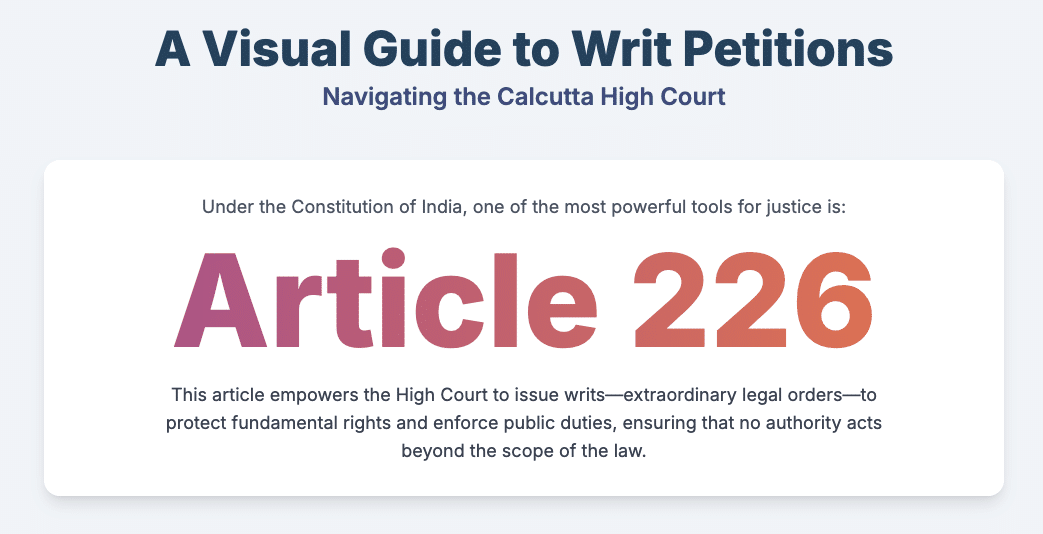
- Article 226 empowers the Calcutta High Court to issue writs, enhancing citizens' access to judicial remedies.
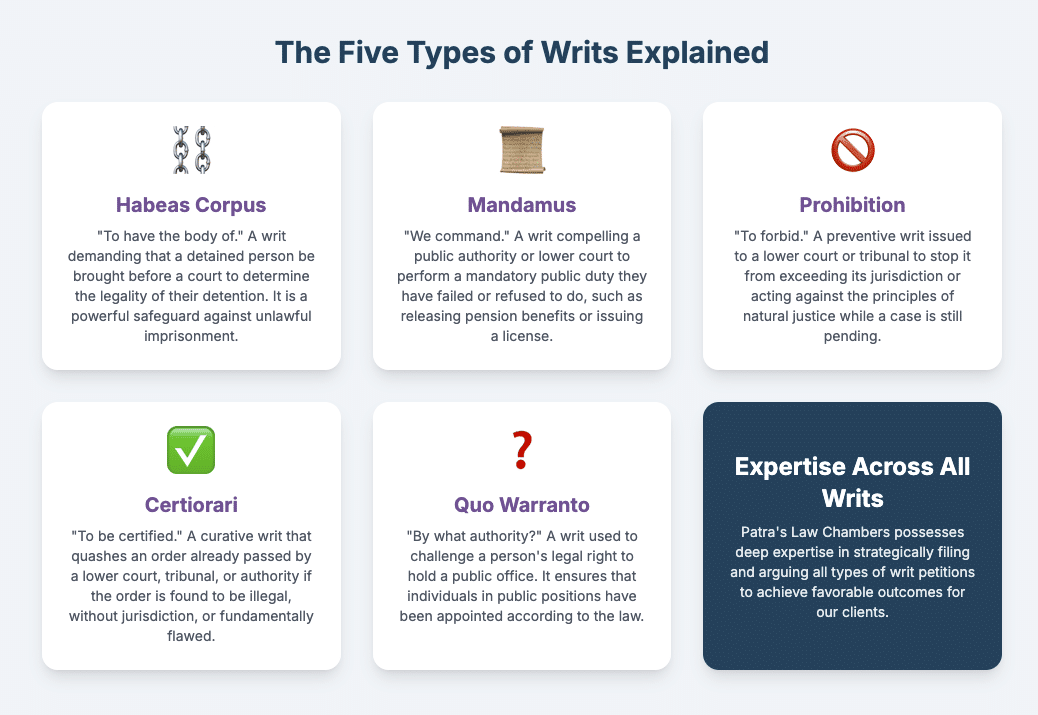
- Five primary writs: Mandamus, Certiorari, Prohibition, Quo Warranto, and Habeas Corpus safeguard rights against state abuses.
- A clear jurisdictional distinction exists between the Original and Appellate Sides of the Calcutta High Court, influencing filing procedures.
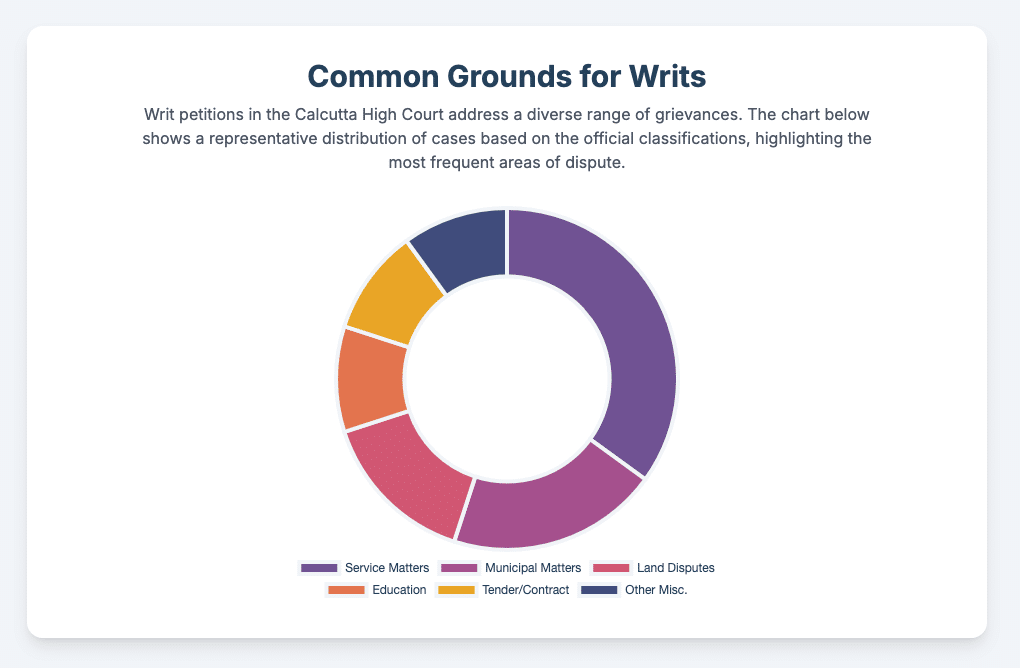
- Pre-filing diligence includes establishing cause of action, identifying parties, and gathering necessary documents to support the petition.
- All writ petitions must adhere strictly to the High Court's rules to be accepted and heard by the court.
- E-filing streamlines litigation processes, but compliance with Calcutta High Court rules remains mandatory.
- Staying updated with recent amendments and practice directions is crucial for legal practitioners.
A Masterclass in Justice: Your Definitive Guide to Filing a Writ Petition in the Calcutta High Court
-
Creditor and contributor of this article:
Patra’s Law Chambers:
About Us:
Patra’s Law Chambers is a law firm with offices in Kolkata & Delhi, offering comprehensive legal services across various domains. Established in 2020 by Advocate Sudip Patra (Advocate, Supreme Court of India & Calcutta High Court) an alumnus of the Prestigious Rajiv Gandhi School of Intellectual Property Law, IIT Kharagpur ,with Post Graduate diploma in Business Law from IIM Calcutta, the firm specializes in Civil, Criminal, Writs,High Court Matters, Trademark, Copyright, Company, Tax, Banking, Property disputes, Service law, Family law, and Supreme Court matters.You can know more about us in here
Kolkata Office:
NICCO HOUSE, 6th Floor, 2, Hare Street, Kolkata-700001 (Near Calcutta High Court)
Delhi Office:
House no: 4455/5, First Floor, Ward No. XV, Gali Shahid
Bhagat Singh, Main Bazar Road, Paharganj, New Delhi-110055
Website: www.patraslawchambers.com
Email: [email protected]
Phone: +91 890 222 4444/ +91 7003 715 325
An exhaustive, expert-led analysis of the procedure for filing writs of Mandamus, Certiorari, Prohibition, Quo Warranto, and Habeas Corpus in the Calcutta High Court. This guide covers the latest rules, landmark judgments, drafting techniques, e-filing, and includes a complete sample petition.
Part I: Foundations of Writ Jurisdiction in the Calcutta High Court
The power of the High Court to issue writs is a cornerstone of the Indian judicial system, serving as a swift and powerful mechanism for the enforcement of rights and the upholding of the rule of law. Rooted in the Constitution of India, this extraordinary jurisdiction allows citizens to directly approach the High Court for redress against administrative overreach, judicial errors, and unlawful actions. For any practitioner or aggrieved citizen, a foundational understanding of this power is the first step toward seeking justice.
The Constitutional Mandate: The Power of Article 226
The authority of the Calcutta High Court to issue writs emanates from Article 226 of the Constitution of India. This provision empowers every High Court to issue directions, orders, or writs to any person, authority, or government within its territorial jurisdiction. A critical aspect of Article 226 is its expansive scope; it can be invoked not only for the enforcement of Fundamental Rights as enshrined in Part III of the Constitution but also “for any other purpose”.1 This phrase significantly broadens the High Court’s power of judicial review, allowing it to intervene in cases of illegality, irrationality, or procedural impropriety in administrative actions, even where a fundamental right is not directly violated. This power is discretionary and is intended to be used as an extraordinary remedy where alternative legal avenues are inadequate or ineffective.
The Five Prerogative Writs: An Arsenal for Justice
The judicial toolkit under Article 226 comprises five primary “prerogative writs,” each designed to address a specific type of grievance. These writs—Mandamus, Certiorari, Prohibition, Quo Warranto, and Habeas Corpus—form a comprehensive arsenal for safeguarding citizens’ rights against arbitrary state action.2
Table 1: The Five Writs at a Glance
| Writ Name | Literal Meaning | Core Purpose | Issued Against | General Rule on Locus Standi (Right to Sue) |
| Mandamus | “We Command” | To compel a public authority to perform its legal duty. | Public authority, lower court, tribunal, corporation. | A person whose legal right has been infringed. |
| Certiorari | “To be Certified” | To quash an illegal or ultra vires order of a lower court or quasi-judicial body. | Lower court, tribunal, or any authority exercising quasi-judicial functions. | A person aggrieved by the order. |
| Prohibition | “To Forbid” | To prevent a lower court or tribunal from proceeding in a case outside its jurisdiction. | Lower court, tribunal, or any authority exercising quasi-judicial functions. | A person aggrieved by the proceeding. |
| Quo Warranto | “By What Authority” | To challenge a person’s claim to a public office. | A person holding a substantive public office. | Any member of the public. |
| Habeas Corpus | “To Have the Body” | To secure the release of a person from unlawful detention. | State or private individual detaining a person. | The detainee or any person on their behalf. |
The Jurisdictional Divide: Original Side vs. Appellate Side
A unique and critical feature of the Calcutta High Court is its procedural bifurcation into the Original Side and the Appellate Side for writ petitions. This distinction is not merely a matter of nomenclature; it dictates the applicable rules, timelines, and filing procedures. The determination of the correct side is a crucial first step that, if done incorrectly, can lead to procedural delays or even dismissal. This division is a historical legacy of the Chartered High Courts, where the Original Side traditionally handled matters arising within the Presidency town of Calcutta, while the Appellate Side dealt with cases from the districts (mofussil). This historical structure has direct modern consequences for every writ petitioner.
- Original Side Jurisdiction (Rules 4 & 5):
- Mandamus, Prohibition, and Quo Warranto: A petition for these writs must be filed on the Original Side if all respondents reside, carry on business, or have their offices situated within the Ordinary Original Civil Jurisdiction of the High Court.6
- Certiorari: The determining factor for a writ of Certiorari is the location of the records of the proceeding being challenged. If these records are located or available within the Original Side’s jurisdiction, the application must be marked as an “Original Side” application.6
- Appellate Side Jurisdiction (Rule 7):
- All other applications that do not fall under the specific conditions for the Original Side are to be dealt with by the Appellate Side and marked as “Appellate Side” applications.6 This typically includes cases where any respondent is located outside the Original Side’s jurisdiction.
- Practical Implications:
- Numbering: Original Side applications are numbered as “W.P. No…. of (year),” while Appellate Side applications are numbered as “W.P. No…. (W) of (year)”.6
- Advocate Appearance: The rules governing the appearance and acting of advocates differ between the two sides, as detailed in Rule 34.6
- Timelines: The returnable date for a Rule Nisi (an initial order calling upon the respondent to show cause) is typically three weeks for Original Side matters and eight weeks for Appellate Side matters, unless ordered otherwise.6
This jurisdictional divide necessitates meticulous pre-filing due diligence. Before drafting the petition, a practitioner must definitively ascertain the precise location of every respondent and the records in question. This initial investigation is a fundamental risk-mitigation strategy to ensure the petition is filed in the correct forum from the outset.
Part II: The Anatomy of a Writ Petition: A Procedural Blueprint
Filing a writ petition is a formal process governed by a specific set of rules designed to ensure clarity, fairness, and efficiency. The “Rules of High Court at Calcutta relating to Applications under Article 226 of The Constitution of India” provide a comprehensive roadmap. Adherence to these procedural requirements is not optional; it is essential for the petition to be accepted and heard.
Pre-Filing Diligence
Before a single word of the petition is drafted, thorough preparation is key. This involves:
- Establishing a Clear Cause of Action: Identifying the specific legal right that has been violated and the corresponding failure of duty or illegal action by the respondent authority.
- Identifying Parties: Determining all necessary and proper parties to be included as respondents. This includes the primary authority against whom relief is sought and any other party that may be affected by the court’s order.
- Gathering Documents: Meticulously collecting all relevant orders, communications, representations, and other documents that will be annexed to the petition to substantiate the facts.
Structuring the Petition: Adherence to High Court Rules (Rules 8B-24A)
The structure of the writ petition must conform to the High Court’s rules to ensure it is accepted by the registry.
- Cause Title and Classification (Rules 9 & 8B): The petition must begin with the correct cause title, instituted “In the Matter of: An application under Article 226 of the Constitution,” followed by the names and particulars of the petitioner(s) and respondent(s).6 Crucially, Rule 8B mandates the inclusion of a proforma (Schedule A) which requires the petitioner to classify the matter under a specific Group and Head as detailed in Schedule B of the Rules. This classification is vital for the court’s computerised listing system.6
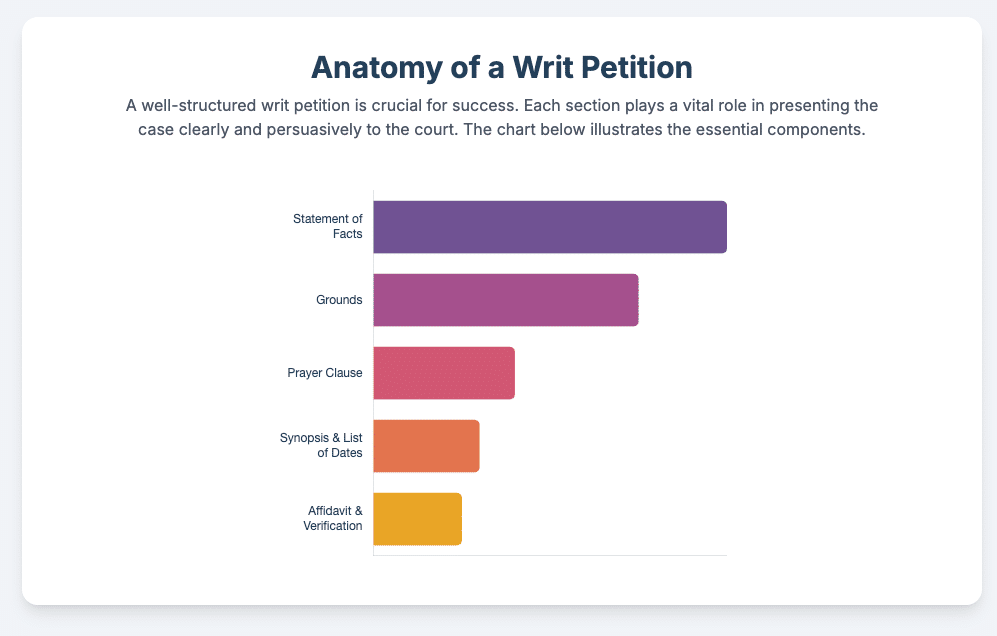
- Core Components: The petition should be logically structured with:
- A List of Dates and Events providing a quick chronological overview.
- A Synopsis of Facts summarising the case.
- Points of Law involved.
- The main body of the petition, presented in consecutively numbered paragraphs (Rule 10).6
- A distinct section for “Grounds” (Rule 11), where each legal argument is set out in a separate, numbered paragraph.6
- A clear and precise “Prayers” section (Rule 12), stating the specific writ and relief sought.6
- The Mandatory Declaration (Rule 11): Every petition must contain a statement confirming that no application on the self-same facts or cause of action was moved earlier before any court. If a similar application was moved, its outcome must be disclosed. This is a strict requirement to prevent abuse of the judicial process and forum shopping.6
- Verification and Affidavit (Rule 15): The petition must be verified by a solemn affirmation made by the petitioner or another person acquainted with the facts. The verification must clearly state, by reference to specific paragraphs, whether the statements are based on personal knowledge, information received (the source of which must be disclosed), or official records (which must be identified).6
The Paper Book: Compiling and Presenting Evidence (Rules 21-23)
The petition, along with all supporting documents, must be compiled into a “paper book” format.
- Assembly: The paper book must have an index, a list of dates, and a statement of the point of law involved.6
- Annexure Protocol (Rule 21(d)): The rules prescribe a specific and distinct marking system for annexures, which must be strictly followed to avoid filing defects.
Table 2: Annexure Marking Protocol (Rule 21)
| Pleading Type | Corresponding Annexure Marking |
| Petition | P/1, P/2, P/3, etc. |
| Affidavit-in-Opposition (by Respondent No. 1) | R−1/1, R−1/2, R−1/3, etc. |
| Affidavit-in-Opposition (by Respondent No. 2) | R−2/1, R−2/2, R−2/3, etc. |
| Affidavit-in-Reply | P/4, P/5, P/6, etc. (continuing from the petition’s annexures) |
- Vernacular Documents (Rules 21(c) & 23): Documents that are not in English do not automatically require translation upon filing. However, the Court may direct that an official translation be provided at a later stage.6
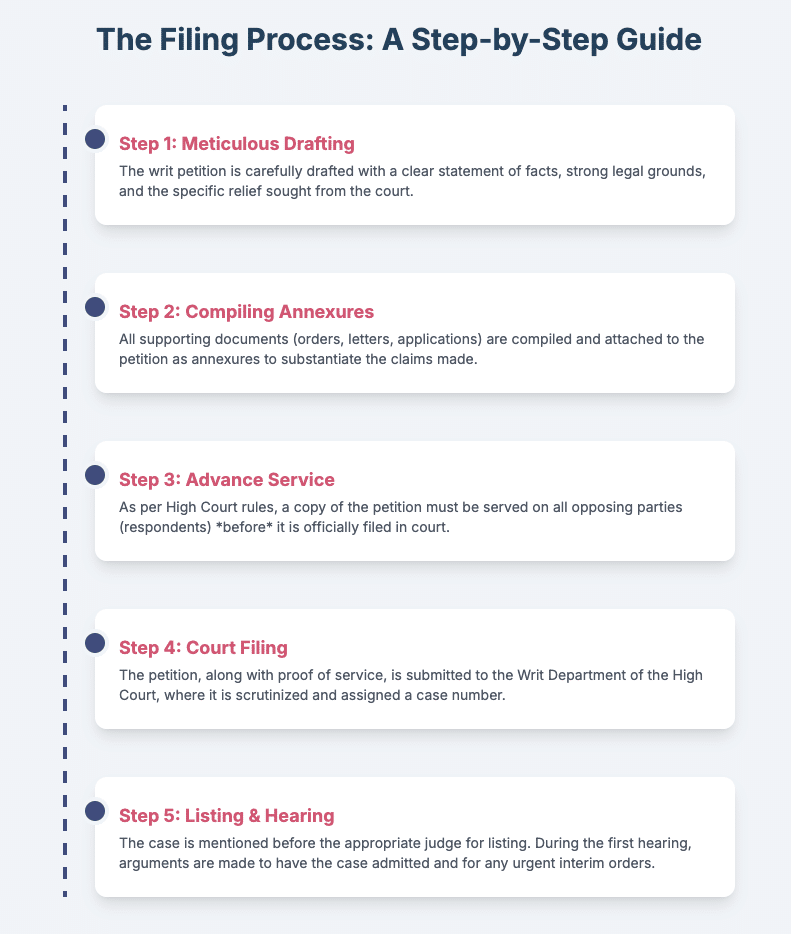
Filing, Service, and the First Hearing (Rules 25-28)
\
- Centralized Filing (Rule 25): All writ applications are filed centrally as per the High Court’s computerised listing rules.6
- Advance Notice (Rule 26): A fundamental principle of natural justice is embedded in Rule 26. No application for a Rule Nisi or prayer for an interim order shall be entertained without serving a copy of the petition (with all annexures) upon the respondents. This service must be effected at least 48 hours prior to moving the application in court. This rule ensures that the opposing party has a reasonable opportunity to appear and contest the matter, preventing surprise ex parte orders.6
- Affidavit of Service (Rule 27): Before the matter is taken up for hearing, the petitioner must file an affidavit of service, which serves as formal proof to the court that the respondents have been duly notified of the proceedings.6
- Listing “For Admission” (Rule 28): Once filed and served, the petition is ordinarily listed before the appropriate bench under the heading “For Admission.” The 48-hour notice period is considered sufficient time for the respondents to obtain preliminary instructions from their respective departments or clients.6
Part III: A Deep Dive into Each Writ: Doctrine, Precedents, and Practice
While the procedural framework is common to all writs, each writ has a distinct legal character, specific prerequisites, and a body of case law that defines its application. Understanding these nuances is essential for choosing the correct remedy and framing a successful petition.
The Writ of Mandamus (To Command)
- Doctrine & Scope: Mandamus is a positive command issued to a public authority, compelling it to perform a public or statutory duty that it has unlawfully failed or refused to perform.7 It is a remedy for inaction and is used to enforce the performance of a non-discretionary, mandatory duty.
- The “Demand for Justice” (Rule 20): A unique and mandatory prerequisite for a writ of Mandamus is the “demand for justice.” The petitioner must demonstrate to the court that they first made a clear and formal demand to the concerned authority to perform its duty and that this demand was either explicitly refused or met with inaction tantamount to refusal. A copy of this written demand must be annexed to the petition.6 This rule ensures that judicial intervention is a last resort after administrative remedies have been exhausted.
- Celebrated Judgments & Analysis:
- Lalita Kumari v. Government of Uttar Pradesh (2014): This Supreme Court judgment is a classic illustration of Mandamus in action. The Court held that the registration of a First Information Report (FIR) is mandatory under Section 154 of the CrPC if the information discloses a cognizable offence. This transformed what was often treated as a discretionary act into a binding public duty. Consequently, if a police officer refuses to register an FIR in such a case, the aggrieved person can seek a writ of Mandamus to compel them to do so.10
- State of Kerala v. A. Lakshmikutty (1986): This case clarifies the limits of Mandamus. The Supreme Court held that while Mandamus can be issued to compel an authority to exercise its discretion, it cannot be issued to dictate how that discretion should be exercised. For example, the court can direct a selection committee to make an appointment, but it cannot direct it to appoint a specific individual.8
- Kalpana Pal vs State Of West Bengal & Ors (2010): This Calcutta High Court judgment is significant as it acknowledges the court being “flooded with petitions” alleging police inaction. It underscores the court’s readiness to issue Mandamus to address systemic issues of administrative lethargy and compel law enforcement agencies to perform their statutory duties, making it a vital tool for citizens in West Bengal.10
- Illustrative Example: A resident of Kolkata files multiple complaints with the Kolkata Municipal Corporation (KMC) regarding an unauthorized construction in their neighbourhood, providing photographic evidence and citing relevant building rules. The KMC takes no action. The resident then sends a formal “demand for justice” letter via registered post, explicitly asking the Municipal Commissioner to initiate proceedings under the KMC Act. After a reasonable period with no response, the resident can file a writ of Mandamus in the Calcutta High Court, praying for a direction compelling the KMC to take lawful action against the illegal construction.
The Writ of Certiorari (To Quash)
- Doctrine & Scope: Certiorari is a corrective writ. It is issued by a superior court to a lower court, tribunal, or quasi-judicial authority to quash an order that is legally flawed. The grounds for issuing Certiorari are well-defined: lack of jurisdiction, acting in excess of jurisdiction, violation of the principles of natural justice, or an “error of law apparent on the face of the record”.3
- Procedural Prerequisite (Rule 13): A petition for Certiorari must contain a statement specifying the location of the records of the proceedings being challenged.6 This is essential as the very nature of Certiorari involves the High Court calling for and reviewing these records.
- Celebrated Judgments & Analysis:
- Surya Dev Rai v. Ram Chander Rai & Ors. (2003): This landmark Supreme Court judgment affirmed that the High Court’s power to issue a writ of Certiorari under Article 226 extends to the judicial orders of subordinate civil courts. It clarified that this constitutional power is distinct from the statutory power of revision under Section 115 of the Code of Civil Procedure (CPC) and cannot be curtailed by amendments to the CPC. The judgment established that even if a statutory remedy like revision is barred, the constitutional remedy of Certiorari remains available to correct grave jurisdictional errors.12
- Hari Vishnu Kamath v. Syed Ahmad Ishaque (1954): This foundational case defined an “error apparent on the face of the record.” The Supreme Court explained that it is not any minor error of fact or law, but a patent, self-evident legal error that can be identified without a detailed examination of evidence or complex argumentation. The judgment also crucially held that Certiorari can be issued even after the concerned tribunal has become functus officio (i.e., its task is complete and it has ceased to exist), as the writ is directed against the record of the decision, not the body itself.3
- Syed Yakoob v. K.S. Radhakrishnan (1963): This judgment firmly established that a writ of Certiorari is not an appeal in disguise. The High Court, in its Certiorari jurisdiction, will not act as an appellate court to re-appreciate evidence or substitute its own judgment on merits. It will only intervene if a finding is completely unsupported by evidence (perverse) or if the inferior tribunal has acted on inadmissible evidence that has influenced the decision.3
- Illustrative Example: A disciplinary authority dismisses a government employee based on an inquiry report. During the inquiry, the employee was denied the opportunity to cross-examine a crucial witness and was not provided with copies of key documents relied upon by the authority. This is a clear violation of the principles of natural justice. The employee can file a writ of Certiorari seeking to quash the dismissal order on the ground that the inquiry was vitiated.
The Writ of Prohibition (To Forbid)
- Doctrine & Scope: Prohibition is a preventive writ, often described as the counterpart to Certiorari. It is issued to a lower court or tribunal to prevent it from proceeding with a matter that is outside its jurisdiction or where it is acting contrary to the principles of natural justice.4
- Key Distinction: The defining feature of Prohibition is its timing. It is issued while the proceedings are still pending in the lower body. If the proceedings have concluded and an order has been passed, the appropriate remedy is Certiorari, not Prohibition.
- Celebrated Judgment & Analysis:
- East India Commercial Co. Ltd. v. The Collector of Customs, Calcutta (1962): This seminal Supreme Court case is a leading authority on the writ of Prohibition. The Court held that a High Court can issue a writ of Prohibition to an authority to prevent it from acting in contravention of the law. It established that if an authority is proceeding under a provision which it has no jurisdiction to apply to the facts of the case, it can be stopped in its tracks by a writ of Prohibition. The judgment underscored that an authority cannot confer jurisdiction upon itself by a wrong decision on a jurisdictional fact.29
- Illustrative Example: The West Bengal Land Reforms and Tenancy Tribunal begins to adjudicate a dispute that is purely contractual in nature and does not involve any matter falling under the specified acts that define its jurisdiction. A party to the proceeding can file a writ of Prohibition in the Calcutta High Court to restrain the Tribunal from continuing with the case due to a lack of subject-matter jurisdiction.
The Writ of Quo Warranto (By What Authority)
- Doctrine & Scope: This writ, meaning “by what authority,” is a judicial inquiry into the legality of a person’s claim to a substantive public office. If the court finds that the person is holding the office without legal authority, it can issue an order to oust them from that position.39 The office in question must be a public office, created by the Constitution or a statute, and must be of a substantive character.
- Relaxed Locus Standi: A unique feature of Quo Warranto is that any member of the public can file the petition, regardless of whether their personal rights have been affected. The rationale is that the public has an interest in ensuring that public offices are not usurped by unqualified individuals.39
- Celebrated Judgments & Analysis:
- University of Mysore v. C.D. Govinda Rao (1965): The Supreme Court laid down the precise scope of inquiry in a Quo Warranto petition. The Court held that it would scrutinize whether the appointment is contrary to statutory rules and whether the person holds the necessary qualifications. However, the Court will not delve into the comparative merits of candidates or act as an appellate body over the selection made by the appointing authority, provided the appointee possesses the prescribed qualifications.41
- G.D Karkare v. T.L Shevde (1952): In this case, the Nagpur High Court affirmed that the office of the Advocate-General is a public office of a substantive nature. It entertained a Quo Warranto petition challenging an appointment on the grounds of age disqualification, establishing that high constitutional offices are subject to judicial scrutiny through this writ.41
- Illustrative Example: The State of West Bengal appoints an individual as the Vice-Chancellor of a state university. A statute governing the university prescribes that the candidate must have at least ten years of experience as a professor. An alert citizen discovers that the appointee has only seven years of such experience. This citizen can file a writ of Quo Warranto in the Calcutta High Court to challenge the legality of the appointment.
The Writ of Habeas Corpus (To Have the Body)
- Doctrine & Scope: Habeas Corpus is the most revered writ, considered the bulwark of individual liberty. It is a remedy against unlawful detention or confinement. The writ commands the detaining authority (which can be the State or a private individual) to produce the detained person before the court so that the legality of the detention can be determined. If the detention is found to be illegal, the court will order the immediate release of the person.45
- Special Procedure (Rule 6): Recognizing its urgency and importance, the Calcutta High Court Rules provide a special and distinct procedure for Habeas Corpus petitions. Under Rule 6, these applications are to be made before the Division Bench taking the criminal business of the Appellate Jurisdiction. The rule outlines specific requirements for the petition, verification, and the process for issuing a Rule Nisi, which commands the respondent to not only show cause but also to “produce in Court the body of the person”.6
- Celebrated Judgment & Analysis:
- ADM Jabalpur v. Shivkant Shukla (The Habeas Corpus Case) (1976): This case is a critical chapter in India’s constitutional history. During the Emergency, the Supreme Court, by a 4:1 majority, held that an individual’s right to approach the court for a writ of Habeas Corpus could be suspended. However, the powerful dissenting opinion of Justice H.R. Khanna, who argued that the right to life and liberty is inherent and cannot be taken away without the authority of law even in an emergency, is now celebrated as the correct legal position. The majority decision was widely criticized and was effectively nullified by the 44th Constitutional Amendment Act, 1978, which made Articles 20 and 21 non-suspendable. The case was formally overruled by the Supreme Court in the Puttaswamy (Right to Privacy) judgment in 2017. The saga of this case demonstrates the evolution of Indian jurisprudence and the ultimate triumph of the principle that personal liberty is sacrosanct.45
- Illustrative Example: A person is arrested by the police in Kolkata. After 24 hours, the family is not informed of the grounds of arrest, and the person is not produced before the nearest Magistrate, in clear violation of Article 22 of the Constitution. A family member or a friend can immediately file a writ of Habeas Corpus in the Calcutta High Court, seeking a direction for the person to be produced before the court and set at liberty.
Part IV: The Art of Legal Drafting: A Practitioner’s Guide
A well-drafted writ petition is a powerful tool of persuasion. It must not only comply with procedural rules but also present the case in a clear, logical, and compelling manner. The quality of drafting can significantly influence the outcome of the first hearing.
Drafting the Statement of Facts
The statement of facts should be a concise and chronological narrative of the events leading to the filing of the petition. The key is to build a persuasive foundation for the legal arguments that will follow.
- Chronological Clarity: Present the facts in the order they occurred. This helps the court understand the sequence of events without confusion.
- Objectivity and Precision: Use neutral language and avoid emotional or argumentative statements in the facts section. State facts, not conclusions.
- Link to Evidence: Every factual assertion should be supported by a document, which must be clearly referred to by its annexure mark (e.g., “…as stated in the letter dated 01.01.2025 (Annexure P/1)”). This practice lends credibility to the petition and allows for easy verification by the court.
Formulating the Grounds
The “Grounds” section is the legal core of the petition. Each ground should be a distinct legal argument, presented as a separate, numbered paragraph.
- Logical Structure: Arrange the grounds strategically. Typically, the strongest ground, such as a challenge to jurisdiction or a blatant violation of natural justice, should be presented first.
- Clarity and Brevity: Each ground should clearly state the legal principle or statutory provision that has been violated and briefly explain how the facts of the case constitute such a violation. For example: “For that the impugned order is liable to be set aside as it has been passed in gross violation of the principles of natural justice, inasmuch as the petitioner was not afforded an opportunity of being heard before the said adverse order was passed.”
- Self-Contained Arguments: Each ground should be able to stand on its own as a complete legal argument, making it easy for the court to grasp the petitioner’s contentions.
Crafting the Prayers
The prayer clause is where the petitioner explicitly tells the court what relief they are seeking. Precision and clarity are paramount.
- Specific Relief: The prayers must distinctly state the particular writ or order sought, as required by Rule 12.6 Avoid vague or overly broad requests.
- Structure: A well-structured prayer clause typically includes:
- A prayer for a Rule Nisi in terms of the main prayers.
- The main prayer for the final relief (e.g., “A writ in the nature of Mandamus commanding the respondents to…”).
- A prayer for an interim order to protect the petitioner’s interests during the pendency of the petition (e.g., “An order of stay of the impugned notice dated…”).
- A prayer for the costs of the proceeding, as permitted under Rule 53A.6
- An omnibus prayer for “any other order or orders as to this Hon’ble Court may seem fit and proper.”
Part V: The Digital Courtroom: E-Filing a Writ Petition
The advent of e-filing has revolutionized the process of initiating litigation, making it more accessible and efficient. The national e-filing portal, https://filing.ecourts.gov.in, provides a unified platform for filing cases in High Courts across India, including the Calcutta High Court.46 While this system standardizes the logistical aspects of filing, it is crucial to remember that it does not replace the specific procedural rules of the Calcutta High Court. The digital platform is a tool to facilitate compliance with local rules, not a substitute for knowing them. An advocate must still ensure the petition’s content, classification, and format adhere strictly to the Calcutta High Court’s Rules relating to Article 226.
A Step-by-Step E-Filing Guide
Based on the functionalities of the e-Filing 3.0 portal, the process for filing a new writ petition is as follows 47:
- One-Time Registration: An advocate or litigant-in-person must first register on the portal https://filing.ecourts.gov.in. Advocates will need to provide their Bar Council enrollment details, mobile number, and email address. The system uses OTP verification for authentication.50
- Initiating a New Case: After logging in, select the option to file a new case. You will be prompted to choose the state (West Bengal) and the court (High Court at Calcutta), and then specify the side (Original or Appellate).
- Filling Digital Forms: The portal presents a series of forms where you must enter the case details. This includes selecting the case type (e.g., WPA for a standard writ petition on the Appellate Side), entering petitioner and respondent details, and providing the advocate’s information. It is at this stage that the crucial classification under the correct Group and Head (as per Schedule B of the Calcutta High Court Rules) must be entered.
- Uploading Documents: The entire paper book—including the main petition, verification, affidavit, and all annexures—should be scanned and compiled into a single, searchable PDF file. It is best practice to scan documents at a resolution of 300 dpi for clarity.54 The portal allows for uploading this PDF. The documents should be bookmarked for easy navigation by the court.
- Online Payment of Court Fees: The portal is integrated with online payment gateways. The user can pay the requisite court fees electronically and must enter the generated transaction ID or receipt number into the e-filing form.55
- E-Signing and Oath: The uploaded documents must be digitally authenticated. This can be done via an Aadhaar-linked OTP or a Digital Signature Certificate (DSC) token. The e-Filing 3.0 portal also includes a feature for the online video recording of the deponent’s oath, which adds another layer of verification.47
- Final Submission and Defect Removal: After completing all steps, the petition is submitted. A temporary e-filing number is generated. The High Court registry will then scrutinize the filing. If any defects are found (e.g., incorrect classification, missing documents), an objection will be raised, and the advocate will be notified via SMS or email. The advocate can then log back into the portal to rectify the defects online and resubmit the petition.51
Part VI: Staying Current: Recent Amendments and Practice Directions
The “Rules of High Court at Calcutta relating to Applications under Article 226” were substantially framed with amendments up to 2005. However, the law is not static. The High Court periodically issues notifications and practice directions to amend its rules and procedures. A diligent practitioner must stay abreast of these changes.
- Amendments Post-2005:
- 2014 Amendments: Notifications were issued in 2014 amending the Civil and Criminal Rules and Orders concerning the period for ‘Lapsed Deposits’ and updating the guidelines for the enlistment of Pleader Commissioners.56 The court hours were also extended.56
- 2023 Amendments: A significant notification in September 2023 introduced new rules into the Criminal Rules and Orders to protect the identity of victims in cases involving sexual offenses. These rules mandate that the victim’s identity not be disclosed in pleadings or judgments and require such documents to be kept in sealed covers.57 This could be relevant for writ petitions that touch upon such sensitive matters.
- 2025 Bail Application Rule Change: Following observations from the Supreme Court regarding delays, the Calcutta High Court amended its rules, effective from April 1, 2025, to allow most pre-conviction bail and anticipatory bail applications to be heard by a Single Judge instead of a Division Bench. While not a writ rule, this significant procedural reform reflects the court’s ongoing efforts to streamline its processes.58
- A Necessary Caveat: The legal and procedural landscape is constantly evolving. The information in this guide is comprehensive but should not be a substitute for verifying the latest updates. Practitioners are strongly advised to regularly consult the “Latest Notifications” section on the official website of the Calcutta High Court (https://www.calcuttahighcourt.gov.in) before filing any petition to ensure full compliance with the most current rules and practice directions.59
Part VII: Model Draft: Sample Writ Petition
The following is a sample draft of a Writ Petition in the nature of Mandamus, structured for filing on the Appellate Side of the Calcutta High Court.
IN THE HIGH COURT AT CALCUTTA
CONSTITUTIONAL WRIT JURISDICTION
APPELLATE SIDE
W.P. No. ______ (W) of 2025
Subject Matter in relation to:
Group V (Matters relating to Municipalities), Head (e) (Demolition) of the Classification List.
Cause Title:
In the matter of:
An application under Article 226 of the Constitution of India;
-And-
In the matter of:
Sri Anjan Kumar Das,
Son of Late Bimal Kumar Das,
Residing at 10, ABC Road,
Kolkata – 700019.
… Petitioner
-Versus-
- The Kolkata Municipal Corporation, having its office at 5, S.N. Banerjee Road, Kolkata – 700013, service to be effected through the Municipal Commissioner.
- The Municipal Commissioner, The Kolkata Municipal Corporation, having his office at 5, S.N. Banerjee Road, Kolkata – 700013.
- The Director General (Building), The Kolkata Municipal Corporation, having his office at 5, S.N. Banerjee Road, Kolkata – 700013.
- Sri Rajesh Sharma, Son of Sri Gopal Sharma, Residing at 12, ABC Road, Kolkata – 700019.
… Respondents
To,
The Hon’ble Thottathil B. Radhakrishnan, Chief Justice and His Companion Justices of the said Hon’ble Court.
The humble petition of the Petitioner abovenamed most respectfully –
SHEWETH:
- LIST OF DATES AND EVENTS
(A chronological list of all relevant dates and events would be inserted here.)
- SYNOPSIS OF FACTS
(A brief summary of the case would be inserted here.)
III. POINTS OF LAW
- Whether the respondent municipal authorities have a statutory duty under the Kolkata Municipal Corporation Act, 1980 to take action against illegal and unauthorized constructions?
- Whether the failure of the respondent authorities to act upon the repeated complaints of the petitioner amounts to a dereliction of their public duty, warranting the issuance of a writ of Mandamus?
- PETITION
- That the Petitioner is a law-abiding citizen of India and resides at the address mentioned in the cause title. The Petitioner is aggrieved by the inaction of the respondent nos. 1 to 3 in taking steps against the illegal construction being carried out by the respondent no. 4.
- That the respondent no. 4 is the owner of the premises at 12, ABC Road, Kolkata – 700019, which is immediately adjacent to the petitioner’s property.
- That in or around January 2025, the respondent no. 4 commenced construction at the said premises without any sanctioned building plan and in gross violation of the Kolkata Municipal Corporation Building Rules, 2009. The said illegal construction has blocked the petitioner’s right to light and air.
- That the petitioner lodged a written complaint with the respondent no. 3 on 15.02.2025, detailing the illegal nature of the construction. A copy of the said complaint is annexed hereto and marked as Annexure “P/1”.
- That despite the said complaint, the respondent authorities failed to take any action, and the respondent no. 4 continued with the illegal construction with impunity.
- That the petitioner, having no other alternative, sent a formal “Demand for Justice” through his learned advocate to the respondent no. 2 on 01.04.2025, calling upon the said respondent to discharge his statutory duty by initiating demolition proceedings against the unauthorized structure. A copy of the said demand for justice is annexed hereto and marked as Annexure “P/2”.
- That the said demand for justice has gone unheeded, and the respondent authorities have failed to perform their public duty.
- That the inaction of the respondent nos. 1 to 3 is arbitrary, illegal, and contrary to the provisions of the Kolkata Municipal Corporation Act, 1980.
- That the petitioner has no other efficacious alternative remedy and has been constrained to approach this Hon’ble Court.
- That this petition is made bona fide and for the ends of justice.
- (Mandatory Declaration as per Rule 11) That the petitioner states that on the self-same facts and cause of action, no other application under Article 226 of the Constitution of India or otherwise has been moved before this Hon’ble Court or any other court.
- GROUNDS
- FOR THAT the respondent municipal authorities are duty-bound under the Kolkata Municipal Corporation Act, 1980 to ensure that all constructions within their jurisdiction are in accordance with sanctioned plans and building rules, and their failure to act against the illegal construction raised by respondent no. 4 constitutes a manifest dereliction of their statutory duty.
- FOR THAT the inaction of the respondent authorities is arbitrary and unreasonable and violates the petitioner’s right to a clean environment and enjoyment of his property, which is a facet of Article 21 of the Constitution of India.
III. FOR THAT the petitioner has complied with the prerequisite of issuing a “Demand for Justice” as mandated by the rules of this Hon’ble Court, but the respondent authorities have failed to respond, leaving the petitioner with no other remedy but to seek a writ of Mandamus.
- PRAYERS
In the circumstances, it is most humbly prayed that Your Lordships may be graciously pleased to:
- a) Issue a Rule NISI in terms of prayers (b) and (c) below;
- b) Issue a Writ in the nature of Mandamus commanding the respondent nos. 1 to 3 to forthwith consider the petitioner’s complaint (Annexure P/1) and demand for justice (Annexure P/2) and to initiate appropriate proceedings, including demolition proceedings, against the unauthorized construction carried out by the respondent no. 4 at premises no. 12, ABC Road, Kolkata – 700019, in accordance with law;
- c) Issue an interim order restraining the respondent no. 4 from carrying out any further construction at the said premises during the pendency of this writ petition;
- d) Pass such other or further order or orders as to Your Lordships may seem fit and proper.
And for this act of kindness, your petitioner as in duty bound shall ever pray.
AFFIDAVIT
I, Sri Anjan Kumar Das, son of Late Bimal Kumar Das, aged about 55 years, by faith Hindu, by occupation Service, residing at 10, ABC Road, Kolkata – 700019, do hereby solemnly affirm and say as follows:
- That I am the petitioner in the instant writ petition and as such I am well acquainted with the facts and circumstances of the case.
- That the statements made in paragraphs 1 to 10 of the foregoing petition are true to my knowledge, and the statements made in the remaining paragraphs are my humble submissions before this Hon’ble Court.
Verified at Kolkata this ____ day of ________, 2025.
Deponent
Identified by me:
Advocate
CREDIT & CONSULTATION
This guide has been prepared by Patra’s Law Chambers, a full-service law firm founded by Advocate Sudip Patra (Advocate, Supreme Court of India & Calcutta High Court). With a distinguished background combining a B.Tech in Engineering, an LL.B. (IPR) from IIT Kharagpur, and an LL.M. & P.G.D. from IIM Calcutta, our firm brings unparalleled analytical rigor to every case.
Our team has extensive experience in handling matters across a wide spectrum of law, including:
- Writ & High Court Matters: Writ Petitions (all types), Appeals, Revisions, and matters under Article 227.
- Supreme Court Matters: Special Leave Petitions (SLPs), Bail, Transfer Petitions.
- Civil & Criminal Law: Property suits, contractual disputes, bail (anticipatory/regular), quashing petitions, and NI Act cases.
- Specialized Areas: Intellectual Property (Patent, Trademark, Copyright), Corporate & Tax Law (Insolvency, GST, Income Tax), Service Law, Land & Mutation matters, Family Law, Banking (DRT & SARFAESI), and Armed Forces Tribunal (AFT) matters.
If your rights have been violated and you require expert legal representation, our team is here to provide strategic advice and dedicated support.
Contact us for a consultation:
Patra’s Law Chambers
Kolkata Office: NICCO HOUSE, 6th Floor, 2, Hare Street, Kolkata-700001 (Near Calcutta High Court)
Delhi Office: House no: 4455/5, First Floor, Ward No. XV, Gali Shahid Bhagat Singh, Main Bazar Road, Paharganj, New Delhi-110055
- Website: www.patraslawchambers.com
- Email: [email protected]
- Phone: +91 890 222 4444 / +91 9044 04 9044
#CalcuttaHighCourt #WritPetition #IndianLaw #Article226 #KolkataLawyer #LegalGuide #PIL #HabeasCorpus #Mandamus #Certiorari #Prohibition #QuoWarranto #HighCourtRules #WritFiling #KolkataHighCourt #LegalAdvice #LawFirmIndia #Justice #RuleOfLaw #ConstitutionalLaw #AdvocateKolkata #Litigation #JudiciaryOfIndia #LegalProcedure #CalcuttaHighCourtRules #WritJurisdiction #KnowYourRights #ServiceMatters #PropertyDispute #KolkataLegal
Works cited
- Exploring Writ Jurisdiction of Calcutta High Court – Patras Law Chamber, accessed on September 11, 2025, https://patraslawchambers.com/writs-under-the-calcutta-high-court-a-comprehensive-legal-analysis/
- Matters at Hon’ble High Court: – A.L.L.O.W.B, accessed on September 11, 2025, https://allowb.org/assets/pdfs/courtmatters/fc2.pptx
- All you need to know about the writ of certiorari – iPleaders, accessed on September 11, 2025, https://blog.ipleaders.in/all-you-need-to-know-about-the-writ-of-certiorari/
- All you need to know about the writ of prohibition – iPleaders, accessed on September 11, 2025, https://blog.ipleaders.in/all-you-need-to-know-about-the-writ-of-prohibition/
- Writs in the Indian Constitution – ClearTax, accessed on September 11, 2025, https://cleartax.in/s/writs
- Rules of High Court at Calcutta relating to Applications under Article….pdf
- Writ Of Mandamus: Legal Imperatives And Doctrinal Limitations – IJCRT.org, accessed on September 11, 2025, https://ijcrt.org/papers/IJCRT2507507.pdf
- (PDF) Writ of Mandamus – ResearchGate, accessed on September 11, 2025, https://www.researchgate.net/publication/314384185_Writ_of_Mandamus
- Writ of Mandamus: Background, Features, Types & More | UPSC Notes! – Testbook, accessed on September 11, 2025, https://testbook.com/ias-preparation/writ-of-mandamus
- Police Inaction Writ in Calcutta High Courts – Patras Law Chamber, accessed on September 11, 2025, https://patraslawchambers.com/police-inaction-writs-calcutta-high-court-%F0%9F%8F%9B%EF%B8%8F/
- writ of mandamus doctypes: judgments – Indian Kanoon, accessed on September 11, 2025, https://indiankanoon.org/search/?formInput=writ%20of%20mandamus+doctypes:judgments
- certiorari doctypes: judgments – Indian Kanoon, accessed on September 11, 2025, https://indiankanoon.org/search/?formInput=certiorari%20cases
- Certiorari – Legal Maxim – B&B Associates LLP, accessed on September 11, 2025, https://bnblegal.com/certiorari/
- Surya Dev Rai vs. Ram Chander Rai and Ors. – Manupatra Academy, accessed on September 11, 2025, http://www.manupatracademy.com/home/subject_wise_case_guide_law_students_surya_dev_ram_chander
- 2003+6+scc+675 | Indian Case Law – CaseMine, accessed on September 11, 2025, https://www.casemine.com/search/in/2003%2B6%2Bscc%2B675
- surya+dev+rai | Indian Case Law – CaseMine, accessed on September 11, 2025, https://www.casemine.com/search/in/surya%2Bdev%2Brai
- Leading Supreme Court Judgment on distinction between Article 226 and 227 of Constitution of India – Law Web, accessed on September 11, 2025, https://www.lawweb.in/2024/03/leading-supreme-court-judgment-on.html
- surya dev rai – Indian Kanoon, accessed on September 11, 2025, https://indiankanoon.org/search/?formInput=surya%20dev%20rai
- Surya Dev Rai vs Ram Chander Rai – 2003 0 Supreme(Raj) 703, accessed on September 11, 2025, https://supremetoday.ai/doc/judgement/01702003624
- Surya Dev Rai Vs. Ram Chander Rai & Ors | Judgments | Supreme Court Judgments: September, 2003 | Law Library | AdvocateKhoj, accessed on September 11, 2025, https://www.advocatekhoj.com/library/judgments/index.php?go=2003/september/54.php
- High Courts’ Power to Quash Election Tribunal Decisions under …, accessed on September 11, 2025, https://www.casemine.com/commentary/in/high-courts’-power-to-quash-election-tribunal-decisions-under-article-226:-analysis-of-hari-vishnu-kamath-v.-syed-ahmad-ishaque/view
- (1) of Section 190, accessed on September 11, 2025, https://cdnbbsr.s3waas.gov.in/s3ec020afa92fc0f8a9cf051bf2961b06a/documents/circular/PART_III_-_Pages_61-80.pdf
- All about writ petition in India – Aggarwals & Associates – Law Firm in Chandigarh, accessed on September 11, 2025, https://aggarwalsandassociates.com/all-about-writ-petition-in-india/
- Hari Vishnu Kamath vs Syed Ahmad Ishaque And Others on 9 December, 1954 – Indian Kanoon, accessed on September 11, 2025, https://indiankanoon.org/doc/1450722/
- 783677_1600491144.docx, accessed on September 11, 2025, https://www.iilsindia.com/study-material/783677_1600491144.docx
- Hari Vishnu Kamath v. Ahmad Ishaque Archives – The Legal Quotient, accessed on September 11, 2025, https://thelegalquotient.com/tag/hari-vishnu-kamath-v-ahmad-ishaque/
- HARI VISHNU KAMATH Vs. AHMAD ISHAQUE – REGENT COMPUTRONICS PVT. LTD., accessed on September 11, 2025, https://www.the-laws.com/Encyclopedia/browse/Case?caseId=004591371000&title=hari-vishnu-kamath-vs-ahmad-ishaque
- Hari Vishnu Kamath vs Syed Ahmad Ishaque and Others – CourtKutchehry, accessed on September 11, 2025, https://www.courtkutchehry.com/Judgement/Search/t/276748-hari-vishnu-kamath-vs-syed
- writ of prohibition doctypes: supremecourt – Indian Kanoon, accessed on September 11, 2025, https://indiankanoon.org/search/?formInput=writ%20of%20prohibition+doctypes:supremecourt
- Writ of prohibition – Wikipedia, accessed on September 11, 2025, https://en.wikipedia.org/wiki/Writ_of_prohibition
- writ+of+prohibition | Indian Case Law – CaseMine, accessed on September 11, 2025, https://www.casemine.com/search/in/writ%2Bof%2Bprohibition
- accessed on January 1, 1970, https://indiankanoon.org/doc/1252394/
- East India Commercial Co. Ltd. vs. The Collector of Customs | PDF | Appeal – Scribd, accessed on September 11, 2025, https://www.scribd.com/document/699556880/East-India-Commercial-Co-Ltd-vs-the-Collector-of-Customs
- Jurisdiction of Customs Authorities in Confiscation under License …, accessed on September 11, 2025, https://www.casemine.com/commentary/in/jurisdiction-of-customs-authorities-in-confiscation-under-license-conditions:-east-india-commercial-co.-ltd.-v.-collector-of-customs,-calcutta-1962/view
- EAST INDIA COMMERCIAL CO LIMITED CALCUTTA Vs. COLLECTOR OF CUSTOMS CALCUTTA – The Laws, accessed on September 11, 2025, https://www.the-laws.com/Encyclopedia/browse/Case?caseId=002691612000&title=east-india-commercial-co-limited-calcutta-vs-collector-of-customs-calcutta
- East India Commercial Ltd. vs Collector Of Customs And Anr. on 21 July, 1959 – Indian Kanoon, accessed on September 11, 2025, https://indiankanoon.org/doc/1928998/
- East India Commerclal Co., Ltd. … vs The Collector Of Customs, Calcutta on 4 May, 1962, accessed on September 11, 2025, https://indiankanoon.org/doc/1839963/
- EAST INDIA COMMERCIAL LTD. Vs. COLLECTOR OF CUSTOMS – The Laws, accessed on September 11, 2025, https://www.the-laws.com/encyclopedia/browse/case?caseId=509591132000&title=east-india-commercial-ltd-vs-collector-of-customs
- VOL. XI – Punjab and Haryana High Court, accessed on September 11, 2025, https://highcourtchd.gov.in/landmark_judgments/HC/English/CW_607_1957.pdf
- writ of quo warranto doctypes: judgments – Indian Kanoon, accessed on September 11, 2025, https://indiankanoon.org/search/?formInput=writ%20of%20quo%20warranto+doctypes:judgments
- All you need to know about the writ of Quo Warranto – iPleaders, accessed on September 11, 2025, https://blog.ipleaders.in/all-you-need-to-know-about-the-writ-of-quo-warranto/
- The Writ of Quo Warranto – Jyoti Judiciary Coaching, accessed on September 11, 2025, https://www.jyotijudiciary.com/the-writ-of-quo-warranto/
- of quo warranto doctypes: judgments – Indian Kanoon, accessed on September 11, 2025, https://indiankanoon.org/search/?formInput=+cases+of+quo+warranto+
- Judicial Review In India: Importance, Landmark Cases & Criticism – Century Law Firm, accessed on September 11, 2025, https://www.centurylawfirm.in/blog/judicial-review-in-india/
- Habeas Corpus Case – Rest The Case, accessed on September 11, 2025, https://restthecase.com/knowledge-bank/habeas-corpus-case
- E-FILING | Official Website of e-Committee, Supreme Court of India, accessed on September 11, 2025, https://ecommitteesci.gov.in/service/e-filing/
- e-Filing services for online filing of cases, plaints, written statements …, accessed on September 11, 2025, https://filing.ecourts.gov.in/
- eFiling | Department of Justice | India, accessed on September 11, 2025, https://doj.gov.in/efiling/
- efiling-User-manual.pdf – e-Courts, accessed on September 11, 2025, https://ecourts.gov.in/ecourts_home/static/manuals/efiling-User-manual.pdf
- efiling – The Digital Online Filing Process – High Court Chhattisgarh, accessed on September 11, 2025, https://highcourt.cg.gov.in/manual/e-Filing-A%20Digital%20Process.pdf
- Software User Manual For E-Filing [Version 1.0] – Punjab & Haryana High Court, accessed on September 11, 2025, https://phhc.gov.in/efiling/data/user_manual_efiling.pdf
- English – How to e File a new case – High Courts and District courts of India – e-Committee, accessed on September 11, 2025, https://ecommitteesci.gov.in/video/how-to-e-file-a-new-case-high-courts-and-district-courts-of-india/
- Mathili – How to e File a case – High Courts and District courts of India – YouTube, accessed on September 11, 2025, https://www.youtube.com/watch?v=bhbHvJ09QAI
- Practice Directions for Electronic Filing (E-filing) – Delhi High Court, accessed on September 11, 2025, https://delhihighcourt.nic.in/files/announcements/announcementfile_uknurlit.pdf
- J – ‘THE ELECTRONIC FILING (E-FILING) RULES’ In exercise of powers under Articles 225 and, accessed on September 11, 2025, https://cdnbbsr.s3waas.gov.in/s3ec0175b9b6dc7fe44437c6e0a69fd863/uploads/2023/02/2023022493.pdf
- in the high court at calcutta, accessed on September 11, 2025, https://cdnbbsr.s3waas.gov.in/s3ec0556db57b4db0a6fcb7f9e0c0b504f/uploads/2024/03/2024030474.pdf
- Untitled, accessed on September 11, 2025, https://cdnbbsr.s3waas.gov.in/s3ec057d2a383e54274888b4b73b97e1aa/uploads/2024/01/2024011197.pdf
- After SC’s Criticism, Calcutta HC Amends Rule On Listing Bail …, accessed on September 11, 2025, https://www.youtube.com/watch?v=qJrOybyYDX0
- Calcutta High Court, accessed on September 11, 2025, https://calcuttahighcourt.org/
- High Court Notification – West Bengal Judicial Academy, accessed on September 11, 2025, https://www.wbja.nic.in/pages/display/149-high-court-notification
- High Court of Jharkhand, India, accessed on September 11, 2025, https://jharkhandhighcourt.nic.in/
- Calcutta High Court – Original Side – Case Status : Search by Case Number, accessed on September 11, 2025, https://hcservices.ecourts.gov.in/ecourtindiaHC/cases/case_no.php?state_cd=16&dist_cd=1&court_code=1&stateNm=Calcutta
- High Court of Manipur at Imphal, accessed on September 11, 2025, https://hcmimphal.nic.in/
- Calcutta High Court – Appellate side, accessed on September 11, 2025, https://hcservices.ecourts.gov.in/ecourtindiaHC/index_highcourt.php?state_cd=16&dist_cd=1&court_code=3&stateNm=Calcutta
- Case Status – High Court of Andhra Pradesh, accessed on September 11, 2025, https://aphc.gov.in/aphc_old/hcservices.html