- India's Parliament introduced The Promotion and Regulation of Online Gaming Bill, 2025, balancing innovation and prohibition in online gaming.
- The bill promotes e-sports and social games while prohibiting online money games to protect citizens from harms.
- It features severe penalties including imprisonment and fines for involvement with online money games.
- A new Authority on Online Gaming will oversee game classifications and handle grievances.
- The definition of "online money game" risks classifying legitimate skill-based competitions as illegal.
- Concerns arise about the discretionary power of the Authority and lack of clear guidelines for game classification.
- Prohibiting financial transactions for online money gaming poses enforcement challenges in the digital landscape.
- India's Parliament introduced The Promotion and Regulation of Online Gaming Bill, 2025, balancing innovation and prohibition in online gaming.
- The bill promotes e-sports and social games while prohibiting online money games to protect citizens from harms.
- It features severe penalties including imprisonment and fines for involvement with online money games.
- A new Authority on Online Gaming will oversee game classifications and handle grievances.
- The definition of "online money game" risks classifying legitimate skill-based competitions as illegal.
- Concerns arise about the discretionary power of the Authority and lack of clear guidelines for game classification.
- Prohibiting financial transactions for online money gaming poses enforcement challenges in the digital landscape.
In a landmark move to bring order to the burgeoning and chaotic world of online gaming, the Indian Parliament has introduced The Promotion and Regulation of Online Gaming Bill, 2025. This ambitious legislation attempts to walk a tightrope, aiming to simultaneously foster innovation in certain segments of the industry while imposing a blanket prohibition on others. The bill clearly delineates the digital playground into two distinct zones: a nurtured garden for e-sports and social games, and a forbidden territory for “online money games.”
While the stated objectives—protecting vulnerable citizens, curbing financial fraud, and promoting legitimate sports—are commendable, the bill’s rigid framework and broad definitions raise significant legal and practical questions. This analysis by Patra’s Law Chambers delves into the critical aspects of the bill, examining its provisions and identifying potential lacunae that could impact the future of India’s digital economy.
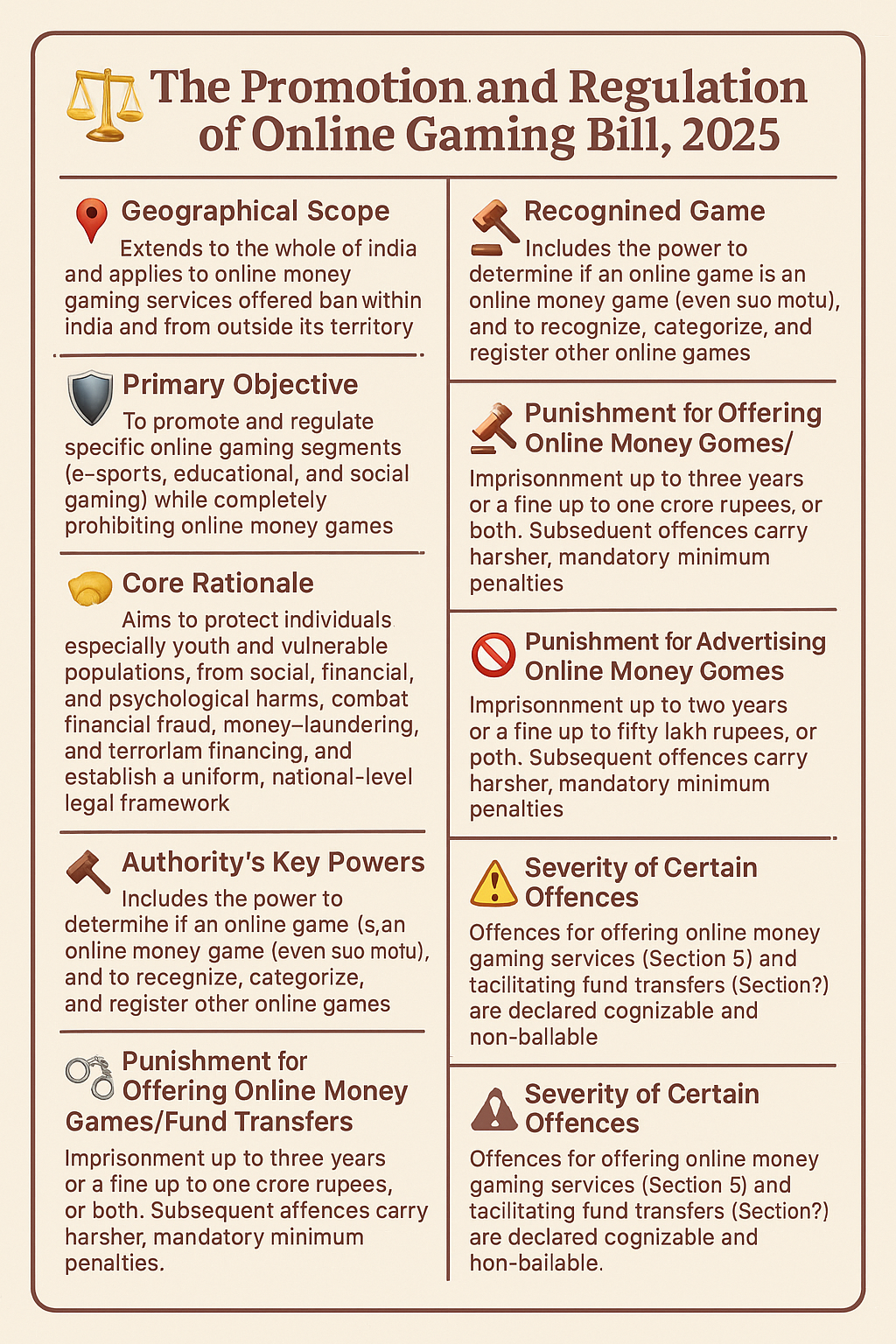
Key Overview:
The Dual Mandate: Promote and Prohibit
The core philosophy of the Bill is its dual-pronged approach:
- Promotion and Development: The legislation actively seeks to promote and regulate benign forms of gaming. It provides a formal structure for recognizing e-sports as a legitimate competitive sport and encourages the development of online social games for entertainment and educational purposes. This is a welcome step that could unlock immense potential for innovation, employment, and global competitiveness.
- Prohibition and Protection: The bill takes an uncompromising stance against “online money games.” Citing “grave social, economic, and psychological consequences,” it imposes an outright ban on any game involving monetary stakes for monetary returns, irrespective of whether the game is based on skill or chance.
Key Provisions: A Closer Look
- Broad Prohibition (Chapter III): Sections 5, 6, and 7 form the prohibitory core of the act. They criminalize not just offering online money games, but also advertising them and facilitating financial transactions related to them. This three-pronged attack aims to dismantle the entire ecosystem supporting such games.
- Stringent Penalties (Chapter V): The penalties are severe, with imprisonment up to three years and fines reaching one crore rupees. Crucially, offences related to offering games and facilitating payments are classified as cognizable and non-bailable, granting law enforcement significant power.
- Creation of a Central Authority (Chapter IV): A new “Authority on Online Gaming” will be established. This body will hold the critical power to decide whether a game falls into the prohibited “online money game” category, register legitimate games, and handle grievances.
- Sweeping Enforcement Powers (Chapter VI): The bill grants authorities the power to block access to any computer resource related to online money gaming and to conduct searches, seizures, and arrests without a warrant, extending this power to the “virtual digital space.”
Critical Analysis and Potential Lacunae
While the bill’s intent is clear, its execution raises several critical concerns that could lead to legal challenges and implementation hurdles.
1. The Overly Broad Definition of “Online Money Game”
The bill defines an “online money game” as any game where a user pays fees or deposits money with the “expectation of winning which entails monetary and other enrichment.” Crucially, it explicitly states this applies “irrespective of whether such game is based on skill, chance, or both.”
- Lacuna: This definition collapses the long-standing legal distinction between games of skill and games of chance, a cornerstone of Indian gaming jurisprudence established in cases like State of Bombay v. RMD Chamarbaugwala. By doing so, it risks classifying legitimate, skill-based competitions that have prize pools (common in e-sports tournaments or competitive coding platforms) as illegal “online money games.” While the bill exempts e-sports, the definition of an e-sport itself prohibits “the placing of bets, wagers or any other stakes.” How will entry fees for a tournament with a prize pool be interpreted? This ambiguity could stifle the very e-sports ecosystem the bill aims to promote.
2. The Prohibition-Over-Regulation Approach
The “Statement of Object and Reasons” explicitly states that it is “prudent and practical… to completely prohibit the activity… rather than attempts to regulation.”
- Lacuna: This prohibitory stance, while seemingly straightforward, may prove counterproductive. History shows that blanket bans often drive activities underground, making them harder to monitor and control. A regulated market, with strict KYC norms, age-gating, spending limits, and responsible gaming features, could have offered a middle path. This approach could lead to a surge in offshore, illegal platforms that are beyond the reach of Indian law, exacerbating the very problems of money laundering and fraud the bill seeks to solve. The enforcement challenges related to offshore operators, acknowledged by the bill itself, will only intensify under a prohibition regime.
3. Unchecked Powers of the New Authority
Section 8 establishes an Authority with the power to “determine… whether a particular online game is an online money game or otherwise.”
- Lacuna: The bill does not lay down clear, objective criteria or guidelines for the Authority to make this determination. This grants the body immense discretionary power. Without a well-defined framework, decisions could be arbitrary, inconsistent, and susceptible to influence, creating an environment of uncertainty for game developers and investors. The lack of a clear appellate mechanism against the Authority’s decisions within the bill is also a significant concern from a due process perspective.
4. The Practicality of Enforcing Financial Transaction Bans
Section 7 prohibits financial institutions from facilitating transactions for online money gaming.
- Lacuna: While noble in intent, this is incredibly difficult to enforce in the age of cryptocurrencies, international wallets, and complex payment gateways. Malicious actors will quickly pivot to alternative financial channels that are difficult for Indian regulators to trace and block. This provision may inconvenience legitimate users while failing to stop determined offenders.
Conclusion: A Step Forward or a Stumble?
The Promotion and Regulation of Online Gaming Bill, 2025, is a decisive and bold legislative intervention. Its focus on promoting e-sports and protecting citizens from the harms of gambling addiction is a necessary step in the right direction.
However, its reliance on outright prohibition over nuanced regulation, its dangerously broad definitions, and the vast, unchecked power vested in the proposed Authority are significant causes for concern. By failing to distinguish between skill and chance, the bill may inadvertently cripple legitimate segments of the gaming industry it seeks to protect. The success of this legislation will depend entirely on how the rules are framed and how the Authority exercises its powers. A more balanced, regulation-focused approach might have been a safer bet for ensuring a secure, responsible, and thriving digital gaming ecosystem in India.
For expert legal advice and representation in matters related to technology law, intellectual property, and regulatory compliance, connect with Patra’s Law Chambers. Our team is equipped to navigate the complexities of the evolving digital landscape.
Website: www.patraslawchambers.com Email: [email protected] Phone: +91 8250 422 880 / +91 890 222 4444