- The Essential Commodities Act, 1955 ensures the equitable distribution of essential goods and protects consumers from exploitation.
- A commodity is considered essential if specified in the Schedule and can be added or removed by the Central Government.
- Legal challenges can arise from arbitrary decisions regarding petrol pumps, gas godowns, or ration shops.
- Penalties for violations under the Act include imprisonment of three months to seven years and substantial fines.
- The 2020 Amendment shifted the law’s focus from regulation to market liberalization, allowing deregulation of essential foodstuffs.
- Judicial oversight ensures compliance with natural justice principles in dealership terminations and licensing issues.
- The High Court's writ jurisdiction is for addressing public wrongs, not settling private disputes.
A Guide to Essential Commodities, Petrol Pumps, Gas Godowns, and Ration Shops Related Calcutta High Court Cases
-
Creditor and contributor of this article:
Patra’s Law Chambers:
About Us:
Patra’s Law Chambers is a law firm with offices in Kolkata & Delhi, offering comprehensive legal services across various domains. Established in 2020 by Advocate Sudip Patra (Advocate, Supreme Court of India & Calcutta High Court) an alumnus of the Prestigious Rajiv Gandhi School of Intellectual Property Law, IIT Kharagpur ,with Post Graduate diploma in Business Law from IIM Calcutta, the firm specializes in Civil, Criminal, Writs,High Court Matters, Trademark, Copyright, Company, Tax, Banking, Property disputes, Service law, Family law, and Supreme Court matters.You can know more about us in here
Kolkata Office:
NICCO HOUSE, 6th Floor, 2, Hare Street, Kolkata-700001 (Near Calcutta High Court)
Delhi Office:
House no: 4455/5, First Floor, Ward No. XV, Gali Shahid
Bhagat Singh, Main Bazar Road, Paharganj, New Delhi-110055
Website: www.patraslawchambers.com
Email: [email protected]
Phone: +91 890 222 4444/ +91 7003 715 325
Are you dealing with a legal dispute involving a petrol pump license, facing an unfair ration shop (PDS) license cancellation, or have safety concerns about a nearby gas godown? This guide is your essential resource for understanding your legal rights in India.We provide a detailed breakdown of the Essential Commodities Act, 1955, and explain how it impacts the operation of these vital services. Learn about the common legal battles, key court judgments, and the specific grounds on which you can challenge arbitrary decisions by filing a Writ Petition in the High Court. From dealership termination and location disputes to violations of safety rules, we cover the legal remedies available to you.If you need expert legal representation, Patra’s Law Chambers specializes in navigating these complex administrative law matters and protecting your rights.
Youtube Video in this Regard:
I: The Essential Commodities Act – A Foundational Overview
Section 1: What Are “Essential Commodities” and Why Do They Matter?

1.1. The Genesis and Objective of the Essential Commodities Act, 1955 (ECA)
The Essential Commodities Act, 1955 (ECA) is a pivotal piece of Indian legislation born from the economic realities of a newly independent nation. Its origins can be traced to the Defence of India Act, 1939, a wartime measure to control vital supplies.1 In the post-independence era, India faced significant food scarcity and was heavily reliant on imports to feed its population.2 This context of scarcity created a fertile ground for unethical trade practices. The primary objective of the ECA, therefore, was to establish a legal framework to ensure the continuous and equitable availability of certain vital goods to the public at fair prices.4 It was enacted “in the interests of the general public, for the control of the production, supply and distribution of, and trade and commerce in, certain commodities”.5 In essence, the Act serves as a statutory safeguard to protect consumers from exploitation by unscrupulous traders who might engage in hoarding, black-marketing, or artificial price inflation.3
1.2. Defining an “Essential Commodity”: A Dynamic Concept
A common misconception is that the term “essential commodity” is a fixed and exhaustive list. However, the Act is designed with inherent flexibility. Section 2(A) of the ECA does not provide a static definition but states that an “essential commodity” is any commodity specified in the Schedule of the Act.2 This schedule is not immutable. The Central Government is empowered, if it deems necessary in the public interest, to add new commodities to this list or remove existing ones through a “notified order” published in the Official Gazette.6 This power is typically exercised in consultation with state governments.2
This dynamic nature allows the government to respond to emergent crises. A prominent recent example was the COVID-19 pandemic, during which the Union Government, on March 14, 2020, brought masks and hand sanitizers under the purview of the ECA to ensure their availability at correct prices and quality during a period of unprecedented demand.5 This demonstrates that the Act is not merely a relic of a scarcity-driven economy but a potent instrument of governance that can be activated to manage the supply chain of any product deemed critical to public life during a crisis.
1.3. Classification of Essential Commodities: Statutory vs. Monitored
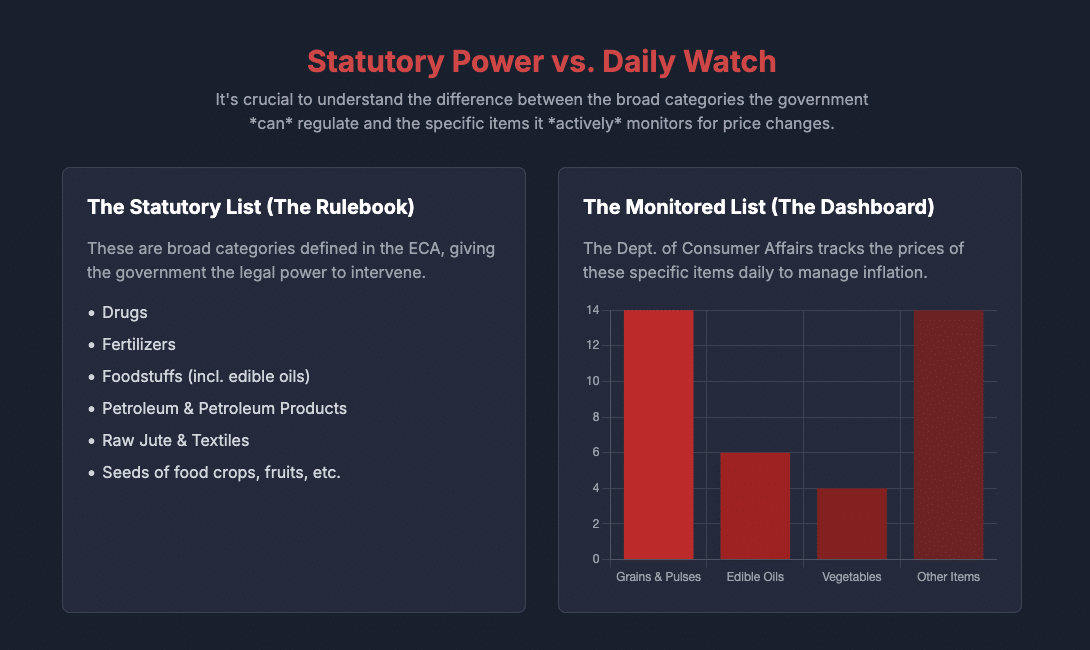
To fully grasp the scope of the ECA, it is crucial to distinguish between the broad legal categories defined in the Act and the specific list of items whose prices are actively tracked by the government for inflation management.
- Statutory List (The Schedule): This forms the legal foundation of the Act, granting the government regulatory power over broad classes of goods. These categories include items like drugs, fertilizers (inorganic, organic, or mixed), foodstuffs (a wide category that includes edible oilseeds and oils), petroleum and petroleum products, raw jute, and various seeds (for food crops, fruits, vegetables, and cattle fodder).6 This list provides the legal authority for government intervention.
- Monitored List (Price Monitoring): This is an administrative tool used by the Department of Consumer Affairs, under the Ministry of Consumer Affairs, Food & Public Distribution, for the day-to-day management of the economy.12 The department’s Price Monitoring Cell (PMC) actively tracks the retail and wholesale prices of a select basket of commodities to monitor inflation and inform policy decisions, such as the release of buffer stocks. This list was significantly expanded from 22 to 38 commodities and includes specific items like rice, wheat, various dals (pulses), packed edible oils, key vegetables (potato, onion, tomato), sugar, milk, and tea.14 This price monitoring mechanism is supported by instruments like the Price Stabilization Fund (PSF), which is used to moderate price volatility for commodities like pulses, onions, and potatoes.15
The distinction is significant. While petroleum products are legally classified as an “essential commodity,” giving the government the power to regulate them, the daily focus of the Price Monitoring Cell might be on the fluctuating prices of tomatoes or tur dal. This dual structure allows for broad legal authority that can be invoked when needed, alongside a more focused, agile administrative response to immediate inflationary pressures.
| Statutory Categories under ECA, 1955 | Commodities Actively Monitored by Dept. of Consumer Affairs (38 Items) |
| Drugs | Grains & Pulses: Rice, Wheat, Atta, Gram Dal, Tur/Arhar Dal, Urad Dal, Moong Dal, Masoor Dal, Bajra, Jowar, Ragi, Suji, Maida, Besan |
| Fertilizers (inorganic, organic, or mixed) | Edible Oils (Packed): Groundnut Oil, Mustard Oil, Vanaspati, Soya Oil, Sunflower Oil, Palm Oil |
| Foodstuffs (including edible oilseeds and oils) | Vegetables: Potato, Onion, Tomato, Brinjal, Banana |
| Hank yarn made wholly from cotton | Others: Sugar, Gur, Milk, Tea (Loose), Salt (Iodised), Ghee, Butter, Egg, Black Pepper, Coriander, Cumin Seed, Red Chillies, Turmeric Powder |
| Petroleum and Petroleum Products | |
| Raw jute and Jute Textiles | |
| Seeds of food crops, fruits, vegetables, cattle fodder, and jute seeds |
Section 2: The Government’s Powers, Penalties, and the 2020 Amendment
2.1. The Scope of Government Power under Section 3
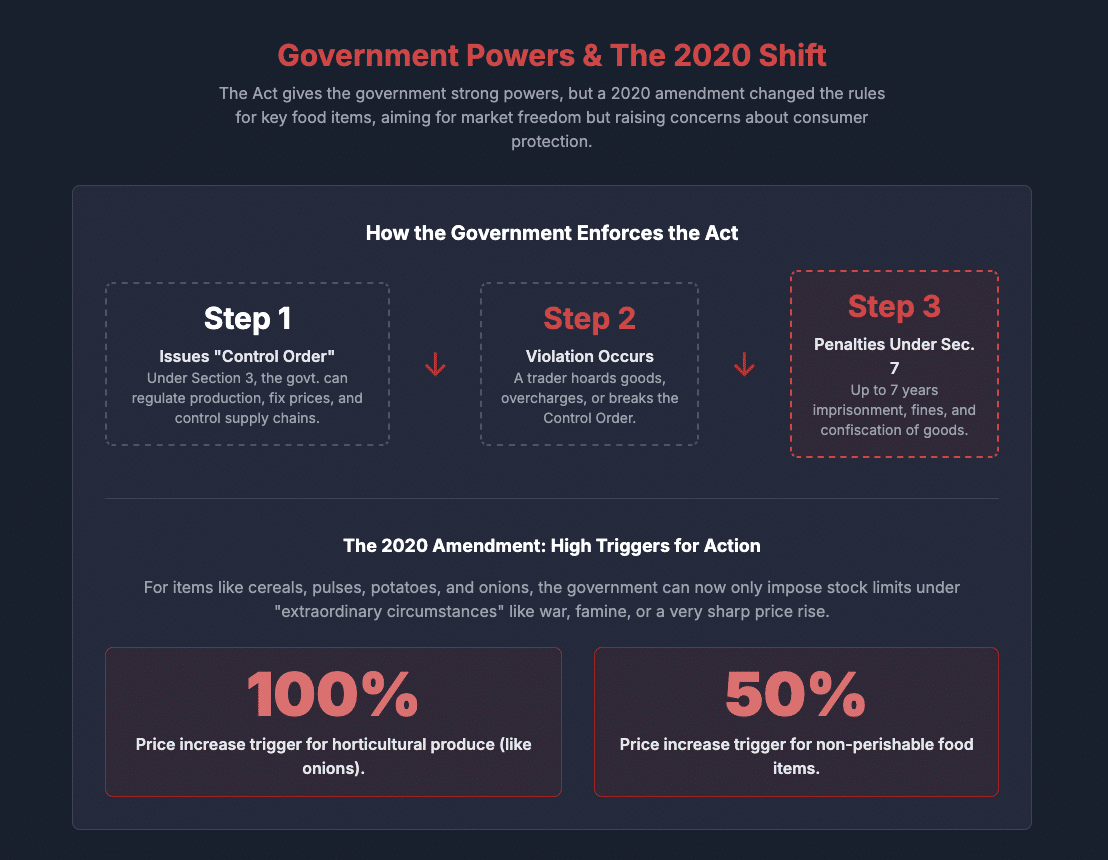
Section 3 of the ECA is the heart of the legislation, vesting the Central Government with extensive powers. It stipulates that if the government is of the opinion that it is “necessary or expedient” to do so for maintaining supplies, ensuring equitable distribution at fair prices, or for national defense, it can issue legally binding “Control Orders”.3 The scope of these orders is vast and can be used to:
- Regulate Production and Manufacturing: Control the production of any essential commodity through a system of licenses and permits.7
- Control Prices: Fix the maximum price at which an essential commodity may be bought or sold.3
- Control Supply Chain: Regulate the storage, transport, distribution, use, or consumption of any essential commodity.9
- Prevent Hoarding: Prohibit any person from withholding an essential commodity from sale if it is ordinarily kept for sale.9
- Compel Sale: Require any person holding stock of an essential commodity to sell the whole or a specified part of it to the Central or State Government or their agents.7
- Mandate Record-Keeping: Require persons engaged in the trade of essential commodities to maintain and produce for inspection such books, accounts, and records as may be specified.9
2.2. Penalties and Enforcement (Section 7): The Teeth of the Act
The ECA is backed by stringent penal provisions to ensure compliance. Section 7 of the Act outlines the penalties for contravening any Control Order issued under Section 3. Violations can lead to:
- Imprisonment: A minimum imprisonment of three months, which can extend up to seven years.3
- Fines: The imposition of fines.
- Confiscation: Under Section 6A, authorities have the power to confiscate the seized essential commodity, along with any package, covering, or receptacle in which it is found, and any animal, vehicle, or vessel used in carrying it.7
Offences under the Act are cognizable, meaning the police can arrest without a warrant, and are generally non-bailable.3 The Act also places a significant burden of proof on the accused in certain circumstances.
Judicial interpretation has played a key role in shaping the application of these penalties. In Sapana Trimbak Wani v. State of Maharashtra, (1976) 4 SCC 299, the Supreme Court established that a court could award a sentence less than the prescribed minimum only if there were “adequate or special reasons” to do so, underscoring the seriousness with which violations are to be treated.3
A crucial procedural safeguard was clarified in Prakash Babu Raghuvanshi v. State of M.P., (2004) 7 SCC 490. The court held that a conviction under Section 7 requires the violation of a formal “order” made under Section 3. A violation of a government “scheme” or guideline that has not been notified in the Official Gazette as a formal Control Order is not sufficient for prosecution under Section 7.3 This establishes a clear legal distinction: for penal consequences to apply, the government must follow the prescribed procedure of issuing a notified order, not just an administrative circular or scheme.
2.3. The Essential Commodities (Amendment) Act, 2020: A Paradigm Shift?
In 2020, as part of a package of controversial agricultural reforms, the Parliament passed the Essential Commodities (Amendment) Act.5 This amendment represented a fundamental shift in the philosophy underpinning the law, moving from a model of state control towards market liberalization. The original Act was a product of an era of scarcity, whereas the amendment was justified on the grounds that India is now a surplus producer of many agricultural goods.2
The key features of the 2020 amendment were:
- Deregulation of Foodstuffs: It sought to deregulate key agricultural items, including cereals, pulses, potato, onions, edible oilseeds, and oils. The government’s power to regulate the supply of these items was restricted to “extraordinary circumstances” only.5
- Defined Triggers for Regulation: These extraordinary circumstances were narrowly defined as (i) war, (ii) famine, (iii) extraordinary price rise, and (iv) natural calamity of a grave nature.10
- A High Price-Trigger Mechanism: The amendment introduced a specific and high threshold for what constitutes an “extraordinary price rise.” Stock limits could only be imposed if there was a 100% increase in the retail price of horticultural produce or a 50% increase in the retail price of non-perishable agricultural foodstuffs, compared to the price in the preceding 12 months or the last five-year average, whichever is lower.5
The stated rationale was to remove the “fear of excessive regulatory interference” among private investors, thereby attracting investment in the food supply chain, such as cold storages and warehouses. The government argued this would reduce post-harvest losses, create a competitive market environment, and ultimately lead to price stability for both farmers and consumers.19
However, the amendment was met with widespread protests and criticism. Opponents argued that it would dismantle the safety net provided by the ECA, leaving consumers and farmers at the mercy of large corporations. The primary concerns were that the deregulation would encourage hoarding, lead to artificial price hikes, and that the price triggers were set so high that they would rarely, if ever, be activated, effectively rendering the Act toothless for these commodities.10 This ideological clash between state regulation for public welfare and market freedom for economic growth lies at the core of the debate surrounding the ECA’s modern relevance.
Part II: Legal Precedents and Proceedings in Focus Areas
Section 3: “Having Issues with a Petrol Pump?” — A Legal Preview
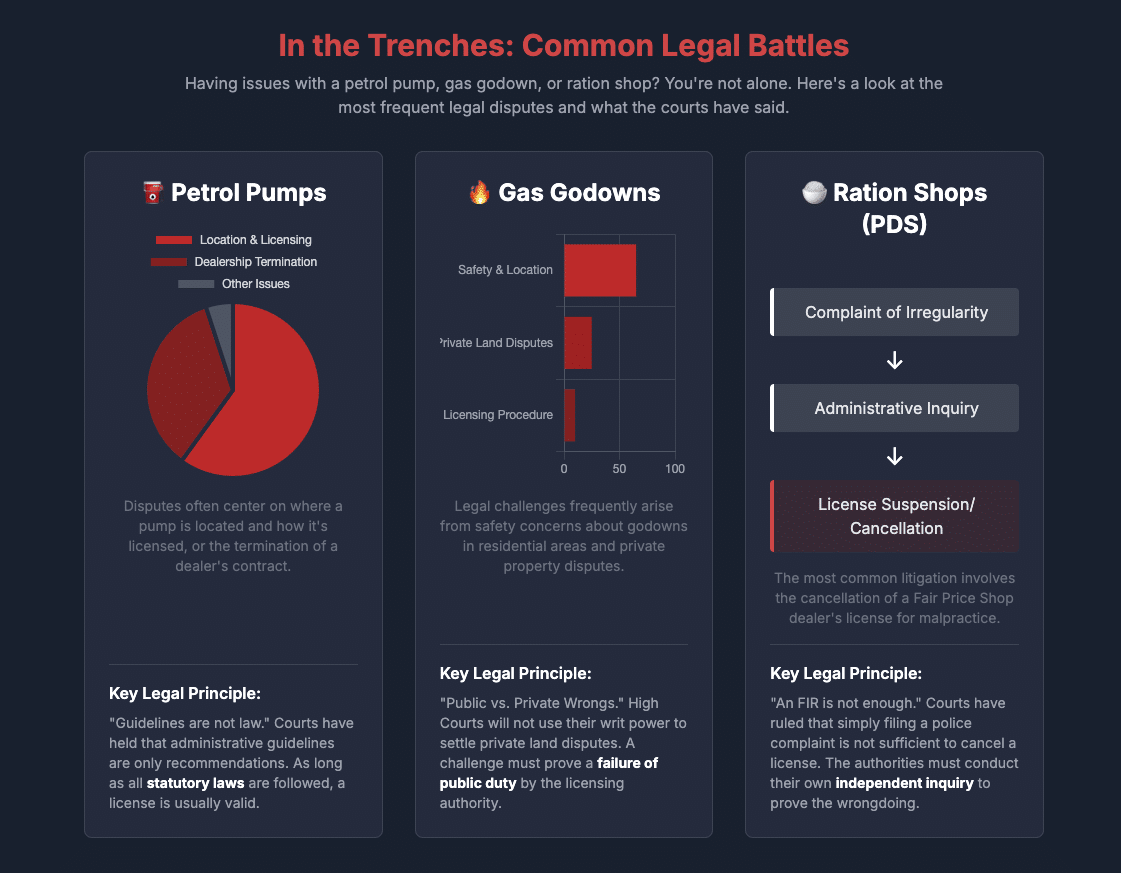
The establishment and operation of petrol pumps (retail outlets) are governed by a complex web of regulations, leading to frequent legal disputes. These disputes typically fall into two categories: challenges to the location and licensing of a new pump, and challenges against the termination of an existing dealership.
3.1. The Regulatory Maze: Licensing and Location Norms
Operating a petrol pump in India requires navigating a stringent licensing process. An applicant must meet several eligibility criteria, including being an Indian citizen between 21 and 58 years of age with a certain minimum educational qualification.22 Beyond personal eligibility, the most critical aspect is securing a multitude of approvals for the proposed site. This includes obtaining No Objection Certificates (NOCs) from various authorities such as the local municipal corporation, the fire safety department, and environmental bodies. A crucial license is also required from the Petroleum and Explosives Safety Organisation (PESO), which governs the safety of storing and handling petroleum products.23 Land ownership or a long-term lease over a suitable plot of land is a fundamental prerequisite.22
3.2. Location Disputes: When Guidelines Clash with Law
A significant portion of litigation concerning petrol pumps revolves around their location. Residents of an area or competing businesses often file civil suits or writ petitions challenging the setup of a new retail outlet on grounds of public safety, environmental pollution (from Volatile Organic Compounds like Benzene), or non-compliance with distance norms from schools, hospitals, or other petrol pumps.24
In adjudicating these disputes, courts have drawn a sharp line between statutory law and non-binding guidelines. A key legal principle that has been repeatedly affirmed is that guidelines issued by bodies like the Indian Road Congress (IRC), which suggest minimum distances between fuel stations, are recommendatory in nature and do not have the force of law.25
- In Neeraj Kachhawaha VS State of Rajasthan, the court held that such guidelines cannot serve as an absolute bar to the installation of a petrol pump if all statutory requirements under local zoning laws, master plans, and environmental regulations have been fulfilled.25
- The Calcutta High Court, in Amitava Roy Chowdhury VS State Of West Bengal, clarified that a civil suit challenging an installation is maintainable if it is based on the violation of statutory provisions or demonstrable procedural lapses in obtaining the necessary clearances.25
- A Public Interest Litigation (PIL) in the Madras High Court highlighted the judiciary’s proactive stance on public safety. The court directed PESO to conduct a thorough and due enquiry to satisfy itself about site suitability before granting initial approval, rather than issuing permissions mechanically. This case underscores that while administrative guidelines may be flexible, the statutory duty of care owed by regulatory bodies is not.24
The underlying judicial philosophy is clear: courts will not substitute their own judgment for that of the executive on the suitability of a location. However, they will rigorously scrutinize whether the executive has followed the legally mandated procedure to arrive at its decision. A challenge based on a violation of a non-binding guideline is likely to fail, whereas a challenge based on a failure to obtain a mandatory environmental clearance has a strong chance of success.
3.3. Dealership Termination and the Shield of Natural Justice
Another frequent area of litigation involves the termination of dealership agreements by Oil Marketing Companies (OMCs) like Indian Oil Corporation or Hindustan Petroleum. These actions are typically governed by the OMCs’ internal Marketing Discipline Guidelines (MDG), which set out procedures for inspections, penalties for irregularities (like adulteration or short-selling), and termination.26
The courts have consistently read the principles of natural justice into these proceedings. The MDG itself provides for a structured process:
- Show-Cause Notice: In case of any detected irregularity, a show-cause notice must be issued to the dealer, typically within 30 days of the inspection, detailing the specific charges.26
- Opportunity to be Heard: The dealer must be given a reasonable opportunity to present their case and defend themselves against the allegations. Any action taken without following this principle is liable to be struck down.
- Appellate Remedy: The MDG provides for an internal appellate mechanism, often a Dispute Resolution Panel (DRP) composed of a retired judge and other experts, to review termination orders.26
- The case of M/S M.K. Fuel Centre vs Indian Oil Corporation Limited serves as an important precedent, illustrating the court’s insistence on strict adherence to these procedural safeguards before the drastic step of termination is taken.26
- In Suresh Kumar vs UOI and Others, the Himachal Pradesh High Court demonstrated a pragmatic approach. Faced with a termination based on an alleged concealment of employment by the dealer, the court directed the OMC to reconsider the matter in light of a new, more lenient policy that allowed for the condonation of past irregularities upon payment of a penalty. The court directed that the case be decided afresh under the new policy, without being prejudiced by the earlier termination order.27 This shows that courts will hold public bodies accountable to their own evolving standards of fairness.
Section 4: Navigating Gas Godown Regulations and Disputes
The storage of Liquefied Petroleum Gas (LPG) is an inherently hazardous activity, and its regulation is a matter of significant public interest. Legal disputes concerning LPG godowns often mirror those related to petrol pumps, focusing on safety, location, and licensing.
4.1. Regulatory Framework for LPG Storage
The primary legislation governing the storage of LPG in cylinders is the Gas Cylinders Rules, 2004, which are enforced by PESO. These rules are highly technical and prescribe detailed norms for the location, design, and construction of LPG storage godowns, including mandatory minimum safety distances from surrounding buildings, roads, and property lines.28 Obtaining a license under these rules is a prerequisite for operating an LPG distributorship.
4.2. Common Legal Disputes
Litigation concerning LPG godowns frequently arises from:
- Location in Residential Areas: Residents often approach courts with writ petitions or civil suits to prevent or halt the construction of LPG godowns in close proximity to their homes, citing the risk of fire and explosion.28
- Land Ownership and Joint Property: As with petrol pumps, disputes erupt when an LPG distributorship is awarded to one co-owner of a joint property, who then proceeds to construct a godown on the land without a formal partition, infringing upon the rights of the other co-owners.29
- Procedural Violations: Challenges are also mounted on the grounds that the licensing authorities (like PESO or the local municipality) granted permissions without conducting proper site inspections or ensuring strict compliance with all safety regulations.
4.3. The Calcutta High Court’s Stance: Public vs. Private Wrongs
The Calcutta High Court has provided a crucial and clarifying judgment on the scope of its writ jurisdiction in such matters. The decision in Sayed Afridi Sarkar v. Indian Oil Corpn. is a landmark in this context, establishing a clear boundary between private disputes and public wrongs.29
- Factual Background: In this case, a petitioner filed a writ petition seeking to quash an LPG distributorship granted to a relative (the private respondent). The core of the grievance was that the respondent was constructing the necessary office and godown on a piece of ancestral land for which a partition suit was already pending in a civil court. The petitioner alleged that the distributorship was obtained by misrepresenting the ownership of the land to the OMC (Indian Oil Corporation Limited).
- The Court’s Decision and Rationale: The High Court dismissed the writ petition. It reasoned that the dispute over the ownership of the land was a private civil dispute between the petitioner and the respondent. The proper forum for resolving such a dispute is the civil court where the partition suit was pending. The decision by IOCL to grant a distributorship, on the other hand, is a commercial decision.
- The Key Legal Principle: The Court held that it would not interfere with such a commercial decision under its extraordinary writ jurisdiction (Article 226) unless the petitioner could demonstrate that the decision-making process of the public authority (IOCL) was itself flawed by arbitrariness, irrationality, or perversity. The mere existence of a private land dispute between the applicant and a third party does not, in itself, render the public authority’s decision arbitrary.
This judgment serves as a strong deterrent against the misuse of writ petitions as a tool to settle private property scores. It forces litigants to address the correct forum for their grievance. For a challenge against an LPG godown to succeed in the High Court, the petitioner must prove a failure of public duty on the part of the regulatory authority—for instance, by showing that PESO ignored its own safety rules or that the OMC’s selection process was fundamentally unfair—rather than focusing on their private property rights.
Section 5: The Ration Shop Conundrum: Rights, Responsibilities, and Recourse
The Public Distribution System (PDS) is the backbone of India’s food security apparatus, and the Fair Price Shop (FPS), commonly known as the ration shop, is its final delivery point. Given the vast scale of the PDS and the critical nature of the commodities involved, this area is rife with legal challenges, primarily concerning the licensing of FPS dealers.
5.1. The Legal Framework of the Public Distribution System (PDS)
The PDS evolved from a system of managing food scarcity in the 1960s into a massive welfare mechanism aimed at distributing foodgrains at affordable prices.30 While the Central Government, through the Food Corporation of India (FCI), is responsible for procurement, storage, and bulk allocation of foodgrains, the operational responsibility rests with the State Governments. This includes identifying eligible families, issuing ration cards, and, crucially, the licensing and supervision of FPS.13 The functioning of the PDS is now primarily governed by the provisions of the
National Food Security Act, 2013.31
5.2. Suspension and Cancellation of Licenses: A Hotbed of Litigation
A significant volume of litigation under the ECA pertains to the suspension or cancellation of FPS licenses by district authorities. These actions are typically taken in response to allegations of irregularities such as:
- Diverting subsidized foodgrains (wheat, rice, sugar) and kerosene to the black market.
- Creating bogus or “ghost” ration cards to siphon off supplies.
- Maintaining false stock registers.
- Overcharging beneficiaries.
The procedure for such disciplinary action is laid out in state-specific Control Orders, such as the U.P. Scheduled Commodities Distribution Order, 2004, or the West Bengal Kerosene Control Order, 1968.32 The process generally involves an inquiry by a food inspector, a show-cause notice to the dealer, and an order of suspension or cancellation by the competent authority (e.g., the District Supply Officer or Sub-Divisional Magistrate). These orders are typically appealable to a higher administrative authority like the Divisional Commissioner.32
5.3. Judicial Review of Administrative Action
Aggrieved FPS dealers frequently challenge these administrative orders by filing writ petitions in the High Courts. Over the years, the judiciary has laid down several important principles that govern these disputes:
- An FIR is Not a Substitute for an Inquiry: In a significant ruling, a Full Bench of the Allahabad High Court in Bajrangi Tiwari held that the mere registration of an FIR against a dealer under Section 3/7 of the ECA is not a sufficient ground to suspend or cancel their license. The administrative authority must conduct its own independent inquiry to establish the alleged irregularities. This principle was reiterated in Radhey Shyam vs State Of U.P..35 This prevents dealers from being penalized solely on the basis of a police complaint, which may or may not lead to a conviction.
- No Automatic Stay on Appeal: The Allahabad High Court in Mandhata Rai Vs. State Of U.P. clarified that the mere filing of an appeal against a cancellation order does not automatically stay the operation of that order. The cancellation remains in force unless the appellate authority explicitly grants a stay. This is a crucial principle that allows the administration to make alternative arrangements for the supply of essential commodities to the public, ensuring that beneficiaries do not suffer while the appeal is pending.32
- Judicial Scrutiny of Political and Ministerial Discretion: The judiciary acts as a vital check against the arbitrary or politically motivated exercise of power. In a notable case from Maharashtra, the Aurangabad bench of the Bombay High Court set aside an order by the state’s Civil Supplies Minister, Girish Bapat, who had restored the license of an FPS dealer despite it being cancelled by both the District Supply Officer and the Deputy Commissioner based on strong evidence of malpractice. The court strongly criticized the minister, stating that he had been “over-indulgent” and had “failed in his duties” as a custodian of public rights, especially given the allegation that the dealer was politically well-connected.36 This case affirms that even high-level executive decisions are subject to judicial review for fairness and reasonableness.
- Limited Standing of Complainants: While ration cardholders have a right to complain against a dealer and provide evidence during an inquiry, their legal standing is limited. The Allahabad High Court, in a case involving Anar Singh, held that once an inquiry is initiated, the matter becomes a legal dispute (lis) between the state and its agent (the FPS dealer). The original complainant is not a party to this dispute and cannot challenge the final order or the quantum of punishment. The court reasoned that allowing complainants to prolong litigation would impede the functioning of the PDS. The remedy for a cardholder who is denied their entitlements lies under the grievance redressal mechanism of the National Food Security Act, 2013.31
- Adherence to Eligibility Criteria: In a case before the Calcutta High Court, a challenge to the appointment of an FPS dealer was dismissed because the court found that the selected candidate had met all the eligibility criteria laid out in the vacancy notification. The court reiterated the principle that it would not interfere in the grant of licenses unless there was clear evidence of arbitrariness or malafide conduct.38 This principle applies with equal force to both the appointment and the cancellation of licenses.
Part III: A Practical Guide to Legal Remedies
Section 6: The Citizen’s Legal Toolkit: From Complaint to Courtroom
#image_title
Navigating disputes related to essential commodities requires understanding the appropriate channels for grievance redressal. The legal path often begins with administrative complaints and may escalate to the High Court through a writ petition or Public Interest Litigation (PIL).
6.1. Administrative Remedies: The First Port of Call
Before resorting to litigation, it is almost always advisable, and sometimes legally required, to exhaust the available administrative remedies.
- Against Hoarding and Black-Marketing: Any citizen who has information about the hoarding, black-marketing, or overcharging of essential commodities can file a complaint. The appropriate authorities to approach are the District Magistrate (Collector), the Commissioner of Police (in metropolitan areas), the District Police Superintendent, or the Secretary of the relevant state department (e.g., Food and Civil Supplies).39
- Regarding Ration Shops (PDS): For issues like non-distribution, poor quality of grains, or overcharging at a Fair Price Shop, the initial complaint should be lodged with the local office of the Food and Civil Supplies Department. These offices are mandated to display the contact details of officials to whom such grievances can be addressed.40
- Concerning Petrol Pumps and Gas Godowns: For complaints related to quality/quantity of fuel, safety violations, or licensing irregularities, the complaint can be directed to the specific Oil Marketing Company (e.g., IOCL, BPCL, HPCL), the Petroleum and Explosives Safety Organisation (PESO) for safety issues, or the District Magistrate for general administrative oversight.
6.2. The Writ Petition: Invoking the High Court’s Power
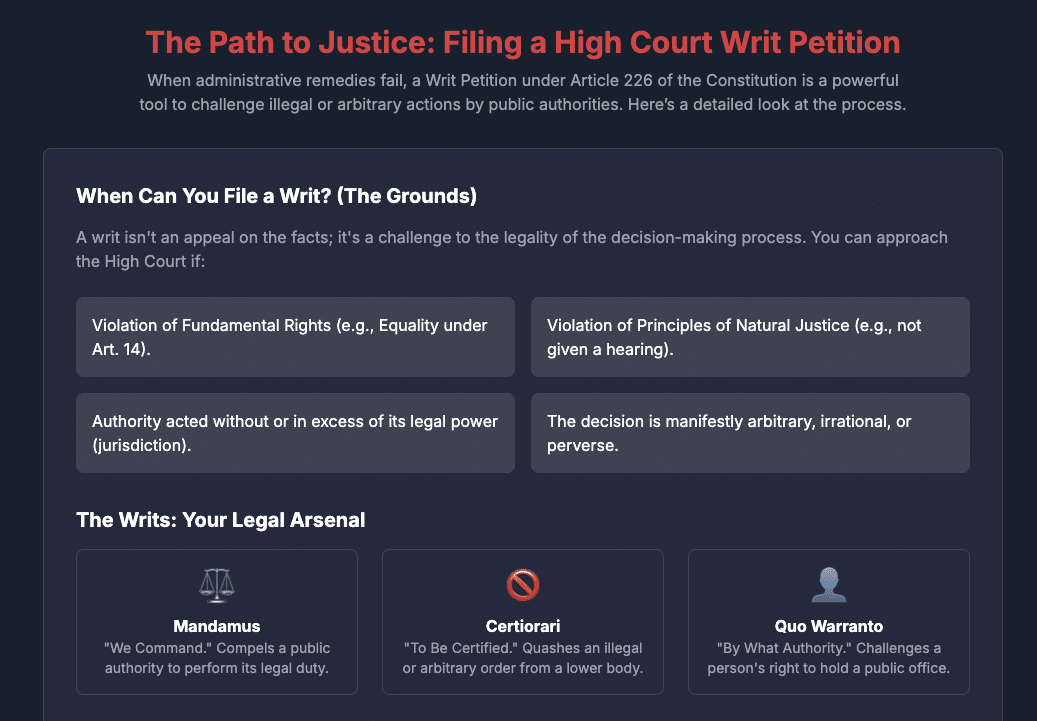
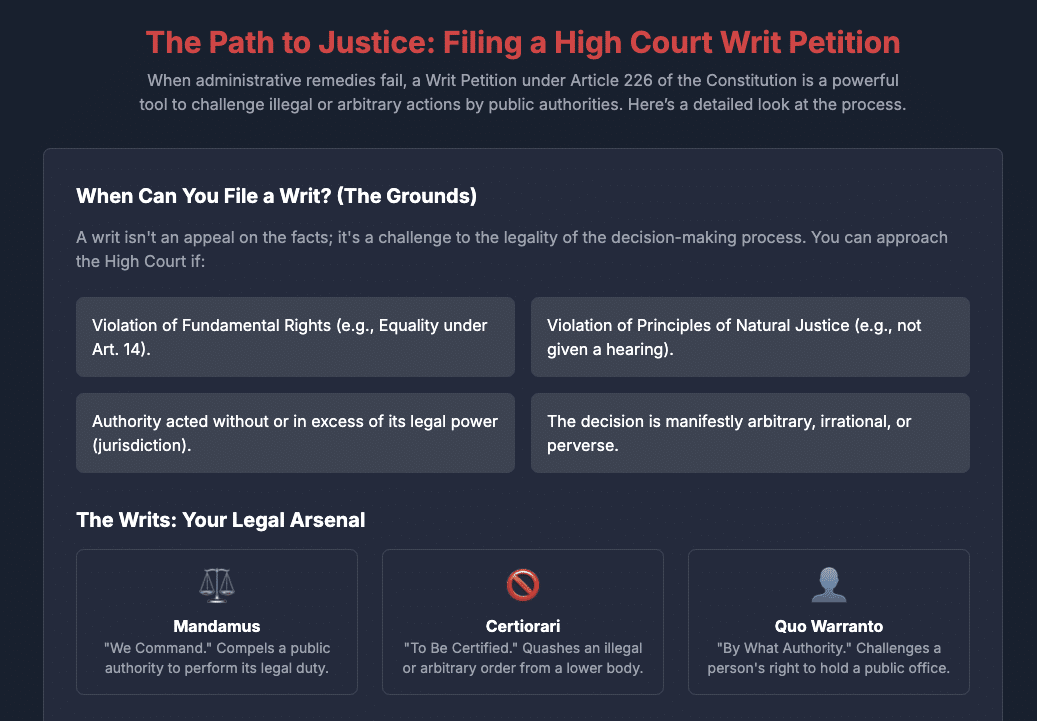
When administrative remedies fail or when there is a clear case of arbitrary or illegal action by a public authority, a citizen can approach the High Court by filing a writ petition under Article 226 of the Constitution of India.41
- Grounds for Filing: A writ petition is not an appeal on the merits of a decision. It is a challenge to the legality of the decision-making process. Common grounds include:
- Violation of Fundamental Rights (e.g., Article 14 – Right to Equality, Article 19(1)(g) – Right to practice any profession).
- Violation of the principles of natural justice (e.g., not being given a hearing before an adverse order).
- The authority acting without or in excess of its jurisdiction.
- The decision being manifestly arbitrary, irrational, or based on irrelevant considerations.41
- Types of Writs: Depending on the relief sought, different writs can be prayed for:
- Mandamus (we command): To compel a public authority to perform its statutory duty.
- Certiorari (to be certified): To quash an illegal or arbitrary order passed by a lower court, tribunal, or quasi-judicial authority.
- Quo Warranto (by what authority): To challenge a person’s right to hold a public office.43
- Procedure for Filing in the Calcutta High Court: The Calcutta High Court has a unique procedural distinction between its Original Side and Appellate Side for writ petitions.
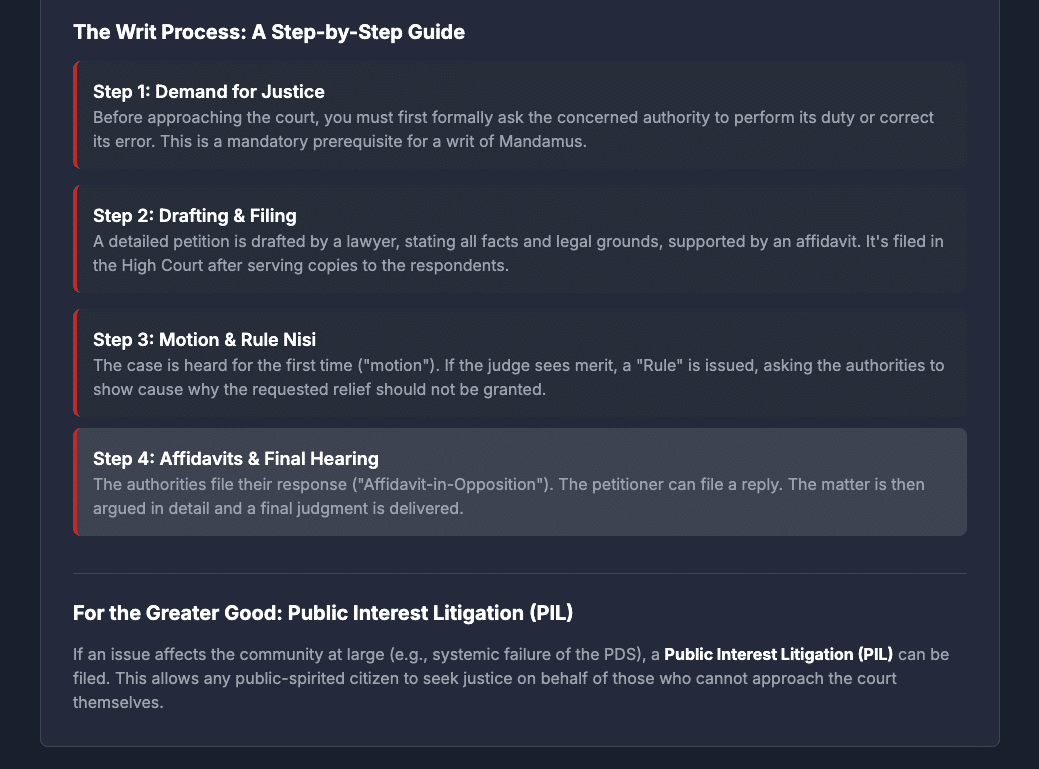
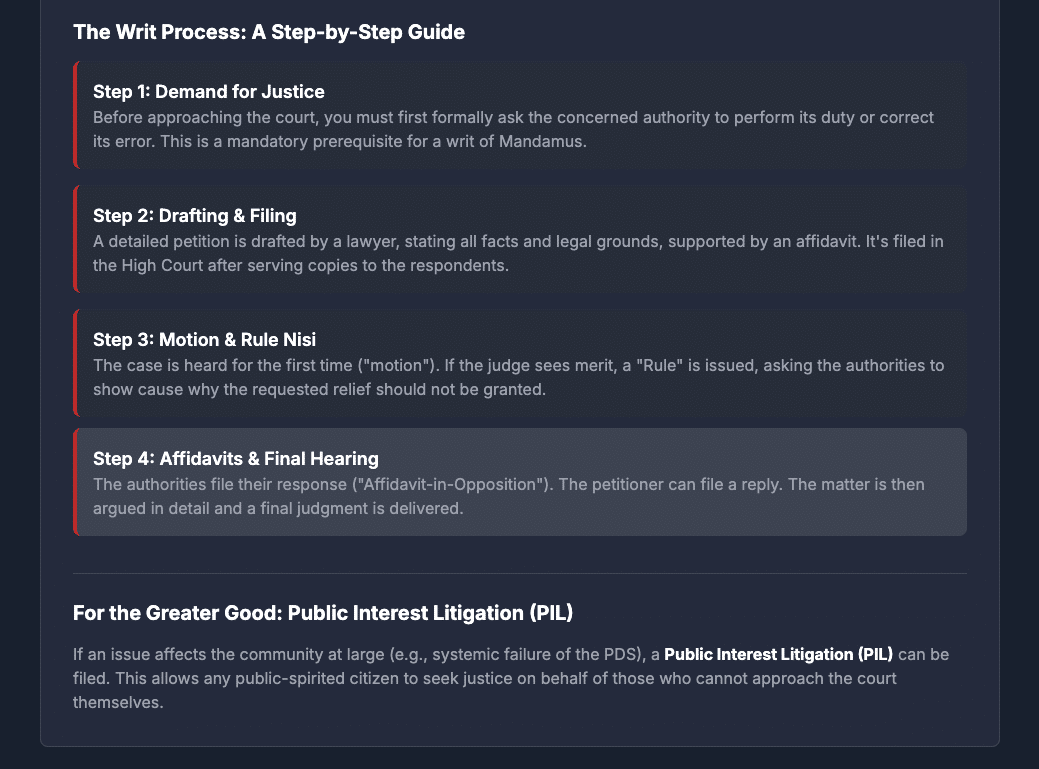
- Jurisdiction: As per the High Court’s rules, applications for writs like Mandamus, Prohibition, and Quo Warranto where all respondents reside or have their offices within the Ordinary Original Civil Jurisdiction of the High Court are dealt with by the Original Side. All other writ applications are dealt with by the Appellate Side.44 The petition must be correctly titled, for instance, “In the High Court at Calcutta, Constitutional Writ Jurisdiction, Appellate Side”.43
- Drafting: The petition must be meticulously drafted, setting out the facts, the legal grounds for the challenge, and a clear prayer for relief. It must be supported by an affidavit verifying the contents. If seeking a writ of Mandamus, it is essential to state that a “demand for justice” was made to the authority and was refused or ignored.43
- Filing and Hearing: The drafted petition, along with all supporting documents (annexures) and the requisite court fees, is filed with the Registrar. Copies must be served in advance to all respondents. The matter is then listed for a preliminary hearing (“Motion”). If the judge finds a prima facie case, a “Rule” is issued, calling upon the respondents to show cause why the relief should not be granted. Respondents then file their “Affidavit-in-Opposition,” to which the petitioner may file a reply. The matter is then heard finally and disposed of.43
6.3. Public Interest Litigation (PIL): A Tool for Systemic Change
For issues that affect the public at large, rather than an individual grievance, the most effective tool is a Public Interest Litigation (PIL). A PIL can be filed by any public-spirited citizen or social action group, even if they are not personally affected by the issue.48
- Scope: A PIL is appropriate for challenging systemic failures, such as the non-functioning of the PDS across an entire district, widespread environmental violations by a group of industries, or the government’s failure to implement a food security policy.50
- Forum: A PIL can be filed in the High Court under Article 226 or directly in the Supreme Court under Article 32 of the Constitution.48
- Key Considerations: Courts are cautious to ensure that the PIL mechanism is not misused for private gain, political motives, or to settle personal scores. The petitioner must demonstrate that the matter is of genuine public importance and that they have approached the court with clean intentions.51
The choice of legal remedy is therefore a strategic one. An individual’s wrongful license cancellation requires a writ petition. A systemic failure of governance requires a PIL. And a private property dispute, even if it involves a licensed entity like a gas godown, must be agitated before a civil court.
Section 7: Key Legal Principles and Actionable Advice
7.1. Synthesis of Key Judgments and Law Points
The body of case law surrounding the Essential Commodities Act and the regulation of related services has established several clear and actionable legal principles. The following is a consolidated list of over 15 such important points derived from the preceding analysis.
- Objective of ECA: The primary purpose of the ECA, 1955, is to ensure the equitable distribution of essential goods at fair prices and protect consumers from hoarding and black-marketing.3
- Dynamic Definition: An “essential commodity” is not static; the Central Government can add or remove items from the Schedule of the Act via a notified order in the public interest.2
- “Scheme” vs. “Order”: For a person to be prosecuted under Section 7 of the ECA, they must have violated a formal “Control Order” notified in the Official Gazette, not merely an administrative “scheme” or guideline. (Prakash Babu Raghuvanshi v. State of M.P.).3
- Minimum Sentence: Penalties under Section 7 are stringent, and a sentence below the prescribed minimum can only be given for “adequate or special reasons.” (Sapana Trimbak Wani v. State of Maharashtra).3
- Non-Statutory Guidelines are Not Law: Administrative guidelines, such as those from the Indian Road Congress for petrol pump distances, are recommendatory and not legally enforceable in court if all statutory laws have been complied with. (Neeraj Kachhawaha VS State of Rajasthan).25
- Writ for Procedural Illegality: A civil suit or writ petition against a petrol pump or gas godown installation is maintainable if it is based on a violation of statutory law or a failure to follow the legally mandated procedure for obtaining clearances. (Amitava Roy Chowdhury VS State Of West Bengal).25
- Duty of Regulatory Bodies: Regulatory bodies like PESO have a statutory duty to conduct a proper and thorough inquiry before granting site approvals for hazardous installations like petrol pumps. (Madras High Court PIL).24
- Natural Justice in Dealership Termination: An Oil Marketing Company cannot terminate a dealership without adhering to the principles of natural justice, which includes issuing a clear show-cause notice and providing a fair opportunity to be heard. (M/S M.K. Fuel Centre vs Indian Oil Corporation Limited).26
- Application of Fair Policies: Courts can direct authorities to reconsider a harsh administrative action (like dealership termination) in light of newer, more lenient policies that may be applicable. (Suresh Kumar vs UOI and Others).27
- Writ Jurisdiction is for Public Wrongs, Not Private Disputes: The High Court’s writ jurisdiction under Article 226 is meant to correct errors of public authorities, not to settle private civil disputes like land ownership, even if one party is a public sector undertaking. (Sayed Afridi Sarkar v. Indian Oil Corpn.).29
- FIR is Insufficient for License Cancellation: The mere registration of an FIR under the ECA is not, in itself, a ground for cancelling a Fair Price Shop license. An independent administrative inquiry establishing the irregularity is essential. (Bajrangi Tiwari principle, cited in Radhey Shyam vs State Of U.P.).35
- No Automatic Stay on Appeal: Filing an appeal against a license cancellation order does not result in an automatic stay. The administration is free to make alternative arrangements for PDS distribution unless a stay is explicitly granted by the appellate authority. (Mandhata Rai Vs. State Of U.P.).32
- Judicial Review of Ministerial Action: The quasi-judicial decisions of high executive authorities, including Ministers, are subject to judicial review and can be struck down if found to be arbitrary, politically motivated, or against the public interest. (Bombay High Court judgment on Minister Girish Bapat’s order).36
- Limited Locus Standi of Complainants: A ration cardholder’s right is limited to lodging a complaint and giving evidence in the inquiry. They are not a party to the legal dispute between the state and the FPS dealer and cannot challenge the final administrative order. (Anar Singh Vs. State of U.P.).31
- Interference Only on Grounds of Arbitrariness: Courts will refrain from interfering in the grant or cancellation of contracts and licenses unless there is clear evidence of arbitrariness, mala fides, or irrationality in the decision-making process. (Calcutta High Court judgment on FPS dealer appointment).38
- Price Fixation as a Legislative Function: The power to fix prices of essential commodities is a legislative function delegated to the executive. Courts will not interfere with the price fixed unless the methodology is proven to be arbitrary or contrary to the statute. (Union Of India & Anr vs Cynamide India Ltd. & Anr).53
- Overriding Effect of ECA: In case of a conflict between a state law and a Central Government order under the ECA on a concurrent list subject (like price fixation of sugarcane), the Central order will prevail due to the principle of repugnancy. (West U.P. Sugar Mills Association vs The State Of Uttar Pradesh).53
| Case Name & Citation | Court | Subject Matter | Key Legal Principle Established |
| Sayed Afridi Sarkar v. Indian Oil Corpn. | Calcutta HC | LPG Godown | Writ jurisdiction under Art. 226 is for public wrongs, not to settle private property disputes. 29 |
| M/S M.K. Fuel Centre vs Indian Oil Corpn. Ltd. | Allahabad HC | Petrol Pump | Dealership termination requires adherence to natural justice and procedures in Marketing Discipline Guidelines. 26 |
| Mandhata Rai Vs. State Of U.P. | Allahabad HC | Ration Shop | Filing an appeal against license cancellation does not operate as an automatic stay of the order. 32 |
| Radhey Shyam vs State Of U.P. | Allahabad HC | Ration Shop | Mere registration of an FIR under ECA is not sufficient ground for license cancellation without an administrative inquiry. 35 |
| Neeraj Kachhawaha VS State of Rajasthan | Rajasthan HC | Petrol Pump | Administrative guidelines (like IRC norms) are recommendatory and not legally binding if statutory rules are met. 25 |
| Amitava Roy Chowdhury VS State Of West Bengal | Calcutta HC | Petrol Pump | A civil suit is maintainable against a petrol pump installation if it violates statutory provisions or procedural requirements. 25 |
| Suresh Kumar vs UOI and Others | Himachal Pradesh HC | Petrol Pump | Authorities can be directed to reconsider a termination decision based on new, more lenient policies. 27 |
| Bombay HC Judgment on Girish Bapat’s order | Bombay HC | Ration Shop | Ministerial orders are subject to judicial review and can be quashed if found arbitrary or against public interest. 36 |
| Prakash Babu Raghuvanshi v. State of M.P. | Supreme Court | ECA Principle | Prosecution under Sec. 7 of ECA is only valid for violation of a notified “Order,” not a mere “scheme.” 3 |
| Union Of India & Anr vs Cynamide India Ltd. & Anr | Supreme Court | ECA Principle | Price fixation is a legislative function; courts will not interfere unless the process is arbitrary. 53 |
| West U.P. Sugar Mills Association vs The State Of Uttar Pradesh | Supreme Court | ECA Principle | Central Government orders under ECA prevail over conflicting state laws on concurrent subjects. 53 |
| State Of Bihar Etc. Etc vs P.P. Sharma | Supreme Court | ECA Principle | Established principles regarding investigation and quashing of criminal proceedings under ECA. 53 |
| Sapana Trimbak Wani v. State of Maharashtra | Supreme Court | ECA Principle | A sentence below the statutory minimum under ECA requires “adequate or special reasons.” 3 |
| Anar Singh Vs. State of U.P. (In re) | Allahabad HC | Ration Shop | A complainant in a PDS matter has limited locus standi and is not a party to the lis between the State and the dealer. 31 |
| Madras HC PIL on Petroleum Outlets | Madras HC | Petrol Pump | Regulatory bodies like PESO have a positive duty to conduct due inquiry before granting site approvals for hazardous units. 24 |
7.2. Actionable Advice and Checklists
For Business Owners (Petrol Pumps, Gas Godowns, FPS Dealers):
- Compliance Checklist:
- Know the Law: Differentiate between binding statutory rules (e.g., Gas Cylinders Rules, state Control Orders) and non-binding guidelines (e.g., IRC norms). Compliance with the former is non-negotiable.
- Maintain Meticulous Records: Keep all licenses, permits, stock registers, and sale records updated and available for inspection at all times.
- Display Information: Ensure all mandatory information, such as license numbers on signboards and cash memos, is prominently displayed as required.
- Respond to Notices Promptly: Never ignore a show-cause notice. Respond in writing, addressing each allegation specifically with supporting documents, within the stipulated time.
- Document Everything: Keep a record of all inspections, communications with authorities, and complaints received.
- Litigation Checklist:
- Seek Legal Counsel Immediately: Upon receiving a suspension or termination notice, consult a lawyer experienced in administrative law.
- Exhaust Appellate Remedies: Before filing a writ petition, ensure you have exhausted the available departmental appeal process, unless the initial order is wholly without jurisdiction.
- Focus on Procedural Lapses: In court, the strongest challenge is often against procedural irregularities—failure to issue a notice, denial of a hearing, reliance on non-statutory rules, or a non-speaking (unreasoned) order.
- Preserve Evidence: Secure copies of all relevant documents, including the inquiry report, witness statements, and official correspondence.
For Citizens and Activists:
- “Know Your Rights” Guide:
- You have the right to receive the specified quantity and quality of essential commodities from your ration shop at the government-fixed price.
- You have the right to a safe environment, which can be a ground to object to the hazardous location of a petrol pump or gas godown if it violates statutory safety or environmental laws.
- You have the right to complain to the relevant authorities about any malpractice.
- Guide to Effective Complaining:
- Be Specific: Vague complaints are often ignored. State the exact nature of the problem (e.g., “Ration shop dealer X overcharged by Rs. 2 per kg of wheat on [date]”), the location, date, and time.
- Complain in Writing: A written complaint creates a record. Always ask for a receipt or acknowledgment.
- Provide Evidence: If possible, attach supporting evidence like a cash memo, photograph, or names of other witnesses.
- Escalate: If the local authority does not act on your complaint within a reasonable time, escalate it to the next higher authority in the department.
- Checklist for Considering a PIL:
- Is it a Public Issue? Does the problem affect a large number of people or a vulnerable section of the community? (e.g., failure of PDS in an entire block).
- Is it a Private Grievance? Avoid filing a PIL for personal disputes or to target a single individual or business.
- Have You Done Your Homework? Collect substantial evidence (documents, photographs, data) to support your claims of a systemic failure.
- Have You Approached the Authorities First? Before filing a PIL, it is good practice to send a representation or legal notice to the concerned government departments, giving them an opportunity to act. This strengthens your case in court.
#EssentialCommoditiesAct #PetrolPumpDispute #GasGodownRules #RationShopLicense #HighCourtWrit #PublicInterestLitigation #AntiHoardingLaw #CalcuttaHighCourtLawyer #PDS #FuelAdulteration #WritOfMandamus #NaturalJustice #PESOLicense #IOCLDispute #ConsumerRights #BlackMarketing #LandDisputeLawyer #LegalAdviceIndia #FilePIL #PatrasLawChambers
Works cited
- An overview of the Essential Commodities Act,1955 – iPleaders, accessed on July 30, 2025, https://blog.ipleaders.in/overview-of-the-essential-commodities-act-1955/
- Essential Commodities (Amendment) Bill, 2020 – Shankar IAS Parliament, accessed on July 30, 2025, https://www.shankariasparliament.com/current-affairs/gs-ii/gs-ii-govt-policies-interventions/essential-commodities-amendment-bill-2020
- The Essential Commodities Act, 1955: Merits and Challenges – IJFMR, accessed on July 30, 2025, https://www.ijfmr.com/papers/2024/6/33906.pdf
- Essential Commodities Regulation and Enforcement, accessed on July 30, 2025, https://consumeraffairs.gov.in/pages/ecree#:~:text=The%20Essential%20Commodities%20Act%2C%201955%20was%20enacted%20to%20ensure%20the,from%20exploitation%20by%20unscrupulous%20traders.
- Essential Commodities Act – Wikipedia, accessed on July 30, 2025, https://en.wikipedia.org/wiki/Essential_Commodities_Act
- The Essential Commodities Act, 1955 – People’s Archive of Rural India, accessed on July 30, 2025, https://ruralindiaonline.org/en/library/resource/the-essential-commodities-act-1955/
- THE ESSENTIAL COMMODITIES ACT, 1955 An Act to provide, in the interests of the general public, for the control of the production, accessed on July 30, 2025, https://gujhealth.gujarat.gov.in/images/pdf/Act/essential-commodities-act.pdf
- study on implementation of essential commodities act, 1955 and the prevention of black marketing, accessed on July 30, 2025, https://consumeraffairs.nic.in/sites/default/files/file-uploads/study-report-on-ec-act-and-pbmmsec-act/Study_Vol1.pdf
- THE ESSENTIAL COMMODITIES ACT, 1955 (As amended upto 24,.12.1986) – SeedNet India Portal, accessed on July 30, 2025, https://seednet.gov.in/PDFFILES/Essential_Commodity_Act_1955(Amend_upto_1986).pdf
- Essential Commodities Act – Details, Amendments and Impacts – Testbook, accessed on July 30, 2025, https://testbook.com/articles/essential-commodities-act-eca
- Essential Commodities Act, 1955 | Department of Food, Civil Supplies and Consumer Protection | India, accessed on July 30, 2025, https://mahafood.gov.in/essential-commodities-act-1955/
- Ministry of Consumer Affairs, Food and Public Distribution – Open Government Data (OGD) Platform India, accessed on July 30, 2025, https://www.data.gov.in/ministrydepartment/Ministry%20of%20Consumer%20Affairs,%20Food%20and%20Public%20Distribution
- Ministry of Consumer Affairs, Food and Public Distribution – Wikipedia, accessed on July 30, 2025, https://en.wikipedia.org/wiki/Ministry_of_Consumer_Affairs,_Food_and_Public_Distribution
- nic.in, accessed on July 30, 2025, https://fcainfoweb.nic.in/Essential_comm.aspx
- India expands daily price monitoring to 38 essential commodities, accessed on July 30, 2025, https://www.indiabusinesstrade.in/news_buzz/india-expands-daily-price-monitoring-to-38-essential-commodities/
- Price Rise of Essential Commodities – PIB, accessed on July 30, 2025, https://www.pib.gov.in/newsite/PrintRelease.aspx?relid=191386
- THE ESSENTIAL COMMODITIES ACT, 1955 ______ ARRANGEMENT OF SECTIONS – India Code, accessed on July 30, 2025, https://www.indiacode.nic.in/bitstream/123456789/7053/1/essential_commodities_act_1955.pdf
- Essential Commodities Act, 1955 Section 3(C) – CourtKutchehry, accessed on July 30, 2025, https://www.courtkutchehry.com/Judgement/Search/AdvancedV2?s_acts=Essential%20Commodities%20Act,%201955§ion_art=section&s_article_val=3(c)
- Parliament passes the Essential Commodities (Amendment) Bill, 2020 – PIB, accessed on July 30, 2025, https://www.pib.gov.in/PressReleasePage.aspx?PRID=1657657
- org, accessed on July 30, 2025, https://prsindia.org/billtrack/the-essential-commodities-amendment-bill-2020#:~:text=The%20Essential%20Commodities%20(Amendment)%20Ordinance%2C%202020%20allows%20the%20central,is%20a%20steep%20price%20rise.
- THE ESSENTIAL COMMODITIES (AMENDMENT) BILL, 2020 – Chanakya Mandal Online, accessed on July 30, 2025, https://lms.chanakyamandal.org/current-event/the-essential-commodities-amendment-bill-2020/
- How to Secure Petrol Pump License in India? – Corpbiz, accessed on July 30, 2025, https://corpbiz.io/learning/how-to-secure-petrol-pump-license-in-india/
- Know About Petrol Pump License Eligibility and Cost. – TaxTMI, accessed on July 30, 2025, https://www.taxtmi.com/article/detailed?id=12750
- Madras High Court directs PESO to give licence to petroleum retail outlets in Tamil Nadu, Puducherry only if they fulfill mandatory norms – India Legal, accessed on July 30, 2025, https://indialegallive.com/constitutional-law-news/courts-news/madras-high-court-petroleum-retail-outlets-mandatory-norms/
- Is civil suit against installation of petrol pump barred – Supreme Today AI, accessed on July 30, 2025, https://supremetoday.ai/issue/Is-civil-suit-against-installation-of-petrol-pump-barred
- M/S M.K. Fuel Centre vs Indian Oil Corporation Limited And 4 … on …, accessed on July 30, 2025, https://indiankanoon.org/doc/36063328/
- Suresh Kumar vs Uoi And Others on 25 April, 2024 – Indian Kanoon, accessed on July 30, 2025, https://indiankanoon.org/doc/158993908/
- lpg gas godown – Indian Kanoon, accessed on July 30, 2025, https://indiankanoon.org/search/?formInput=lpg%20gas%20godown&pagenum=3
- No public interest involved in LPG distributorship grant amidst land …, accessed on July 30, 2025, https://www.scconline.com/blog/post/2023/10/16/no-public-interest-involved-in-lpg-distributorship-grant-amidst-land-ownership-dispute-calcutta-high-court-scc-blog/
- Public Distribution System (PDS) – NFSA, accessed on July 30, 2025, https://nfsa.gov.in/portal/PDS_page
- Complaints were made by the petitioner against the respondent No.4-fair price shop dealer of village Nagla Bhagat, Tehsil and – eLegalix, accessed on July 30, 2025, https://elegalix.allahabadhighcourt.in/elegalix/WebDownloadOriginalHCJudgmentDocument.do?translatedJudgmentID=1748
- JUDGMENT/ORDER IN – WRIT – C No. 62316 of 2015 at Allahabad Dated-25.1.2017 CASE TITLE – Mandhata Rai Vs. State Of U.P. & 3 Others – eLegalix, accessed on July 30, 2025, https://elegalix.allahabadhighcourt.in/elegalix/WebShowJudgment.do?judgmentID=5253136
- Cal HC Vital facts overlooked by the Trial Court; Conviction set aside under Essential Commodities Act, 1955 – SCC Online, accessed on July 30, 2025, https://www.scconline.com/blog/post/2022/05/20/essential-commodities-act-1955/
- cancellation of fair price shops licence – Indian Kanoon, accessed on July 30, 2025, https://indiankanoon.org/search/?formInput=cancellation%20of%20fair%20price%20shops%20licence
- Radhey Shyam vs State Of U.P. Thru. Prin. Secy. Food And … on 16 February, 2022, accessed on July 30, 2025, https://indiankanoon.org/doc/14432134/?type=print
- HC sets aside Bapat’s order restoring ration shop licence | Mumbai News – Times of India, accessed on July 30, 2025, https://timesofindia.indiatimes.com/city/mumbai/hc-sets-aside-bapats-order-restoring-ration-shop-licence/articleshow/67596468.cms
- HC slams BJP minister for restoring ration shop’s cancelled licence in Maharashtra’s Beed | Mumbai news – Hindustan Times, accessed on July 30, 2025, https://www.hindustantimes.com/mumbai-news/hc-slams-bjp-minister-for-restoring-ration-shop-s-cancelled-licence-in-maharashtra-s-beed/story-PLg3ggIkcfuRwdTDI06sGJ.html
- Calcutta High Court dismisses challenge to Fair Price Shop …, accessed on July 30, 2025, https://www.scconline.com/blog/post/2023/10/09/calcutta-high-court-dismisses-challenge-to-fair-price-shop-dealership-appointment-scc-blog-legal-research/
- FAQ, accessed on July 30, 2025, https://consumeraffairs.gov.in/pages/ecree-faq
- DEPARTMENT OF CIVIL SUPPLIES AND CONSUMER AFFAIRS, PUDUCHERRY, accessed on July 30, 2025, https://py.gov.in/sites/default/files/citizens-charterdcsca.pdf
- What is a Writ Petition. And how do you file one in Court? – MyAdvo.in, accessed on July 30, 2025, https://www.myadvo.in/blog/how-to-file-writ-petition-in-court/
- WHAT IS WRIT PETITION? HOW CAN YOU FILE ONE IN THE COURT?, accessed on July 30, 2025, https://alc.edu.in/blog/what-is-writ-petition-how-can-you-file-one-in-the-court/
- Exploring Writ Jurisdiction of Calcutta High Court, accessed on July 30, 2025, https://patraslawchambers.com/writs-under-the-calcutta-high-court-a-comprehensive-legal-analysis/
- Matters at Hon’ble High Court: – A.L.L.O.W.B, accessed on July 30, 2025, https://allowb.org/assets/pdfs/courtmatters/fc2.pptx
- Rules of High Court at Calcutta relating to Applications under Article …, accessed on July 30, 2025, https://indiankanoon.org/doc/23892089/
- Form No.J(2) IN THE HIGH COURT AT CALCUTTA CONSTITUTIONAL WRIT JURISDICTION APPELLATE SIDE Present : THE HON’BLE JUSTICE RAJA – app.ecourts.gov.in, accessed on July 30, 2025, https://app.ecourts.gov.in/ecourt_mobile_encrypted_HC/display_pdf.php?filename=/orders/2008/201200183722008_12.pdf&caseno=WPA/0018372/2008&cCode=3&appFlag=1&state_cd=16&dist_cd=1&court_code=3
- Rules of High Court at Calcutta relating to Applications under Article 226 of The Constitution of India – Latest Laws, accessed on July 30, 2025, https://www.latestlaws.com/bare-acts/state-acts-rules/west-bengal-state-laws/rules-of-high-court-at-calcutta-relating-to-applications-under-article-226-of-the-constitution-of-india/
- Public Interest Litigation in India |PIL Importance – Corpbiz, accessed on July 30, 2025, https://corpbiz.io/online-public-interest-litigation
- Jurisdiction – Supreme Court of India, accessed on July 30, 2025, https://www.sci.gov.in/jurisdiction/
- How to file a PIL? – ALEC for Judiciary, accessed on July 30, 2025, https://www.alec.co.in/show-blog-page/how-to-file-a-pil
- Complete Guide to Filing a Public Interest Litigation (PIL): All about it – Lloyd Law College, accessed on July 30, 2025, https://www.lloydlawcollege.edu.in/blog/public-interest-litigation-guide.html
- In What Conditions The Public Interest Litigation Can Be Filed Through? – Corpbiz, accessed on July 30, 2025, https://corpbiz.io/learning/in-what-conditions-the-public-interest-litigation-can-be-filed-through/
- essential commodities act doctypes: judgments – Indian Kanoon, accessed on July 30, 2025, https://indiankanoon.org/search/?formInput=essential%20commodities%20act+doctypes:judgments