- Enacted under Article 134(2), the Supreme Court (Enlargement of Criminal Appellate Jurisdiction) Act, 1970 expanded Supreme Court appellate access for severe criminal sentences.
- Section 2(a): absolute right of appeal when a High Court reverses an acquittal and imposes life imprisonment or ten years.
- Section 2(b): applies where a High Court withdraws a case for trial and convicts with life imprisonment or ten years or more.
- Integrated with CrPC Section 379 and the 1973 Code; SLPs may be converted into statutory appeals via Jayapal Janagouda.
- Sita Ram mandates records and written reasons; summary dismissal permitted only in plainly frivolous appeals to protect Article 21 rights.
- Court conducts full factual re-examination; Bahal Singh endorses the "reasonable view" protection and Mehraj Singh stresses evidentiary scrutiny.
- 1972 Amendment extended the Act to Jammu and Kashmir; procedural governance rests in Order XX and limitation rules.

Ambit of the Supreme Court (Enlargement of Criminal Appellate Jurisdiction) Act, 1970
Creditor and contributor of this article:
Patra’s Law Chambers:
About Us:
Patra’s Law Chambers is a law firm with offices in Kolkata & Delhi, offering comprehensive legal services across various domains. Established in 2020 by Advocate Sudip Patra (Advocate, Supreme Court of India & Calcutta High Court) an alumnus of the Prestigious Rajiv Gandhi School of Intellectual Property Law, IIT Kharagpur ,with Post Graduate diploma in Business Law from IIM Calcutta, the firm specializes in Civil, Criminal, Writs,High Court Matters, Trademark, Copyright, Company, Tax, Banking, Property disputes, Service law, Family law, and Supreme Court matters.You can know more about us in here
Kolkata Office:
NICCO HOUSE, 6th Floor, 2, Hare Street, Kolkata-700001 (Near Calcutta High Court)
Delhi Office:
House no: 4455/5, First Floor, Ward No. XV, Gali Shahid
Bhagat Singh, Main Bazar Road, Paharganj, New Delhi-110055
Website: www.patraslawchambers.com
Email: [email protected]
Phone: +91 890 222 4444/ +91 7003 715 325
Introduction
The architecture of the Indian judicial system is predicated upon a hierarchy of appeals designed to minimize the risk of judicial error, particularly in matters concerning the life and liberty of the individual. At the apex of this structure stands the Supreme Court of India, whose appellate jurisdiction is a complex tapestry of constitutional mandates and parliamentary enlargements. Central to this framework is the Supreme Court (Enlargement of Criminal Appellate Jurisdiction) Act, 1970 (Act No. 28 of 1970), a legislative intervention that fundamentally altered the accessibility of the highest court for those facing severe criminal penalties.1 This Act, promulgated under the specific enabling power of Article 134(2) of the Constitution of India, serves as a vital safeguard for persons whose acquittals have been reversed by High Courts, ensuring that a first-time conviction resulting in life imprisonment or a substantial term of incarceration is subjected to the highest level of scrutiny.3
Historical Necessity and Constitutional Origins

The genesis of the 1970 Act lies in a perceived imbalance in the original constitutional scheme of 1950. As initially drafted, Article 134 of the Constitution provided an absolute right of appeal to the Supreme Court in only two narrow circumstances: where a High Court reversed an acquittal and sentenced an accused to death, or where the High Court withdrew a case for trial before itself and awarded the death penalty.3 In all other criminal matters, an appeal was not a matter of right but was dependent upon the High Court’s discretion to grant a certificate of fitness under Article 134(1)(c) or the Supreme Court’s discretionary grant of special leave under Article 136.2
This stood in stark contrast to the civil appellate jurisdiction of the time. Under the unamended Article 133, a civil litigant had an automatic right of appeal if the value of the subject matter was Rs. 20,000 or more, regardless of whether a substantial question of law was involved.2 The parliamentary debates and the Statement of Objects and Reasons for the 1970 Act highlighted the irony that while property interests were protected by an absolute right of appeal, the “valuable right of human liberty” was left to the discretionary mercy of the courts unless a death sentence was involved.2 Consequently, the 1970 Act was enacted to bridge this gap and provide an absolute right of appeal in cases where a High Court, for the first time, imposed a sentence of life imprisonment or ten years or more.1
| Feature | Original Constitutional Framework (Art 134) | Post-1970 Act Framework |
| Appeal as of Right (Death) | Available under Art 134(1)(a) & (b) | Maintained under Art 134(1) |
| Appeal as of Right (Life) | Not Available (Discretionary only) | Available under Section 2(a) & (b) |
| Appeal as of Right (10+ Years) | Not Available (Discretionary only) | Available under Section 2(a) & (b) |
| Certificate Required | Only for Art 134(1)(c) “fit cases” | No certificate for 1970 Act cases |
| Source of Power | Articles 132, 134 | Article 134(2) and Act 28 of 1970 |
The legal validity of this expansion is rooted in Article 134(2), which explicitly permits Parliament to confer “any further powers” on the Supreme Court to hear criminal appeals from a High Court, subject to specified conditions and limitations.3 The Act consists of a single chapter divided into two primary sections, with Section 2 serving as the operative clause that defines the enlarged ambit.1
Analyzing the Statutory Ambit: Section 2 and its Ingredients
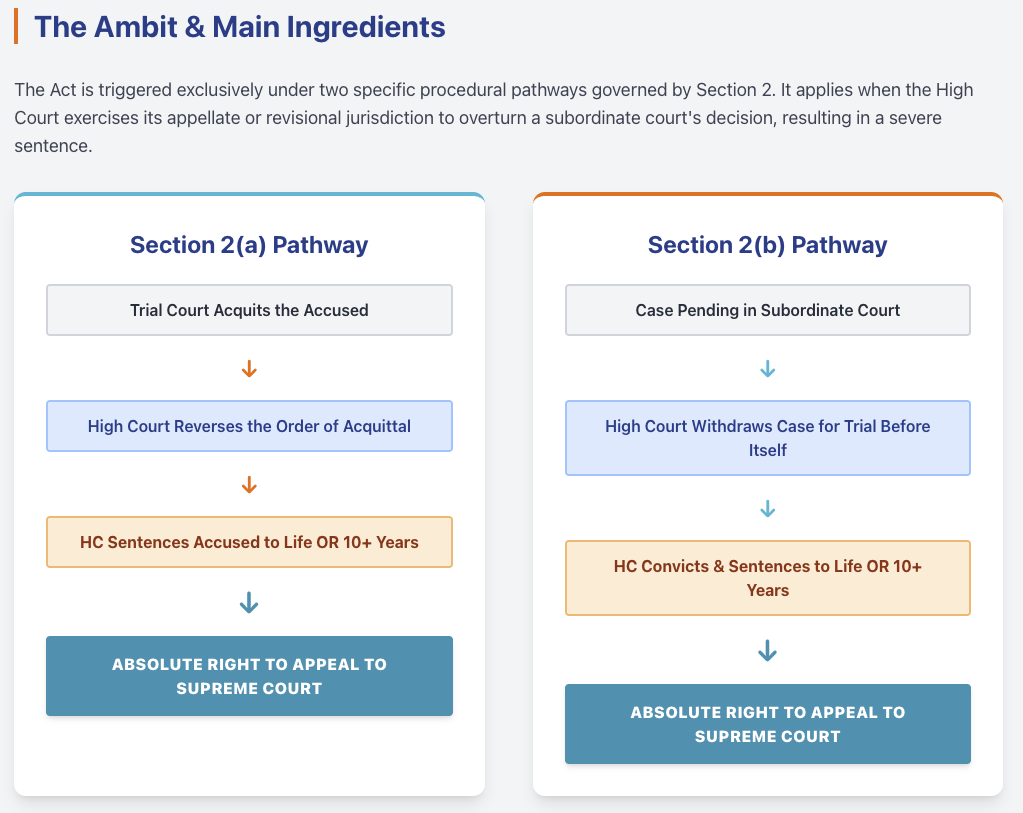
Section 2 of the 1970 Act is the cornerstone of this enlarged jurisdiction. It provides that “without prejudice to the powers conferred on the Supreme Court by clause (1) of Article 134 of the Constitution,” an appeal shall lie to the Supreme Court from any judgment, final order, or sentence in a criminal proceeding of a High Court if the High Court fulfills either of two conditions.9 These conditions constitute the “main ingredients” of the power and define the threshold for its invocation.
Reversal of Acquittal under Section 2(a)
The first ingredient, codified in Section 2(a), applies when a High Court, on appeal, has reversed an order of acquittal of an accused person and sentenced him to imprisonment for life or to imprisonment for a period of not less than ten years.1 The jurisdictional trigger here is the transition from a state of innocence—judicially declared by a trial court—to a state of guilt and severe punishment pronounced for the first time by the High Court.4 This reversal signifies a fundamental disagreement between the first two tiers of the judiciary regarding the appreciation of evidence and the application of law.4
For an appeal to lie under this section, the following elements must be present:
- There must be an existing order of acquittal by a court subordinate to the High Court.
- An appeal against that acquittal must have been filed (typically by the State under Section 378 of the CrPC).
- The High Court must have set aside that acquittal and substituted it with a conviction.
- The sentence imposed must be life imprisonment or a term of ten years or more.6
Withdrawal of Trial under Section 2(b)
The second ingredient, found in Section 2(b), concerns cases where the High Court has withdrawn for trial before itself any case from any court subordinate to its authority and has in such trial convicted the accused person and sentenced him to imprisonment for life or to imprisonment for a period of not less than ten years.1 This provision addresses the High Court’s extraordinary original criminal jurisdiction. Since the High Court acts as the court of first instance in such trials, the 1970 Act ensures that its decision is not final if it results in a heavy sentence, thereby providing the accused with a first appeal to the Supreme Court as a matter of right.5
| Ingredient | Section 2(a) Application | Section 2(b) Application |
| High Court Role | Appellate Court (reversing lower court) | Trial Court (after withdrawing case) |
| Original Status | Acquittal by lower court | Trial pending in lower court |
| Punishment | Life or 10+ Years Imprisonment | Life or 10+ Years Imprisonment |
| Right of Appeal | Absolute / Statutory | Absolute / Statutory |
Integration with the Code of Criminal Procedure
The operation of the 1970 Act is mirrored and supplemented by the Code of Criminal Procedure (CrPC), particularly Section 379. Following the Law Commission’s recommendations, Section 379 was incorporated into the 1973 Code to harmonize the procedural law with the 1970 Act.11 It stipulates that where the High Court has reversed an acquittal and sentenced an accused to death, life imprisonment, or ten years or more, an appeal lies to the Supreme Court.12
This creates a dual statutory basis for such appeals, often referred to in judicial orders as “statutory appeals filed under Section 2 of the 1970 Act read with Section 379 of the CrPC”.14 The Supreme Court, in its recent 2025 decision in Jayapal Bhimappa Janagouda v. State, clarified that because this is an absolute right, an accused is not required to file a Special Leave Petition (SLP) under Article 136. If an SLP is mistakenly filed, the Court will permit its conversion into a Criminal Appeal to protect the statutory right of the petitioner.13 This procedural synergy ensures that the lack of technical knowledge regarding the 1970 Act does not deprive a convict of their mandatory review.13
The Philosophical and Procedural Pivot: Sita Ram v. State of U.P.

The most profound judicial interpretation of the 1970 Act is found in Sita Ram & Ors vs State Of U.P (1979). This case addressed the constitutional validity of Rule 15(1)(c) of Order XXI of the Supreme Court Rules, 1966, which empowered the Court to dismiss criminal appeals summarily at the admission stage without a full hearing.4 The appellants, who had been convicted of murder and sentenced to life imprisonment after a reversal of their acquittal, challenged this rule as being ultra vires to both the 1970 Act and Article 134.4
The Court’s analysis, led by Justice Krishna Iyer, delved into the distinction between a “right of appeal” and a “permission to appeal” (special leave). The judgment established several critical principles:
- The Content of the Right: Jurisprudentially, a “right” is larger than a “permission.” Article 134 and the 1970 Act place a class of cases beyond the discretionary compass of Article 136 and within the compulsory area of a full hearing.4
- The Fallibility of Judges: The single right of appeal is a universal requirement rooted in the conception that men are fallible, and even judges can err. When the trial court and High Court differ, the need for an independent examination of material evidence by the Supreme Court becomes paramount.4
- Fair Procedure under Article 21: The right of appeal under the 1970 Act is part of the procedure established by law for the protection of life and personal liberty. Therefore, any procedural rule that makes this right “illusory” or “chancy” would violate Article 21.4
- The Mandate for Reasons: While the Court upheld the technical validity of the summary dismissal rule as a means to “weed out worthless appeals,” it held that the Court must ordinarily send for the records and provide written reasons for any dismissal. Summary dismissal should only occur in “glaring cases” where the appeal is demonstrably frivolous.4
The Sita Ram precedent ensured that the “substantive sweep” of the 1970 Act remains intact, preventing it from being diluted by administrative rules. It reinforced the notion that a first-time heavy sentence imposed by a High Court demands a “real and abiding concern” for the judicial process.3
Leading Judgments on Evidentiary Scrutiny and Ambit
The Supreme Court has consistently exercised its power under the 1970 Act to act as a court of first appeal on facts, conducting a meticulous re-appraisal of the trial record. Several leading judgments delineate the standards the Court applies when reviewing a reversed acquittal.
The “Reasonable View” Doctrine: Bahal Singh vs State of Haryana
In Bahal Singh vs State of Haryana (1976), the Supreme Court reviewed a case where the High Court of Punjab and Haryana had reversed a trial court’s acquittal for murder and imposed a life sentence.16 The trial court had found the prosecution’s story unreliable, specifically noting that the alleged eyewitnesses were “chance witnesses” whose presence at the crime scene was not credible.16
The Supreme Court, hearing the appeal under Section 2 of the 1970 Act, held that while the High Court has the power to interfere with an acquittal, it must be “slow” in disturbing a finding of fact arrived at by a judge who saw and heard the witnesses.16 The Court established that if the view taken by the trial court was a “reasonably possible” one, the High Court could not reverse it merely because it inclined toward a different interpretation of the facts.16 This judgment reinforces the protection granted by the 1970 Act by ensuring that an acquittal is not discarded unless it is palpably perverse.16
Scrutiny of Unnatural Conduct: Mehraj Singh vs State of U.P.
In Mehraj Singh vs State of U.P (1994), the Court dealt with another reversal of acquittal involving a murder in a village.18 The trial court had acquitted the accused, viewing the incident as a “blind murder” where the witnesses had roped in their enemies on suspicion.19 The High Court reversed this, relying heavily on the testimony of the deceased’s wife.19
The Supreme Court, in its appellate capacity under Section 2(a), criticized the High Court for ignoring “vital aspects,” such as the delay in sending the FIR to the Magistrate, which indicated a story recorded after “due deliberations and consultations”.19 Furthermore, the Court noted that the conduct of the wife was “unnatural”—she claimed to be present during a gunfight but took no steps to save her husband and did not receive even a scratch.19 By setting aside the High Court’s judgment, the Supreme Court utilized the 1970 Act to restore justice where the appellate process had overlooked fundamental evidentiary flaws.19
| Leading Case | Judgment Date | Core Precedent Regarding the 1970 Act |
| Bahal Singh v. Haryana | March 12, 1976 | Reversal of acquittal is prohibited if trial court’s view is “reasonably possible.” |
| Sita Ram v. State of U.P. | January 24, 1979 | Mandatory right of appeal requires reasons/records even in summary dismissal. |
| Mehraj Singh v. State of U.P. | April 21, 1994 | FIR delay and unnatural conduct must be weighed in reversals. |
| Durbal v. State of U.P. | January 25, 2011 | Reaffirmed the mandatory nature of Section 2(a) appeals. |
| Jayapal Janagouda v. State | February 3, 2025 | SLPs can be converted to statutory appeals to preserve the absolute right. |
The 1972 Amendment and Geographic Reach
The initial iteration of the 1970 Act did not extend to the State of Jammu and Kashmir, reflecting the legal constraints of the time.2 However, the State Legislature of Jammu and Kashmir passed a resolution on September 14, 1971, requesting that the Supreme Court’s enlarged jurisdiction be extended to the state.2 This request was rooted in the desire to ensure that the residents of Jammu and Kashmir had access to the same appellate safeguards as other Indian citizens in matters of life and imprisonment.2
Parliament responded by enacting the Supreme Court (Enlargement of Criminal Appellate Jurisdiction) Amendment Act, 1972 (Act 37 of 1972).2 This amendment omitted the words “except the State of Jammu and Kashmir” from Section 1(2) of the 1970 Act.9 This legislative change was a milestone in the integration of criminal justice standards across the territory of India, ensuring that the ambit of the 1970 Act became truly national in scope.2
Regulatory Framework: Supreme Court Rules 2013 (Order XX)
The procedural governance of appeals under the 1970 Act has transitioned from the 1966 Rules to the Supreme Court Rules, 2013.11 Order XX of the 2013 Rules specifically deals with “Criminal Appeals”.5 While Rule 21 of Order XX provides for the preliminary hearing of such appeals, it has faced contemporary challenges for a lack of explicit guidelines.11
In a significant 2022 judgment, the Supreme Court addressed a petition seeking a declaration that Rule 21 was unconstitutional for failing to provide guidelines for the preliminary hearing of appeals under Section 2(a) of the 1970 Act.11 The petitioner argued that without guidelines, the rule could be used to routinely dispose of appeals that are supposed to be “as of right,” thus violating Article 21.11 The Court, referencing the Sita Ram decision, acknowledged the power of preliminary dismissal but emphasized that the principles of fair hearing and reasoned orders must continue to guide the registry and the bench.11
| Regulatory Element | Rule under Supreme Court Rules, 2013 | Functional Outcome |
| Appeal Classification | Order XX – Criminal Appeals | Categorizes statutory vs. discretionary appeals. |
| Preliminary Hearing | Order XX, Rule 21 | Admission stage check for “frivolous” cases. |
| Bench Strength | Order VI (Min 2 Judges; 3 for Death) | Ensures multi-judge scrutiny of heavy sentences. |
| Filing Registry | Order I, Rule 3 | Administrative center for processing 1970 Act cases. |
| Correction of Defects | aggregat-papers / record rules | Allows curing of procedural errors for convicts. |
5
Comparative Ambit: 1970 Act vs. Discretionary Powers
A nuanced understanding of the 1970 Act requires contrasting it with the Supreme Court’s discretionary power under Article 136. While Article 134 and the 1970 Act establish “ordinary” appellate routes where an appeal lies as a constitutional or statutory right, Article 136 is a “residual” power of the widest possible amplitude.3
The 1970 Act differs from Article 136 in the following ways:
- Threshold of Intervention: In Article 136, the Supreme Court may refuse leave even if a heavy sentence is involved, as it is not an ordinary court of appeal.7 In 1970 Act cases, the Court must hear the appeal as an ordinary appellate court because the right is absolute.4
- Nature of Scrutiny: Appeals under the 1970 Act involve a “full-scale re-examination of facts”.4 Under Article 136, the Court typically intervenes only where there is a “grave miscarriage of justice” or a “substantial question of law”.7
- Administrative Flow: 1970 Act appeals are registered as “Criminal Appeals” immediately upon filing if they meet the sentence criteria.13 Article 136 matters are registered as “Special Leave Petitions” and only become “Criminal Appeals” if leave is granted.13
Furthermore, the 1970 Act addresses the specific vulnerability of a “reversed acquittal.” If both the lower court and the High Court convict an accused (concurrent findings), even if they receive a life sentence, they have no right of appeal under the 1970 Act and must invoke Article 136.3 The Law Commission has noted this as a potential area for future enlargement, suggesting that all life imprisonment cases should perhaps be appealable as of right to the Supreme Court.3
Limitation Periods and Administrative Safeguards
The effectiveness of the 1970 Act is contingent upon the accessibility of its procedural timelines. Generally, the limitation period for filing an appeal in the Supreme Court is 60 days from the date of the High Court’s judgment or order.23 However, if the High Court refuses a certificate of fitness under Article 134A, the limitation for an SLP (which might later be converted) is also 60 days.25
The Limitation Act, 1963, provides for the exclusion of time requisite for obtaining a certified copy of the judgment.26 For accused persons in custody, Section 14 of the Limitation Act and the CrPC provide that lodging the appeal with the Jail Superintendent is sufficient for meeting the limitation deadline.27 The Court has repeatedly held that Section 5 of the Limitation Act, which allows for the condonation of delay for “sufficient cause,” should be construed liberally in criminal matters to prevent the destruction of rights due to technical delays.25
Jurisprudential Implications and Future Outlook
The Supreme Court (Enlargement of Criminal Appellate Jurisdiction) Act, 1970, represents a democratization of the highest court. By lowering the barrier to entry from “death only” to “10+ years or life,” Parliament acknowledged that the loss of personal liberty for a decade is as significant a judicial event as the imposition of capital punishment.2
The “Sita Ram” requirement for reasoned orders in such appeals continues to be the primary check against administrative opacity.4 The 2025 development allowing for the conversion of SLPs into Statutory Appeals underscores a modern judicial philosophy that prioritizes substantive rights over procedural rigidities.13
However, the ambit of the Act remains limited by the requirement of a “reversed acquittal.” As sentencing patterns in India move away from the death penalty toward “fixed-term” life sentences, the 1970 Act may eventually require another expansion to include all heavy sentences, regardless of the trial court’s original findings.3 Such an expansion would be in consonance with the evolving standards of Article 21, ensuring that the “third deck” of protection provided by the Supreme Court is available to all who face the permanent or long-term loss of their civil liberties.3
In conclusion, the 1970 Act is not merely a procedural statute but a vital constitutional adjunct. It empowers the Supreme Court to fulfill its role as the ultimate guardian of human liberty, ensuring that no person is condemned to a lifetime of imprisonment without at least one mandatory review by the highest judicial authority in the land.4 Through its main ingredients of reversed acquittals and heavy sentences, and guided by leading precedents like Sita Ram and Bahal Singh, the Act continues to be an indispensable pillar of India’s criminal justice system.4
Works cited
- Supreme Court Criminal Jurisdiction Act | PDF – Scribd, accessed on March 9, 2026, https://www.scribd.com/document/481668956/DAY-71-FINAL-THE-SUPREME-COURT-ENLARGEMENT-OF-CRIMINAL-APPELLATE-JURISDICTION-ACT-1970
- The Supreme Court (Enlargement of Criminal Appellate Jurisdiction) Act, 1970 | India Code, accessed on March 9, 2026, https://www.indiacode.nic.in/bitstream/123456789/1449/1/A1970-28.pdf
- Eastern Book Company – Practical Lawyer – EBC, accessed on March 9, 2026, http://www.ebc-india.com/lawyer/articles/2003v2a2.htm
- Sita Ram & Ors vs State Of U.P on 24 January, 1979 – Indian Kanoon, accessed on March 9, 2026, https://indiankanoon.org/doc/1594547/
- PAPER I PRACTICE AND PROCEDURE – S3waas, accessed on March 9, 2026, https://cdnbbsr.s3waas.gov.in/s3ec0490f1f4972d133619a60c30f3559e/uploads/2024/05/2024051178.pdf
- SUPREME COURT (ENLARGEMENT OF CRIMINAL, APPELLATE …, accessed on March 9, 2026, https://lawsisto.com/Read-Central-Act/1479/SUPREME-COURT-ENLARGEMENT-OF-CRIMINAL-APPELLATE-JURISDICTION-ACT-1970
- Article 134 vs 136: Supreme Court Appeals | PDF – Scribd, accessed on March 9, 2026, https://www.scribd.com/document/940641789/Ambit-of-Article-134
- Jurisdiction Of Supreme Court ~ UPSC Polity Notes – Compass by Rau’s IAS, accessed on March 9, 2026, https://compass.rauias.com/polity/jurisdiction-of-supreme-court/
- The Supreme Court (Enlargement of Criminal Appellate Jurisdiction) Act, 1970 | BareLaws, accessed on March 9, 2026, https://barelaws.com/supreme-court-enlargement-of-criminal-appellate-jurisdiction-act-1970
- Supreme Court (enlargement Of Criminal Appellate Jurisdiction) Act, 1970, India-legitquest, accessed on March 9, 2026, https://www.legitquest.com/act/supreme-court-enlargement-of-criminal-appellate-jurisdiction-act-1970/632A
- IN THE SUPREME COURT OF INDIA CRIMINAL ORIGINAL …, accessed on March 9, 2026, https://api.sci.gov.in/supremecourt/2018/20644/20644_2018_3_15_37306_Judgement_16-Aug-2022.pdf
- CrPC : Appeals | Devgan.in, accessed on March 9, 2026, https://devgan.in/crpc/chapter_29.php
- Right of Accused to Appeal Reversed Acquittals by High Courts: SC – LawBeat, accessed on March 9, 2026, https://lawbeat.in/supreme-court-judgments/accused-has-right-file-appeal-supreme-court-reversal-acquittal-high-court-sc
- enlargement of criminal appellate jurisdiction act, 1970 – Indian Kanoon, accessed on March 9, 2026, https://indiankanoon.org/search/?formInput=enlargement%20of%20criminal%20appellate%20jurisdiction%20act%2C%201970&pagenum=14
- IN THE SUPREME COURT OF INDIA – Manupatra, accessed on March 9, 2026, https://www.manupatra.com/manufeed/contents/PDF/634073511434807500.pdf
- Bahal Singh vs The State Of Haryana on 12 March, 1976 – JUDICIAL ACADEMY JHARKHAND, accessed on March 9, 2026, https://jajharkhand.in/wp/wp-content/judicial_updates_files/13_Evidence_Act/10_interested_witness_chance_witness/Bahal_Singh_vs_The_State_Of_Haryana_on_12_March,_1976.PDF
- BAHAL SINGH Vs. STATE OF HARYANA – REGENT COMPUTRONICS PVT. LTD., accessed on March 9, 2026, https://www.the-laws.com/Encyclopedia/browse/Case?caseId=006791790000&title=bahal-singh-vs-state-of-haryana
- enlargement of criminal appellate jurisdiction act, 1970 – Indian Kanoon, accessed on March 9, 2026, https://indiankanoon.org/search/?formInput=enlargement%20of%20criminal%20appellate%20jurisdiction%20act%2C%201970&pagenum=7
- Mehraj Singh V. State of U.P. – B&B Associates LLP, accessed on March 9, 2026, https://bnblegal.com/landmark/mehraj-singh-v-state-u-p/
- cites: 121858438 – Indian Kanoon, accessed on March 9, 2026, https://indiankanoon.org/search/?formInput=cites:121858438
- Detailed Notes On Supreme Court Rules | PDF | Advocate | Judgment (Law) – Scribd, accessed on March 9, 2026, https://www.scribd.com/document/937010397/Detailed-Notes-on-Supreme-Court-Rules
- Supreme Court Rules, 2013., accessed on March 9, 2026, https://images.assettype.com/barandbench/import/2014/07/Supreme-Court-Rules-2013.pdf
- Procedure – Supreme Court Observer, accessed on March 9, 2026, https://www.scobserver.in/about/supreme-court-of-india/procedure/
- Civil Appeal To The Supreme Court On A Certificate Of Fitness – Indian Kanoon, accessed on March 9, 2026, https://indiankanoon.org/doc/82527063/
- Supreme Court Appeal Filing Process in India – S.S. Rana & Co., accessed on March 9, 2026, https://ssrana.in/litigation/special-leave-petition-india/appeal-filing-supreme-court/
- 1. Conditions as to time and Limitation under different Statutes 2. Different reliefs with different period of limitation 3. Amendment of pleadings – S3waas, accessed on March 9, 2026, https://cdnbbsr.s3waas.gov.in/s3ec03333cb763facc6ce398ff83845f22/uploads/2025/04/2025043088.pdf
- Section 14 – India Code, accessed on March 9, 2026, https://www.indiacode.nic.in/show-data?actid=AC_CEN_5_5_00005_196249_1517807318076&orderno=14