- India's drone legislation has shifted from restrictive frameworks to more liberalized Drone Rules, 2021, boosting the industry.
- Key features include Digital Sky platform for registrations and streamlined compliance requirements.
- The Remote Pilot Certificate (RPC) replaces the previous pilot license, simplifying training and certification.
- Regulations categorize drones based on weight, affecting registration and certification protocols.
- Import policies heavily restrict foreign drones while promoting local manufacturing under the Make in India initiative.
- The airspace is divided into Green, Yellow, and Red zones, dictating where drones can fly.
- Judicial rulings emphasize privacy rights and procedural correctness in drone operations, creating a dynamic regulatory landscape.
All that you need to know about the law regarding having any drones in India
Audio Overview of the Legal Blog:
Section 1: Introduction: The New Age of Drone Regulation in India
India’s regulatory landscape for Unmanned Aircraft Systems (UAS), commonly known as drones, has undergone a monumental transformation. The pre-2021 era was characterized by a highly restrictive and cumbersome framework, culminating in the Unmanned Aircraft System (UAS) Rules, 2021, which were widely criticized by industry stakeholders for creating excessive administrative bottlenecks and lengthy approval timelines.1 Recognizing these impediments, the Government of India executed a significant policy pivot, repealing the restrictive rules and introducing the liberalized Drone Rules, 2021. This new legislation is explicitly founded on a philosophy of “trust, self-certification and non-intrusive monitoring,” signaling a strategic shift from control to facilitation.2
The core tenets of this new regulatory regime are designed to foster growth, innovation, and position India as a “global drone hub by 2030”.5 This is evidenced by a drastic simplification of the compliance framework, including a reduction in the number of required forms from 25 to just five and a consolidation of fee types from 72 to four.2 Numerous complex approvals, such as unique authorization numbers, certificates of manufacturing, and import clearances, have been abolished to lower the barrier to entry for manufacturers, operators, and service providers.4
Central to this modernized framework is the Digital Sky platform, a user-friendly, single-window online system managed by the Directorate General of Civil Aviation (DGCA). This platform is the non-negotiable hub for the entire drone ecosystem in India. All critical interactions with the regulator—from the registration of a drone and certification of its type to obtaining a pilot certificate and seeking flight permissions—are now managed digitally through this portal.9 This digital-first approach is a cornerstone of the new regulatory framework, designed to ensure transparency, efficiency, and ease of compliance for all stakeholders.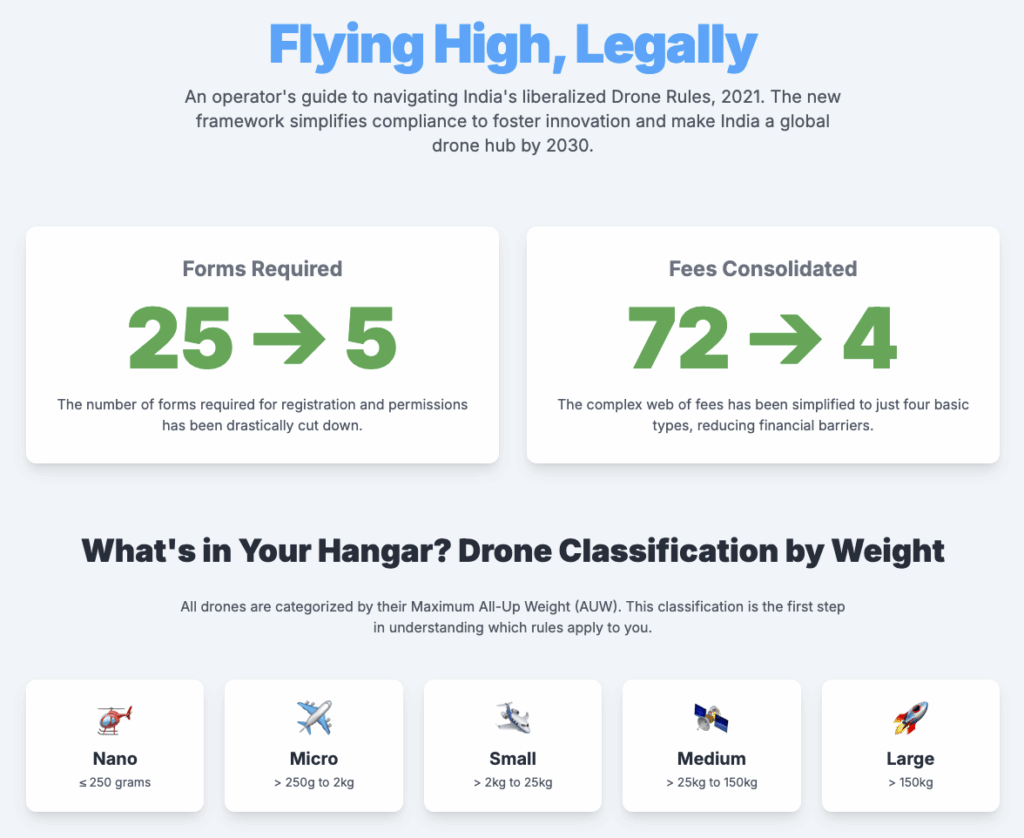
Section 2: The Legal Bedrock: Deconstructing the Drone Rules, 2021 and Amendments
The legal framework governing drone operations in India is primarily encapsulated in the Drone Rules, 2021, and its subsequent amendments. This agile legislative approach demonstrates a commitment to refining the regulatory environment in response to industry feedback and technological advancements.
The Drone Rules, 2021 (Notified August 25, 2021)
Notified on August 25, 2021, the Drone Rules, 2021, replaced the short-lived and highly restrictive UAS Rules of March 2021.1 These rules apply comprehensively to any person who owns, possesses, leases, operates, transfers, or maintains a drone in India, as well as to all unmanned aircraft systems being used within or over Indian territory.15 The foundational mandates of these rules include the compulsory registration of drones to obtain a Unique Identification Number (UIN), the requirement for manufacturers to secure a Type Certificate (TC) for their drone models, and the creation of an interactive airspace map to segregate the sky into distinct operational zones.2 The rules also significantly increased the weight coverage from 300 kg to 500 kg, bringing heavy-payload logistics drones and potential drone taxis under their purview.4
The Drone (Amendment) Rules, 2022 (Notified February 11, 2022)
The first significant amendment came in early 2022, introducing two key changes. First, it abolished the concept of a “drone pilot license” issued by the DGCA and replaced it with a “Remote Pilot Certificate (RPC)”.17 This certificate is issued directly by DGCA-authorized Remote Pilot Training Organisations (RPTOs), effectively decentralizing and expediting the pilot certification process. Second, the amendment extended the deadline for owners of existing drones (those manufactured in or imported into India on or before November 30, 2021) to register their aircraft on the Digital Sky platform to March 31, 2022.19
The Drone (Amendment) Rules, 2023 (Notified September 27, 2023)
The 2023 amendment addressed a critical barrier to entry for many aspiring pilots. It modified Form D-4, the application for a Remote Pilot Certificate, by removing the mandatory requirement of an Indian passport.5 Applicants can now furnish other government-issued proofs of identity and address, such as a Voter ID card, Ration Card, or Driving License.7 This change was a direct response to feedback that the passport requirement was a significant impediment, particularly for individuals in rural and agricultural sectors who are key to the expansion of drone applications like crop spraying and land surveying.5
The rapid succession of these amendments highlights a responsive and iterative policy-making process. The government is actively refining the rules based on ground-level challenges and industry feedback, rather than adhering to a static framework. This legislative agility, aimed at systematically removing friction points, underscores the strategic intent to accelerate drone adoption across key economic sectors.
Section 3: Know Your Drone: Classification, Registration, and Certification
Understanding the specific legal requirements for a drone begins with its classification, which is based on its weight. The Drone Rules, 2021, establish a clear system for categorization, registration, and certification.
3.1 Drone Classification by Weight
All drones are classified into five categories based on their Maximum All-Up Weight (AUW), which is the total weight of the drone including its payload.2
- Nano: Less than or equal to 250 grams (≤250 g)
- Micro: More than 250 grams and up to 2 kilograms (>250 g to 2 kg)
- Small: More than 2 kilograms and up to 25 kilograms (>2 kg to 25 kg)
- Medium: More than 25 kilograms and up to 150 kilograms (>25 kg to 150 kg)
- Large: More than 150 kilograms (>150 kg)
3.2 The Unique Identification Number (UIN)
Every drone operating in India, unless specifically exempted, must be registered on the Digital Sky platform to obtain a Unique Identification Number (UIN).9 The UIN functions as a digital license plate, ensuring traceability and accountability for each aircraft. It is mandatory to physically display this UIN on the body of the drone.11
3.3 A Step-by-Step Guide to DigitalSky Registration
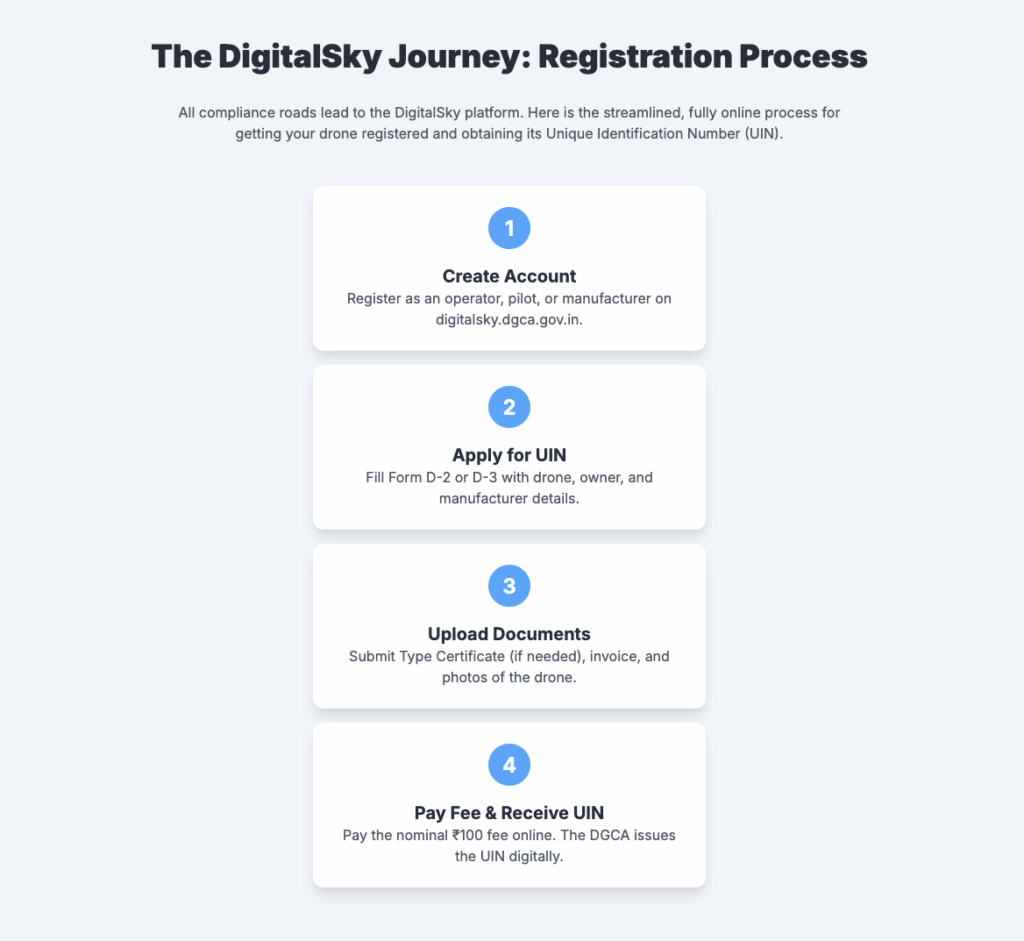
The entire registration process is conducted online through the Digital Sky platform.11
- Create an Account: The first step is to visit the Digital Sky portal (digitalsky.dgca.gov.in) and create a profile as an operator, pilot, or manufacturer.11
- Apply for UIN: Log in to the platform. For drones that require a Type Certificate, the application for a UIN is made using Form D-2. For models that are exempt (such as Nano drones or custom-built models), the process begins with adding an “Exempted Model” via Form D-3.11
- Provide Information: The applicant must fill in comprehensive details about the drone, including its manufacturer, model, serial number, and technical specifications. Details of the owner, such as Aadhaar and PAN, are also required.11
- Upload Documents: Necessary documents must be uploaded. This typically includes a copy of the drone’s Type Certificate (if applicable), proof of ownership (like an invoice), and clear photographs of the drone from the top and front, along with a close-up of the serial number.25
- Pay Fee: A nominal, non-refundable fee of ₹100 must be paid online to process the application.11
- Receive UIN: Once the application is submitted and verified, the DGCA issues the UIN digitally through the platform.11
3.4 Type Certification (TC)
A Type Certificate (TC) is a design and safety approval issued by the DGCA for a specific type of drone. It is mandatory for all drones intended for operation in India, with the specific exemptions of Nano drones and model aircraft used for recreational purposes.15 To obtain a TC, a manufacturer or importer must apply using Form D-1 on the Digital Sky platform and submit the prototype for testing by an accredited body, such as the Quality Council of India (QCI) or another authorized testing entity.26
The following table provides a clear, at-a-glance summary of the primary compliance requirements for each drone category, helping operators quickly determine their legal obligations.
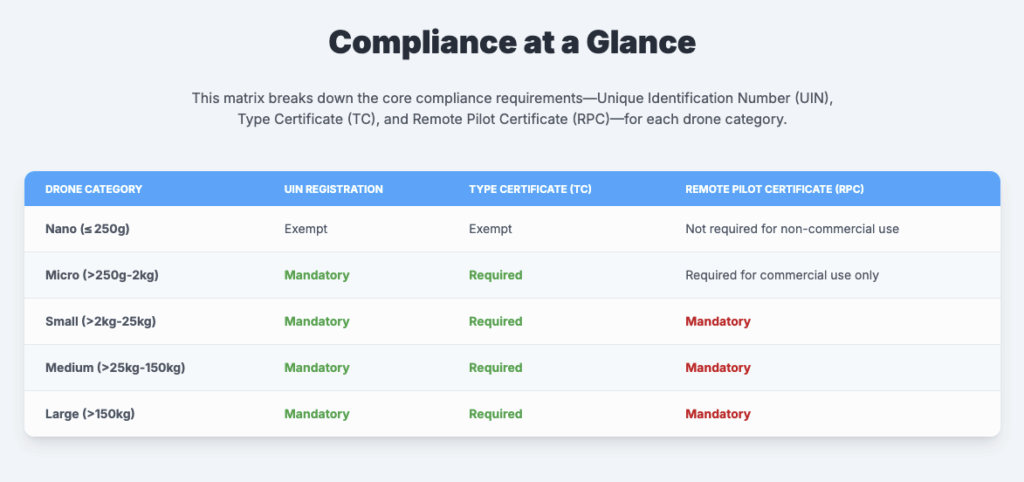
Table 1:
| Drone Category | All-Up Weight (AUW) | UIN Registration | Type Certificate (TC) | Remote Pilot Certificate (RPC) Requirement |
|---|---|---|---|---|
| Nano | ≤ 250 grams | Exempt | Exempt | Not required for non-commercial use |
| Micro | > 250 g to 2 kg | Mandatory | Required | Not required for non-commercial use; Required for commercial use |
| Small | > 2 kg to 25 kg | Mandatory | Required | Mandatory |
| Medium | > 25 kg to 150 kg | Mandatory | Required | Mandatory |
| Large | > 150 kg | Mandatory | Required | Mandatory |
Section 4: The Pilot’s Mandate: Obtaining a Remote Pilot Certificate (RPC)
A Remote Pilot Certificate (RPC) is the official credential required to legally operate most drones in India. The process for obtaining it is standardized and managed through DGCA-authorized training organizations.
Who Needs an RPC?
An RPC is mandatory for anyone operating a drone in the Small, Medium, or Large categories, regardless of whether the purpose is commercial or recreational.22 Furthermore, it is required for operating a Micro drone for commercial purposes.23
Eligibility Criteria
To be eligible for an RPC, an applicant must meet the following criteria 5:
- Age: Be between 18 and 65 years old.
- Education: Have passed the 10th class examination or its equivalent from a recognized board.
- Training: Have successfully completed the required ground and practical training from a DGCA-authorized Remote Pilot Training Organisation (RPTO).
- Identity Proof: Possess a valid government-issued identity and address proof. Following the Drone (Amendment) Rules, 2023, this can be an Indian Passport, Voter ID card, Ration Card, or Driving License.7
- Medical Fitness: Submit a medical fitness certificate from a registered medical practitioner.25
The Role of RPTOs
Remote Pilot Training Organisations (RPTOs) are the cornerstone of pilot certification. These are flight schools authorized by the DGCA to impart the necessary training as per the prescribed curriculum.36 A typical RPC training course is a 5-day program that includes theoretical knowledge sessions on regulations, aerodynamics, and meteorology, as well as practical training on simulators and live drones in an approved green zone.25
Application and Issuance
Upon successful completion of the training and passing the requisite tests, the RPTO is responsible for applying for the RPC on behalf of the student. This application is submitted via Form D-4 on the Digital Sky platform.31 The Remote Pilot Certificate is then issued digitally through the platform and remains valid for a period of 10 years, unless suspended or cancelled.5
Section 5: Flying Under the Radar: A Legal Guide to Exemptions
While the Drone Rules, 2021, establish a comprehensive regulatory framework, they also provide specific exemptions to encourage recreational use, research, and innovation.
Exemptions from Registration and Certification
The following are key exemptions from the standard requirements of obtaining a UIN, Type Certificate, and Remote Pilot Certificate:
- Nano Drones: Drones weighing 250 grams or less are exempt from the requirement to obtain a UIN and a Type Certificate.15 An RPC is also not required for their non-commercial operation.6
- Micro Drones (Non-Commercial Use): An individual operating a Micro drone (weighing between 250g and 2kg) for non-commercial purposes is exempt from the requirement of obtaining a Remote Pilot Certificate.15 However, the drone itself must still be registered to get a UIN and must have a Type Certificate.
- Research & Development (R&D): To foster innovation, the rules provide a significant exemption for R&D activities. Recognized R&D entities, including academic institutions and startups, that operate drones within their own or rented premises located in a Green Zone are not required to obtain a Type Certificate, UIN, or RPC for those operations.2
- Model Remotely Piloted Aircraft: Model aircraft used purely for recreational and educational purposes are exempt from the requirement of a Type Certificate.15
It is critical to note that the rules provide an exemption for the “non-commercial” use of Micro drones without an RPC.15 However, the legislation does not provide a clear and unambiguous definition of what constitutes “commercial” versus “non-commercial” activity. This creates a legal grey area. For instance, it is unclear whether a hobbyist who uploads drone footage to a monetized YouTube channel, or a real estate agent who uses a drone to capture images for a property listing without directly billing for the drone service, would be considered commercial operators. This ambiguity presents a potential compliance risk, as operators may inadvertently cross the threshold into commercial activity and find themselves in violation of the rules.
Section 6: Importing Drones: Navigating a Prohibitive Landscape
The policy for importing drones into India is highly restrictive and stands in sharp contrast to the liberalized rules for domestic operations. This approach is a deliberate strategy to bolster domestic manufacturing.
6.1 The 2022 Import Prohibition
A pivotal shift in policy occurred on February 9, 2022, with the issuance of DGFT Notification No. 54/2015-2020.39 This notification amended the Indian Trade Classification (Harmonised System) and changed the import policy for drones falling under HS Code 8806. The status was moved from “Restricted” to “Prohibited” for drones imported in Completely Built-Up (CBU), Semi-Knocked-Down (SKD), or Completely Knocked-Down (CKD) forms. This effectively banned the import of ready-to-fly or easily assembled foreign drones for general civil use.
6.2 Legal Gateways: Exceptions to the Ban
The prohibition is not absolute and contains narrow, specific exceptions for which import is permissible, albeit under strict control 39:
- Research and Development (R&D): Government entities, educational institutions recognized by central or state governments, government-recognized R&D entities, and domestic drone manufacturers may import drones for R&D purposes.
- Defence and Security: Drones may be imported for defence and security purposes.
In both these exceptional cases, the importer must obtain a specific import authorization from the Directorate General of Foreign Trade (DGFT), which is granted only after consultation with the relevant line ministries (e.g., Ministry of Defence, Ministry of Home Affairs). This process is designed to be rigorous and is not a route for commercial or recreational imports.39
6.3 The Component Advantage
A critical stipulation in the 2022 notification is that the import ban does not apply to drone components. The policy for drone components is designated as ‘Free’, meaning they can be imported without the need for a special authorization from the DGFT.39 This provision is the linchpin of the government’s strategy to create a domestic drone manufacturing and assembly ecosystem.
The combination of liberalizing domestic drone operations while simultaneously banning drone imports is a calculated two-pronged industrial policy. By making it easier for sectors like agriculture, logistics, and surveying to use drones, the government has created significant domestic demand.5 The import ban prevents this demand from being fulfilled by established foreign manufacturers, while the free import of components enables Indian companies to build drones locally to serve this captive market. This is a classic import substitution strategy aimed at fostering a self-reliant “Make in India” drone industry.41
6.4 The Cost of Entry: Customs Duty and Clearance
Even when import is legally permitted, drones and their components are subject to customs duties.
- Duty on Drones: For the rare cases where a fully built drone is imported legally (e.g., for R&D), the total customs duty is approximately 31%. This is composed of a 10% Basic Customs Duty (BCD), a 10% Social Welfare Surcharge (SWS) on the BCD, and an 18% Integrated Goods and Services Tax (IGST).44 Some sources suggest the total duty can range from 28% to 35%, depending on the specific valuation by customs officials.45
- Duty on Components: While the import of components is ‘Free’ from a licensing perspective, they are still subject to applicable customs duties, which vary based on the specific HS code of each component.44
- Clearance Documents: A legal import consignment requires a standard set of documents for customs clearance, including the commercial invoice, packing list, airway bill, and any necessary regulatory approvals like the Equipment Type Approval (ETA) from the Wireless Planning & Coordination (WPC) Wing and the DGFT import authorization.44
The following table summarizes the high-level import policy for drones and their components.
Revised Analysis of India’s Drone Import Policy Transformation
The Directorate General of Foreign Trade (DGFT) has fundamentally altered India’s drone import regulations, shifting the policy from a “Restricted” framework to a “Prohibited” one for most imports, while liberalizing the import of components. This change was enacted via Notification No. 54/2015-2020 and came into immediate effect.
Previous Import Policy
Under the earlier regulations, the import of drones and other unmanned aerial systems was categorized as “Restricted”22. This meant that:
- General Imports: Any import required prior clearance from the Directorate General of Civil Aviation (DGCA) as well as an import license from the DGFT.
- Existing Exemption: A specific exemption was in place for Nano category drones (weighing 250 grams or less) that operate below 50 feet (15 meters). These drones did not need clearance from the DGCA or an import license from the DGFT55. However, they still required an Equipment Type Approval (ETA) from the WPC Wing of the Department of Telecommunications to operate in de-licensed frequency bands66.
Current Policy and Key Changes
The revised policy marks a significant shift by outright prohibiting the import of drones in most forms and establishing a new set of exemptions.
- Change in Import Status:
- The import of drones in Completely-Built-Up (CBU), Semi-Knocked-Down (SKD), or Completely-Knocked-Down (CKD) forms is now Prohibited. This is a major change from the previous “Restricted” status88.
- New Exemptions:
The previous exemption for Nano drones has been replaced. Under the new policy, drone imports are permitted only under the following exceptions:
- Research and Development: Government entities, state or central government-recognized educational institutions, government-recognized R&D entities, and drone manufacturers may import drones for R&D purposes99.
- Defence and Security: Imports for defence and security purposes are allowed1010.
- New Approval Process:
For the exceptions listed above, the approval process has changed. Instead of DGCA clearance, importers must now obtain:
- An import authorisation issued by the DGFT, which will be granted in consultation with the concerned line ministries1111.
- Liberalization of Component Imports:
A significant change is the treatment of parts. The new policy explicitly states:
The import of drone components is now ‘Free’. This means components can be imported without needing an import license or specific permission, a move intended to encourage domestic manufacturing.
Section 7: The Rules of the Sky: India’s Airspace Map and No-Fly Zones
Safe and legal drone operation in India is contingent on strict adherence to the national airspace map, which is a dynamic, interactive tool available on the Digital Sky platform.3 All operators must consult this map before every flight.
7.1 Decoding the Zones
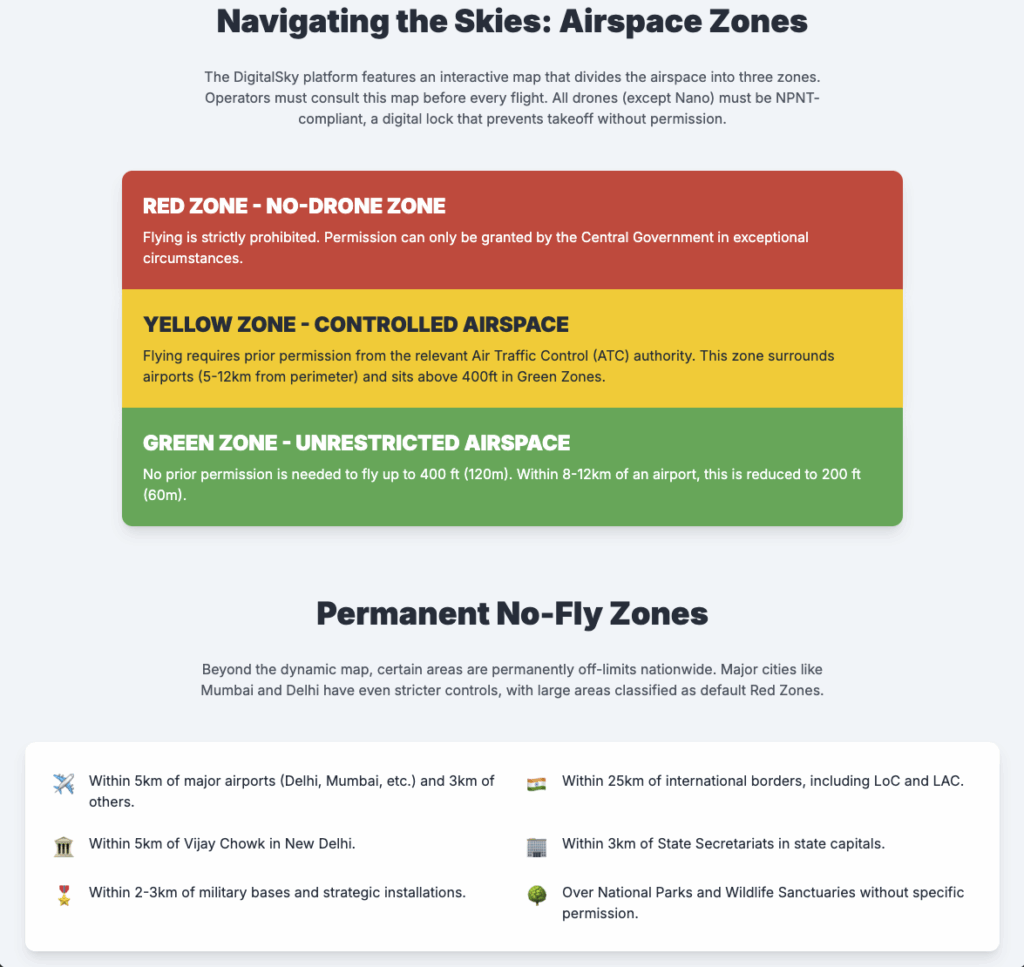
The airspace is segregated into a three-tier system to manage drone traffic :
- Green Zone: This is largely unrestricted airspace where no prior permission is required to fly a drone with an all-up weight of up to 500 kg.3 The standard altitude limit in a Green Zone is 400 feet (120 meters) above ground level (AGL). However, within the airspace located between 8 and 12 kilometers from the perimeter of an operational airport, the altitude is restricted to 200 feet (60 meters) AGL.3
- Yellow Zone: This is controlled airspace where flight operations require prior permission from the concerned Air Traffic Control (ATC) authority, such as the Airports Authority of India (AAI), Indian Air Force (IAF), or Indian Navy. The Yellow Zone includes the airspace above 400 feet in a designated Green Zone and the airspace within a lateral distance of 5 to 12 kilometers from an airport’s perimeter.3 The previous 45 km yellow zone around airports was significantly reduced to 12 km under the new rules.49
- Red Zone: This is a ‘No-Drone Zone’. Flying in a Red Zone is strictly prohibited unless explicit permission is granted by the Central Government.3
7.2 NPNT: The Digital Gatekeeper
The “No Permission, No Takeoff” (NPNT) policy is a critical safety and security feature mandated for all drones except those in the Nano category.9 NPNT-compliant drones are equipped with software that prevents the motors from arming unless the drone has received a valid, digitally signed flight permission from the Digital Sky platform for that specific time and location. This system acts as a real-time, automated digital gatekeeper, ensuring that drones cannot take off in restricted areas or without authorization.
7.3 General No-Fly Zones (Nationwide)
In addition to the color-coded map, the rules specify several areas that are permanently designated as no-fly zones across the country :
- Areas near airports: Within a 5 km radius of major metropolitan airports (Delhi, Mumbai, Chennai, Kolkata, Bengaluru, Hyderabad) and within a 3 km radius of all other airports.
- International Borders: Within 25 km of India’s international borders, including the Line of Control (LoC) and Line of Actual Control (LAC).
- Strategic Locations in Delhi: Within a 5 km radius of Vijay Chowk in New Delhi.
- Government Complexes: Within a 3 km radius of State Secretariat Complexes in all state capitals.
- Military and Strategic Installations: Within 2 km to 3 km of military facilities and other strategic locations as notified by the Ministry of Home Affairs.
- Eco-Sensitive Areas: Over National Parks and Wildlife Sanctuaries without prior permission from the Ministry of Environment, Forest and Climate Change.
7.4 Metropolitan No-Fly Zones (City-Specific)
Major metropolitan cities have extensive no-fly zones due to the high density of airports, strategic locations, and security considerations.
- Delhi: The capital is heavily restricted. Red Zones include the 5 km buffer around Indira Gandhi International Airport, the 5 km radius around Vijay Chowk, and numerous other sensitive government buildings, military cantonments, and diplomatic enclaves.
- Mumbai: The DGCA has effectively classified the entire city of Mumbai as a ‘Red Zone’ for drone operations, making any unauthorized flight a punishable offense.52 Mumbai Police frequently issue temporary blanket bans on the operation of all flying objects, including drones, paragliders, and hot air balloons, citing security threats.
- Kolkata: Key no-fly zones include the 5 km radius around Netaji Subhas Chandra Bose International Airport and the airspace around the Eastern Command headquarters at Fort William. Recent unauthorized drone sightings have led to heightened police and military vigilance.
- Chennai: Much of Chennai is considered a ‘Red Zone’ where private operators require specific permission from state authorities to fly.59 The 5 km radius around Chennai International Airport is a permanent no-fly zone.
- Bengaluru: The city has multiple no-fly zones due to the presence of Kempegowda International Airport (5 km radius), HAL Airport, the Yelahanka Air Force Station, and numerous sensitive establishments like ISRO and DRDO labs.
Section 8: Drones in the Dock: Judicial Oversight and Landmark Rulings
While the DGCA and Ministry of Civil Aviation create the regulations, the Indian judiciary plays a crucial role in their interpretation, enforcement, and in safeguarding constitutional rights. Although no Supreme Court judgment has directly ruled on the validity of the Drone Rules, 2021, several key rulings from the Apex Court and various High Courts provide a vital framework for understanding the legal landscape.
8.1 The Supreme Court’s Gaze: Privacy as a Fundamental Right
The most significant judicial precedent affecting drone operations is the landmark Supreme Court case of Justice K.S. Puttaswamy (Retd.) v. Union of India.1 This nine-judge bench ruling unequivocally established the Right to Privacy as a fundamental right protected under Article 21 of the Constitution (Right to Life and Personal Liberty). The Court held that any intrusion into this right by the state must satisfy a three-part test: it must be backed by law, serve a legitimate state aim, and be proportionate to the objective.
This judgment is profoundly relevant because drone technology, by its very nature, can be used for pervasive surveillance. The Drone Rules, 2021, have been noted for their relative silence on explicit privacy safeguards, a departure from the preceding (albeit restrictive) UAS Rules which had provisions for data protection.1 This regulatory gap means that any large-scale drone surveillance by state agencies could be legally challenged as a disproportionate infringement on the fundamental right to privacy, as established in Puttaswamy.
8.2 High Court Precedents: Shaping the Ground Reality
Various High Courts have adjudicated on drone-related matters, providing practical insights into how the rules are applied and enforced. These judgments reveal that the judiciary is acting as a crucial check on executive power and as a practical arbiter in disputes.
- Bombay High Court: In a notable case, the court quashed an FIR against individuals who were booked for flying a drone during the Prime Minister’s visit to Mumbai. The court’s decision was based on the finding that the police had failed to properly promulgate the prohibitory order as required by law. This judgment underscores that procedural correctness is paramount, and actions taken by law enforcement can be successfully challenged if due process is not followed.64
- Karnataka High Court: The court ordered the formation of a Special Investigation Team (SIT) to probe a case of data theft from a drone company supplying the Indian military. The court intervened after observing that the initial police investigation was lax, terming it a “fake investigation” and highlighting the serious risks of “cyber espionage.” This ruling shows that the judiciary recognizes the high-stakes nature of drone technology in the national security domain and is willing to intervene decisively to ensure the integrity of investigations.66
- Madras High Court: In a case concerning a religious conference, the court modified a blanket ban imposed by the local police and permitted the limited use of two drones for event coverage within the venue. This demonstrates that courts may view absolute prohibitions by local authorities as unreasonable restrictions and can adopt a balanced approach, allowing for conditional and controlled use of drones.69
- Delhi High Court: The court has, in one instance, directed municipal authorities to use drones for surveillance to identify illegal constructions, thereby judicially sanctioning the use of the technology for administrative and governance purposes.72 In a separate matter, it handled a case involving the security clearance of an aviation services firm linked to the origin of drones used in a cross-border attack, illustrating the judiciary’s role in complex national security issues intertwined with aviation law.73
- Calcutta High Court: The court has directed police to intensify vigilance and submit a report on the use of drones in a case involving a foreign national, citing national security concerns.74
These High Court judgments collectively illustrate that the judiciary is not a passive observer. It is actively shaping the drone ecosystem by ensuring procedural fairness, protecting national security interests, balancing fundamental rights with public order, and even directing the use of the technology for public good. For any drone operator, this means that legal compliance extends beyond the written rules to the evolving interpretations and standards set by the courts.
Section 9: Conclusion: A Compliance Checklist for the Responsible Drone Operator
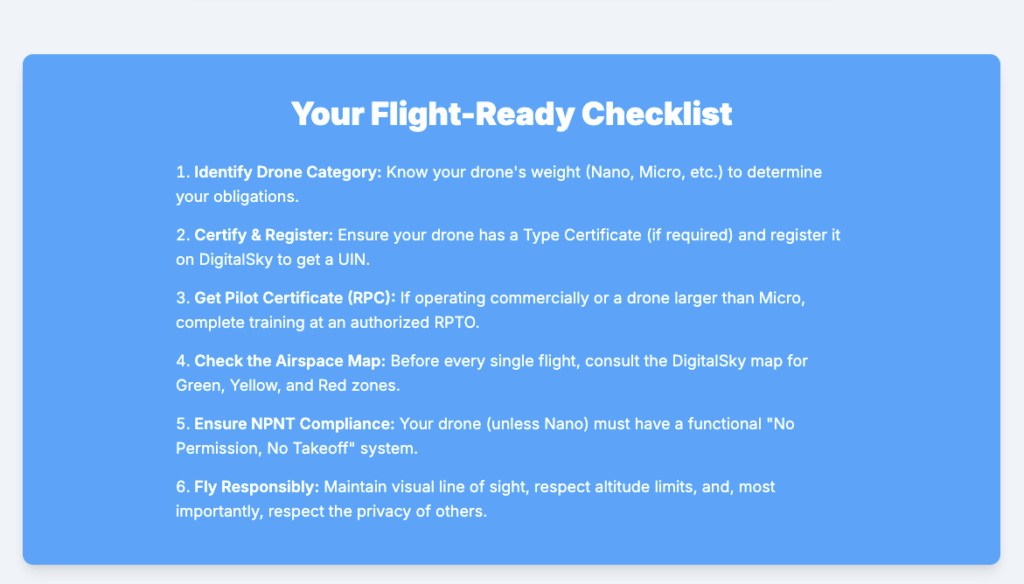
Navigating India’s drone regulations requires a systematic approach to compliance. The liberalized framework is built on trust and self-certification, placing the onus of responsibility squarely on the operator. The following checklist synthesizes the key legal requirements for any individual or entity looking to operate a drone in India.
- Step 1: Identify Your Drone: The first and most crucial step is to determine the weight category of your drone (Nano, Micro, Small, Medium, or Large), as all subsequent legal obligations flow from this classification.
- Step 2: Certify & Register: For all drones except Nano and model aircraft, ensure the model has a valid Type Certificate (TC) issued by the DGCA. Subsequently, register your specific drone on the Digital Sky platform to obtain its mandatory Unique Identification Number (UIN).
- Step 3: Get Your Pilot Certificate: If you are operating a drone commercially (Micro and above) or operating any drone in the Small, Medium, or Large categories, you must obtain a Remote Pilot Certificate (RPC). This involves completing the required training at a DGCA-authorized RPTO.
- Step 4: Check the Airspace Map: Before every single flight, it is mandatory to check the latest interactive airspace map on the Digital Sky platform. This will show you the boundaries of the Green, Yellow, and Red zones in your intended area of operation.
- Step 5: Ensure NPNT Compliance: Your drone (unless it’s a Nano) must be equipped with “No Permission, No Takeoff” (NPNT) functionality. You must obtain digital permission via the Digital Sky platform before each flight in controlled airspace.
- Step 6: Respect Privacy & Follow Operational Rules: Always maintain a direct visual line of sight (VLOS) with your drone, adhere to altitude limits (typically 400 feet in Green Zones), and fly only during the daytime unless you have specific permission for night operations. Critically, even in the absence of explicit privacy clauses in the Drone Rules 2021, the constitutional Right to Privacy is paramount. Avoid flying over private property without consent and be mindful not to capture images or videos of individuals in a way that infringes upon their privacy.
Looking ahead, the Indian drone ecosystem is poised for further evolution. The government has indicated plans to develop sophisticated Unmanned Traffic Management (UTM) systems for automated flight approvals, create dedicated drone corridors for cargo deliveries, and formulate regulations for advanced operations like drone swarms and Beyond Visual Line of Sight (BVLOS) flights.2 Staying informed about these regulatory developments will be crucial for all stakeholders in this dynamic and rapidly growing sector.
#DronesIndia #DroneLaw #DroneRules2021 #DGCA #DigitalSky #UAV #UnmannedAerialVehicle #DroneRegistration #DronePilot #NanoDrone #MicroDrone #MakeInIndia #DroneSafety #NoFlyZone #DroneRegulations #IndianDrones #DroneTech #AviationLaw #DronePrivacy #DronesForGood #TechLaw #DroneOperator
Resources:
2.Drone (Amendment) Rules 2022
3.Drone (Amendment) Rules, 2023
4.DGFT_Notification_No.54_2022
Works cited
- The Drone Regulations 2021: One Step Forward and Two Steps Back – The Digital Future, accessed on June 19, 2025, https://thedigitalfuture.in/2022/02/24/the-drone-regulations-2021-one-step-forward-and-two-steps-back%EF%BF%BC/
- The Drone Rules, 2021 – PIB, accessed on June 19, 2025, https://static.pib.gov.in/writereaddata/specificdocs/documents/2022/jan/doc202212810701.pdf
- Ministry of Civil Aviation releases India’s airspace map for drone operations – PIB, accessed on June 19, 2025, https://www.pib.gov.in/PressReleaseIframePage.aspx?PRID=1757850
- Ministry of Civil Aviation notifies liberalised Drone Rules, 2021 | Digital governance, accessed on June 19, 2025, https://egovernance.vikaspedia.in/viewcontent/e-governance/digital-india/unmanned-aircraft-system/ministry-of-civil-aviation-notifies-liberalised-drone-rules-2021?lgn=en
- 2023 DGCA Drone Regulations Effective September 2023: Crucial …, accessed on June 19, 2025, https://mpowerlithium.com/blogs/blog/2023-dgca-drone-regulations-effective-september-2023-crucial-updates-for-drone-pilates
- Things to know before Flying a Drone in India – Sify, accessed on June 19, 2025, https://www.sify.com/science-tech/things-to-know-before-flying-a-drone-in-india/
- Drone (Amendment) Rules, 2023 – | India Cine Hub, accessed on June 19, 2025, https://indiacinehub.gov.in/sites/default/files/2024-04/drone_rules_2021_with_2023_amendment_1.pdf
- Drone Rules, 2021 – Digital Sansad, accessed on June 19, 2025, https://sansad.in/getFile/loksabhaquestions/annex/177/AU834.pdf?source=pqals
- Drone Laws in India | UAV Coach (2023), accessed on June 19, 2025, https://uavcoach.com/drone-laws-in-india/
- The Legal Landscape of Drone Technology in India: Navigating Privacy, Security, and Commercial Use. – The Amikus Qriae, accessed on June 19, 2025, https://theamikusqriae.com/the-legal-landscape-of-drone-technology-in-india-navigating-privacy-security-and-commercial-use/
- How to register a Drone in India? – AEROGO, accessed on June 19, 2025, https://www.aerogo.live/post/how-to-register-a-drone-in-india
- Login to DigitalSky, accessed on June 19, 2025, https://digitalsky.dgca.gov.in/login
- Drone Registration in India – Application Process – IndiaFilings, accessed on June 19, 2025, https://www.indiafilings.com/learn/drone-registration/
- Welcome to DigitalSky, accessed on June 19, 2025, https://digitalsky.dgca.gov.in/
- Drone Registration in India | Drone Rule 2021 – Aleph INDIA, accessed on June 19, 2025, https://alephindia.in/drone-registration-in-india.php
- Drone Rules | PDF | Unmanned Aerial Vehicle | Transport – Scribd, accessed on June 19, 2025, https://www.scribd.com/document/528549991/Drone-Rules
- reform measures undertaken to facilitate drone manufacturing and operations in the country – Press Release: Press Information Bureau, accessed on June 19, 2025, https://www.pib.gov.in/PressReleseDetail.aspx?PRID=1986162
- nearly 90% of indian airspace opened up as a green zone for drone flying up to 400 feet. – PIB, accessed on June 19, 2025, https://www.pib.gov.in/PressReleasePage.aspx?PRID=1986162
- Drone (Amendment) Rules, 2022 – SCC Online, accessed on June 19, 2025, https://www.scconline.com/blog/post/2022/02/15/drone-amendment-rules-2022/
- Drone (Amendment) Rules, 2023 – Ministry of Civil Aviation, accessed on June 19, 2025, https://www.civilaviation.gov.in/ministry-documents/rules/drone-amendment-rules-2023
- Drone (Amendment) Rules 2023 – TNPSC Current Affairs, accessed on June 19, 2025, https://www.tnpscthervupettagam.com/currentaffairs-detail/drone-amendment-rules-2023?cat=national-news
- Drone Regulations in India 2025: What You Need to Know – ThinkRobotics.com, accessed on June 19, 2025, https://thinkrobotics.com/blogs/learn/drone-regulations-in-india-2025-what-you-need-to-know
- Drone Regulation in India: The Legal and Regulatory Landscape of 2025 – IZI, accessed on June 19, 2025, https://www.izicart.com/blogs/news/drone-regulation-in-india-the-legal-and-regulatory-landscape-of-2025
- Drone Registration in India: A License Guide – RegisterKaro, accessed on June 19, 2025, https://www.registerkaro.in/post/drone-registration-in-india
- Drone Laws: Mega-thread : r/dronesIndia – Reddit, accessed on June 19, 2025, https://www.reddit.com/r/dronesIndia/comments/193eq2d/drone_laws_megathread/
- Drone Registration In India | DGCA Approved Process 2025 – Diligence Certifications, accessed on June 19, 2025, https://www.diligencecertification.com/drone-registration-in-india/
- Indian Drone Basic Rules – Fly Eye, accessed on June 19, 2025, https://www.flyeye.io/indian-drone-regulations-basic-rules/
- DGCA Drone Registration: A Step-by-Step Guide – Wix.com, accessed on June 19, 2025, https://dsouzaemily64.wixsite.com/my-site-2/post/dgca-drone-registration-a-step-by-step-guide
- How to Get a Drone Flying License in India: Your Step-by-Step Guide, accessed on June 19, 2025, https://www.flywithgati.com/Blog/blog_detail/how-to-get-drone-flying-license-in-india
- Drone Registration in India – Document and Process – Corpbiz, accessed on June 19, 2025, https://corpbiz.io/drone-registration
- Drone Registration in India – Documents, Application Process, accessed on June 19, 2025, https://bisregistrationcertificate.com/blog/drone-registration-in-india/
- DRONE REGISTRATION IN INDIA, accessed on June 19, 2025, https://absoluteveritas.com/drone-registration/
- Legal Aspects of Drone Technology in India – Legal Articles – Free Law, accessed on June 19, 2025, https://www.freelaw.in/legalarticles/Legal-Aspects-of-Drone-Technology-in-India-
- Drone Flying Rules in India 2025: Complete Guide on Regulations & Safety – Berry Avionics, accessed on June 19, 2025, https://www.berryavionics.com/blog/drone-flying-rules-in-india
- How to Get Drone Certification in India: Rules, Documents & Digital Sky Platform Process, accessed on June 19, 2025, https://www.diligencecertification.com/drone-certification/
- Drone Training | Airbus in India, accessed on June 19, 2025, https://www.airbus.com/en/about-us/our-worldwide-presence/airbus-in-asia-pacific/airbus-in-india/learn-to-fly-drones-with-airbus
- Remote Pilot Certificate Training Program | ideaForge – Ideaforgetech.com, accessed on June 19, 2025, https://ideaforgetech.com/solutions/remote-pilot-certificate-training
- How to Get a Remote Pilot License in India? – mPower Lithium, accessed on June 19, 2025, https://mpowerlithium.com/blogs/blog/how-to-get-a-remote-pilot-license-in-india
- DGFT Notification No. 54/2015-2020 Dated: 9th February, 2022 – Referencer, accessed on June 19, 2025, https://www.referencer.in/Baggage_Rules/Files/DGFT_Notification_No.54_2022.pdf
- India Drone Rules For Importers 2022 – TropoGo, accessed on June 19, 2025, https://tropogo.com/india-guides/drone-laws/supplier/importer
- Updates on Indian Drone Import Rules – The National Law Review, accessed on June 19, 2025, https://natlawreview.com/article/foreign-drone-imports-restricted-boost-make-india
- Regulatory Landscape of Indian Drone Ecosystem – Department of Legal Affairs, accessed on June 19, 2025, https://legalaffairs.gov.in/sites/default/files/Civil%20Aviation%20Regulatory%20Landscape%20of%20Indian%20Drone%20Ecosystem%20red.pdf
- Legal requirements to import drones (Unmanned Aircrafts) into India, accessed on June 19, 2025, https://arogyalegal.com/2021/article/legal-requirements-to-import-drones-unmanned-aircrafts-into-india/
- How To Import Drones In India: An Updated Guide – MULTIMODAL, accessed on June 19, 2025, https://multimodal.biz/how-to-import-drones-in-india/
- Importing and Registering DJI Drones in India: Step‑by‑Step Process – Jetayu Gadgets, accessed on June 19, 2025, https://jetayugadgets.com/blog/importing-and-registering-dji-drones-in-india-step%E2%80%91by%E2%80%91step-process/
- India’s No-Fly Zones for Drones: What You Need to Know – Flapone Aviation Blog, accessed on June 19, 2025, https://www.flapone.com/blog/india-no-fly-zones-for-drones-what-you-need-to-know
- DigitalSky – Airspace Map, accessed on June 19, 2025, https://digitalsky.dgca.gov.in/airspace-map/
- Govt launches Airspace Map of India! Know how drone operators can check the flying zones, accessed on June 19, 2025, https://www.financialexpress.com/business/infrastructure-govt-launches-airspace-map-of-india-know-how-drone-operators-can-check-the-flying-zones-2339328/
- Ministry of Civil Aviation releases airspace map for drone operations in India | YourStory, accessed on June 19, 2025, https://yourstory.com/2021/09/aviation-ministry-releases-airspace-map-drone-operations
- No Drone Zone And Restrictions: Everything You Need To Know – Mavdrones, accessed on June 19, 2025, https://www.mavdrones.com/no-drone-zone-and-restrictions-drone-blog/
- Guidelines for Drone Operations – Shankar IAS Parliament, accessed on June 19, 2025, https://www.shankariasparliament.com/article/guidelines-for-drone-operations
- Mumbai Police bans use of drones, flying devices till June 3; here’s …, accessed on June 19, 2025, https://www.knocksense.com/mumbai/mumbai-police-bans-use-of-drones-flying-devices-till-june-3-heres-why
- Drone ban enforced in Thane amid security concerns – Times of India, accessed on June 19, 2025, https://timesofindia.indiatimes.com/city/thane/drone-ban-enforced-in-thane-amid-security-concerns/articleshow/121232641.cms
- Panic in Mumbai as drone violates ban in Kandivali – Social News XYZ, accessed on June 19, 2025, https://www.socialnews.xyz/2025/06/08/panic-in-mumbai-as-drone-violates-ban-in-kandivali/
- Kolkata Drones: AAI Denies Permission Amid Unidentified Aerial …, accessed on June 19, 2025, https://timesofindia.indiatimes.com/city/kolkata/drones-in-kolkata-sky-we-did-not-give-permission-says-aai/articleshow/121350828.cms
- Drone Flying Regulations in India – India Fixer Gurus, accessed on June 19, 2025, https://indiafixergurus.com/drone-flying-regulations-in-india.php
- BI News, Kolkata, May 23 — The Indian Army has clarified that drone-like objects sighted in the skies over Kolkata on Mo – AIMA Media, accessed on June 19, 2025, https://aimamedia.org/newsdetails.aspx?nid=452317
- Drone-like objects spotted over Kolkata sky, police probe espionage angle, accessed on June 19, 2025, https://m.economictimes.com/news/india/drone-like-objects-spotted-over-kolkata-sky-police-probe-espionage-angle/articleshow/121310536.cms
- Cyclone Michaung: Tamil Nadu govt starts using drones to map …, accessed on June 19, 2025, https://timesofindia.indiatimes.com/city/chennai/cyclone-michaung-tamil-nadu-govt-starts-using-drones-to-map-flooded-areas-in-chennai/articleshow/105834703.cms
- Entering Red Zone? Drone do that – Bangalore Mirror, accessed on June 19, 2025, https://bangaloremirror.indiatimes.com/bangalore/others/entering-red-zone-drone-do-that/articleshow/112662495.cms
- Pros and Cons of flying drone in bengaluru anyone – Reddit, accessed on June 19, 2025, https://www.reddit.com/r/Bengaluru/comments/1g39s9a/pros_and_cons_of_flying_drone_in_bengaluru_anyone/
- “Balancing Security and Privacy: The Constitutional Implications of Drone Surveillance in the Digital Age.” – The Amikus Qriae, accessed on June 19, 2025, https://theamikusqriae.com/balancing-security-and-privacy-the-constitutional-implications-of-drone-surveillance-in-the-digital-age/
- ‘Eye in the Sky’- India’s Drone Operations and Privacy Concerns, accessed on June 19, 2025, https://vidhilegalpolicy.in/blog/eye-in-the-sky-indias-drone-operations-and-privacy-concerns/
- Bombay High Court Quashes Case Against Individuals Booked For …, accessed on June 19, 2025, https://lawbeat.in/news-updates/bombay-high-court-quashes-case-against-individuals-booked-flying-drones-during-pm
- Bombay High Court Quashes FIR Against Individuals for Flying Drone During PM Modi’s Visit – Latest Laws, accessed on June 19, 2025, https://www.latestlaws.com/latest-news/bombay-high-court-quashes-fir-against-individuals-for-flying-drone-during-pm-modi-s-visit-202852
- Karnataka HC orders SIT probe into drone data theft, urges …, accessed on June 19, 2025, https://www.newindianexpress.com/states/karnataka/2025/Apr/29/karnataka-hc-orders-sit-probe-into-drone-data-theft-urges-cybercrime-unit-creation
- Drone Firm Data Theft Case Gets SIT Scrutiny, HC Warns of Fake Investigation – The420.in, accessed on June 19, 2025, https://the420.in/karnataka-hc-orders-sit-probe-into-newspace-data-theft-citing-cyber-espionage-risk/
- Karnataka HC orders SIT probe into drone firm’s data theft allegations – Daijiworld.com, accessed on June 19, 2025, https://www.daijiworld.com/news/newsDisplay?newsID=1279065
- Madurai Bench Of Madras High Court Relaxes Conditions For Hindu …, accessed on June 19, 2025, https://thecommunemag.com/madurai-bench-of-madras-high-court-relaxes-conditions-for-hindu-munnanis-muruga-bakthargal-maanadu/
- Madras High Court Modifies Police Restrictions On Murugan Devotees’ Conference; Directs Organisers To Ensure Communal Harmony – Verdictum, accessed on June 19, 2025, https://www.verdictum.in/court-updates/high-courts/madras-high-court/hindu-munnani-madurai-v-state-of-tamil-nadu-murugan-devotee-1581277
- Madras HC Allows Hindu Munnani’s Murugan Meet With Modified Conditions, Emphasises Harmony And Order – Swarajya, accessed on June 19, 2025, https://swarajyamag.com/news-brief/madras-hc-allows-hindu-munnanis-murugan-meet-with-modified-conditions-emphasises-harmony-and-order
- Delhi High Court Directs Use Of Drones To Detect Illegal Constructions – NDTV, accessed on June 19, 2025, https://www.ndtv.com/delhi-news/delhi-high-court-directs-use-of-drones-to-detect-illegal-constructions-2106336
- Celebi calls Centre’s move ‘violation of rules’, Delhi High Court reserves order – India Today, accessed on June 19, 2025, https://www.indiatoday.in/india/law-news/story/delhi-high-court-reserves-order-in-turkish-aviation-firm-celebis-case-solicitor-general-tushar-mehta-to-file-written-arguments-2729555-2025-05-23
- Intensify watch, submit drone report: HC to cops | Kolkata News …, accessed on June 19, 2025, https://timesofindia.indiatimes.com/city/kolkata/intensify-watch-submit-drone-report-hc-to-cops/articleshow/121472859.cms