- Title Suit: A civil lawsuit to obtain a legal declaration of ownership over disputed immovable property.
- Primary Reliefs: Declaration, recovery of possession, permanent injunction, and cancellation of deeds that cloud title.
- Key Laws: Specific Relief Act (Sections 5, 34, 38) and Limitation Act (Articles 64, 65) govern title suits.
- Stages: Plaint, summons, written statement, interlocutory stage, framing issues, evidence, final hearing, judgment, decree.
- Interlocutory Reliefs: Temporary injunctions, receivership, and attachment before judgment protect parties during litigation.
- Injunction Test: Prima facie case, balance of convenience, and irreparable injury required for temporary injunctions.
- Post-Judgment: Execution (Order XXI), appointments (bailiff, commissioner), and appeals (Sections 96, 100; SLP to Supreme Court).
🏛️ A Comprehensive Guide to Title Suits in India
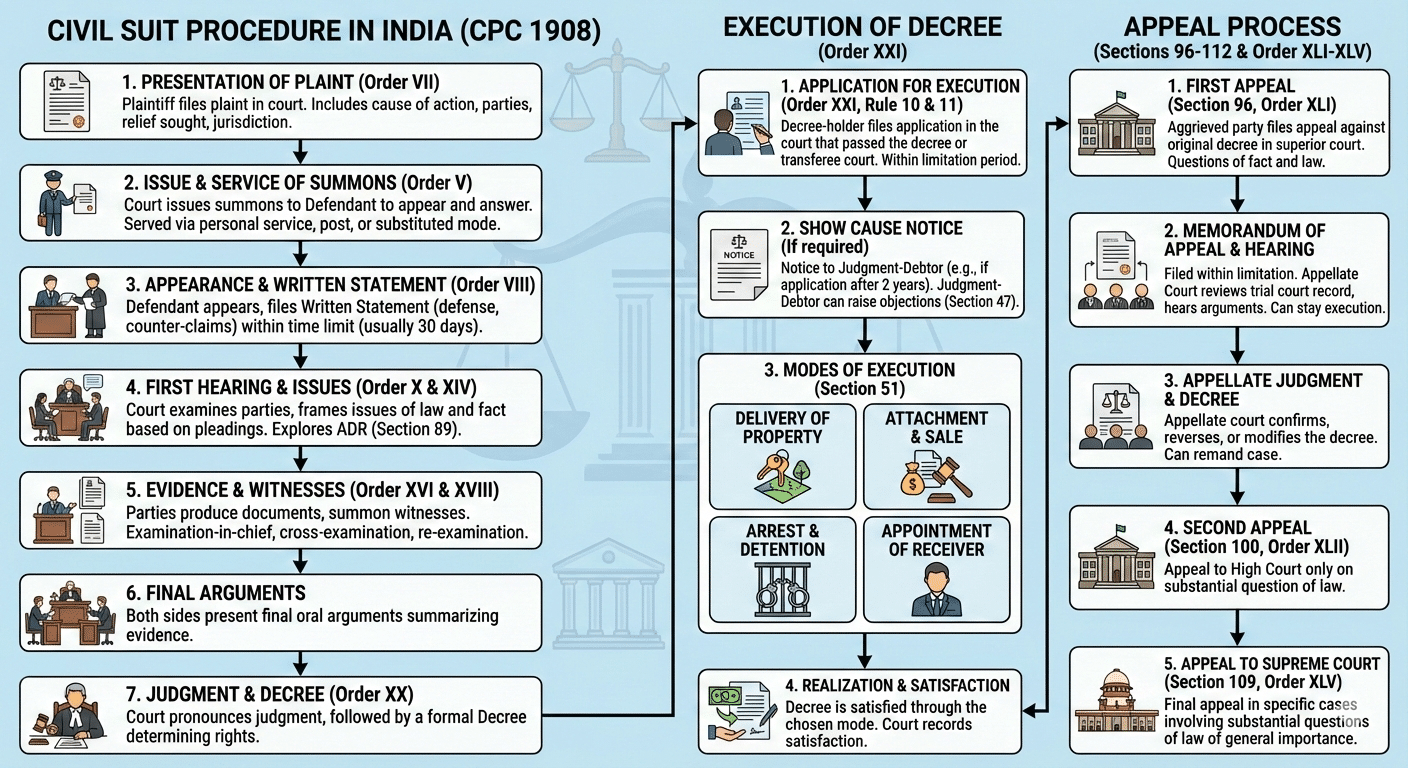
Title suit infographics
Click here to download this infographic in PDF format.
CREDITS: Patra’s Law Chambers
A “Title Suit” is one of the most common forms of civil litigation in India. It is a lawsuit filed to establish or claim ownership (i.e., “title”) over a disputed property.1 This guide will walk through the entire lifecycle of a title suit, from its definition to its final execution.
1. What is a Title Suit?
A title suit is a legal proceeding initiated by a person (the Plaintiff) to get a formal declaration from the court establishing their ownership rights over a specific property against another person (the Defendant) who is denying or casting a doubt upon that title.
The primary objective is not always just to get a declaration; it is often combined with other reliefs, such as:
- Recovery of Possession: If the Plaintiff is not in possession of the property.
- Permanent Injunction: To permanently stop the Defendant from interfering with the Plaintiff’s possession.2
- Cancellation of a Deed: To nullify a fraudulent or invalid sale deed, gift deed, etc., that clouds the Plaintiff’s title.3
Key Legal Provisions:
- Section 5 of the Specific Relief Act, 1963: Provides for the recovery of possession of specific immovable property based on title.4
- Section 34 of the Specific Relief Act, 1963: This is the core provision. It allows a person to file a suit for a “declaration” of their legal right or character, especially when their title to property is denied.
- Articles 64 & 65 of the Limitation Act, 1963: These articles are crucial.
- Article 64 allows a suit for possession based on previous possession (not necessarily title), and the suit must be filed within 12 years from the date of dispossession.5
- Article 65 is for a suit for possession based on title.6 The 12-year limitation period begins when the Defendant’s possession becomes “adverse” to the Plaintiff.
2. Common Types of Title Suits (Examples)
Title suits can take many forms depending on the dispute:
- Suit for Declaration of Title and Recovery of Possession: The most common type. (e.g., “A” files a suit claiming he is the rightful owner of a house currently occupied by “B,” who claims it’s his.)
- Suit for Partition: Filed by a co-owner (e.g., a family member) to divide a joint property and get their specific share.7
- Suit for Declaration and Injunction: Filed by a person in possession to declare their title and get a court order preventing the defendant from evicting them.
- Suit for Cancellation of a Deed: (e.g., An elderly parent files a suit to cancel a gift deed, alleging it was obtained by their son through fraud or coercion.)
3. How a Title Suit Proceeds in India
The entire procedure is governed by the Code of Civil Procedure, 1908 (CPC). Here are the step-by-step stages:
Stage 1: Filing of Plaint (Order VII)
The suit begins when the Plaintiff files a “Plaint.”8 This is a written document containing:
- The facts of the case (the “cause of action”).
- The details of the property.
- The legal basis for the Plaintiff’s claim.
- The specific reliefs claimed (e.g., declaration, possession, injunction).
Stage 2: Summons to the Defendant (Order V)
The court reviews the plaint. If it is in order, the court issues a “Summons” to the Defendant, ordering them to appear in court and file their defense.9
Stage 3: Filing of Written Statement (Order VIII)
The Defendant files a “Written Statement” (WS).10 This is their formal, point-by-point reply to the plaint. They can either admit or deny the allegations. They can also raise their own claims, such as a “counter-claim.”
Stage 4: The Interlocutory Stage (Orders XXXVIII-XL)
This is a critical “in-between” stage that happens after filing but before the final trial. During this time, the property or the rights of the parties must be protected. Either party can file “Interlocutory Applications” (I.A.s) seeking temporary orders.
Key activities in this stage include:
- Temporary Injunctions (This is what you asked about): This is the most important I.A. in a title suit.
- Appointment of a Receiver (Order XL): If the property is generating income (e.g., rent), the court can appoint a neutral third party (a “Receiver”) to manage it and submit accounts until the suit is decided.
- Attachment Before Judgment (Order XXXVIII): If the Plaintiff fears the Defendant might sell or dispose of the property to frustrate the final decree, the court can “attach” it.
What is an Injunction?
An injunction is a formal court order that commands a person to do, or refrain from doing, a specific act.11
- Temporary Injunction (Order XXXIX, Rules 1 & 2):
- This is a temporary order to maintain the “status quo” (the current state of affairs) until the suit is over.12
- For example, in a title suit, the Plaintiff (who is in possession) can get a temporary injunction to stop the Defendant from forcibly evicting them.
- To get a temporary injunction, the applicant must prove three things:
- Prima Facie Case: A strong initial argument that they are likely to win.
- Balance of Convenience: The inconvenience to the applicant (if the injunction is refused) will be greater than the inconvenience to the opponent (if it is granted).13
- Irreparable Injury: The applicant will suffer a loss that cannot be compensated by money.
- Permanent Injunction (Section 38, Specific Relief Act):
- This is not an interlocutory order. It is a final relief granted in the final judgment after the trial is complete, permanently restraining the defendant.14
Stage 5: Framing of Issues (Order XIV)
Once the Plaint and Written Statement are filed, the court identifies the core points of disagreement.15 These are framed as “Issues” (e.g., “Issue 1: Whether the Plaintiff is the owner of the suit property?” “Issue 2: Whether the suit is barred by limitation?”). The entire trial is now focused on answering these issues.
Stage 6: Evidence (Order XVIII)
This is the trial itself.
- Plaintiff’s Evidence: The Plaintiff (or their witnesses) submits their evidence first.16 This is done by filing an Affidavit-in-Chief (a sworn written statement) and producing all original documents
- Cross-Examination: The Defendant’s lawyer then cross-examines the Plaintiff and their witnesses to find inconsistencies and discredit their testimony.17
- Defendant’s Evidence: The process repeats for the Defendant, who presents their evidence-in-chief and documents.
- Cross-Examination: The Plaintiff’s lawyer cross-examines the Defendant and their witnesses.18
Stage 7: Final Hearing / Arguments (“Peremptory Hearing”)
You referred to this as a “preemptory hearing.” In legal practice, this is the “Final Hearing” or “Final Arguments” stage. (A “peremptory” date is simply a court date that is fixed and will not be adjourned).
At this stage, all evidence is closed. The lawyers for both sides present their arguments to the judge, summarizing the evidence, citing relevant laws and case precedents (judgments from High Courts/Supreme Court), and explaining how the evidence has proven their side’s case and disproven the other.19
Stage 8: Judgment (Order XX)
After hearing the final arguments, the judge “reserves” the case for judgment. The Judgment is the final decision of the court.20
- Legal Provision: Section 2(9) of the CPC defines a judgment as “the statement given by the Judge on the grounds of a decree or order.”21
- It must contain the reasoning for the decision. As per Order XX, Rule 4, it includes a summary of the case, the issues, the findings on each issue, and the reasons for those findings.22Stage 9: Drawing up the Decree (Order XX)
This is the formal step that follows the judgment.
- Legal Provision: Section 2(2) of the CPC defines a “Decree” as the “formal expression of an adjudication” which conclusively determines the rights of the parties.23
- While the judgment is the reasoning, the decree is the operative order. It is the short, formal document, signed by the judge, that states the outcome (e.g., “It is hereby declared that the Plaintiff is the owner…” or “The suit is dismissed.”). The winning party must get this decree to enforce their rights.24
4. Post-Judgment: Execution and Appeals
Stage 10: Execution of the Decree (Order XXI)
What if the losing party (the Judgment-Debtor) refuses to comply with the decree? The winning party (the Decree-Holder) cannot take the law into their own hands. They must file an “Execution Petition” in the court.
- Legal Provision: Order XXI is the single largest order in the CPC and details the entire procedure.
- How it works:
- For Recovery of Possession: The court can depute a court officer (Bailiff) to go to the property, remove the Judgment-Debtor (using police force if necessary), and deliver possession to the Decree-Holder.
- For an Injunction: If the defendant violates the injunction (e.g., enters the property again), they can be held in civil prison or their property can be attached.25For Partition: The court appoints a Commissioner to physically divide the property
Stage 11: Appeals
If a party is dissatisfied with the judgment, they have the right to appeal to a higher court.26
- First Appeal (Section 96, CPC):
- An appeal from the original decree of the trial court (e.g., Civil Judge) lies with the first appellate court (e.g., District Judge’s Court).27
- This appeal can be on questions of both fact and law. The appellate court can re-examine the evidence.28
- Second Appeal (Section 100, CPC):
- An appeal from the judgment of the first appellate court lies with the High Court.
- This is a crucial limitation: A second appeal can only be filed if the case involves a “substantial question of law.” The High Court will not re-examine the facts or evidence.29
- Appeal to the Supreme Court (Article 136, Constitution):
- Finally, any party can file a Special Leave Petition (SLP) to the Supreme Court of India. The Supreme Court has the discretion whether to hear the case or not.
Would you like me to elaborate on any specific stage, such as the rules of evidence or the grounds for a second appeal?
CREDITS:
Patra’s Law Chambers
Kolkata Office:
NICCO HOUSE, 6th Floor, 2, Hare Street, Kolkata-700001 (Near Calcutta High Court)
Delhi Office: House no: 4455/5, First Floor, Ward No. XV, Gali Shahid
Bhagat Singh, Main Bazar Road, Paharganj, New Delhi-110055
Website: www.patraslawchambers.com
Email: [email protected]
Phone: +91 890 222 4444/ +91 9044 04 9044