- Partition suit converts joint ownership into separate individual titles for co-owners or legal heirs.
- Applicable laws: Code of Civil Procedure, 1908, Partition Act, 1893, and the West Bengal Court Fees Act, 1970.
- Jurisdiction & valuation: territorial court where property lies; pecuniary limits determine Civil Judge (Junior/Senior) forum.
- Court fees hinge on possession: nominal fee if in joint possession; ad valorem fee if ousted, often litigated early.
- Two-stage decrees: a preliminary decree declares shares; a final decree effects physical division by metes and bounds.
- Court Commissioner role: Advocate Commissioner inspects property, proposes division, records on-site evidence, and files a report as court evidence.
- Partition Act remedies: court can order sale when division is impracticable; co-sharers have pre-emption and Section 4 protections for family dwellings.
A Definitive Guide to Partition Suits in West Bengal: From Filing to Final Decree
Video information on partition suit in West Bengal:
An exhaustive legal analysis of the procedure for filing a partition suit in West Bengal. This guide covers the CPC, Partition Act, court fees, injunctions, evidence, landmark judgments, and the roles of Civil Judges and Court Commissioners.
Introduction: Understanding Partition and Your Right to Claim a Share
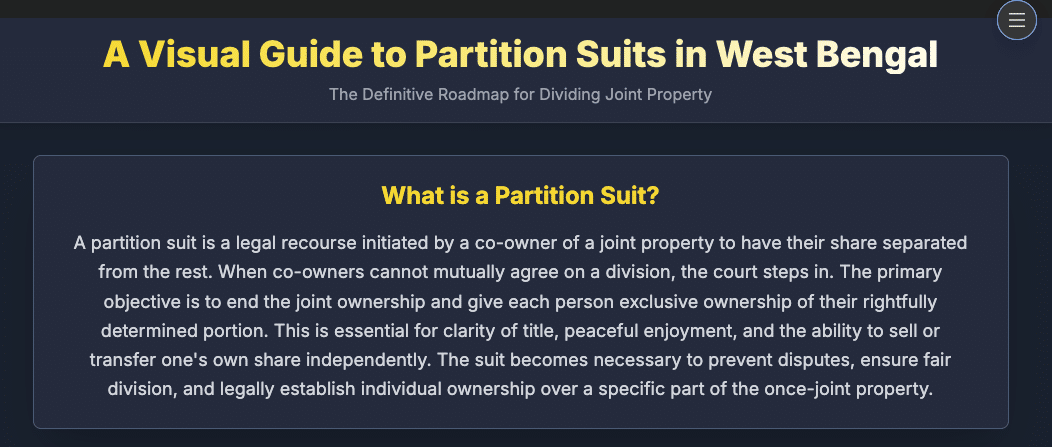
A partition suit is a legal recourse available to co-owners of a joint property to assert their right to a distinct and separate share. It is a proceeding instituted by a coparcener or legal heir when a property dispute arises within a family, or when mutual consent for the division or sale of the property is absent among its multiple owners.1 The fundamental purpose of such a suit is to transform joint ownership into separate, individual ownership, thereby providing each co-owner with exclusive title and possession over their demarcated portion of the property.
Any individual who is a legal heir or a co-owner of a joint property is entitled to file a suit for partition.1 This right extends to those who hold a share through inheritance, purchase, gift, or under a will.2 Before initiating legal proceedings, it is imperative for the claimant to gather all necessary certified documents that substantiate their claim of co-ownership. These documents typically include title deeds, sale deeds, gift deeds, wills, mutation records, and the death certificates of any deceased ancestors or co-owners from whom the title has devolved.1
Section 1: The Legal Bedrock: Governing Statutes
The process of partitioning property through the courts is not governed by a single law but is a complex interplay of procedural and substantive statutes. A comprehensive understanding of these legal frameworks is essential for navigating a partition suit successfully.
The Code of Civil Procedure, 1908 (CPC): The Procedural Blueprint

The Code of Civil Procedure, 1908 (CPC) is the foundational procedural law that governs the entire lifecycle of a partition suit, just as it does for most other civil litigation in India. It provides a comprehensive blueprint for every stage of the legal process, from the initiation of the suit to the final execution of the court’s decision. Key provisions of the CPC dictate the rules for determining the appropriate court (jurisdiction) 3, the formal institution of the suit 3, the structure and meaning of decrees 4, the process for executing a final decree, particularly for land-revenue paying estates 3, and the mechanisms for ancillary relief, such as the appointment of court commissioners for local investigation 4 and the granting of temporary injunctions to protect the property during the litigation.4
The Partition Act, 1893: The Substantive Law for Indivisible Properties
While the CPC provides the “how,” the Partition Act, 1893, provides a crucial part of the “what,” especially in complex situations. This Act was specifically legislated to address a significant lacuna in the law: what to do when a property, by its very nature, cannot be reasonably or conveniently divided among the co-sharers.6 Before this Act, courts were often powerless in such scenarios, leading to impractical and unenforceable decrees.6 The Partition Act empowers the court, under specific and controlled circumstances, to order a sale of the property and distribute the sale proceeds among the co-owners according to their respective shares.8 This provides a pragmatic and equitable solution where physical division would destroy the property’s value or is otherwise unfeasible.
The West Bengal Court Fees Act, 1970: The Financial Gateway to Justice
Access to the courts is contingent upon the payment of a prescribed fee, and in West Bengal, this is governed by the West Bengal Court Fees Act, 1970. This state-specific law determines the amount of court fee a plaintiff must pay when filing a partition suit.11 The calculation of this fee is not uniform; it critically depends on the valuation of the suit and, most importantly, on whether the plaintiff is in joint possession of the property or has been ousted (excluded) from it.11 This financial prerequisite is a crucial first hurdle in the litigation process.
Section 2: The First Step: Jurisdiction and Court Fees
Before a plaint is even drafted, two fundamental questions must be answered: which court has the authority to hear the case, and how much will it cost to file it? These preliminary considerations of jurisdiction and court fees are governed by specific statutes and can have a profound impact on the entire litigation.
Choosing the Correct Forum: Territorial and Pecuniary Jurisdiction in West Bengal
The authority of a court to adjudicate a matter is primarily divided into territorial and pecuniary jurisdiction.
- Territorial Jurisdiction: As stipulated by Section 16 of the CPC, a suit for the partition of immovable property must be instituted in the court within whose local geographical limits the property is situated.3 If the property spans multiple jurisdictions, the suit may be filed in any court where a portion of the property lies.3
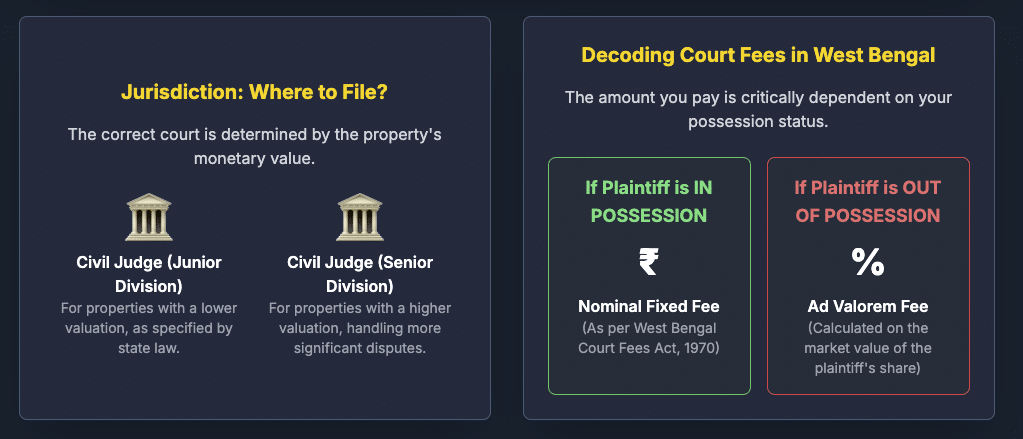
- Pecuniary Jurisdiction: This refers to the court’s competence to hear a case based on its monetary value. In West Bengal, this is determined by the Bengal, Agra and Assam Civil Courts Act, 1887. The hierarchy is as follows:
- Civil Judge (Junior Division): These courts generally have the jurisdiction to hear suits where the value of the subject matter does not exceed ₹30,000.13 However, Section 19(2) of the Act empowers the State Government, on the recommendation of the High Court, to issue a notification extending this limit to ₹60,000 for specific, named courts.13 For instance, Notification No. 272-JL, dated August 12, 2016, enhanced the pecuniary jurisdiction to ₹60,000 for several Civil Judge (Junior Division) courts at Alipore.13
- Civil Judge (Senior Division): The jurisdiction of a Civil Judge (Senior Division) extends to all original suits and proceedings of a civil nature.14 This means they have unlimited pecuniary jurisdiction for original suits and will hear all partition suits whose valuation exceeds the limit of the Junior Division courts.
Table 1: Pecuniary Jurisdiction of Civil Courts in West Bengal
| Court | Governing Act | Pecuniary Limit | Enhanced Limit (by Notification) | Remarks |
| Civil Judge (Junior Division) | Bengal, Agra and Assam Civil Courts Act, 1887 | General Limit: Up to ₹30,000 | Can be extended up to ₹60,000 for specified courts | The appropriate court is determined by the valuation of the suit property. It is crucial to check for the latest notifications applicable to the specific court where the suit is to be filed. |
| Civil Judge (Senior Division) | Bengal, Agra and Assam Civil Courts Act, 1887 | No upper limit for original suits | Not Applicable | Hears all original suits valued above the jurisdiction of the Junior Division. |
Valuation of the Suit and Calculation of Court Fees
The manner in which a plaintiff pleads their possession of the suit property is not merely a statement of fact; it is a critical strategic decision with significant financial consequences. The West Bengal Court Fees Act, 1970, creates a clear distinction based on possession, which often becomes the first battleground in a partition suit.
If a plaintiff is in joint possession (even constructive possession) of the property along with the other co-sharers, they are required to pay only a nominal, fixed court fee.1 This is because the suit is primarily for changing the form of enjoyment from joint to separate.
However, if the plaintiff has been ousted or excluded from possession of the property, the nature of the suit changes. It is no longer just for partition but also for recovery of possession. In such cases, the court fee is calculated ad valorem—that is, based on the market value of the plaintiff’s claimed share in the property.11 This can be a substantial amount and a significant financial barrier to litigation.
This legal distinction gives rise to a common litigation strategy. A defendant, seeking to put financial pressure on the plaintiff, will almost invariably challenge the plaintiff’s assertion of joint possession. By doing so, the defendant aims to compel the plaintiff to pay the much higher ad valorem court fee, hoping that the cost will be prohibitive and force the plaintiff to abandon the suit. Consequently, the first major dispute in many partition suits is not over the respective shares but over the preliminary issue of whether the plaintiff is in joint possession, as the answer determines the court fee payable and, potentially, the viability of the entire lawsuit.
Section 3: The Anatomy of a Partition Suit: A Step-by-Step Chronology

A partition suit proceeds through a series of well-defined stages as prescribed by the Code of Civil Procedure. Each stage serves a specific purpose, from formally stating the claim to the final adjudication by the court.
Initiating the Action: Drafting and Filing the Plaint
The legal process commences with the filing of a “plaint,” which is the formal written complaint presented by the plaintiff to the court.1 The plaint must be meticulously drafted to include all necessary particulars to avoid rejection at the outset. It must be filed within the limitation period, which for a partition suit is 12 years from the date the plaintiff’s right to a share is denied by the other co-owners.2 The plaint must be accompanied by a Vakalatnama, a document authorizing an advocate to act on the plaintiff’s behalf.1
Table 2: Checklist of Essential Details for a Plaint in a Partition Suit
| Information/Document | Description |
| Parties’ Details | Full names, parentage, and current addresses of all co-owners (plaintiffs and defendants). |
| Property Description | Detailed description of all joint properties (e.g., premises number, plot number, area, boundaries). |
| Title Documents | Certified copies of property documents (e.g., title deeds, sale deeds, mutation records). |
| Ancillary Documents | Death certificates of deceased ancestors/co-owners through whom title is claimed. |
| Claim Statement | A clear statement of the share being claimed by the plaintiff (e.g., one-third, one-fourth). |
| Valuation | Approximate market value of the entire property for the purpose of jurisdiction and court fees. |
| History of Dispute | Details of any prior attempts at an amicable partition. |
| Cause of Action | The date and specific details of when the right to partition was denied, which gives rise to the suit. |
The Defendant’s Response: The Written Statement
Upon receiving the summons from the court, the defendant must file a “written statement”.1 This is the defendant’s formal reply to the plaint. It must be filed within 30 days, a period that the court can extend to a maximum of 90 days.1 The written statement is crucial as it must specifically deny each allegation in the plaint that the defendant disputes. According to the rules of pleading, any allegation of fact in the plaint that is not specifically denied in the written statement is deemed to be admitted by the defendant.1
The Crucial Stage of Framing Issues (Order XIV, CPC)
Once the pleadings (plaint and written statement) are complete, the court proceeds to one of the most critical stages of the trial: the framing of issues.16 An issue arises when a material proposition of fact or law is affirmed by one party and denied by the other.17 The court carefully examines the pleadings and frames distinct questions or “issues” that need to be adjudicated. This process is vital as it narrows the scope of the dispute and provides a clear roadmap for the trial. The entire evidence-gathering process and subsequent arguments are structured around proving or disproving these framed issues.16
Presenting Your Case: The Evidence Stage (Order XVIII, CPC)
With the issues framed, the suit moves to the evidence stage. Both parties are given the opportunity to substantiate their respective claims and counterclaims by producing evidence.1 This evidence can be of two types:
- Documentary Evidence: Parties submit original documents, such as title deeds, tax receipts, and correspondence, which support their case.19
- Oral Evidence (Testimony): Parties produce witnesses who testify before the court. The process of recording a witness’s testimony is structured into three parts:
- Examination-in-Chief: The party who called the witness questions them to bring out facts that support their case.
- Cross-Examination: The opposing party’s lawyer questions the witness to test the veracity of their statements and bring out facts favorable to their side.
- Re-Examination: The party who originally called the witness may ask further questions to clarify any ambiguities that arose during cross-examination.19
The “Peremptory Hearing”: A Tool for Expeditious Disposal
While the term “peremptory hearing” is not explicitly defined in the CPC, it is a procedural term frequently used by courts in India, including the Calcutta High Court, to signify a commitment to an expeditious trial.20 When a court fixes a date for a “peremptory hearing,” it serves as a strict notice to all parties that the case will proceed on that day and that no further adjournments will be granted except in the most extreme circumstances.20 This is typically done after the preliminary stages of the suit are complete and is a judicial tool to combat unnecessary delays and ensure that the trial moves forward decisively.21
Final Arguments and the Pronouncement of Judgment
After both sides have presented all their evidence, the evidence stage is closed. The lawyers for the plaintiff and defendant then present their “final arguments”.1 In this stage, they summarize the evidence on record, connect it to the framed issues, and cite relevant laws and judicial precedents to persuade the court to rule in their client’s favor. Following the conclusion of the arguments, the court reserves the matter for judgment. The judgment is the statement of the judge on the grounds for the decision, which then culminates in a formal decree.3
Section 4: Protecting the Property Pendente Lite: The Power of Injunctions
During the pendency of a partition suit, which can often be a lengthy process, there is a significant risk that one of the co-sharers might attempt to sell, mortgage, or otherwise alter the nature of the joint property. To prevent such actions, the law provides a powerful protective remedy: the temporary injunction.
The Role of Temporary Injunctions in Partition Suits (Order XXXIX, CPC)
Under Order XXXIX of the CPC, any party to the suit can apply for a temporary injunction. This is a provisional order from the court that restrains another party from committing a specific act until the final disposal of the suit.22 In the context of a partition suit, an injunction is typically sought to prevent any party from:
- Alienating the property: Selling, gifting, or mortgaging their undivided share.
- Wasting or damaging the property: Undertaking actions that diminish the value of the property.
- Creating third-party rights: Leasing the property or creating any other encumbrance.
- Changing the nature of the property: Demolishing existing structures or raising new constructions.
This remedy is crucial for preserving the “status quo” of the property, ensuring that the subject matter of the suit remains intact and available for partition when the final decree is passed.22
The Three Pillars for Granting an Injunction
A court does not grant an injunction lightly. The party seeking this equitable relief must satisfy the court on a tripartite test, often referred to as the “three pillars” for granting an injunction 22:
- Prima Facie Case: The applicant must demonstrate that there is a serious and bona fide question to be tried. They do not need to prove their case conclusively at this stage, but they must show that their claim is not frivolous or vexatious and that there is a high probability they will succeed in the suit.
- Irreparable Injury: The applicant must prove that they will suffer an injury that cannot be adequately compensated by monetary damages if the injunction is not granted. The loss of a unique ancestral property, for example, is often considered an irreparable injury.
- Balance of Convenience: The court weighs the potential harm to the applicant if the injunction is denied against the potential harm to the defendant if it is granted. The injunction will be issued only if the balance of convenience is in favor of the applicant, meaning the hardship they would face without the injunction is greater than the hardship the defendant would face if it is granted.
Section 5: The Two-Tiered Judgment: Preliminary and Final Decrees
A unique feature of a partition suit is that it typically culminates in not one, but two decrees: a preliminary decree and a final decree.2 This two-stage process is necessitated by the nature of the relief sought—first the declaration of rights, and then the physical division of the property.
The Preliminary Decree: A Declaration of Rights and Shares
The first stage of adjudication concludes with the passing of a preliminary decree. As defined in Section 2(2) of the CPC, a preliminary decree is one that conclusively determines the rights of the parties with regard to the matters in controversy but does not completely dispose of the suit.4 In a partition suit, the preliminary decree identifies the properties that are joint and available for partition and declares the specific quantum of the share that each co-owner is entitled to (e.g., one-third, one-fourth).24 This decree is a final adjudication of the rights and shares and is appealable on its own merits. However, it does not effect an actual physical division of the property.
The Final Decree: The Actual Division by Metes and Bounds
After the preliminary decree has been passed and the shares are determined, the suit remains pending for the next stage: the final decree proceedings. The purpose of the final decree is to implement the preliminary decree by physically dividing the property “by metes and bounds”—that is, by precise measurements, boundaries, and demarcation—and delivering separate possession of the allotted portions to the respective co-sharers.24 This process is often carried out with the assistance of a Court-appointed Advocate Commissioner, who inspects the property and suggests a mode of division.26 The final decree effectuates the partition on the ground, bringing the suit to its complete conclusion.
The procedural separation between the preliminary and final decrees reveals a profound conceptual truth about partition suits: they are ‘living’ proceedings. Unlike a suit for money which concludes with a single, final judgment, a partition suit remains pending and active even after the rights of the parties have been declared in a preliminary decree. This ongoing nature has been affirmed by the Supreme Court in landmark rulings, giving these suits a unique dynamism. For instance, in Phoolchand v. Gopal Lal, the Court held that if a party dies after the preliminary decree is passed, the court can—and should—recalculate the augmented shares of the remaining parties and pass a fresh, amended preliminary decree.27 This demonstrates that the preliminary decree is not an immutable final word but a declaration of rights as they stand at that moment, capable of being adapted to subsequent events.
Furthermore, in Shub Karan Bubna v. Sita Saran Bubna, the Supreme Court established that an application for a final decree is not a new proceeding that can be barred by the Limitation Act.29 Instead, it is merely a request for the court to complete its duty in a suit that is still pending. Together, these principles illustrate that a partition suit is not a linear process that ends with one judgment. It is an adaptable proceeding that remains alive until the final division is achieved, ensuring that the ultimate partition reflects the true state of ownership, even if it changes during the course of the litigation. This reinforces the legal maxim that in a partition suit, every party, whether plaintiff or defendant, is in the position of a claimant.
Section 6: On-Site Adjudication: The Role of the Court Commissioner
The transition from a preliminary decree (declaring shares) to a final decree (dividing the property) often requires a practical, on-the-ground assessment that a judge cannot conduct from the courtroom. This is where the role of the Court Commissioner becomes indispensable.
Appointment, Powers, and Duties (Order XXVI, CPC)
Following a preliminary decree, the court, under the provisions of Order XXVI of the CPC, frequently appoints an Advocate Commissioner to facilitate the actual partition.19 The Commissioner acts as an officer of the court, tasked with a local investigation to ensure the division is equitable and practical. Their primary duties include:
- Visiting the suit property to conduct a thorough inspection.
- Proposing a plan for dividing the property by “metes and bounds” (with precise measurements and boundaries) in strict accordance with the shares declared in the preliminary decree.26
- Taking evidence and examining witnesses on-site, if necessary, to clarify matters relevant to the division.31
- Suggesting the payment of “owelty” (an equalizing amount of money) if an absolutely equal division is not possible and one party receives a share of greater value.
It is important to note that while a Commissioner is crucial for the final decree stage, their appointment cannot be used as a tool to collect evidence to prove a disputed fact, such as possession, before the preliminary decree has been passed.31
The Commissioner’s Report: Its Process and Evidentiary Value
After completing the local investigation, the Commissioner prepares and submits a detailed report to the court. This report typically includes maps, plans, proposed share lists, and the evidence recorded during the investigation.26 Under Order XXVI, Rule 10, this report and the evidence taken by the Commissioner are considered evidence in the suit and form part of the official court record.31
The parties are given an opportunity to review the report and file objections if they disagree with the Commissioner’s findings or proposed mode of partition. The court will then hear these objections, and may even examine the Commissioner in person. Based on a consideration of the report, the objections, and other evidence, the court may confirm the report, vary its recommendations, or set it aside and issue new directions, before ultimately passing the final decree.3
Section 7: When Physical Division Fails: Invoking the Partition Act, 1893
The traditional outcome of a partition suit is the physical division of the property. However, reality often presents situations where such a division is impractical, inequitable, or would destroy the value of the asset. It was to address these “insuperable practical difficulties” that the Partition Act, 1893, was enacted.6
The Court’s Discretionary Power to Order a Sale (Section 2)
Section 2 of the Act grants the court a discretionary power to order a sale of the property instead of a physical division. This power can be exercised if two conditions are met:
- The court finds that a division of the property cannot be reasonably or conveniently made, due to factors like the nature of the property (e.g., a single, small dwelling house), the large number of shareholders, or other special circumstances.6
- A request for sale is made by one or more shareholders who, individually or collectively, hold at least a moiety (a 50% share) in the property.10
If these conditions are satisfied, and the court believes a sale and distribution of the proceeds would be more beneficial for all shareholders, it may direct a sale.6
The Right of Pre-emption: A Co-sharer’s Right to Buy (Sections 3 & 4)
The Partition Act contains powerful provisions designed to protect the interests of co-sharers and preserve the integrity of family property, especially dwelling houses.
- Section 3 – The Right to Buy-Out: If a request for sale is made under Section 2, Section 3 provides a right of pre-emption to the other co-sharers. Any shareholder who does not want the property to be sold in a public auction can apply to the court for leave to buy the share(s) of the party or parties who are asking for the sale. The court will then conduct a valuation of those shares and offer to sell them to the applying co-sharer(s) at the ascertained price.6 If multiple co-sharers apply, the court will sell to the one who offers the highest price above the valuation.6 This provision allows family members to consolidate ownership and prevent the property from being sold to an outsider.
- Section 4 – The Shield for the Family Dwelling House: Section 4 provides a robust defense against the intrusion of a stranger into an undivided family’s dwelling house. If a person who is not a member of the family purchases a share of such a dwelling house and then files a suit for partition, this section is triggered. Any member of the family who is also a shareholder can undertake to buy the stranger-transferee’s share at a valuation to be determined by the court.9 The court is then bound to order the sale of the stranger’s share to the family member, effectively preventing the fragmentation of the family home.
Procedure for Sale and Distribution of Proceeds
When a sale is ordered under the Act, it is conducted under the court’s supervision. Key procedural aspects include:
- Bidding by Shareholders (Section 6): Any of the shareholders are at liberty to bid at the auction.32
- Procedure (Section 7): The procedure for the sale is generally to be followed as laid down in the Code of Civil Procedure for court-auctioned sales.8
- Sale Orders as Decrees (Section 8): Crucially, any order for sale made by the court under the Partition Act is deemed to be a decree.8 This gives it the force of a final court order and makes it appealable.
- Partial Partition and Sale (Section 9): The court also has the flexibility to order that a part of the property be partitioned physically, while another part is sold.8
Section 8: A Compendium of Landmark Judgments
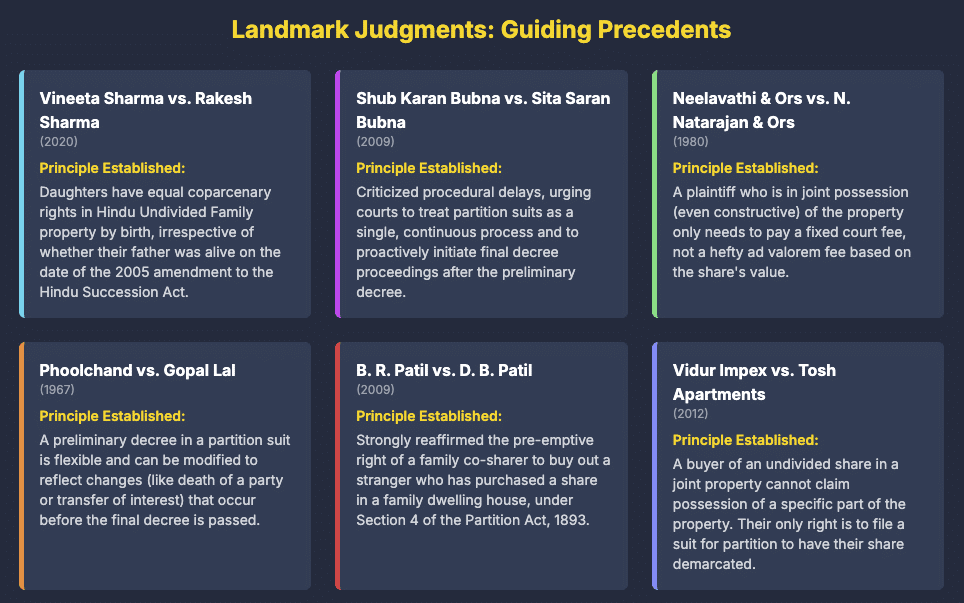
The law of partition is not static; it is continuously shaped and clarified by the judiciary. The following is a curated list of landmark judgments from the Supreme Court of India and the Calcutta High Court that have significantly influenced the conduct and outcome of partition suits.
| Case Name | Legal Principle/Law Point |
|---|---|
| Phoolchand And Anr vs Gopal Lal | The court is not barred from passing more than one preliminary decree in a partition suit. If circumstances change after the first decree (such as the death of a party), necessitating a re-adjustment of shares, the court has the power and duty to pass a fresh, amended preliminary decree to reflect the new entitlements. |
| Shub Karan Bubna @ Shub Karan Prasad Bubna vs Sita Saran Bubna & Ors | An application for the court to draw up a final decree is regarded merely as a continuation of the pending partition suit and is therefore not subject to any period of limitation under the Limitation Act. The court has a duty to proceed with the final decree once the preliminary decree is passed. |
| Vineeta Sharma v. Rakesh Sharma | Daughters possess coparcenary rights in Hindu ancestral property by birth, placing them on par with sons. This right is retrospective, meaning it exists irrespective of whether the father was alive on September 9, 2005. |
| Angadi Chandranna v. Shankar | Once joint family property is formally partitioned, the share received by a coparcener transforms into their self-acquired property. The coparcener then gains absolute rights to sell or dispose of it without requiring the consent of their heirs. |
| Shashidhar & Ors. v. Ashwini Uma Mathad & Anr. | Properties acquired through inheritance or transfer cannot be presumed to be coparcenary. To include such property in a partition, it must be specifically pleaded and proven through evidence that the property is ancestral in nature. |
| Trinity Infraventures Ltd. v. M.S. Murthy | Findings regarding property title that are recorded in a simple suit for partition are not binding upon third parties who were not impleaded or involved in that suit. |
| Rajendra Kumar Bose vs Brojendra Kumar Bose | This case established the foundational rule against partial partition, holding that a partition suit must generally include all the joint properties owned by the co-tenants. A suit seeking to partition only some joint properties is generally not maintainable. |
| Satchidananda Samanta vs Ranjan Kumar Basu | This judgment reaffirmed the established legal principle against suits for partial partition, discouraging them except in rare, exceptional circumstances. |
| Santosh Kr. Mitra v. Kalipada Das | The right of a family member to buy the share of a stranger-transferee under Section 4 of the Partition Act can be invoked regardless of whether the suit for partition was initiated by the stranger-purchaser or by another family member. |
| Satyendu Kundu v. Amar Nath Ghosh | The terms “undivided family” and “dwelling house” were interpreted liberally, holding that a property remains a family dwelling house even if portions have been temporarily leased out to tenants, provided the family maintains the intention to use it as a residence. |
| Boto Krishna Ghose vs Akhoy Kumar Ghose | This case explored the legislative intent behind Section 4 of the Partition Act, noting its core purpose of preserving the sanctity and privacy of the family home. |
| Ram Krishna Tarafdar vs Nemai Krishna Tarafdar | Defined “owelty” as money paid to equalize shares when perfect physical division is impossible. Owelty is considered a part of the partitioned property itself (a substituted property) and is not merely an ordinary debt. |
| His Heirs And Legal Representatives vs Pratul Saha & Ors | Clarified that the non-payment of owelty money, by itself, does not prevent the title from passing to the respective parties once a deed of partition has been formally executed and registered. |
| Anonymous Judgment (AIR 2015 (NOC) 1094 (CAL)) | A suit for partition is not maintainable if all necessary parties are not impleaded. A purchaser of a co-sharer’s portion steps into the shoes of the seller and is consequently a necessary party to the suit. |
A. Supreme Court of India Precedents
On the Nature of Decrees and Limitation
- Phoolchand And Anr vs Gopal Lal (1967): This seminal judgment established the principle that in a partition suit, the court is not barred from passing more than one preliminary decree. If circumstances change after the first preliminary decree (such as the death of a party), which necessitates a re-adjustment of shares, the court can and should pass a fresh, amended preliminary decree to reflect the new entitlements.27
- Shub Karan Bubna @ Shub Karan Prasad Bubna vs Sita Saran Bubna & Ors (2009): The Court provided a crucial clarification on the limitation period for final decrees. It held that an application to draw up a final decree is merely a continuation of the pending partition suit and not a fresh application. Therefore, it is not subject to any period of limitation under the Limitation Act, 1963. The Court emphasized that it is the duty of the court to proceed with the final decree after the preliminary decree is passed.29
On Co-parcenary Rights and Nature of Property
- Vineeta Sharma v. Rakesh Sharma (2020): In a judgment with far-reaching implications for gender equality, the Supreme Court held that daughters possess coparcenary rights in Hindu ancestral property by birth, on par with sons. It clarified that this right exists irrespective of whether their father was alive on September 9, 2005, the date the Hindu Succession (Amendment) Act came into force, giving the amendment retrospective effect.36
- Angadi Chandranna v. Shankar (2025): This ruling clarified the status of property post-partition. The Court held that once a joint family property is formally partitioned, the share received by a coparcener becomes their self-acquired property. They then have absolute rights to sell, gift, or otherwise dispose of it without the consent of their heirs.36
- Shashidhar & Ors. v. Ashwini Uma Mathad & Anr. (2024): The Court underscored the importance of pleadings and proof in determining the nature of property. It held that properties acquired through inheritance or transfer cannot be presumed to be part of the ancestral coparcenary. It must be specifically pleaded and proven through evidence that such property is ancestral in nature for it to be included in the partition.41
- Trinity Infraventures Ltd. v. M.S. Murthy (2023): The Court limited the scope of a partition suit by holding that findings on property title recorded in a simple suit for partition are not binding on third parties who were not part of the suit.41
B. Calcutta High Court Precedents
On the Impermissibility of Partial Partition
- Rajendra Kumar Bose vs Brojendra Kumar Bose (1922): This is a foundational judgment of the Calcutta High Court that firmly established the rule against partial partition. The court held that a suit for partition must, as a general rule, embrace all the joint properties owned by the co-tenants. A suit for partitioning only some of the joint properties is not maintainable, as it would lead to a multiplicity of suits and could result in an inequitable division.45
- Satchidananda Samanta vs Ranjan Kumar Basu (1991): This case reaffirmed the well-settled legal principle laid down in Rajendra Kumar Bose, discouraging suits for partial partition except in exceptional circumstances.45
On the Interpretation of Section 4, Partition Act
- Santosh Kr. Mitra v. Kalipada Das (1980): This judgment reinforced the protective intent of Section 4 of the Partition Act. The court held that the primary objective of the section is to safeguard the family dwelling house from the intrusion of strangers, and this right can be invoked by a family member regardless of whether the suit for partition was initiated by the stranger-purchaser or another family member.50
- Satyendu Kundu v. Amar Nath Ghosh (1963): The court adopted a liberal interpretation of the terms “undivided family” and “dwelling house.” It held that a property does not cease to be a family dwelling house merely because parts of it have been temporarily leased out to tenants, as long as the family retains an intention to use it as a residence.51
- Boto Krishna Ghose vs Akhoy Kumar Ghose (1949): This case explored the legislative history and intent behind Section 4 of the Partition Act, noting its connection to Section 44 of the Transfer of Property Act, 1882, and its core purpose of preserving the sanctity and privacy of the family home.52
On Owelty (Equality of Partition) and Other Co-sharer Rights
- Ram Krishna Tarafdar vs Nemai Krishna Tarafdar (1973): The court provided a clear explanation of “owelty.” It is the money paid by one co-sharer to another to equalize the shares when a property cannot be divided into portions of perfectly equal value. The court held that owelty is considered a part of the partitioned property itself (a substituted property) and is not merely an unpaid purchase price or a debt.53
- His Heirs And Legal Representatives vs Pratul Saha & Ors (2023): This recent judgment clarified that the non-payment of owelty money, by itself, does not prevent the title from passing to the respective parties once a deed of partition has been duly executed and registered.53
- Anonymous Judgment (AIR 2015 (NOC) 1094 (CAL)): In this case, the court held that a suit for partition is not maintainable if all necessary parties are not impleaded. When a co-sharer sells a portion of their share, the purchaser steps into the shoes of the seller and becomes a co-sharer. Therefore, such a purchaser is a necessary party to the suit, and their absence renders the suit defective.55
Conclusion: Navigating Your Partition Claim with Clarity and Confidence
The journey of a partition suit in West Bengal is intricate, governed by a matrix of procedural and substantive laws, and shaped by decades of judicial interpretation. From determining the correct court and calculating the appropriate fees to navigating the complex stages of pleadings, evidence, and decrees, the process demands meticulous attention to detail and a deep understanding of legal nuances. The possibility of injunctions, the appointment of court commissioners, and the invocation of the Partition Act for the sale of indivisible property add further layers of complexity.
The landmark judgments of the Supreme Court and the Calcutta High Court have provided crucial clarity on issues ranging from the rights of daughters and the nature of post-partition property to the procedural technicalities of decrees and the impermissibility of partial partition. This evolving legal landscape underscores the necessity of strategic foresight and expert legal guidance. Understanding one’s rights is the first step; effectively enforcing them through the labyrinth of the legal system is the challenge where professional assistance becomes indispensable.
Conclusion: Navigating Your Partition Claim with Clarity and Confidence
The journey of a partition suit in West Bengal is intricate, governed by a matrix of procedural and substantive laws, and shaped by decades of judicial interpretation. From determining the correct court and calculating the appropriate fees to navigating the complex stages of pleadings, evidence, and decrees, the process demands meticulous attention to detail and a deep understanding of legal nuances. The possibility of injunctions, the appointment of court commissioners, and the invocation of the Partition Act for the sale of indivisible property add further layers of complexity.
The landmark judgments of the Supreme Court and the Calcutta High Court have provided crucial clarity on issues ranging from the rights of daughters and the nature of post-partition property to the procedural technicalities of decrees and the impermissibility of partial partition. This evolving legal landscape underscores the necessity of strategic foresight and expert legal guidance. Understanding one’s rights is the first step; effectively enforcing them through the labyrinth of the legal system is the challenge where professional assistance becomes indispensable.
Expert Legal Guidance from Patra’s Law Chambers
Navigating the complexities of a partition suit requires not just legal knowledge but also strategic acumen and extensive experience in property litigation. Patra’s Law Chambers, a Kolkata-based law firm with an additional office in Delhi, was established in 2020 by Advocate Sudip Patra to provide comprehensive legal solutions across a wide spectrum of practice areas.
The firm specializes in civil law, land disputes, family law, and Supreme Court matters, making it uniquely equipped to handle the multifaceted challenges of partition suits. Our team is dedicated to guiding clients through every stage of the process, from initial documentation to the final decree, ensuring that your rights are protected and your rightful share is secured. We handle matters before all major courts and tribunals, offering robust representation tailored to the specific needs of your case.
If you are facing a dispute regarding joint family property and require expert legal guidance, we invite you to consult with us.
Contact Patra’s Law Chambers for expert legal advice and representation:
- Kolkata Office: NICCO HOUSE, 6th Floor, 2, Hare Street, Kolkata-700001 (Near Calcutta High Court)
- Delhi Office: House no: 4455/5, First Floor, Ward No. XV, Gali Shahid Bhagat Singh, Main Bazar Road, Paharganj, New Delhi-110055.
- Website: patraslawchambers.com
- Email: [email protected]
- Phone: +91 890 222 4444 / +91 9044 04 9044.
Hashtags: #PartitionSuit #WestBengalLaw #PropertyLawIndia #CivilProcedureCode #PartitionAct1893 #KolkataLawyer #PropertyDispute #LegalGuidance #LandmarkJudgments #CourtProcedure #Injunction #FamilyProperty #InheritanceLaw #LegalRights #CivilSuit #CourtCommissioner #RealEstateLaw #CalcuttaHighCourt #SupremeCourtIndia #LegalHelpp
Works cited:
- How to File a Partition Suit in West Bengal and Kolkata? – Property …, accessed on September 9, 2025, https://advocatechenoyceil.com/2021/07/30/how-to-file-a-partition-suit-in-west-bengal-and-kolkata/
- Partition Suit in India – Court Fees, Limitation and Format – NoBroker, accessed on September 9, 2025, https://www.nobroker.in/blog/partition-suit-explained/
- the code of civil procedure, 1908 ______ arrangement … – India Code, accessed on September 9, 2025, https://www.indiacode.nic.in/bitstream/123456789/13813/1/the_code_of_civil_procedure%2C_1908.pdf
- THE CODE OF CIVIL PROCEDURE, 1908 – Supreme Court Legal Services Committee, accessed on September 9, 2025, https://sclsc.gov.in/theme/front/pdf/ACTS%20FINAL/THE%20CODE%20OF%20CIVIL%20PROCEDURE,%201908.pdf
- The Code of Civil Procedure, 1908 (Act No. 5 of 1908) – India Code, accessed on September 9, 2025, https://www.indiacode.nic.in/bitstream/123456789/11087/1/the_code_of_civil_procedure%2C_1908.pdf
- Partition Act, 1893. – High Court of Tripura, accessed on September 9, 2025, https://thc.nic.in/Central%20Governmental%20Acts/Partition%20Act,%201893..pdf
- The Partition Act, 1893, accessed on September 9, 2025, https://cdnbbsr.s3waas.gov.in/s3ca0daec69b5adc880fb464895726dbdf/uploads/2022/08/2022080870.pdf
- Partition Act, 1893 – India Code, accessed on September 9, 2025, https://www.indiacode.nic.in/handle/123456789/5657?locale=en
- The Partition Act,1893 – Indian Kanoon, accessed on September 9, 2025, https://indiankanoon.org/doc/20785267/
- The Partition Act, 1893 | PDF | Decree | Supreme Courts – Scribd, accessed on September 9, 2025, https://www.scribd.com/document/435361690/The-Partition-Act-1893
- The West Bengal Court-Fees Act, 1970 – West Bengal Judicial …, accessed on September 9, 2025, https://www.wbja.nic.in/wbja_adm/files/The%20West%20Bengal%20Court-Fees%20Act,%201970.pdf
- West Bengal Court-Fees Act, 1970 – Latest Laws, accessed on September 9, 2025, https://www.latestlaws.com/bare-acts/state-acts-rules/west-bengal-state-laws/west-bengal-court-fees-act-1970/
- Ashim Safui v. Dipankar Sen And Others | Calcutta High Court …, accessed on September 9, 2025, https://www.casemine.com/judgement/in/5ffee2969fca1917ab0ee78c
- State Acts – India Code: Section Details, accessed on September 9, 2025, https://www.indiacode.nic.in/show-data?abv=null&statehandle=null&actid=AC_MH_166_855_00031_00031_1651839533948&orderno=26&orgactid=AC_MH_166_855_00031_00031_1651839533948
- IN THE HIGH COURT AT CALCUTTA, accessed on September 9, 2025, https://www.wbja.nic.in/wbja_adm/files/Title%20-2%20hc.pdf
- FRAMING OF ISSUES AND NECESSITY OF FRAMING OF …, accessed on September 9, 2025, https://cdnbbsr.s3waas.gov.in/s3ec03333cb763facc6ce398ff83845f22/uploads/2025/07/2025071683.pdf
- Part-I | Framing of Issues, its Importance and Practical Difficulties surrounding it – Lawgical, accessed on September 9, 2025, https://lawgicalhs30.in/part-i-framing-of-issues-its-importance-and-practical-difficulties-surrounding-it/
- FRAMING OF ISSUES Y. Srinivasa Rao* Introduction : When one party affirms and other party denies a material proposition of fact – Manupatra, accessed on September 9, 2025, https://www.manupatra.com/roundup/378/Articles/FRAMING%20OF%20ISSUES.pdf
- Partition Suit : Step by Step Procedure of Dividing the Property into equal portions, accessed on September 9, 2025, https://www.lawyersonia.com/partition-suit-step-by-step-procedure-of-dividing-the-property-into-equal-portions/
- peremptory hearing – Indian Kanoon, accessed on September 9, 2025, https://indiankanoon.org/search/?formInput=peremptory%20hearing
- peremptory+hearing | Indian Case Law – CaseMine, accessed on September 9, 2025, https://www.casemine.com/search/in/peremptory%2Bhearing
- Code of Civil Procedure – Chapter 10 – Temporary Injunction (Order …, accessed on September 9, 2025, http://student.manupatra.com/Academic/Abk/Code-of-Civil-Procedure/Chapter10.htm
- Code of Civil Procedure (CCP) Section 872.130 – Partition Injunctions | Underwood Law Firm, P.C., accessed on September 9, 2025, https://underwood.law/practice-areas/partition-actions/partition-statutes/code-of-civil-procedure-ccp-section-872-130-partition-injunction/
- Preliminary decree for partition (article) | DOC | Law – SlideShare, accessed on September 9, 2025, https://www.slideshare.net/slideshow/preliminary-decree-for-partition-article/90029480
- Partition Final Decree | PDF | Lawsuit – Scribd, accessed on September 9, 2025, https://www.scribd.com/document/728279245/Partition-Final-Decree
- Whether Advocate commissioner can be appointed for … – Law Web, accessed on September 9, 2025, https://www.lawweb.in/2016/01/whether-advocate-commissioner-can-be.html
- Phoolchand v. Gopal Lal (1967 AIR 1470) – Aashayein Judiciary, accessed on September 9, 2025, https://www.alec.co.in/judgement-page/phoolchand-v-gopal-lal-1967-air-1470
- Phoolchand v. Gopal Lal (1967) – Drishti Judiciary, accessed on September 9, 2025, https://www.drishtijudiciary.com/code-of-criminal-procedure/phoolchand-v-gopal-lal-1967
- Case Brief (Rewritten): Shub Karan Bubna v. Sita … – My Legacy Box, accessed on September 9, 2025, https://mylegacybox.in/landmark-cases-articles-indian-succession-act/case_brief_shub_karan_bubna_v_sita_saran_bubna_and_ors
- Final Decree Applications in Partition Suits: Shub Karan Bubna v. Sita Saran Bubna And Others – CaseMine, accessed on September 9, 2025, https://www.casemine.com/commentary/in/final-decree-applications-in-partition-suits:-shub-karan-bubna-v.-sita-saran-bubna-and-others/view
- Can a Commission be Appointed to Find Out the Physical Possession of a Property?, accessed on September 9, 2025, https://indianlawlive.net/2023/02/26/can-a-commission-be-appointed-to-find-out-the-physical-possession-of-a-property/
- The Partition Act, 1893 – Indian Kanoon, accessed on September 9, 2025, https://indiankanoon.org/doc/790676/
- partition suit doctypes: judgments – Indian Kanoon, accessed on September 9, 2025, https://indiankanoon.org/search/?formInput=judgment%20on%20partition%20suit
- Phoolchand vs Gopal Lal Case Analysis – Testbook, accessed on September 9, 2025, https://testbook.com/landmark-judgements/phoolchand-vs-gopal-lal
- Shub Karan Bubna @ Shub Karan Prasad Bub vs Sita Saran Bubna & Ors on 21 August, 2009 – Indian Kanoon, accessed on September 9, 2025, https://indiankanoon.org/doc/5472/
- Latest Supreme Court Judgements on Ancestral Property – Basic Home Loan, accessed on September 9, 2025, https://www.basichomeloan.com/blog/home-loans/supreme-court-judgement-on-ancestral-property
- Impact of Recent Supreme Court Judgments on Property Partition Practices in Chandigarh, accessed on September 9, 2025, https://sslawcodes.com/impact-of-recent-supreme-court-judgments-on-property-partition-practices-in-chandigarh/
- Know about Daughter’s Rights in Ancestral Property – Legalkart, accessed on September 9, 2025, https://www.legalkart.com/legal-blog/know-about-daughter%E2%80%99s-rights-in-ancestral-property
- SUPREME COURT JUDGMENTS ON ANCESTRAL PROPERTY – Legalkart, accessed on September 9, 2025, https://www.legalkart.com/legal-blog/supreme-court-judgments-on-ancestral-property
- Father wins near Bengaluru ancestral property dispute against children after 31-year legal fight; landmark judgement to have wider impact – The Economic Times, accessed on September 9, 2025, https://m.economictimes.com/wealth/legal/will/father-won-the-bengaluru-ancestral-property-dispute-against-children-after-31-years-legal-fight-landmark-supreme-court-judgement-to-have-wider-impact/articleshow/120959603.cms
- Supreme Court Judgements on Partition of the Property to the Great Grandchildren in a Partition Suit in the property inherited from ancestors where the legal heirs died intestate – VENSO LAW OFFICES LLP, accessed on September 9, 2025, https://vensolawoffices.com/supreme-court-judgements-on-partition-of-the-property-to-the-great-grandchildren-in-a-partition-suit-in-the-property-inherited-from-ancestors-where-the-legal-heirs-died-intestate/
- Shashidhar vs Ashwini Uma Mathad on 8 July, 2024 – Indian Kanoon, accessed on September 9, 2025, https://indiankanoon.org/doc/44005905/
- Shasidhar v. Ashwini Uma Mathad | Karnataka High Court …, accessed on September 9, 2025, https://www.casemine.com/judgement/in/5ac5e4774a93261aa79307b2
- Latest Supreme Court Judgement on Partition Suit | Key Legal Insights & Updates, accessed on September 9, 2025, https://restthecase.com/knowledge-bank/latest-supreme-court-judgement-on-partition-suit
- partition suit doctypes: kolkata – Indian Kanoon, accessed on September 9, 2025, https://indiankanoon.org/search/?formInput=partition%20suit%20+doctypes:kolkata
- Rajendra Kumar Bose vs Brojendra Kumar Bose – 1922 0 Supreme …, accessed on September 9, 2025, https://supremetoday.ai/doc/judgement/00900092779
- Unified Partition Suits: Reinforcing Comprehensive Inclusion of Joint Property – Rajendra Kumar Bose v. Brojendra Kumar Bose: Calcutta High Court | CaseMine, accessed on September 9, 2025, https://www.casemine.com/commentary/in/unified-partition-suits:-reinforcing-comprehensive-inclusion-of-joint-property-rajendra-kumar-bose-v.-brojendra-kumar-bose/view
- Radhey Shyam Bagla (Since … vs Smt Ratni Devi Kahnani (Since, accessed on September 9, 2025, https://www.latestlaws.com/amp/judgements/delhi-hc/2014/december/2014-latest-caselaw-6721-del/
- SARA CARRIERE DUBEY @ SARA MARIE MADELIENE v. ASHISH, accessed on September 9, 2025, https://www.casemine.com/judgement/in/6558e2b08340f86fd34bce5e
- Calcutta High Court Upholds Relief Under Section 4 of the Partition Act in Santosh Kr. Mitra v. Kalipada Das And Others – CaseMine, accessed on September 9, 2025, https://www.casemine.com/commentary/in/calcutta-high-court-upholds-relief-under-section-4-of-the-partition-act-in-santosh-kr.-mitra-v.-kalipada-das-and-others/view
- Clarifying ‘Undivided Family’ and ‘Dwelling House’ under Section 4 of the Partition Act: A Comprehensive Analysis of Satyendu Kundu v. Amar Nath Ghosh – CaseMine, accessed on September 9, 2025, https://www.casemine.com/commentary/in/clarifying-‘undivided-family’-and-‘dwelling-house’-under-section-4-of-the-partition-act:-a-comprehensive-analysis-of-satyendu-kundu-v.-amar-nath-ghosh/view
- section 4 of the partition act – Indian Kanoon, accessed on September 9, 2025, https://indiankanoon.org/search/?formInput=section%204%20of%20the%20partition%20act
- owelty money – Indian Kanoon, accessed on September 9, 2025, https://indiankanoon.org/search/?formInput=owelty%20money
- owelty – Indian Kanoon, accessed on September 9, 2025, https://indiankanoon.org/search/?formInput=owelty%20
- Part 1 (Calcutta High Court Judgments on Land Issues and Partition) – West Bengal Judicial Academy, accessed on September 9, 2025, https://www.wbja.nic.in/pages/view/147/146-calcutta-high-court-judgments-on-land-issues-and-partition
- Real Estate & Property Law – PKS Legal Firm, accessed on September 9, 2025, https://www.pkslegalfirm.com/practice-areas/real-estate-property-law/