- Lien is the right of a public servant to hold a specific permanent post substantively, guaranteeing security of tenure.
- A lien is acquired only on a substantive (permanent) appointment; temporary or officiating employees lack a lien.
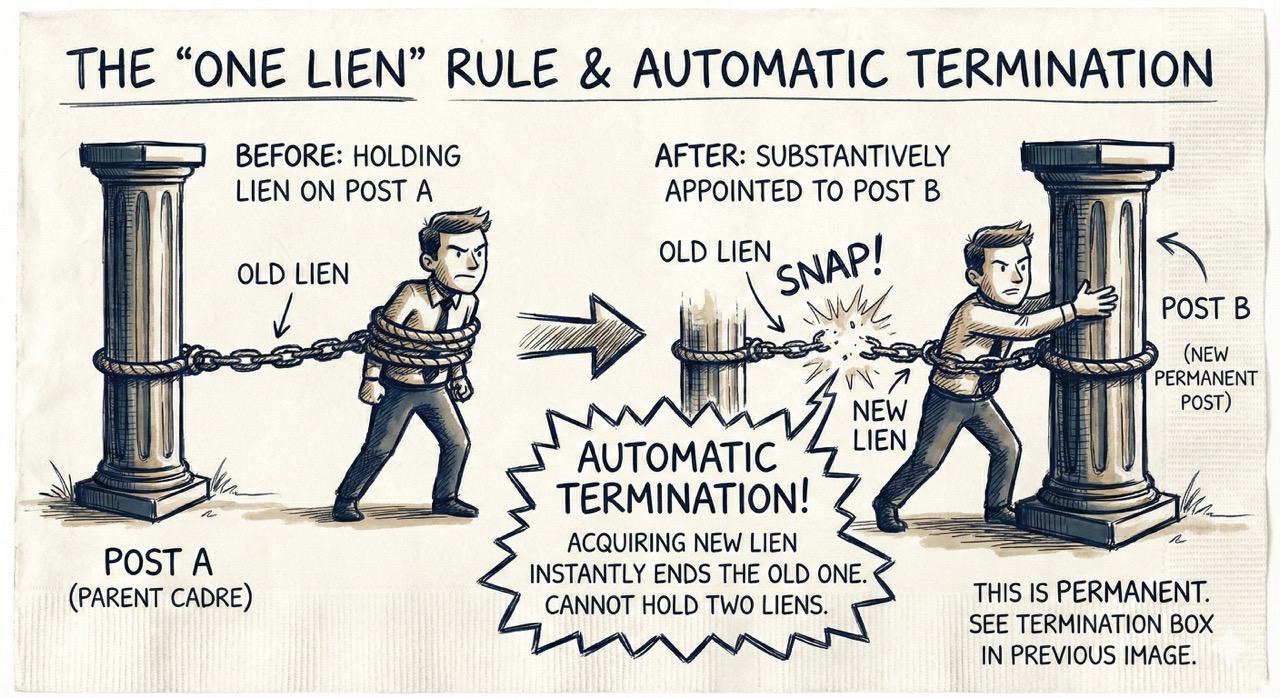
- One servant cannot hold two liens simultaneously; acquiring a new permanent post terminates the prior lien automatically.
- Acquisition, suspension, retention, and termination of lien are governed strictly by Service Rules like the Fundamental Rules.
- Suspension is temporary (deputation, foreign service) and allows revival; it is not a disciplinary penalty.
- Termination is usually permanent and requires the employee's consent; it cannot leave them without any lien on a permanent post.
- Once a lien is terminated it cannot be revived; only suspended liens are capable of revival under specified conditions.
Lien in Goverment Service explained
Contributor of the article:
Patra’s Law Chambers:
- Kolkata Office: NICCO HOUSE, 6th Floor, 2, Hare Street, Kolkata-700001 (Near Calcutta High Court)
- Delhi Office: House no: 4455/5, First Floor, Ward No. XV, Gali Shahid Bhagat Singh, Main Bazar Road, Paharganj, New Delhi-110055
- Website: www.patraslawchambers.com
- Email: [email protected]
- Phone: +91 890 222 4444 / +91 9044 04 9044
- If you want to get legal consultation regarding any law-related matter in government service please click here.
Executive Summary
This document provides a comprehensive analysis of the concept of “lien” within the context of public service law. A lien is the fundamental right of a public servant to hold, in a substantive capacity, the permanent post to which they have been appointed. This right is a cornerstone of service jurisprudence, ensuring security of tenure, but its existence and incidents are entirely governed by the specific Service Rules applicable to the employee.
The most critical takeaways are as follows:
- Prerequisite of Substantive Appointment: A lien can only be acquired upon a substantive (permanent) appointment to a permanent post. Temporary government servants or those in officiating capacities do not hold a lien.
- Singular Nature: A government servant cannot hold two liens simultaneously on two different posts in different cadres. Acquiring a new lien on a permanent post automatically terminates the lien on the previous post.
- Governance by Rules: The acquisition, retention, suspension, and termination of a lien are not arbitrary but are strictly governed by statutory provisions, such as the Fundamental Rules (FR).
- Security of Tenure: A lien cannot be terminated, even with the employee’s consent, if the result would be to leave the individual without a lien or a suspended lien on any permanent post. This provides a significant safeguard for public servants.
- Suspension vs. Termination: A lien can be suspended under specific circumstances, such as deputation or transfer to a temporary post, with the possibility of revival. Termination, however, is the permanent cessation of the lien, which often occurs automatically upon acquiring a new permanent post.
1. Defining Lien: The Right to a Substantive Post
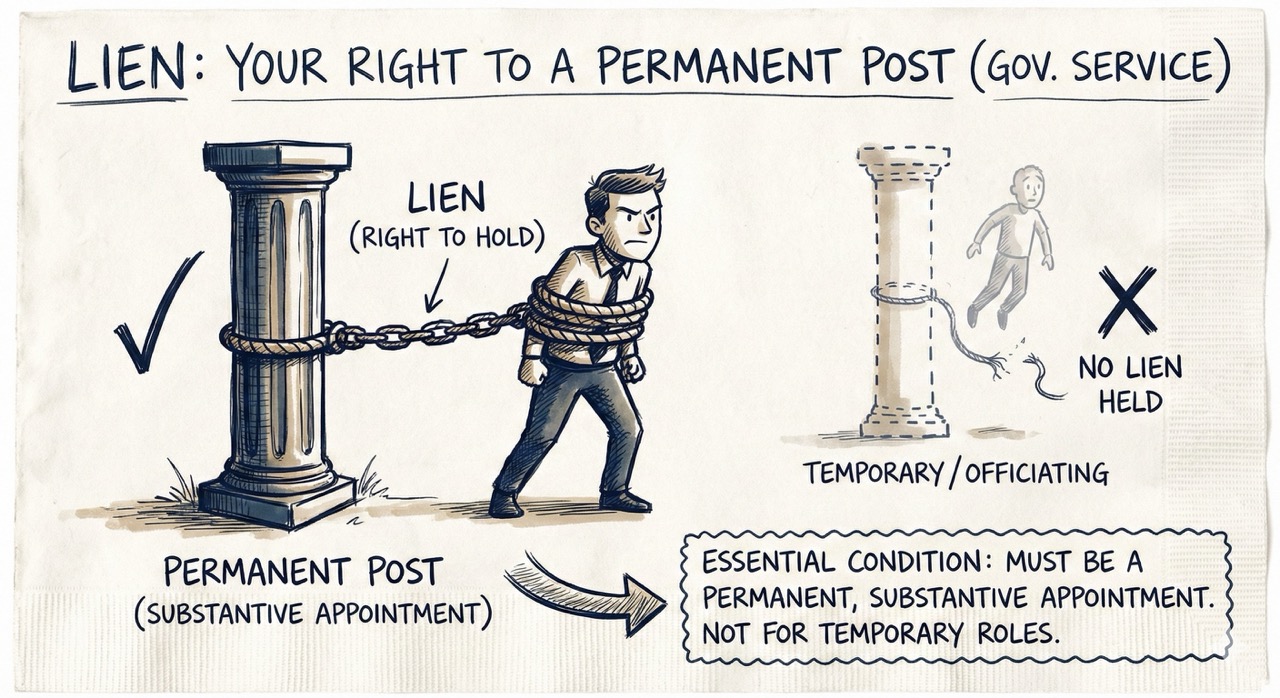
In Service Law, a lien signifies the right of a government servant to hold a permanent post in a substantive capacity. It is an essential incident of a permanent appointment and a core concept related to an employee’s title and security in their position.
1.1. Core Meaning and Legal Definition
The term “lien” originates from the Latin word “ligamen,” meaning “binding,” and its lexical meaning is the “right to retain.” This concept is formally defined in service regulations. For instance, Fundamental Rule 9(13) defines it as:
“Lien means the title of a Government servant to hold substantively, either immediately or on the termination of a period or periods of absence, a permanent post, including a tenure post, to which he has been appointed substantively.”
The Supreme Court, in the case of Parshotam Lal Dhingra v UOI, affirmed that a substantive appointment to a permanent post confers this right upon the servant.
1.2. Foundational Principles
Several key principles underpin the concept of lien:
- Substantive Appointment is Essential: A lien is exclusively linked to a substantive appointment. It is considered “unknown in the case of a temporary Government servant.” Only an employee appointed on a permanent basis can claim a lien.
- Singular Concept: A government servant cannot simultaneously hold two liens against two posts in two different cadres. The Supreme Court in Ramlal Khurana v State of Punjab noted that when a person with a lien on one post is substantively appointed to another, they acquire a lien on the new post, and the lien on the previous post “automatically disappears.”
- Lien on a Post, Not a Place: The right is attached to a specific post, not a geographical location or a particular office space.
- No Lien via Illegality: Illegally acquiring a public post and continuing in it through abuse of the court process does not create any equity or a lien on that post.
2. Governance, Retention, and Suspension of Lien
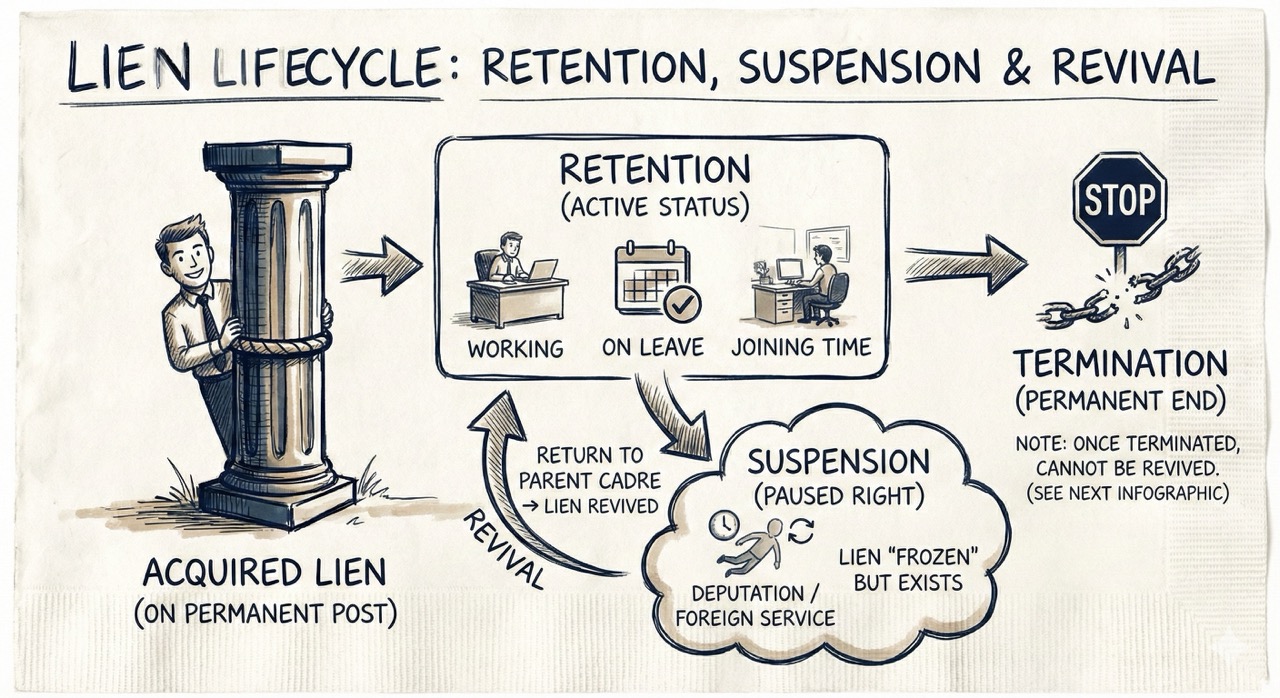
The entire lifecycle of a lien—from its creation to its end—is dictated by Service Rules.
2.1. Retention of Lien
Unless specifically suspended or transferred according to rules, a public servant holding a permanent post retains their lien under various circumstances. As outlined in Fundamental Rule 13, these include periods when the servant is:
- Performing the duties of that post.
- On foreign service, holding a temporary post, or officiating in another post.
- On joining time during a transfer to another post.
- On leave (with certain exceptions).
- Under suspension from service.
A lien continues in a former service if an appointment in a new service is not confirmed.
2.2. Suspension of Lien
Suspension of a lien is not a disciplinary measure but a procedural arrangement related to an employee’s appointment to another post. During the suspension period, another person can be appointed substantively to the post, but this is a provisional arrangement that is reversed upon the revival of the suspended lien.
- Authority and Conditions: The power to suspend a lien is conferred by Service Rules, such as Fundamental Rule 14, which vests this authority in the President under specific conditions:
- Substantive appointment to a tenure post.
- Provisional appointment to a post where another servant’s lien is already suspended.
- Deputation out of India, transfer to foreign service, or transfer to another cadre in an officiating capacity, if the absence is expected to last at least three years.
- Key Prohibition: A government servant’s lien on a tenure post can never be suspended. If they are appointed substantively to another permanent post, the lien on the tenure post must be terminated.
- Consequences of Suspension: An employee whose lien is suspended cannot claim benefits like promotion in the parent cadre based on experience gained during the period of suspension. The competent authority is bound to pass an order for suspension when the conditions are met; it is not considered automatic.
3. Termination of Lien
The termination of a lien is its permanent cessation. This process is subject to strict conditions designed to protect the employee’s security of tenure.
3.1. Core Conditions for Termination
- Consent is Essential: The consent of the public servant is a primary condition for terminating their lien. Without a written request from the employee, a lien cannot be terminated. This consent may be express or implied (e.g., voluntarily requesting a transfer to a lower post).
- Absolute Bar to Termination: Even with the employee’s consent, a lien cannot be terminated if the result would be to leave the employee “without a lien or a suspended lien upon a permanent post.” This is a fundamental principle ensuring that a permanent employee is not left without a substantive post.
3.2. Automatic Termination of Lien
Under specific statutory conditions, a lien can terminate automatically without a formal order.
| Circumstance | Description | Relevant Rule/Precedent |
| Acquisition of a New Lien | When a public servant acquires a lien on a permanent post outside the cadre on which they are borne, the lien on the previous post “stands terminated.” | FR 14A(d) |
| Departmental Conversion | When a government department is converted into an autonomous body and the employee’s service is transferred, the lien in government service is automatically terminated. | S K Saha v Prem Prakash Agarwal |
| Breach of Condition | If an employee agrees to a condition where a breach would lead to automatic termination (e.g., failing to return from an overseas assignment by a set date), they are estopped from challenging the termination. | Anil Bajaj v PGIMER |
| Permanent Transfer | When employees are permanently transferred to a new entity (like a Joint Venture Company) with fresh appointment letters, their lien in the erstwhile company is terminated. | T N Magnesite Ltd v S Manickam |
3.3. Situations Not Resulting in Termination
It is crucial to note circumstances that do not lead to an automatic loss of lien:
- Working in a Senior Cadre: Merely working in a senior post for an extended period does not cause the loss of a lien on a substantive junior post.
- Illegal Appointment: An illegal appointment in another department, even if purportedly substantive, does not terminate the lien on the original, legally held post.
- Simple Transfer: A transfer, defined as a change of place within an organization to a similar post, does not operate as a termination of lien.
- Joining Another Department: An employee does not automatically lose their lien in the parent department simply by joining another one.
3.4. Termination as a Disciplinary Action
Service Rules may provide for the termination of a lien as a consequence of disciplinary issues, such as overstaying sanctioned leave. In such cases, while a full departmental enquiry may not be required, the principles of natural justice must be complied with before the lien can be terminated.
4. Revival of Lien
The concept of revival applies exclusively to a suspended lien, not a terminated one. Once a lien is validly terminated, it cannot be revived.
A suspended lien can be revived under the following circumstances:
- The employee ceases to hold the post that caused the suspension (e.g., completes a tenure post).
- The employee returns from deputation or foreign service.
- The employee is “de-confirmed” from a new substantive post to which they were appointed.
- The post to which the employee was appointed outside their cadre (without their written request) is subsequently abolished.
If you have any such problems with the lien government service and are having any issues, you can consult us in this regard.
Frequently Asked Questions (FAQ)
1. What exactly does “Lien” mean in government service?
A lien is the legal right of a permanent government servant to hold a specific post substantively. It serves as a guarantee of security of tenure, ensuring that even if the employee is away on leave or deputation, their right to return to their original post is protected.
2. Does a temporary or officiating employee have a lien?
No. A lien is exclusively linked to a substantive appointment to a permanent post. It is a concept “unknown” to temporary government servants or those working in an officiating capacity.
3. Can a government servant hold a lien on two posts simultaneously?
No. A government servant cannot hold more than one lien at a time. If an employee is substantively appointed to a new permanent post in a different cadre, their lien on the previous post is automatically terminated.
4. Can my lien be terminated without my consent?
Generally, no. A lien cannot be terminated without the written consent of the employee. Furthermore, even with consent, a lien cannot be terminated if it leaves the employee without a lien on any permanent post, as this would violate their security of tenure.
5. What is the difference between suspension and termination of a lien?
-
Suspension: A temporary “freezing” of the lien (usually during long-term deputation or transfer) where the right to the post remains and can be revived.
-
Termination: The permanent ending of the right to a post, usually occurring when the employee acquires a new lien elsewhere or through specific disciplinary actions.