- West Bengal Premises Tenancy Act, 1997 governs landlord-tenant relations and replaced the 1956 Act.
- Manufactured default occurs when a landlord refuses rent to create grounds for eviction under Section 6(b).
- Section 21 provides a three-stage process: tender, Postal Money Order, then deposit with the Rent Controller.
- Send a Postal Money Order within 15 days of refusal and keep the Money Order receipt as evidence.
- If Money Order is returned, deposit rent with the Rent Controller within 15 days using Form 2 and an affidavit.
- Use the GRIPS portal / T.R. Form No. 7 challan and retain receipted e-challan with GRN/BRN as proof of deposit.
- In eviction suits follow Section 7: deposit arrears within one month or risk losing defence rights.
Legal process when the landlord refuses to receive rent from the tenant in West Bengal
Creditor and contributor of this article:
Patra’s Law Chambers:
About Us:
Patra’s Law Chambers is a law firm with offices in Kolkata & Delhi, offering comprehensive legal services across various domains. Established in 2020 by Advocate Sudip Patra (Advocate, Supreme Court of India & Calcutta High Court) an alumnus of the Prestigious Rajiv Gandhi School of Intellectual Property Law, IIT Kharagpur ,with Post Graduate diploma in Business Law from IIM Calcutta, the firm specializes in Civil, Criminal, Writs,High Court Matters, Trademark, Copyright, Company, Tax, Banking, Property disputes, Service law, Family law, and Supreme Court matters.You can know more about us in here
Kolkata Office:
NICCO HOUSE, 6th Floor, 2, Hare Street, Kolkata-700001 (Near Calcutta High Court)
Delhi Office:
House no: 4455/5, First Floor, Ward No. XV, Gali Shahid
Bhagat Singh, Main Bazar Road, Paharganj, New Delhi-110055
Website: www.patraslawchambers.com
Email: [email protected]
Phone: +91 890 222 4444/ +91 7003 715 325
Resources: infographics.pdf
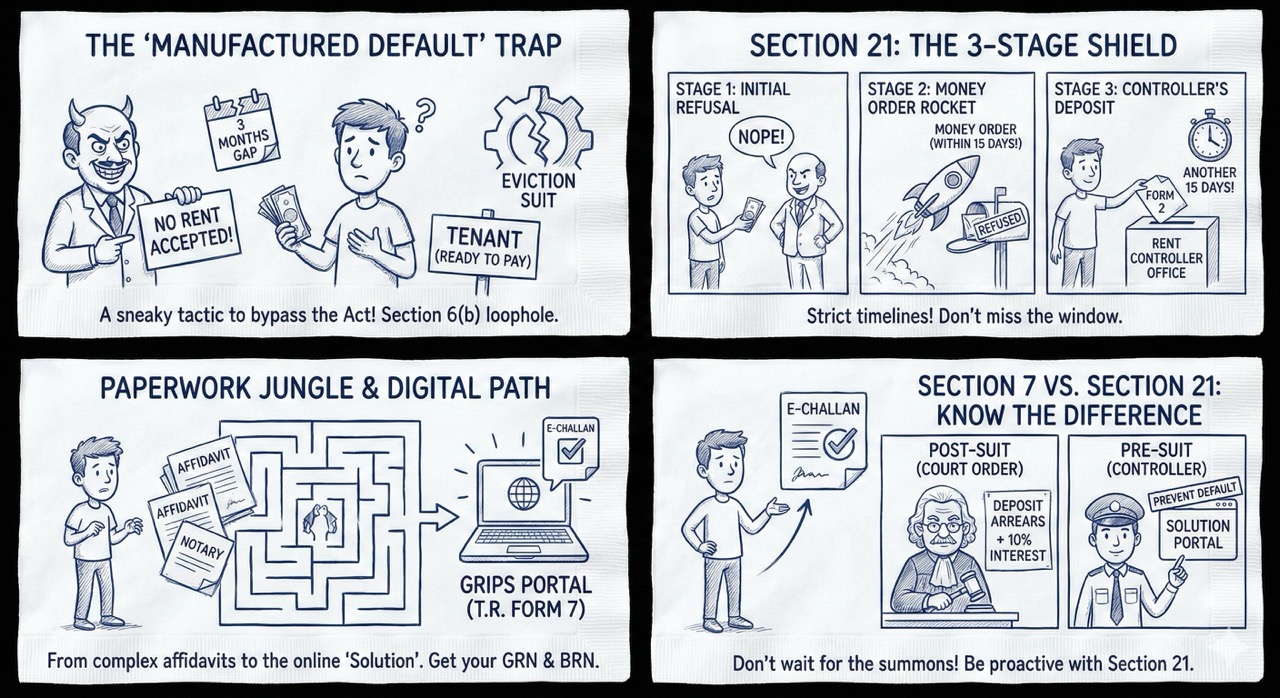 The residential and commercial leasing landscape in West Bengal is defined by a historical struggle between property owners and occupiers, a tension that has necessitated one of the most robust sets of rent control regulations in India. The West Bengal Premises Tenancy Act, 1997, serves as the primary legislative instrument governing these relationships, having replaced the earlier 1956 Act to modernize the balance of rights and obligations. Among the various legal challenges faced by tenants in this jurisdiction, the phenomenon of the “manufactured default” remains a predominant tactic employed by landlords seeking to bypass the significant protections against eviction. By refusing to accept rent, landlords often attempt to create a legal vacuum where the tenant can be classified as a “defaulter,” thereby providing a valid ground for an eviction suit under Section 6 of the Act. This report provides a definitive analysis of the legal safeguards available to tenants, specifically focusing on the operation of Section 21 and the procedural protocols for the deposit of rent with the Rent Controller.
Legislative Evolution and the Regulatory Framework of West Bengal Tenancy Law
The transition from the West Bengal Premises Tenancy Act, 1956, to the West Bengal Premises Tenancy Act, 1997, marked a significant shift in the state’s urban governance. While the 1956 Act was heavily weighted in favor of the tenant, the 1997 Act introduced market-oriented reforms, such as rent thresholds for statutory protection and a time limit on the inheritance of residential tenancies. The 1997 Act, which came into full effect on July 10, 2001, applies to the Kolkata Municipal Corporation (CMC), the Howrah Municipal Corporation (HMC), and various other municipal areas across West Bengal.
Jurisdictional Thresholds and Applicability
The applicability of the Act is determined by the monthly rent amount, creating a bifurcated legal environment where high-value tenancies are governed by the Transfer of Property Act, 1882, while lower and mid-value tenancies enjoy the protection of the Rent Controller.
| Category of Premises | Area | Monthly Rent Threshold for WBPTA 1997 |
| Residential | Kolkata / Howrah Municipal Corporations |
Up to Rs. 2,000 |
| Residential | Other Areas in West Bengal |
Up to Rs. 1,000 |
| Non-Residential | Kolkata / Howrah Municipal Corporations |
Up to Rs. 3,000 |
| Non-Residential | Other Areas in West Bengal |
Up to Rs. 1,500 |
Tenancies that fall within these thresholds are granted “statutory status,” meaning the tenant cannot be evicted except on specific grounds proved before a court of law. This makes the prevention of a “default” in rent payment a critical priority for any occupier wishing to retain their rights.
Definitions of Landlord, Tenant, and Premises
The definitions provided in Section 2 are exhaustive, designed to capture the various forms of urban occupancy. A “landlord” includes not only the owner but any person receiving or entitled to receive rent, such as an agent, trustee, or guardian. A “tenant” is defined as any person by whom rent is payable, including those who continue in possession after the termination of their tenancy. Importantly, the 1997 Act restricts the inheritance of tenancy rights for residential premises to a period of five years from the death of the original tenant, with exceptions for the spouse and dependent family members who do not own residential property. This limitation underscores the urgency for tenants to maintain a clean record of rent payments to avoid giving the landlord any additional grounds for summary eviction.
Obligations of the Parties and the Mechanism of Refusal
Section 4 and Section 5 of the Act outline the fundamental duties of landlords and tenants, respectively. The landlord is legally bound to keep the premises in a “good and tenantable condition” and must issue a written receipt immediately upon the receipt of rent. Conversely, the tenant is obligated to pay the rent within the contractually agreed period or, in the absence of a contract, by the fifteenth day of the following month.
The Strategy of Manufactured Default
Under Section 6(b), a landlord may apply for an eviction order if the tenant has made a “default in payment of rent for three months within a period of twelve months”. In many instances, a landlord seeking to regain possession of a property—perhaps to re-let it at a higher rate or for redevelopment—will intentionally refuse to accept the rent tendered by the tenant. By doing so, the landlord hopes the tenant will eventually stop attempting to pay, thereby creating the requisite three-month gap to file an eviction suit.
When a landlord is not accepting rent in Kolkata or other districts, the tenant faces a significant evidentiary challenge. Verbal or physical tenders of cash are notoriously difficult to prove in court without a receipt. Consequently, the law mandates a formalized alternative through Section 21 of the West Bengal Premises Tenancy Act.
Section 21 West Bengal Premises Tenancy Act: The Three-Stage Protective Shield
Section 21 provides a robust procedural mechanism for the “Deposit of rent by tenant”. It is a remedial provision that allows the tenant to fulfill their statutory obligation to pay rent even when the landlord is uncooperative. The process is not a direct jump to the Rent Controller but a tiered approach designed to provide the landlord with every opportunity to accept the payment.
Stage 1: The Initial Tender and Refusal
The process begins when the tenant attempts to pay the rent in the usual manner (usually in person or by hand) and the landlord refuses. This refusal triggers the subsequent timelines under the Act. It is advisable for tenants to keep a diary or log of such attempts, noting the date, time, and any witnesses to the refusal, although this informal tender is primarily a precursor to the formal stages.
Stage 2: The Money Order Mandate and the 15-Day Rule
Section 21(1) stipulates that if the landlord does not accept rent tendered within the prescribed period, the tenant must remit the rent to the landlord by Postal Money Order.
The timing here is critical: the Money Order must be sent within fifteen days of such refusal. This Money Order serves as a legal “tender” that is verifiable through government records. The tenant must retain the Money Order receipt as primary evidence. If the landlord accepts the Money Order, the tenant is protected, and the receipt of the acknowledgement serves as proof of payment.
Stage 3: Deposit of Rent with the Controller
If the Postal Money Order is returned undelivered, either because the landlord refused to accept it or because the landlord was absent or the address was “locked,” the tenant then gains the right to deposit the rent with the Rent Controller.
The timeline for this third stage is also strictly enforced: the tenant must deposit the rent in the office of the Controller within fifteen days from the date on which the Money Order was returned to the tenant by the postal authority. Failure to adhere to these nested 15-day timelines can invalidate the deposit and leave the tenant vulnerable to being declared a “defaulter”.
| Action Phase | Statutory Requirement | Statutory Deadline |
| Direct Tender | Attempt to pay rent to landlord/agent |
By the 15th of the following month |
| Money Order | Remit rent via Postal Money Order |
Within 15 days of landlord’s refusal |
| Controller Deposit | File application to deposit with Rent Controller |
Within 15 days of Money Order return |
Procedural Requirements for Rent Deposit with Controller West Bengal
The act of depositing rent with the Controller is a quasi-judicial process that requires the filing of a formal application, typically identified as Form 2 under the West Bengal Premises Tenancy Rules, 1999.
The Structure of the Form 2 Application
The application must be comprehensive and contain the following particulars :
-
Identification of Premises: A full description of the tenanted property, including the premises number, street name, and police station.
-
Period of Rent: The exact month or period for which the rent is being deposited.
-
Amount: The exact amount of the rent to be deposited.
-
Landlord Details: The name and address of the landlord or the person entitled to receive the rent.
-
Last Payment Details: The date of receipt of the last rent paid directly to the landlord.
-
Reason for Deposit: A statement detailing the refusal of the direct tender and the return of the Money Order.
The Supporting Affidavit
Section 21(4) mandates that the application must be supported by an affidavit by the tenant. This affidavit is a sworn statement that serves as the factual foundation for the deposit. In the context of a rent deposit, the affidavit must clearly state that the tenant attempted a tender, sent a Money Order, and that the Money Order was returned undelivered.
Judicial scrutiny of these affidavits is rigorous. A common error is being “vague” in the averments. The deponent should provide specific dates and times rather than general statements. Furthermore, the affidavit must include a proper “Verification Clause” and must be attested by a Notary Public or an Oath Commissioner. Once the first deposit is successfully made with an affidavit, Section 21(5) allows the tenant to make successive monthly deposits without a fresh affidavit, provided the circumstances (the landlord’s refusal) remain unchanged.
Service of Notice to the Landlord
Upon receiving the deposit, the Controller is legally obligated to notify the landlord. Section 21(7) requires the Controller to send a copy of the application to the landlord by registered post with acknowledgement due. The tenant must provide as many true copies of the application as there are landlords and pay the prescribed process fees for this service. The authenticated copy of the application, bearing the seal of the Controller’s office, becomes admissible as evidence in any court proceeding to prove that the tenant has paid the rent.
Financial Administration and the Challan System
The actual payment of rent is not made in cash to the Controller’s staff but is processed through the state treasury system to ensure transparency and accountability.
TR Form 7 and the GRIPS Portal
The financial instrument used for this deposit is T.R. Form No. 7 (Challan for Deposit of money in the account of Government of West Bengal). In modern practice, this is increasingly handled through the GRIPS (Government Receipt Portal System).
The procedure for generating and paying the challan involves the following steps :
-
Selection of Head of Account: The tenant or their representative must select the specific Accounting Head for “Rent Control” deposits (often related to the Land and Land Reforms Department).
-
Generation of GRN: The GRIPS portal generates a Government Receipt Number (GRN) upon successful entry of data.
-
Bank Payment: For “Over the Counter” (OTC) payments, the tenant prints the e-challan and presents it at an authorized bank. Major banks like State Bank of India, Punjab National Bank (formerly United Bank of India), and Central Bank of India are integrated into the GRIPS system for these transactions.
-
Receipted e-Challan: After payment, the bank generates a Bank Reference Number (BRN) and the portal issues a “receipted e-challan,” which the tenant must keep as their final proof of deposit.
| Step in Financial Process | Description | Tool / Form |
| Generation | Creating the electronic payment order |
GRIPS Portal |
| Validation | Verifying the Accounting Head |
T.R. Form No. 7 |
| Payment | Physical or online transfer of funds |
Authorized Bank / Net Banking |
| Proof | Receiving the receipted document |
Receipted e-Challan with GRN/BRN |
Institutional Jurisdictions and Contact Information
The “Rent Controller” is an office appointed under Section 38 of the Act, typically staffed by officers of the West Bengal Civil Service (WBCS). The location of the office depends on the police station having jurisdiction over the tenanted premises.
Kolkata and Surrounding Areas
In Kolkata, the primary office is the Office of the Rent Controller, Kolkata, located at 4th Floor, 6 Church Lane, Kolkata – 700001. This office handles a vast volume of cases for the central metropolitan area. Other relevant offices include:
-
Salt Lake / Bidhannagar: Nagarayan, DF-8, Sector-I, Salt Lake City, Kolkata-700064.
-
Howrah: Howrah Sadar Sub-Division office at 6, Rishi Bankim Chatterjee Road, 1st Floor, Old Collectorate Building, Howrah – 711101.
-
Thika Tenancy Controller: Survey Building, 35, Gopal Nagar Road, Kolkata-700027 (specifically for Thika Tenancy properties).
District-Level Administration
In districts outside Kolkata, the Sub-Divisional Officer (SDO) generally performs the functions of the Rent Controller. For example, in Kalimpong, the Rent Control Section is part of the Kalimpong Collectorate under the SDO. Tenants in rural or suburban areas should approach their respective SDO office to initiate rent deposits.
| District / Area | Rent Controller Authority | Office Location |
| Kolkata (Central) | Rent Controller, Kolkata |
6 Church Lane, 4th Floor |
| Salt Lake | UD & MA Department |
Nagarayan, Sector-I |
| Howrah Sadar | SDO, Howrah |
6 Rishi Bankim Chatterjee Road |
| Kalimpong | SDO, Kalimpong |
Kalimpong Collectorate |
| Other Districts | Respective SDOs |
District/Sub-divisional HQ |
The “Solution” Portal and Digitization of Services
The West Bengal Government has launched the “Solution” portal (solution.wb.gov.in) to simplify the rent deposit process. This portal is a significant step toward transparency, allowing tenants to manage several aspects of their deposit online :
-
Status Tracking: Tenants can “Know Your Case” and search for their registered deposit details.
-
Challan Generation: The portal facilitates the generation of rent deposit challans for payment at banks.
-
Mobile Updates: Tenants are encouraged to update their mobile numbers at the Rent Control office to receive notifications and alerts.
-
BSK Integration: For those without personal internet access, services like online rent deposit and challan generation are available at nearest Bangla Sahayata Kendras (BSKs).
This digital infrastructure helps prevent the common mistake of missing deadlines or losing track of deposit periods, which could otherwise lead to a technical default.
Defensive Strategies in Eviction Suits (Section 7)
A crucial distinction must be made between depositing rent under Section 21 (when no suit is pending) and depositing rent under Section 7 (once an eviction suit has been filed).
Section 7(1): Compliance with Summons
If a landlord succeeds in filing an eviction suit on any ground (including default), the tenant must strictly follow Section 7(1). Within one month of the service of summons, the tenant is required to pay to the landlord or deposit with the Civil Judge all arrears of rent, calculated at the last paid rate, together with interest at 10% per annum. This is a mandatory requirement to maintain a defense in the suit.
Section 7(2): Resolving Rent Disputes
Often, a landlord may claim a higher rate of rent or a longer period of arrears in the eviction suit than what is actually due. In such cases, the tenant must file an application under Section 7(2) within the same one-month period. This application asks the court to “determine” the correct amount of rent. The tenant must deposit the “admitted” amount with the court while the dispute is being adjudicated.
If the tenant fails to make these deposits under Section 7, the landlord can move to strike out the tenant’s defense. If the defense is struck out, the tenant loses the right to contest the eviction on its merits, making compliance with the court’s deposit orders the most important tactical priority in litigation.
Historical and Judicial Interpretations of Default
The concept of “bona fide requirement” and “default” has been heavily litigated in West Bengal. In cases like those interpreted under Section 21, the burden of proving that a refusal took place lies initially with the tenant. However, once a tenant produces a “Refused” Money Order receipt, the burden shifts to the landlord to explain why the payment was not accepted.
The 2008 Amendment and Lapsed Deposits
The West Bengal Premises Tenancy (Amendment) Act, 2008, introduced important provisions regarding the withdrawal of rent by landlords and the eventual lapsing of unclaimed funds.
-
Withdrawal: Landlords can apply for the withdrawal of deposited rent under Section 23, and the Controller must order the payment after verification.
-
Lapse: If a deposit is not withdrawn within three years from the date the notice was posted to the landlord, the amount is credited to the Government as a “lapsed deposit”.
-
Repayment: Any deposit that has lapsed to the Government is still repayable to the landlord or entitled person upon following a prescribed procedure, ensuring that the property owner’s right to the funds is not permanently extinguished by their own refusal to accept it.
Mapping Police Station Jurisdictions in Kolkata (2025 Updates)
As the Rent Controller’s administrative boundaries are often aligned with police station jurisdictions, tenants must be aware of recent redrawing of these limits. Correct identification of the police station in Form 2 is essential for the valid service of notice to the landlord.
Kolkata is divided into several administrative divisions, each with its own set of police stations. The Central Division, for instance, includes high-density commercial areas like Muchipara, Burrabazar, and New Market. The South Division encompasses Alipore, Park Street, and Kalighat.
In November 2025, the Kolkata Police reorganised the boundaries of several stations to balance workload :
-
Alipore Police Station: Expanded to include the entire Ward 77, which was previously under Watgunge and Ekbalpore.
-
Park Street Police Station: Expanded to include areas previously under New Market.
-
New Market, Watgunge, and Ekbalpore: Jurisdictional limits were curtailed accordingly.
Tenants filing for rent deposits must verify their current police station at the time of filing to prevent the landlord from later challenging the deposit on the grounds of “improper jurisdiction”.
Conclusion: The Absolute Necessity of Procedural Discipline
The protections offered by the West Bengal Premises Tenancy Act, 1997, are not passive; they require the tenant to be proactive, documented, and disciplined. The manufactured default is a powerful tool in a landlord’s arsenal, but it is one that can be entirely neutralized by the correct application of Section 21.
For a tenant whose landlord is refusing rent, the primary takeaway is the strict adherence to the 15-day Money Order cycle and the subsequent 15-day Rent Controller filing cycle. Utilizing modern tools like the “Solution” portal and the GRIPS treasury system adds a layer of government-verified evidence to the tenant’s record. Whether in the historic corridors of 6 Church Lane or through a digital Sahayata Kendra, the deposit of rent remains the definitive legal barrier between a secure tenancy and a summary eviction. By transforming a private refusal into a public record, Section 21 ensures that the “defaulter” label cannot be unfairly applied to an occupier who is ready, willing, and able to pay their dues.