- CEO West Bengal guidelines (Jan 8, 2026): permit exemptions and alternative appearance to avoid mass physical hearings.
- Exempted categories: overseas students, interstate migrants, hospitalized electors, active service personnel, vulnerable cases.
- Represented appearance: authorized family members may attend with relationship proof and submit indicative documents for the elector.
- Authorization letter rule: must be signed or thumb‑marked by the elector per Supreme Court directives to ensure validity.
- Remote Verification Portal: EPIC login, document upload, and tiered verification by AERO, ERO, then DEO for out‑migrants.
- Supreme Court mandates (Jan 19, 2026): mandatory document receipts, panchayat disclosure, 10‑day extension, accept academic admit cards.
- Burden of proof: authorities must prove non‑citizenship for existing electors; appeals available to DM, CEO, and courts.
Guideline to SIR Hearing Exemption in West Bengal
Creditor and contributor of this article:
Patra’s Law Chambers:
About Us:
Patra’s Law Chambers is a law firm with offices in Kolkata & Delhi, offering comprehensive legal services across various domains. Established in 2020 by Advocate Sudip Patra (Advocate, Supreme Court of India & Calcutta High Court) an alumnus of the Prestigious Rajiv Gandhi School of Intellectual Property Law, IIT Kharagpur , the firm specializes in Civil, Criminal, Writs,High Court Matters, Trademark, Copyright, Company, Tax, Banking, Property disputes, Service law, Family law, and Supreme Court matters.You can know more about us in here
Kolkata Office:
NICCO HOUSE, 6th Floor, 2, Hare Street, Kolkata-700001 (Near Calcutta High Court)
Delhi Office:
House no: 4455/5, First Floor, Ward No. XV, Gali Shahid
Bhagat Singh, Main Bazar Road, Paharganj, New Delhi-110055
Website: www.patraslawchambers.com
Email: [email protected]
Phone: +91 890 222 4444/ +91 7003 715 325
Recognizing the logistical impossibility of 1.36 crore people physically attending hearings in a limited number of venues, the Office of the Chief Electoral Officer (CEO) of West Bengal issued specific guidelines in January 2026 to facilitate exemptions and alternative appearance protocols. These exemptions are designed to balance the need for verification with the practical realities of a modern, mobile workforce.
If you want to know more details about the process of hearing in the SIR, you can click on the following link.
Persons Exempted from In-Person Appearance
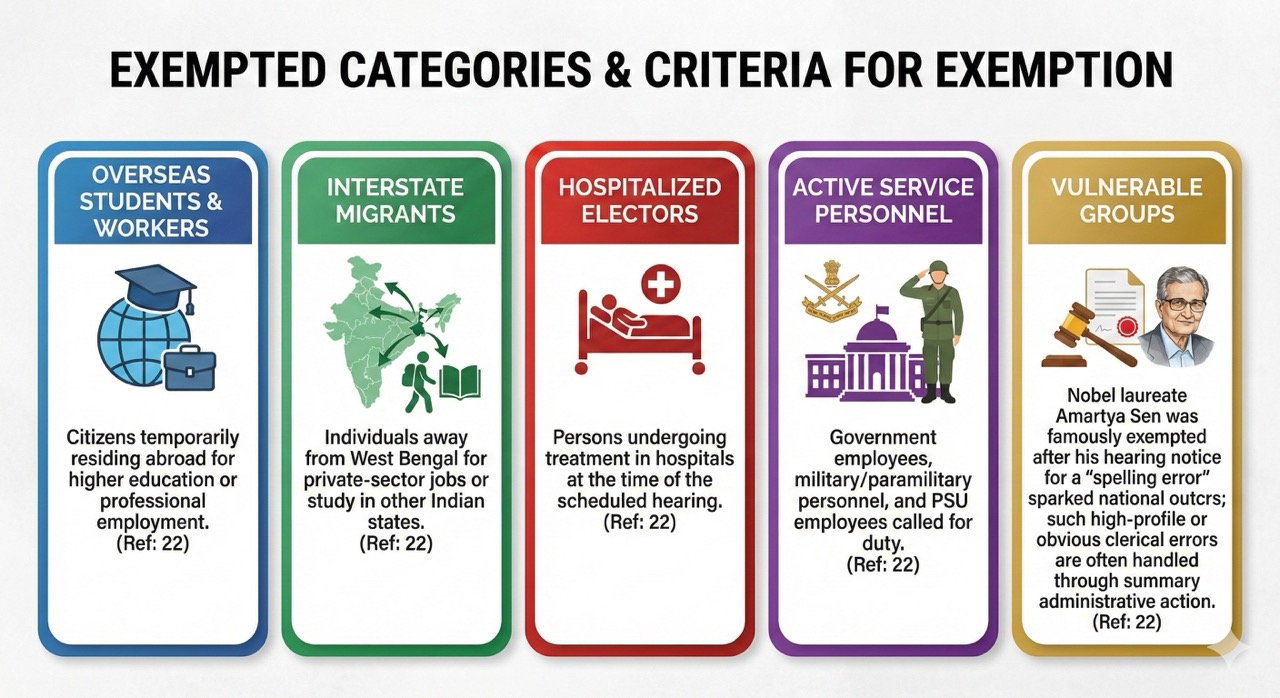
The notice issued by the CEO’s office on January 8, 2026, explicitly identifies categories of electors who are not required to personally appear before the hearing officer :
| Exempted Category | Criteria for Exemption |
| Overseas Students & Workers |
Citizens temporarily residing abroad for the purpose of higher education or professional employment. |
| Interstate Migrants |
Individuals away from West Bengal for private-sector jobs or study in other Indian states. |
| Hospitalized Electors |
Persons undergoing treatment in hospitals at the time of the scheduled hearing. |
| Active Service Personnel |
Government employees, military/paramilitary personnel, and PSU employees called for duty. |
| Vulnerable Groups |
Nobel laureate Amartya Sen was famously exempted after his hearing notice for a “spelling error” sparked national outcry; such high-profile or obvious clerical errors are often handled through summary administrative action. |
Guidelines for Represented Appearance and Authorization
For those who fall under the exemption categories, the CEO has provided a mechanism for “represented appearance.” This ensures that the verification process is not stalled by the absence of the elector.
-
Authorized Family Member: An elector may send any authorized family member to the hearing. This relative must carry proof of their relationship (e.g., Aadhaar, Ration Card).
-
Document Submission: The representative is empowered to submit all necessary indicative documents—such as birth certificates, property records, or previous electoral roll entries—on behalf of the absent elector.
-
The Authorization Letter: Per the Supreme Court’s directives, any authorization letter must be signed or thumb-marked by the elector to ensure its validity and prevent “foul play” by unauthorized intermediaries.
-
Booth Level Agents (BLAs): The Supreme Court clarified that Booth Level Agents, who are representatives of political parties, may also assist voters and submit objections or records on their behalf during the hearings.
The Digital Exemption: Remote Verification Portal
To address the needs of West Bengal’s 22 lakh out-migrants, the ECI is developing a remote hearing portal. This digital infrastructure aims to transform the hearing from a physical requirement to an administrative process:
-
Unique Login: Electors can log in using their unique EPIC number to find their specific hearing notice.
-
Document Upload: The portal allows for the digital submission of verified documents.
-
Tiered Verification: Once uploaded, the documents are verified sequentially by the Assistant Electoral Registration Officer (AERO), the Electoral Registration Officer (ERO), and finally the District Election Officer (DEO).
Judicial Intervention and Constitutional Safeguards (2026)
The 2026 SIR in West Bengal became the subject of intense judicial scrutiny in the case of Mostari Banu v. Election Commission of India. On January 19, 2026, a Supreme Court bench comprising Chief Justice Surya Kant, Justice Dipankar Datta, and Justice Joymalya Bagchi issued a series of landmark directions to protect the rights of voters caught in the logical discrepancy net.
The “Stress and Strain” Doctrine
The Court criticized the ECI for the “stress and strain” caused to 1.36 crore people, noting that the logic used to flag discrepancies was often flawed. Justice Bagchi pointedly questioned the 15-year age gap criterion, noting that “child marriage” remains a historical reality in India and such biological gaps do not automatically imply fraudulent data.
Supreme Court Mandates for Transparency
The Court ordered several immediate changes to the hearing process in West Bengal:
-
Mandatory Document Receipts: In a move that overruled previous ECI practices, the Court ordered that every officer must provide a formal receipt detailing the documents submitted by an applicant during a hearing.
-
Panchayat-Level Disclosure: The names of all individuals flagged for logical discrepancies must be displayed at Gram Panchayat and block offices to allow for local rectification.
-
Deadline Extension: The Court extended the window for filing objections by 10 days post-publication of these lists to ensure no one is disenfranchised due to logistical delays.
-
Recognition of Academic Records: The Court ruled that admit cards issued by the West Bengal Board of Secondary Education must be accepted as valid proof of identity and age, noting their status as official government-issued documents.
Administrative Hierarchy and Appellate Remedies
For those whose names are excluded following a hearing, the West Bengal electoral framework provides a clear path for appeal. This ensures that the decision of an ERO or AERO is not final and is subject to higher-level administrative review.
-
The First Appeal: Filed with the District Magistrate (DM). The DM is tasked with reviewing the evidence submitted during the initial hearing and can order the reinstatement of a name if the exclusion is found to be arbitrary or incorrect.
-
The Second Appeal: If the DM’s decision is unfavorable, a second appeal can be made to the Chief Electoral Officer (CEO) of West Bengal.15
-
Judicial Review: While the ECI is a constitutional body, its actions are subject to the writ jurisdiction of the High Courts and the Supreme Court, as evidenced by the ongoing 2026 litigation.
The Burden of Proof
In the landmark Lal Babu Hussein judgment, the Supreme Court declared that for existing electors, the burden of proof that they are not citizens rests on the authorities making the claim.This is a critical legal protection for voters in the 2026 SIR; as long as they can link their identity to any previous roll, the state must produce evidence to the contrary to justify a deletion.
Conclusion: Balancing Modernization with Democratic Inclusion
The 2025-2026 Special Intensive Revision in West Bengal is a testament to the complexities of managing a modern electoral roll in a state with high migration and deep historical roots. The categorization of voters into “mapped,” “unmapped,” and “logical discrepancy” groups was a necessary step for data purification but one that required substantial judicial intervention to prevent mass disenfranchisement.
The exemption guidelines issued by the CEO’s office represent a pragmatic response to the challenges faced by overseas students, migrant workers, and hospitalized citizens.22 By allowing relatives to appear as representatives and developing digital portals for remote verification, the ECI has acknowledged that the “right to be heard” must be adapted to the 21st-century lifestyles of West Bengal’s citizens.
Furthermore, the Supreme Court’s directives for document receipts and local public displays have introduced a layer of transparency that was previously absent.19 As the process moves toward its conclusion, the focus shifts from the “logical discrepancies” of computer algorithms to the human reality of the voters. The survival of the electoral roll’s credibility in West Bengal depends on the fair application of these exemption rules and the continued vigilance of the judiciary in ensuring that “purification” does not lead to “disenfranchisement”.
For professional legal assistance in navigating these hearings or filing appeals against exclusion, the law firms and practitioners listed at the beginning of this report remain the primary conduits for ensuring a robust and legally sound representation before the ECI authorities.