- Special Intensive Revision (SIR) 2026 is a de novo electoral roll reset for West Bengal, not an annual Summary Revision.
- Draft roll published Dec 16, 2025: ~7.66 crore electorate after deletion of over 58 lakh names (ASDD).
- Stage Two focuses on hearings for three categories: Unmapped, Logical Discrepancies, and Claims & Objections.
- If your name is missing, verify via voters.eci.gov.in or CEO West Bengal and file Form 6 immediately.
- Hearings conducted by ERO/AERO with ~4,500 micro-observers to ensure neutrality and strict digital evidence capture.
- Elderly (85+) and PwDs entitled to house-to-house verification; do not force them to attend camps.
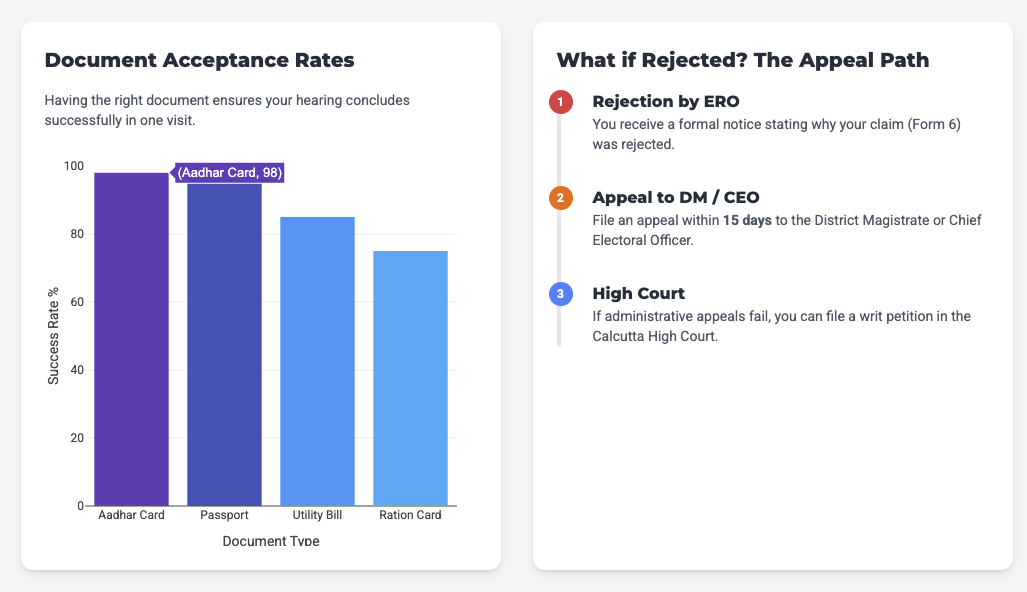
- Appeals: administrative route DM → CEO, then judicial recourse via Calcutta High Court under Article 226.
Guide to West Bengal SIR 2026 Hearings
CREDITS:
Patra’s Law Chambers
Kolkata Office:
NICCO HOUSE, 6th Floor, 2, Hare Street, Kolkata-700001 (Near Calcutta High Court)
Delhi Office: House no: 4455/5, First Floor, Ward No. XV, Gali Shahid
Bhagat Singh, Main Bazar Road, Paharganj, New Delhi-110055
Website: www.patraslawchambers.com
Email: [email protected]
Phone: +91 890 222 4444/ +91 9044 04 9044
RESOURCES:SIR HEARING PROCESS INFOGRAPHICS.PDF
1. Introduction: The Strategic Imperative of the 2026 Special Intensive Revision
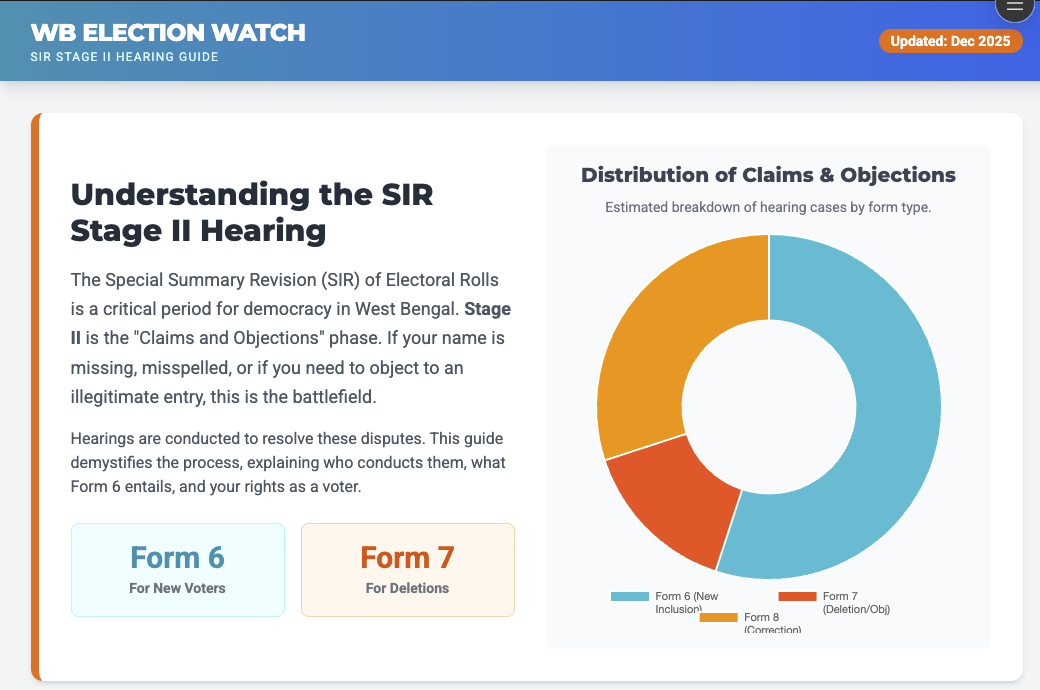
The electoral landscape of West Bengal is currently undergoing a structural transformation of a magnitude not witnessed in over two decades. The Election Commission of India (ECI) has initiated the Special Intensive Revision (SIR) of electoral rolls, a rigorous “de novo” verification exercise designed to purify the voter registry ahead of the critical 2026 Assembly Elections.1 Unlike the annual Summary Revisions which incrementally update the existing rolls, the SIR is a foundational reset. The last exercise of this nature in West Bengal was conducted between 2002 and 2004, leaving a twenty-one-year gap during which demographic shifts, migration, and administrative inertia have ostensibly introduced significant anomalies into the electorate data.3
The scale of this operation is staggering. The draft electoral roll published on December 16, 2025, revealed a total electorate of approximately 7.66 crore, but this figure was arrived at only after the preliminary deletion of over 58 lakh names.1 These deletions were categorized under the “ASDD” framework—Absent, Shifted, Dead, or Duplicate. However, the publication of the draft roll is merely the prelude to the most contentious and critical phase of the SIR: Stage Two, the Hearing and Verification Process.
This report serves as an exhaustive, expert-level dossier on the SIR Stage Two hearings. It is designed for electors, legal practitioners, civil society stakeholders, and administrative observers. It details the intricate bureaucratic machinery conducting the hearings, the algorithmic criteria used to flag “unmapped” voters and “logical discrepancies,” the specific documentation required to survive scrutiny, and the legal remedies available to those disenfranchised by the process.
2. Immediate Action Protocol: What to Do If Your Name Is Missing?
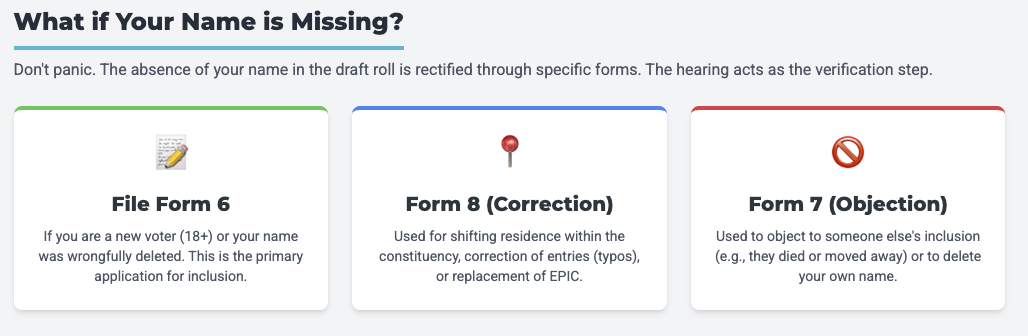
Before delving into the mechanics of the hearings, it is imperative to address the primary anxiety of the electorate: the absence of a name in the draft roll. If a citizen discovers that their name is not included in the draft list published on December 16, 2025, it implies they have been categorized as “deleted” or were never enumerated. The protocol for rectification is distinct from the hearing process for flagged voters.
2.1 Verification of Exclusion
The first step is definitive verification. The ECI has provided digital and physical infrastructures for this purpose. Citizens must not rely on hearsay; they must verify their status through the Voters Service Portal (voters.eci.gov.in) or the Chief Electoral Officer, West Bengal website (ceowestbengal.wb.gov.in).1
- Search Mechanism: The search can be conducted using the “Search by EPIC” (Electoral Photo Identity Card) function if the voter possesses their old card number, or “Search by Details” (Name, Age, District, Assembly Constituency) if the card is lost.4
- The “ASDD” List: In addition to individual searches, Booth Level Officers (BLOs) maintain the “ASDD List” (Absent, Shifted, Dead, Duplicate) at the polling station level. A voter whose name is missing should check this specific list to understand the reason for deletion.6
2.2 The Remedial Pathway: Form 6
If a name is missing, the individual is effectively treated as a new applicant or a re-applicant. They must immediately file Form 6 (Application for Inclusion of Name in Electoral Roll).1 This is the statutory instrument for enrolling in the voter list.
Submission Channels:
- Digital Submission: The most efficient method is via the Voters Service Portal or the Voter Helpline App. This requires an active mobile number linked to the application for OTP verification. If the applicant’s Aadhaar name matches their application exactly, they may use Aadhaar-based e-signing to expedite the process.7
- Physical Submission: For those unable to access digital tools, physical Form 6 copies are available with the designated BLO at the polling station or the office of the Electoral Registration Officer (ERO).
- Required Attachments: The form must be accompanied by valid proof of residence, proof of age (if between 18-21), and a recent passport-sized photograph. The submission of Form 6 triggers a fresh verification cycle, separate from the bulk hearings of “unmapped” voters, involving a field visit by the BLO to the applicant’s residence.1
3. The Administrative Machinery: Who Conducts the Hearings?
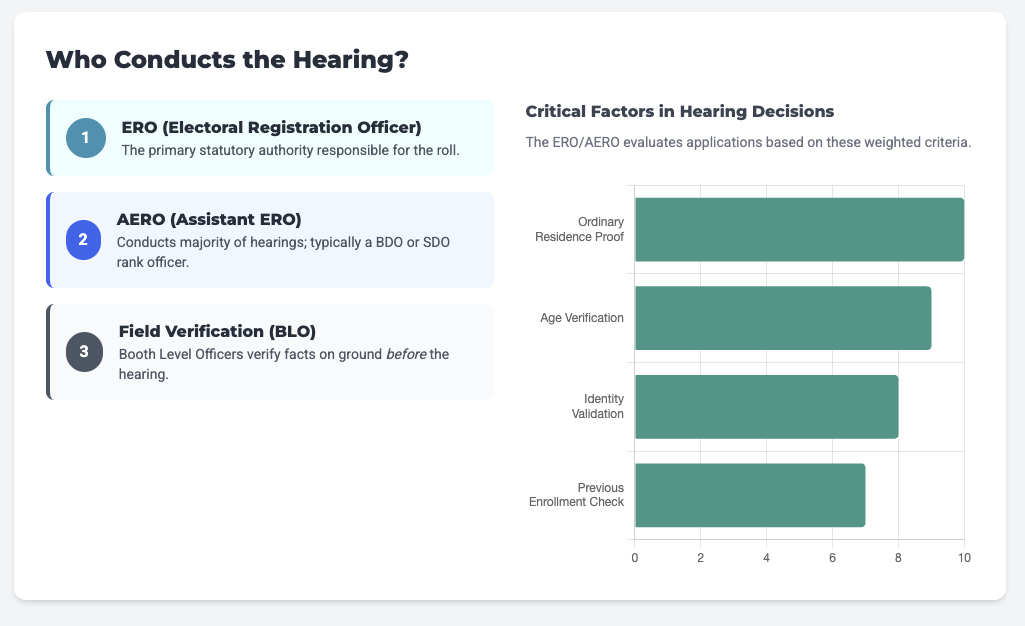
A prevalent misconception regarding the SIR hearings is the attribution of responsibility to the State Government. It is crucial to clarify that the Election Commission of India (ECI) is the sole constitutional authority conducting this exercise.8 The West Bengal State Election Commission, which oversees local body elections, has explicitly stated it is not involved in the SIR process.8
The hearings are quasi-judicial proceedings. The officials conducting them exercise statutory powers under the Representation of the People Act, 1950. The hierarchy of authority in the hearing room is as follows:
| Official Designation | Statutory Role & Power | Function in SIR Hearing |
| Electoral Registration Officer (ERO) | Sub-Divisional Magistrate (SDM) level officer. The primary statutory authority for the constituency. | Adjudicator. The ERO has the final power to accept or reject claims and objections. They issue the hearing notices and sign the final orders.3 |
| Assistant Electoral Registration Officer (AERO) | Block Development Officer (BDO) or Tehsildar level. | Operational Head. AEROs preside over specific hearing tables, examine documents, and make recommendations to the ERO. They handle the bulk of the volume.3 |
| Micro-Observer | Central Government employees or officials from outside the direct state election machinery. | Oversight. Deployed specifically for SIR 2026 to ensure neutrality. They sit at the hearing tables to monitor proceedings and report deviations directly to the Commission.11 |
| Booth Level Officer (BLO) | Local government employees (teachers, Anganwadi workers). | Facilitator. They provide the field verification reports (verifying physical residence) and assist in identifying the voter. They do not have the power to decide the case.13 |
3.1 The Deployment of Micro-Observers
The introduction of Micro-Observers is a significant procedural escalation for the 2026 SIR. Approximately 4,500 micro-observers have been deployed for the first phase of hearings.11 Their presence is a direct response to political allegations of bias and is intended to create a layer of surveillance over the EROs and AEROs. These observers are tasked with ensuring that no voter is turned away without a hearing and that document verification follows the strict protocols of the ECI, rather than local discretionary practices.12
4. The “Three Categories” of Candidates for Hearing
The SIR process utilizes complex data analytics and legacy data mapping to segregate voters into specific categories requiring verification. Unlike a general census where everyone is enumerated equally, the Stage Two hearings target three specific “types” of candidates. Understanding which category a voter falls into is essential for preparation, as the burden of proof varies significantly.
Type 1: The “Unmapped” Voter
- Definition: “Unmapped” voters are those whose current entry in the draft roll could not be algorithmically linked to the historic 2002-2004 SIR database.13 This “mapping” is the digital lineage that the ECI is attempting to establish to prove long-term residency and citizenship continuity.
- Volume: This is the largest category for the first phase of hearings, comprising approximately 32 lakh11
- The Criteria: The ECI’s software attempts to match the current voter’s details (Name, Relative’s Name, Age, Location) with the digitized records of the 2002 roll. If a voter has migrated, changed their surname after marriage, or was enrolled freshly in the intervening years without a clear reference to a past entry, they are flagged as “unmapped.”
- Objective: The hearing aims to manually establish the link that the software missed. The voter must prove they (or their direct ancestors) were present in the 2002 ecosystem or have valid reasons for subsequent inclusion (e.g., coming of age, migration with valid documents).2
Type 2: Voters with “Logical Discrepancies”
- Definition: These are entries flagged by the ECI’s “de-duplication” and “logic check” algorithms for statistical or biological anomalies.13
- Volume: This category is massive, involving an estimated 36 crore cases.16
- The Criteria: The algorithms flag specific “logical” errors that suggest fraudulent or erroneous data. Common flags include:
- Parent-Child Age Gap: Cases where the age difference between the elector and their registered parent is less than 15 years.17
- abnormal Family Size: Households where a single parent is listed with an implausibly high number of children (e.g., >6).17
- Gender Mismatch: Discrepancies between the name/photo and the registered gender.
- Centenarians: Voters listed as exceptionally old without recent verification.
- Objective: The hearing requires the voter to produce specific “biological” proofs (Birth Certificates, Medical Age Proofs) to refute the algorithmic flag.
Type 3: Claims and Objections (Forms 6, 7, 8)
- Definition: This category consists of citizens who have voluntarily engaged the system or are respondents to third-party objections.
- Sub-Types:
- Form 6 Applicants: New voters or those re-applying after deletion.
- Form 7 Respondents: Voters whose inclusion has been challenged by another person (Objector) on grounds of death, absence, or ineligibility. The person against whom the objection is filed is summoned to defend their right to vote.3
- Form 8 Applicants: Voters seeking corrections (shifting within constituency, transposition of entry) who must verify their new claims.18
5. The Hearing Procedure: Step-by-Step
The hearing is a formal interaction between the citizen and the state apparatus. It is conducted at designated Hearing Centers, which are typically located at Polling Stations, Block Development Offices (BDOs), or community centers.
5.1 Pre-Hearing: The Notice (Form B)
Voters selected for a hearing receive a notice, generated by the ERO’s software (often the ERO-Net system). This notice specifies the Date, Time, and Venue of the hearing. It is critical to note that for many “unmapped” voters, these notices are generated automatically (“suo-motu”) by the software, a point of contention among administrative officers who feel bypassed by the automation.9
5.2 The Verification Protocol at the Center
Upon arrival at the hearing center (where long queues are reported 11), the voter undergoes a multi-stage verification process:
- Identity Verification: The voter must present the Hearing Notice and a primary Identity Document (EPIC/Aadhaar) to the verifying officer.
- Biometric and Digital Capture: A new and stringent requirement for SIR 2026 is the digital capture of the elector’s presence. Officials are mandated to:
- Capture a live photograph of the elector at the hearing table.
- Record the signature or thumbprint of the elector digitally or on the verification sheet.15
- This measure is intended to eliminate “proxy” hearings where political agents appear on behalf of voters.
- Document Digitization: The documents produced by the voter are not just inspected physically; they are scanned and uploaded immediately onto the ERONET software or the BLO App.15 This creates an immutable digital trail of the evidence provided, preventing files from being “lost” later.
- The Interrogation: The ERO/AERO will ask specific questions based on the category.
- For Unmapped: “Where did you live in 2002? Do you have your father’s old voter card?”
- For Discrepancies: “Your age is listed as 25 but your mother is 35. Show me your birth certificate.”
5.3 Post-Hearing
The decision is rarely announced instantly. The verified data is processed, and the ERO issues a final order during the publication of the Final Roll. However, voters can track the status of their case using the reference number on their notice via the ECI portal.5
6. Documentation Matrix: Categorized Requirements
The success of a hearing depends entirely on the production of admissible evidence. The ECI has standardized the list of accepted documents, but the relevance of each document depends on the “Type” of candidate.
6.1 General Identity & Address Proofs (Applicable to All)
The ECI accepts 12 standard documents. Crucial Warning: While the Aadhaar Card is a valid proof of identity and age, it cannot be used as a standalone document to prove citizenship or ordinary residence in all contexts, particularly for “Unmapped” lineage verification.11
- List of Accepted Documents:
- EPIC (Voter ID) – Old or Current.
- Aadhaar Card.
- PAN Card.
- Driving License.
- Indian Passport.
- Bank/Post Office Passbook (with photo and current address).
- Pension Document (with photo).
- Service Identity Card (State/Central Govt/PSU).
- Official Identity Card issued to MPs/MLAs.
- MGNREGA Job Card.
- Health Insurance Smart Card (Ministry of Labour).
- Unique Disability ID (UDID).
6.2 Specific Documents for “Unmapped” Candidates (Type 1)
These candidates must bridge the 2002-2026 gap.
- Primary Evidence: Extract of the 2002 Voter List containing the name of the elector or their parent.
- Secondary Evidence (Lineage): Land Deeds (registered before 2002), School Leaving Certificates (dated before 2002), or Old Ration Cards.
- Linkage Proof: Marriage Certificate (for women who migrated due to marriage), Birth Certificate (linking child to parent in 2002 list).
6.3 Specific Documents for “Logical Discrepancies” (Type 2)
- For Age Mismatch: Birth Certificate issued by Municipal Authority/Registrar of Births & Deaths is the gold standard. Class 10 Marksheet or Indian Passport are also strong proofs.21
- For Gender Mismatch: Affidavit or Self-Declaration along with photo ID showing correct gender.
7. Directives for Senior Citizens (85+) and PwDs
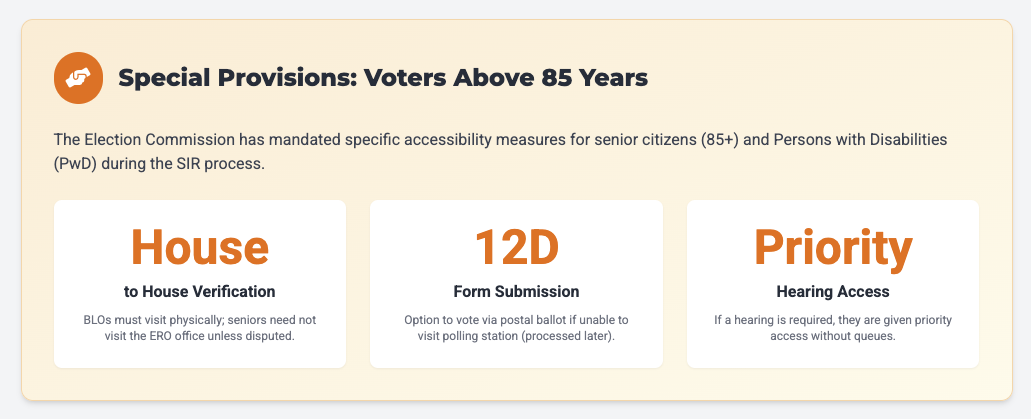
A critical humanitarian aspect of the SIR 2026 is the handling of vulnerable populations. The ECI has issued specific directions to ensure that the rigorous verification process does not become a tool of harassment for the elderly and disabled.
7.1 The “House-to-House” Mandate
For electors aged 85 years and above and Persons with Disabilities (PwDs) (with >40% benchmark disability), the ECI direction is explicit: They are NOT required to visit the hearing camps.
- Process: Verification for these categories is to be conducted at their doorstep. Officials (BLOs/AEROs) must visit the elector’s residence to capture the photograph, verify the documents, and record the status.11
- The Conflict: Despite this directive, there are reports of notices being auto-generated for 85+ voters summoning them to camps, causing distress. Political parties have raised strong objections to this, citing the precedent of “Home Voting” established in the 2024 elections.10
- Actionable Advice: If an 85+ voter receives a camp summons, a family member should visit the camp with the notice and the voter’s proof of age/disability. They should cite the ECI’s “House-to-House” directive and request the ERO to send an official to the residence. Do not force the elderly person to queue at the camp if they are immobile.
8. Appeals and Legal Recourse: What If You Are Excluded?
If a voter attends the hearing but is still rejected, or if they miss the hearing and are deleted, the process does not end. The statute provides a robust appellate hierarchy.
8.1 Administrative Appeals
- First Appeal (District Level):
- Authority: The District Magistrate (DM), who acts as the District Election Officer (DEO).
- Timeline: The appeal must be filed within the statutory period (typically 15 days from the date of the ERO’s order).3
- Process: The DEO has the power to review the documents rejected by the ERO and reverse the decision.
- Second Appeal (State Level):
- Authority: The Chief Electoral Officer (CEO), West Bengal.
- Context: If the DM dismisses the appeal, the voter can approach the CEO’s office. This is the final administrative step.3
8.2 Judicial Recourse (High Court)
Citizens possess the constitutional right to approach the judiciary.
- Writ Jurisdiction: A voter can file a Writ Petition under Article 226 of the Constitution of India before the Calcutta High Court.
- Grounds for Writ: Violation of principles of natural justice (e.g., notice not served, reasonable opportunity not given), arbitrary deletion without verification, or non-adherence to the ECI’s own guidelines regarding “unmapped” voters.9
9. Comprehensive FAQ: 100 Probable Questions on SIR Hearings
#image_title
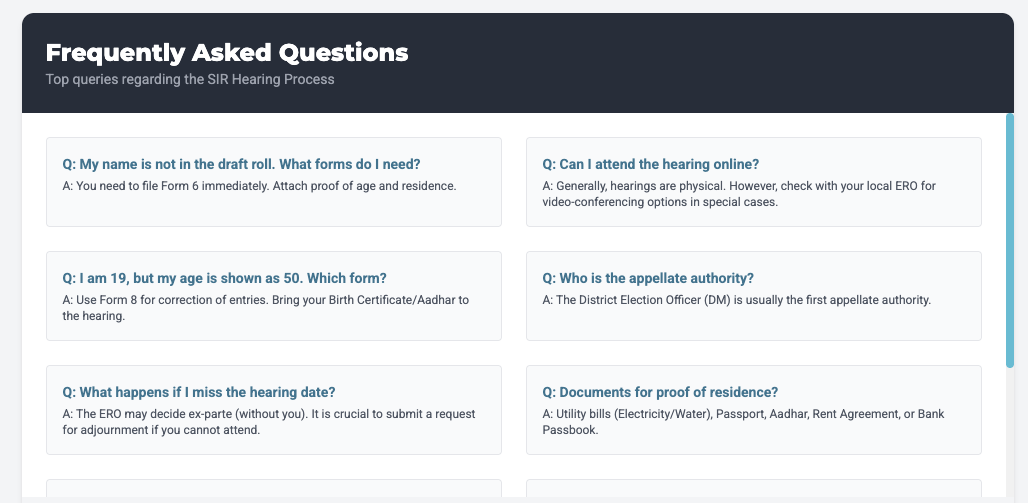
To assist the electorate in navigating this complex landscape, we have compiled 100 probable questions, subcategorized for clarity.
Category I: General SIR Information
- What does SIR stand for? Special Intensive Revision.
- How often is SIR conducted? It is non-periodic and conducted only when the ECI deems the rolls require deep cleansing; the last one in WB was 2002-2004.
- Why is SIR 2026 happening now? To prepare a purified electoral roll for the 2026 Assembly Elections.
- Who ordered the SIR? The Election Commission of India (ECI), not the State Government.
- Is the SIR valid for Lok Sabha elections? Yes, this roll will serve as the base for all future elections until the next revision.
- What is the “Draft Roll”? The preliminary voter list published on Dec 16, 2025, pending hearings.
- What is the “Final Roll”? The conclusive list to be published in February 2026 after all hearings are resolved.
- What implies “ASDD”? Absent, Shifted, Dead, Duplicate – the four main grounds for deletion.
- How many people have been deleted? Over 58 lakh names were deleted in the draft stage.
- What is a “Micro-Observer”? A central government official deployed to oversee the hearing fairness.
- Where can I find the SIR guidelines? On the CEO West Bengal website (ceowestbengal.wb.gov.in).
- Is this process unique to West Bengal? No, but WB is a priority state due to the long gap since the last SIR.
- Can I vote if my name is in the Draft Roll? Yes, unless it is deleted after the hearings.
- What is the cutoff date for age eligibility? You must be 18 on the qualifying date (usually Jan 1, 2026).
- What is the “enumeration phase”? The house-to-house survey done by BLOs before the draft publication.
- Did BLOs visit every house? They were mandated to, but gaps exist, leading to the hearing phase.
- Is SIR connected to NRC? No, SIR is purely an electoral roll revision under the RPA 1950.
- Can I refuse to participate in SIR? Refusal to verify details may lead to deletion of your name.
- What is “Mapping”? Linking a current voter to their historical record (2002) to prove residency continuity.
- Is the 2002 list the only benchmark? It is the primary baseline, but not the only proof accepted.
Category II: Missing Names & Form 6
- My name is not in the draft list. What do I do? File Form 6 immediately.
- Where do I get Form 6? Online at voters.eci.gov.in or from your BLO.
- Is there a fee for Form 6? No, it is free.
- Can I file Form 6 offline? Yes, submit it to the ERO or at the hearing camp.
- What documents do I need for Form 6? Photo, Age Proof, Address Proof.
- How long does Form 6 processing take? It usually takes a few weeks, involving a field visit.
- Can I file Form 6 during the hearing? Yes, camps often accept new forms.
- My whole family is missing. Can we file one form? No, each voter needs a separate Form 6.
- I was deleted as “Shifted” but I still live here. What do I do? File Form 6 and attach current residence proof (utility bill).
- I was deleted as “Dead” by mistake. What do I do? File Form 6 with a “Life Certificate” or appear physically before the ERO.
- Can I track my Form 6 status? Yes, use the reference ID on the portal.
- What if my Form 6 is rejected? You can appeal to the DM.
- Can I file Form 6 if I am 17? Yes, if you turn 18 by the qualifying date.
- Do I need my parents’ voter ID for Form 6? It helps establish linkage but is not strictly mandatory if you have other proofs.
- Can I use a rent agreement for Form 6? Yes, if it is a registered agreement.
Category III: The Hearing Day & Process
- How do I know if I have a hearing? You will receive a Notice (Form B) from the ERO/BLO.
- What if I don’t get a notice? Check online status; if no notice is flagged, you might be safe.
- Where is the hearing held? Usually at your local Polling Station or BDO office.
- What time should I go? Go at the time mentioned in the notice; expect queues.
- Must I go personally? Yes, for biometric/photo capture.
- Can I send a representative? Only in extreme medical cases (with proof), but the ERO has discretion to reject proxies.
- What happens at the hearing? ID check, photo capture, document scanning, brief questions.
- Will they take my fingerprints? Yes, thumb impression/signature is recorded digitally.
- Will they take my photo? Yes, a live photo is captured for the database.
- What if the internet is down at the center? Manual records should be maintained; insist on a receipt.
- How long is the wait? Reports suggest hours; carry water/food.
- Is there a separate queue for women? Usually yes.
- Can I bring a lawyer? It’s not a court; a lawyer isn’t necessary, but a knowledgeable companion is allowed.
- What if the officer is rude? Complain to the Micro-Observer present at the table.
- Will I get an acknowledgement slip? You should ask for one after document submission.
Category IV: Documents & Evidence
- Is Aadhaar mandatory? No, it is voluntary but useful for ID.
- Is Aadhaar enough for “Unmapped” cases? No, you need lineage proof (2002 link).
- What proves “Ordinary Residence”? Utility bills, Bank Passbook, Ration Card.
- What proves “Age”? Birth Certificate, School Marksheet, Passport.
- I don’t have a Birth Certificate. What now? A sworn affidavit by parents or School Leaving Certificate.
- My 2002 card is lost. How do I get the number? Search the “Old Rolls” archive on the CEO website.
- Can I show a soft copy of documents? Hard copies are required for scanning.
- Do I need originals? Yes, for verification. Carry photocopies for submission.
- Is a gas bill valid address proof? Yes, if in your name.
- Is a post office passbook valid? Yes, if it has a photo and address.
- What if my land deed is in Bengali? Local officers can read it; no translation needed usually.
- My name is spelled wrong in the deed. Is it valid? Submit an affidavit declaring both names belong to you.
- Can I use my husband’s papers? Yes, with a marriage certificate.
- Can I use my father’s papers? Yes, to prove lineage.
- What if I have no documents at all? You risk deletion. Contact the DM for guidance on “homeless” enrollment.
Category V: Special Categories (Elderly, PwD, Women)
- I am 85+. Do I go to the camp? Request a home visit.
- How do I request a home visit? Send a family member to the BLO with your age proof.
- What if the BLO refuses home visit? Complain to the ERO or call 1950.
- I am a wheelchair user. Is the center accessible? Centers are mandated to have ramps (Assure Minimum Facilities).
- I am a pregnant woman. Can I skip the queue? Request the presiding officer for priority.
- I am a student in Pune. Do I come back? If you are an “ordinary resident” of WB, yes. Or transfer vote to Pune.
- I am a new bride. How do I transfer my vote? Use Form 8 for shifting residence.
- My husband is dead. Do I need his death certificate? Yes, to update your status and delete his name (Form 7).
- I am transgender. How do I register? Form 6 has a “Third Gender” option.
- Are NRI voters part of SIR? They use Form 6A; usually not summoned to local camps unless they are on the general roll.
Category VI: Logical Discrepancies
- Why is my name flagged as “Discrepancy”? Likely a data error (Age, Gender, Duplicate).
- What is a “Parent-Child Age Error”? If the age gap is <15 years in the system.
- How do I fix Age Error? Show correct Birth Certificates for both.
- What is a “Duplicate” flag? Your photo/name matches another voter.
- I am not a duplicate. What do I do? Sign a declaration that you are a unique voter at this address.
- My photo is male, but I am listed as female. Use Form 8 to correct gender.
- There are 10 people in my house (Joint Family). Is that a discrepancy? Yes, the system flags >6. Verify relationships at the hearing.
- My age is 105. Why the hearing? To verify you are still alive (Death verification).
- I have two Voter IDs. What do I do? Surrender one immediately using Form 7 to avoid penalty.
- What is the penalty for dual voting? Imprisonment/Fine under RPA Act.
Category VII: Legal & Appeals
- Can the ERO delete me without notice? No, “Natural Justice” requires a notice.
- What is the time frame for appeal? 15 days from the order.
- Where is the DM’s office? At the District Headquarters.
- Who is the CEO? The Chief Electoral Officer of the state.
- Can I file a case in the Supreme Court? Usually, you go to the High Court first.
- Is the hearing “Judicial”? It is “Quasi-Judicial.”
- Can political parties represent me? They can assist (BLAs – Booth Level Agents), but cannot stand in for you.
- What is Section 31 of RPA? Punishment for false declarations (Jail up to 1 year).
- If I am deleted, can I vote by “Challenged Vote”? No, if you are off the list, you cannot vote.
- Can I file a generic complaint about the process? Yes, to the ECI observers.
Category VIII: Digital Tools & Apps
- What is “Voter Helpline App”? ECI’s official app for forms and search.
- What is “ERONET”? The backend software used by officials.
- What is “cVIGIL”? App for reporting election code violations (not for SIR specifically).
- Can I download e-EPIC after the hearing? Yes, once the Final Roll is published.
- Is the 1950 Helpline toll-free? Yes, it is the universal ECI helpline.
10. Conclusion
The SIR 2026 Stage Two hearing is a defining moment for the West Bengal electorate. It is a process characterized by rigorous scrutiny, algorithmic flagging, and a massive administrative mobilization. For the 32 lakh “unmapped” voters and the crores flagged for discrepancies, the path to the Final Roll involves navigating a complex web of forms, proofs, and hearings.
The key to survival in this list is proactivity. Voters must not wait for a notice; they must verify their status online immediately. They must understand the specific “category” they fall into and curate their documents accordingly, placing heavy reliance on the 2002 lineage where required. For the vulnerable—the elderly and the disabled—the “house-to-house” verification right must be claimed assertively.
While the system is automated, the presence of Micro-Observers and the appellate hierarchy (DM -> CEO -> High Court) provides safeguards against arbitrary disenfranchisement. This report equips the stakeholder with the knowledge to navigate these safeguards, ensuring that every eligible citizen retains their most fundamental democratic right: the right to vote.
RESOURCES:SIR HEARING PROCESS INFOGRAPHICS.PDF
Works cited
- West Bengal Draft Voters List Published Under SIR 2026 | DD News On Air – Newsonair, accessed on December 29, 2025, https://www.newsonair.gov.in/west-bengal-draft-voters-list-published-under-sir-2026/
- West Bengal Initiates Extensive Electoral Roll Revision in Preparation for 2026 Elections, accessed on December 29, 2025, https://www.uniset.ca/microstates/tel_sp_gib_talks.htm?s-news-23574430-2025-12-27-west-bengal-begins-comprehensive-sir-process-for-electoral-roll-update-20268527
- SPECIAL INTENSIVE REVISION, accessed on December 29, 2025, https://www.eci.gov.in/eci-backend/public/api/download?url=LMAhAK6sOPBp/NFF0iRfXbEB1EVSLT41NNLRjYNJJP1KivrUxbfqkDatmHy12e/zX/LARKC1lI3JwqUiIIk3e9a5deFn8sYeCGEvmhY1eKxnvxsalQ0d0BNaW1QGwL8b5dWfC0v6WB9pbj6BhsnOvg==
- SIR hearing in Bengal today. You will need these documents to update your details in 2026 electoral roll, accessed on December 29, 2025, https://indianexpress.com/article/india/sir-hearing-in-bengal-today-documents-to-update-2026-electoral-roll-10441247/
- West Bengal SIR Draft List 2025 Check & Download – New Job Vacancy, accessed on December 29, 2025, https://newjobvacancy.co.in/west-bengal-sir-draft-list-2025/
- SIR 2026 – CEO West Bengal, accessed on December 29, 2025, https://ceowestbengal.wb.gov.in/SIR
- SIR 2.0: All about enumeration form, draft roll, appeal against exclusion – The Hindu, accessed on December 29, 2025, https://www.thehindu.com/news/national/sir-20-all-about-enumeration-form-draft-roll-appeal-against-exclusion/article70243428.ece
- Welcome To West Bengal State Election Commission, accessed on December 29, 2025, https://wbsec.gov.in/
- In Bengal SIR, local officials flag fear of ‘system-driven’ large-scale voter deletions; EROs being bypassed, accessed on December 29, 2025, https://indianexpress.com/article/india/special-intensive-revision-of-electoral-rolls-bihar-playbook-bengal-pushback-local-officials-flag-fear-of-deletions-say-being-bypassed-as-ec-generates-notices-10440886/
- EC halts hearings for unmapped voters in West Bengal conditionally …, accessed on December 29, 2025, https://www.thehindu.com/news/national/west-bengal/eci-flags-technical-issue-in-2002-rolls-halts-hearings-for-unmapped-electors-in-bengal/article70445838.ece
- SIR hearings begin in Bengal, 32 lakh ‘unmapped’ voters to be covered – The Hindu, accessed on December 29, 2025, https://www.thehindu.com/news/national/west-bengal/sir-hearings-in-west-bengal-on-december-27-updates/article70442912.ece
- Around 4,000 micro-observers to scrutinise SIR hearing process in West Bengal – The Hindu, accessed on December 29, 2025, https://www.thehindu.com/news/cities/kolkata/around-4000-micro-observers-to-scrutinise-sir-hearing-process-in-west-bengal/article70416405.ece
- ECI Pulls a U-Turn: Rolls Out Algorithms Midway into SIR Without Protocols, Manual and Written Instructions – The Reporters’ Collective, accessed on December 29, 2025, https://www.reporters-collective.in/trc/eci-pulls-a-u-turn-rolls-out-algorithms-midway-into-sir
- Why did ECI appoint micro observers in Bengal when State has the lowest voter deletions in SIR, asks Abhishek Banerjee – The Hindu, accessed on December 29, 2025, https://www.thehindu.com/news/national/west-bengal/whydid-eci-appoint-micro-observersin-bengal-when-state-has-the-lowestvoter-deletions-in-sir-asksabhishek-banerjee/article70443462.ece
- West Bengal SIR: Hearings for 32 lakh ‘unmapped’ electors to begin on December 27, accessed on December 29, 2025, https://www.thehindu.com/news/national/west-bengal/west-bengal-sir-hearings-for-32-lakh-unmapped-electors-to-begin-on-december-27/article70440630.ece
- Spellings to mismatches: Bengal voters queue up to remain on rolls, accessed on December 29, 2025, https://indianexpress.com/article/cities/kolkata/spellings-to-mismatches-bengal-voters-queue-up-to-remain-on-rolls-10442456/
- SIR phase 2 in Bengal: Hearings post-Xmas, EC focuses on five border districts with most ‘discrepancies’, accessed on December 29, 2025, https://indianexpress.com/article/cities/kolkata/sir-phase-2-in-bengal-hearings-post-xmas-ec-focuses-on-five-border-districts-with-most-discrepancies-10433939/
- Resident Electors – Election Commission of India, accessed on December 29, 2025, https://www.eci.gov.in/faq/2/9
- SIR 2.0 in Bengal: With hearings from December 27, here’s how your documents will be verified, accessed on December 29, 2025, https://indianexpress.com/article/cities/kolkata/sir-2-0-in-bengal-with-hearings-from-december-27-heres-how-your-documents-will-be-verified-10438513/
- SIR 2.0: How to check if your enumeration form is uploaded on the ECI portal? – The Hindu, accessed on December 29, 2025, https://www.thehindu.com/news/national/how-to-check-if-your-blo-has-uploaded-your-enumeration-form-on-the-eci-portal/article70334525.ece
- List of Documents Required for Voter ID Card Application 2025 – Paytm, accessed on December 29, 2025, https://paytm.com/blog/voter-id/list-of-documents-required-for-voter-id-card/