- Section 104 can convert routine baggage inspection into a criminal arrest for valuation or clerical errors.
- Arrest requires an objective "reason to believe" with a recorded, rational connection to the facts, not mere hunches.
- Statutory non-bailable thresholds: duty evasion over ₹50 Lakhs or undeclared goods over ₹1 Crore.
- Administrative arrest guideline focus: generally reserve arrests for cases above ₹2 Crore unless exigent circumstances exist.
- Value-independent arrests apply to FICN, arms, antiques, explosives, and endangered wildlife regardless of monetary value.
- D.K. Basu safeguards: visible ID, written arrest memo, right to inform, and periodic medical examination for arrestees.
- Burden shifts: possessors of notified goods must prove legality; ship Masters bear heavy duty to show reasonable precautions.
5 Surprising Realities of Customs Arrests and Smuggling Law
Creditor and contributor of this article:
Patra’s Law Chambers:
About Us:
Patra’s Law Chambers is a law firm with offices in Kolkata & Delhi, offering comprehensive legal services across various domains. Established in 2020 by Advocate Sudip Patra (Advocate, Supreme Court of India & Calcutta High Court) an alumnus of the Prestigious Rajiv Gandhi School of Intellectual Property Law, IIT Kharagpur ,with Post Graduate diploma in Business Law from IIM Calcutta, the firm specializes in Civil, Criminal, Writs,High Court Matters, Trademark, Copyright, Company, Tax, Banking, Property disputes, Service law, Family law, and Supreme Court matters.You can know more about us in here
Kolkata Office:
NICCO HOUSE, 6th Floor, 2, Hare Street, Kolkata-700001 (Near Calcutta High Court)
Delhi Office:
House no: 4455/5, First Floor, Ward No. XV, Gali Shahid
Bhagat Singh, Main Bazar Road, Paharganj, New Delhi-110055
Website: www.patraslawchambers.com
Email: [email protected]
Phone: +91 890 222 4444/ +91 7003 715 325
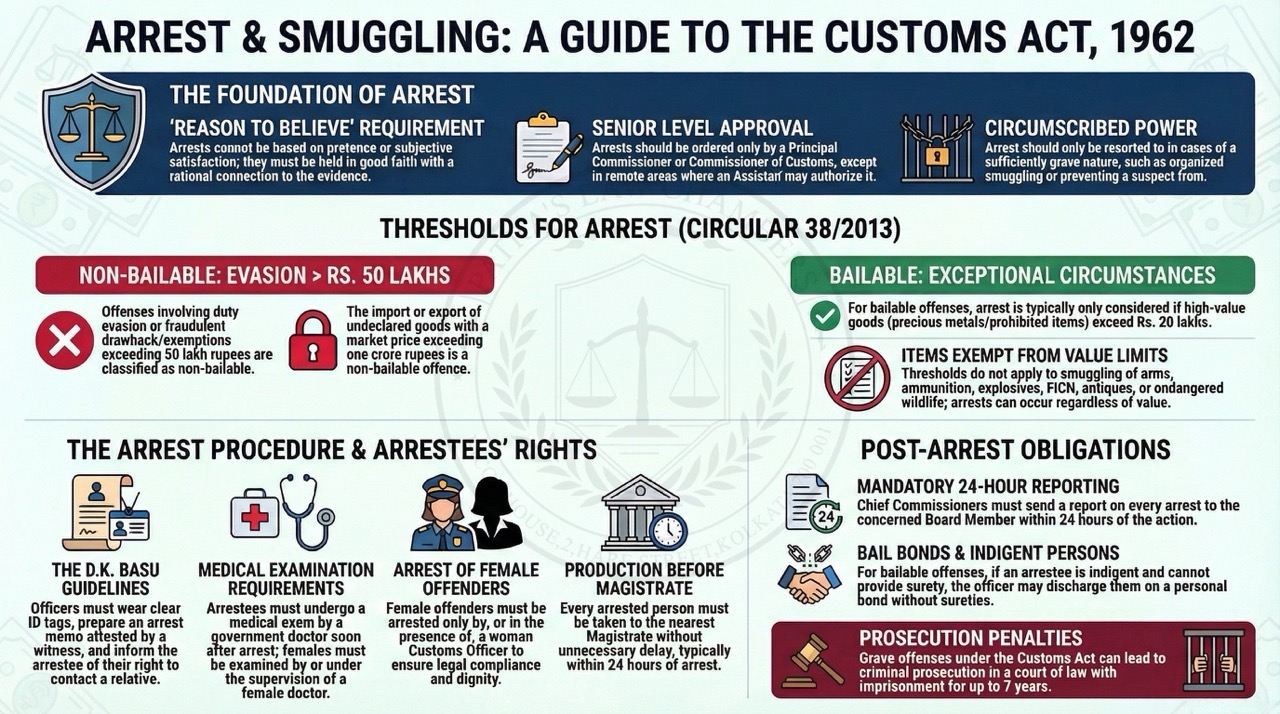
Resource: Infographics.pdf
1. The Moment the Suitcase Becomes a Liability
For the seasoned business traveler or international trader, the word “smuggling” often evokes images of cinematic villains. However, in the realm of Indian trade compliance, the line between a routine baggage inspection and a criminal arrest is governed by the sharp edge of Section 104 of the Customs Act, 1962. It is a provision that can instantly transform a valuation dispute or a clerical oversight into a loss of personal liberty.
As a legal correspondent, I have seen that the “Blue Uniform” possesses formidable powers, yet these powers are not unbridled. To navigate the border safely, one must understand that Customs law draws a very specific—and often surprising—distinction between civil adjudication and criminal prosecution.
2. It’s Not Just a Feeling: The “Reason to Believe” Standard
An arrest under Section 104 is never a matter of an officer’s “subjective satisfaction” or a mere hunch. The law demands a much higher threshold: a “reason to believe.”
While this standard is central to the Customs Act, its definitive interpretation is borrowed from the landmark Income-tax case, M.P. Industries Ltd. v. ITO. The courts have made it clear that “reason to believe” is a objective standard; there must be a “rational connection” between the facts on hand and the officer’s belief. In all cases—and specifically in commercial fraud—the Principal Commissioner or Commissioner must be personally satisfied and must record these reasons in writing on file before an arrest is affected.
“The belief must be held in good faith: it cannot be merely a pretence. It is open to the Court to examine whether the reasons for the belief have a rational connection or a relevant bearing to the formation of the belief and are not extraneous or irrelevant to the purpose of the section.”
This standard protects citizens from routine or arbitrary arrests. Unless “exigencies of the situation” exist—such as a risk of the suspect absconding or evidence being tampered with—the law mandates “extreme circumspection.”
3. The Thresholds of Liberty: Bailable vs. Non-Bailable Offenses
One of the most common misconceptions in trade is that all Customs offenses are bailable. In reality, the law creates a hierarchy of severity based on financial thresholds. Understanding the difference between statutory non-bailable limits and administrative arrest guidelines is crucial for any importer.
The Statutory Non-Bailable Thresholds (Circular 38/2013): An offense becomes non-bailable (where bail is a matter of judicial discretion, not a right) in the following cases:
- Duty Evasion: Attempted or actual evasion exceeding Rs. 50 Lakhs.
- Non-Declaration: Import or export of goods not declared in accordance with the Act, where the market price exceeds Rs. 1 Crore.
- Fraudulent Incentives: Fraudulently availing or attempting to avail of “drawback” or duty exemptions exceeding Rs. 50 Lakhs.
The Bailable Arrest Guidelines: Even for bailable offenses, administrative guidelines suggest that the power of arrest should be exercised only in “exceptional situations.” Generally, for cases involving trade goods (appraising cases), the threshold for considering arrest is set at a market value or duty evasion of Rs. 2 Crores or more. This means that while a Rs. 60 Lakh duty dispute is technically non-bailable, the department’s own guidelines suggest that the “Blue Uniform” should primarily focus arrest powers on cases crossing the Rs. 2 Crore mark, unless specific exigencies demand otherwise.
4. The “Value-Free” Zone: Items That Trigger Immediate Arrest
There is a critical “value-independent” category where monetary thresholds are cast aside. For certain items deemed threats to national security, social order, or the environment, the financial value of the “goods” is irrelevant to the severity of the arrest.
Under sub-para 2.3(g) of the guidelines, value limits do not apply to the smuggling of:
- Fake Indian Currency Notes (FICN)
- Arms, ammunitions, and explosives
- Antiques and art treasures
- Endangered wildlife and protected flora/fauna
In these instances, while an arrest is not “automatic”—it must still be required based on the specific facts and circumstances—the suspect cannot hide behind the “small value” of the shipment. A single prohibited antique can trigger the same procedural machinery as a multi-crore commercial fraud.
5. Your Shield: The D.K. Basu Safeguards
The Supreme Court of India, in the seminal case of D.K. Basu vs. State of W.B., established mandatory procedural rights that act as a shield for any arrestee. Customs officers, acting as quasi-judicial authorities, are strictly bound by these requirements:
- Clear Identification: Arresting and interrogating officers must wear accurate, visible, and clear name tags with their designations.
- The Arrest Memo: A formal memo must be prepared at the time of arrest, attested by at least one witness (a family member or a respectable local person) and countersigned by the arrestee.
- Right to Inform: The arrestee has the right to have a friend or relative informed of their arrest. Crucially, if the relative lives outside the district, the authorities must notify them telegraphically through the Legal Aid Organisation or the local Police Station within 8 to 12 hours.
- Medical Mandates: The arrestee must undergo a medical examination by a trained doctor every 48 hours to record the presence of any injuries and monitor their well-being.
“It shall be the duty of the person having the custody of an arrestee to take reasonable care of the health and safety of the arrestee.”
6. The Burden of Proof: From Betel-nuts to Ships
In Customs law, the “Heavy Onus” of proof shifts depending on the nature of the goods.
- Notified Goods (Section 123): For items like gold or high-value restricted goods, the burden is on the possessor to prove the items are not smuggled.
- Non-Notified Goods: For general trade items—betel-nuts being the classic legal example—the Revenue must provide “tangible and positive evidence” of illegal entry. As highlighted in the Arun Kumar Chirania case, mere suspicion or the visual appearance of a product (such as its packing) is insufficient to sustain a smuggling charge.
This burden of proof extends even to the “Master of a Ship.” Under Section 115, a vessel can be confiscated if the Master fails to take “reasonable precautions” to prevent smuggling. Interestingly, a Master can be held liable even if the government has not officially framed the “rules” for these precautions. The onus is on the professional to prove they exercised due care, as the Master’s heavy responsibilities do not waive their duty to protect the vessel from misuse.
7. Conclusion: A Final Thought on Compliance and Liberty
Customs law exists in a delicate tension between the state’s power to tackle “commercial frauds” and the “liberty of the individual.” While the Act grants the authority to arrest, the mandate for the “Blue Uniform” is “extreme circumspection.”
In an era of increasing trade volume and digital tracking, the line between a clerical error and a criminal “reason to believe” is under constant scrutiny. For the trader, the requirement for a Commissioner to record reasons “in writing on file” is a vital protection, but it is not a substitute for rigorous compliance.
In the final analysis, knowledge of the D.K. Basu guidelines is your best defense. We must ask: As trade becomes more complex, is the standard of “reasonable precautions” for professionals becoming an impossible bar, or is it the only thing standing between commerce and chaos? Keep your records clean, but keep your rights closer.